Comparative Bioavailability of Ranitidine Tablets in Healthy Volunteers
Authors
Abstract
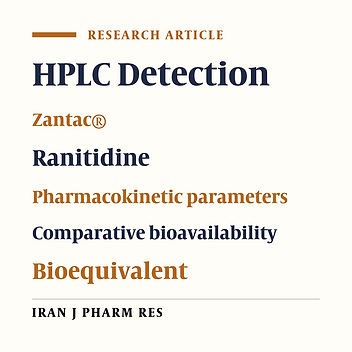
The pharmacokinetic parameters of domestic and imported ranitidine hydrochloride tablets (Ranitidine, formulated and manufactured by Kharazmi Pharmaceuticals, Iran, and Zantac® manufactured by Glaxo, UK) were measured in 14 healthy subjects following oral administration of a single 300-mg dose of each brand and compared for bioequivalence evaluation.
The pharmaceutical equivalency of both formulations was shown by in vitro characterization and dissolution testing. The comparative bioavailability of the two products was then determined in a single-blind, single dose, randomized, cross-over study in 14 healthy volunteers. A sensitive, rapid and precise high performance liquid chromatography (HPLC) method was used to measure concentrations of ranitidine in plasma samples collected up to 12 hours following each dose. Pharmacokinetic parameters, including Cmax, Tmax, AUC0-t, AUC0-¥ , elimination rate constant (k) and half life were determined for both formulations.
Analysis of the data revealed that the variations in all pharmacokinetic parameters were not statistically significant (p> 0.05), and the 90% confidence intervals for the test/reference mean ratios of the plasma pharmacokinetic variables lie within the conventional bioequivalence range of 80-125%. Therefore, both formulations were comparable based on the in vitro characterization and were bioequivalent in terms of Cmax and AUC.
The two formulations were considered to be bioequivalent.
Highlights
Copyright
© 2002, Author(s). This open-access article is available under the Creative Commons Attribution 4.0 (CC BY 4.0) International License (https://creativecommons.org/licenses/by/4.0/), which allows for unrestricted use, distribution, and reproduction in any medium, provided that the original work is properly cited.
Similar Articles
Logic of Selecting Suitable Dissolution Parameters in New Drug Formulations Based on A BCS Approach
Medina-López R, Arregui EE, Aranda EJ, Moreno-Rocha LA, Hurtado M, et al. Logic of Selecting Suitable Dissolution Parameters in New Drug Formulations Based on A BCS Approach. Iran J Pharm Res. 2020;19(1):e124438. doi: https://doi.org/10.22037/ijpr.2020.1100993
Bioequivalence Comparison of Two Formulations of Fixed-Dose Combination Glimepiride/Metformin (2/500 mg)Tablets in Healthy Volunteers
Jung S, Chae J, Song B, Kwona K. Bioequivalence Comparison of Two Formulations of Fixed-Dose Combination Glimepiride/Metformin (2/500 mg)Tablets in Healthy Volunteers. Iran J Pharm Res. 2014;13(2):e125532. doi: https://doi.org/10.22037/ijpr.2014.1495
Pharmacokinetics and Bioequivalence of Two Formulations of Apixaban Tablets: A Double-Blind, Single-Dose, Crossover Study in Healthy Subjects
Abdollahizad E, Haeri A, Jouyban A, Afshar Mogaddam MR, Abbasian Z, et al. Pharmacokinetics and Bioequivalence of Two Formulations of Apixaban Tablets: A Double-Blind, Single-Dose, Crossover Study in Healthy Subjects. Iran J Pharm Res. 2025;24(1):e157714. doi: https://doi.org/10.5812/ijpr-157714
Metabolite Parameters as an Appropriate Alternative Approach for Assessment of Bioequivalence of Two Verapamil Formulations
Haeri A, Javadian B, Saadati R, Dadashzadeh S. Metabolite Parameters as an Appropriate Alternative Approach for Assessment of Bioequivalence of Two Verapamil Formulations. Iran J Pharm Res. 2014;13(2):e125531. doi: https://doi.org/10.22037/ijpr.2014.1508
Bioequivalence Studies of Two Formulations of Baclofen Tablet in Healthy Volunteers
Foroutan SM, Shafaati A, Zarghi A, Khoddam A. Bioequivalence Studies of Two Formulations of Baclofen Tablet in Healthy Volunteers. Iran J Pharm Res. 2022;2(3):e127970. doi: https://doi.org/10.22037/ijpr.2010.52
- Scopus by DOI: 5
Last Update: 3 weeks ago
- Scopus by Title: 5
Last Update: 3 weeks ago
- Scopus by Title (Ref): 5
Last Update: 3 weeks ago
- CrossRef: 0
Last Update: 6 days ago
- OpenAlex: 11
Last Update: 8 hours ago
- OpenCitations: 0
Last Update: 4 days ago