
1. Background
Hematopoietic stem cell transplantation (HSCT) is a key treatment for hematologic malignancies, with more than 50,000 procedures performed worldwide each year (1). However, transplantation places a substantial physical and emotional burden on patients, making supportive care essential to recovery (2). Sleep disturbances are particularly common: Nearly half of patients experience sleep disorders before transplantation, which often worsen during hospitalization and may persist after discharge (3, 4). These disturbances can impede recovery. Anxiety and depression are also common and are associated with poorer health outcomes (5). Patients may experience weight loss and poor nutritional status, which often worsen during treatment because of chemotherapy toxicity, oral mucositis, gastrointestinal problems, and reduced food intake (6, 7). Fatigue frequently coexists with sleep disturbances and mood changes and may share inflammatory mechanisms (8).
Agomelatine acts on MT1 and MT2 melatonin receptors and blocks 5-HT2C receptors, helping regulate sleep–wake cycles (9). Its pharmacological profile supports circadian regulation without daytime drowsiness, and it has been investigated for sleep disturbances in several patient populations (10). Agomelatine also has antidepressant and anxiolytic properties and may improve daytime functioning without substantial daytime sedation (11-13). These properties make it a potential candidate for HSCT recipients, who are susceptible to coexisting sleep disturbances, psychological distress, and functional decline. Although previous research has examined melatonin for stem cell mobilization and neutrophil engraftment in this setting (14), the efficacy of agomelatine for neurobehavioral and circadian outcomes in hospitalized HSCT recipients remains unclear.
2. Objectives
Given the need for safe approaches to managing sleep disturbances and psychological symptoms, we evaluated the effects of agomelatine on sleep, anxiety, depression, fatigue, and appetite in patients undergoing HSCT. To our knowledge, this is the first evaluation of agomelatine’s effects on these outcomes in this population.
3. Methods
3.1. Study Design and Setting
This triple-blind, randomized, placebo-controlled trial was conducted at the Bone Marrow Transplantation Unit of Taleghani Hospital in Tehran, Iran, after approval by the local ethics committee (IR.SBMU.PHARMACY.REC.1403.137). All participants provided written informed consent before enrollment. The study was prospectively registered in the Iranian Registry of Clinical Trials on June 26, 2024 (IRCT20100127003210N28). Patients were recruited from July 2024 to May 2025 and followed throughout their transplantation hospitalization until discharge. Outcomes were assessed using the Pittsburgh Sleep Quality Index (PSQI), Hospital Anxiety and Depression Scale (HADS), Brief Fatigue Inventory (BFI), and Council on Nutrition Appetite Questionnaire (CNAQ) (15-19).
3.2. Sample Size Calculation
The sample size was calculated using data from comparable studies on expected changes in PSQI scores. With a two-sided significance level of α = 0.05, power of 81%, and an allowance for a 20% dropout rate, 40 patients per group were required. An additional calculation based on the prevalence of sleep and psychological problems, projected to decline from 50% - 70% at baseline to 10% - 20% after intervention, with α = 0.01 and 90% power, also supported a target of 40 patients per group (20).
3.3. Eligibility Criteria
3.3.1. Inclusion Criteria
Consenting adults aged 18 - 75 years who were scheduled to undergo HSCT were eligible. Participants were required to have stable baseline organ function, defined as a creatinine clearance of at least 30 mL/min and serum transaminase levels Aspartate Aminotransferase and Alanine Aminotransferase (AST and ALT) below 3 times the upper limit of normal.
3.3.2. Exclusion Criteria
Patients were excluded if they had documented hypersensitivity to agomelatine or its excipients, preexisting liver or kidney disease, significant thyroid dysfunction, or a history of neurological conditions or bipolar disorder. Additional exclusion criteria included ongoing opioid therapy and concurrent use of medications known to interact strongly with agomelatine, including fluvoxamine, ciprofloxacin, and rifampin.
3.4. Randomization, Allocation Concealment, and Blinding
Eligible participants were randomized in a 1:1 ratio using a stratified block randomization schedule generated using Sealed Envelope. Stratification factors were age group, sex, and transplant type. The randomization sequence and master code key were maintained securely and remained inaccessible to investigators throughout the trial. Agomelatine and placebo tablets were manufactured to be visually and physically indistinguishable and supplied in identical coded packaging. Participants, the principal investigator, outcome assessors, safety monitors, and data analysts remained unaware of treatment allocation until trial completion.
3.5. Intervention
Participants in the intervention group received agomelatine 25 mg orally once daily at bedtime, whereas those in the control group received a matching placebo on the same schedule. Treatment continued throughout the HSCT hospitalization, which varied among patients and lasted approximately 1 month. The 25 mg dose was selected based on its established efficacy and favorable safety profile, particularly its low risk of hepatotoxicity. Although higher doses of 50 mg have shown acceptable safety in previous studies, dose escalation was avoided to prioritize safety in this medically fragile population, in whom conditioning chemotherapy and immunosuppressive agents may increase the risk of hepatotoxicity.
3.6. Rescue Therapy
For persistent or worsening insomnia after 3 days of treatment, lorazepam 1 mg or alprazolam 0.5 mg was permitted as needed in both groups to avoid withholding symptomatic treatment.
3.7. Outcome Measures
Participants were assessed at 3 predefined time points: hospital admission before intervention (baseline, T0), the third day of the neutropenic period (T1), and hospital discharge (T2). Sleep quality was assessed using the PSQI, anxiety and depression were assessed using the HADS, fatigue was assessed using the BFI, and appetite was assessed using the CNAQ. Secondary outcomes included treatment-related adverse events, changes in liver enzyme levels, length of hospital stay, need for nutritional support, and in-hospital mortality.
3.8. Safety Monitoring
Participants were withdrawn if AST or ALT levels exceeded 3 times the upper limit of normal, as assessed by daily liver function tests performed during hospitalization in accordance with standard clinical practice. Other safety-related withdrawal criteria included severe adverse reactions, suicidal ideation, or marked worsening of psychiatric symptoms.
3.9. Statistical Analysis
The distribution of quantitative variables was assessed visually using histograms. Continuous variables are presented as medians and interquartile ranges (first to third quartiles), and categorical variables as frequencies and percentages. Between-group comparisons of continuous variables were performed using the independent Student t-test or Mann–Whitney U test, according to the data distribution. Homogeneity of variance was assessed using Levene’s test. Categorical variables were compared using the chi-square test or Fisher exact test, as appropriate.
Primary analyses used a modified intention-to-treat approach and included all randomized patients who received at least 1 dose of the assigned intervention and had at least 1 postbaseline assessment (n = 90; n = 45 per group). Missing data resulting from early discharge or dropout were handled within the generalized estimating equations (GEE) framework under a missing-at-random assumption, using all available longitudinal observations (T0, T1, T2). Repeated continuous outcomes were analyzed using linear GEE models, whereas repeated categorical outcomes were analyzed using binary or ordinal GEE models. Group-by-time interaction terms were used to evaluate differences in changes over time between groups. An exchangeable correlation structure was specified for all GEE models. Statistical significance was defined as a two-sided P < 0.05. Analyses were performed using STATA version 17.0 (StataCorp LLC, College Station, TX, USA).
4. Results
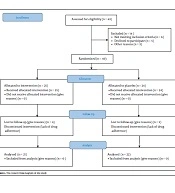
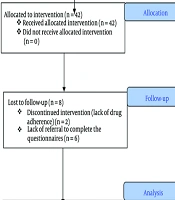
The CONSORT 2010 flow diagram shows the screening, enrollment, randomization, follow-up, and analysis of patients undergoing HSCT who were assigned to agomelatine or placebo (Figure 1).
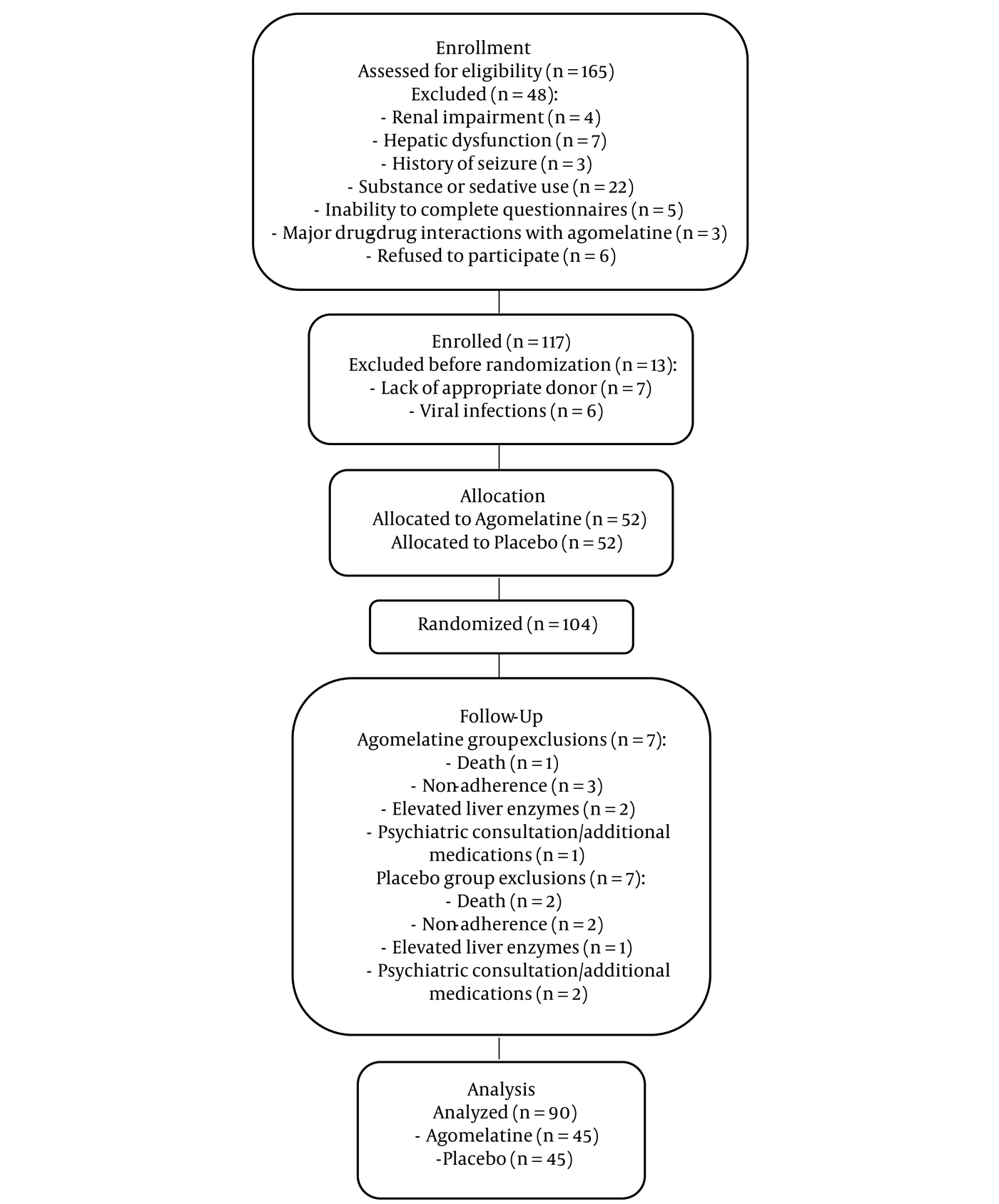
Figure 1.
CONSORT flow diagram of patient screening, enrollment, randomization, follow-up, and analysis.
4.1. Baseline Characteristics
The final analysis included 90 patients, with 45 in each group. The most common age category was 50 - 60 years, accounting for approximately 30% of participants. Overall, 54.4% were male, and most underwent autologous HSCT (85.6%). The median hospital stay was 29 days (interquartile range, 27 - 32 days).
At baseline, participants had a substantial symptom burden. Impaired sleep quality, defined as a PSQI score ≥ 7, was present in 57.8% of participants. Non-normal anxiety, defined as a HADS anxiety subscale score ≥ 11, was present in 8.89%. Appetite disturbance, defined as a CNAQ score < 28, was present in 43.3%. Severe fatigue, defined as a BFI score of 7 - 10, was present in 10%.
Baseline demographic and clinical characteristics did not differ significantly between groups (all P > 0.05), indicating that measured baseline characteristics were comparable after randomization (Table 1).
Table 1.
Baseline Characteristics of Hematopoietic Stem Cell Transplant Recipients by Intervention Group a
| Variables | Agomelatine (n = 45) | Placebo (n = 45) | Total (n = 90) | P-Value |
|---|---|---|---|---|
| Age groups (y) | 0.663 | |||
| 20 - 30 | 6 (13.33) | 6 (13.33) | 12 (13.33) | |
| 30 - 40 | 11 (24.44) | 11 (24.44) | 22 (24.44) | |
| 40 - 50 | 6 (13.33) | 11 (24.44) | 17 (18.89) | |
| 50 - 60 | 16 (35.56) | 11 (24.44) | 27 (30.0) | |
| 60 - 70 | 6 (13.33) | 6 (13.33) | 12 (13.33) | |
| Gender | 0.832 | |||
| Female | 21 (46.67) | 20 (44.44) | 41 (45.56) | |
| Male | 24 (53.33) | 25 (55.56) | 49 (54.44) | |
| Transplant type | 0.368 | |||
| Autologous | 37 (82.22) | 40 (88.89) | 77 (85.56) | |
| Allogeneic | 8 (17.78) | 5 (11.11) | 13 (14.44) | |
| Length of hospital stay (d) | 30 (27 - 32) | 29 (27 - 32) | 29 (27 - 32) | 1.000 |
| Initial PSQI score | 8 (5 - 10) | 7 (5 - 10) | 7 (5 - 10) | 0.898 |
| Normal | 20 (44.44) | 18 (40.0) | 38 (42.22) | 0.670 |
| Abnormal | 25 (55.56) | 27 (60.0) | 52 (57.78) | |
| Initial anxiety score | 5 (3 - 7) | 4 (2 - 7) | 4 (2 - 7) | 0.839 |
| Normal | 36 (80.0) | 35 (77.78) | 71 (78.89) | 1.000 |
| Mild | 5 (11.11) | 6 (13.33) | 11 (12.22) | |
| Moderate to severe | 4 (8.89) | 4 (8.89) | 8 (8.89) | |
| Initial depression score | 4 (2 - 6) | 4 (2 - 6) | 4 (2 - 6) | 0.957 |
| Normal | 37 (82.22) | 37 (82.22) | 74 (82.22) | 1.000 |
| Mild | 5 (11.11) | 6 (13.33) | 11 (12.22) | |
| Moderate to severe | 3 (6.67) | 2 (4.44) | 5 (5.56) | |
| Initial CNAQ score | 29 (25 - 30) | 28 (24 - 31) | 28 (24 - 31) | 0.509 |
| Normal appetite | 26 (57.78) | 25 (55.56) | 51 (56.67) | 0.832 |
| Moderate loss of appetite | 19 (42.22) | 20 (44.44) | 39 (43.33) | |
| Severe loss of appetite | 0 (0.0) | 0 (0.0) | 0 (0.0) | |
| Initial BFI score | 2 (1 - 4.5) | 2.4 (0.5 - 4) | 2.15 (0.8 - 4.5) | 0.925 |
| Mild | 30 (66.67) | 31 (68.89) | 61 (67.78) | 0.849 |
| Moderate | 11 (24.44) | 9 (20.0) | 20 (22.22) | |
| Severe | 4 (8.89) | 5 (11.11) | 9 (10.0) |
a Values are No. (%) or median (interquartile range). Abbreviations: BFI, Brief Fatigue Inventory; CNAQ, Council on Nutrition Appetite Questionnaire; PSQI, Pittsburgh Sleep Quality Index.
4.2. Longitudinal Changes in Sleep Quality
Global PSQI scores changed significantly over time in both groups (P < 0.05). The group-by-time interaction was also statistically significant (P < 0.001), indicating that the trajectories differed between groups.
The crude group coefficient for global PSQI score favored agomelatine by 0.94 points (approximately 1 point), but this difference was not statistically significant (β = -0.94; 95% CI, -1.91 to 0.01; P = 0.055). Mean changes in PSQI component scores were lower with agomelatine across the 3 assessment periods. The mean change in the sleep-medication component score was approximately 0.5 units lower with agomelatine than with placebo (β = -0.49; 95% CI, -0.90 to -0.09; P = 0.016). This finding concerns the questionnaire component score.
4.3. Anxiety, Depression, Appetite, and Fatigue
Anxiety, depression, appetite, and fatigue scores changed significantly over time in both groups (P < 0.001), and the corresponding group-by-time interactions were statistically significant (P < 0.001). Anxiety, depression, and fatigue scores increased during the neutropenic phase (visit 1) relative to baseline and subsequently decreased by discharge (visit 2) in both groups (Table 2). The crude group coefficients for anxiety and depression favored agomelatine, whereas the fatigue coefficient did not; these overall between-group comparisons were not statistically significant (P > 0.05). Appetite scores decreased during the neutropenic phase and increased by discharge. The crude group coefficient for appetite favored agomelatine by 0.74 units but was not statistically significant (β = 0.74; 95% CI, -0.84 to 2.38; P = 0.356).
Table 2.
Changes in Sleep Quality, Anxiety, Depression, Appetite, and Fatigue Scores in Hematopoietic Stem Cell Transplant Recipients by Intervention Group a
| Scores and Groups | Baseline (T0) | Visit 1 (T1) | Visit 2 (T2) | Crude β (95% CI) | P value for Time Effect b | P value for Time × Group b | Within-Group Time Comparisons b |
|---|---|---|---|---|---|---|---|
| Total PSQI | |||||||
| Agomelatine | 8 (5 - 10) | 9 (7 - 11) | 7 (6 - 8) | -0.94 (-1.91, 0.01) | < 0.001 | < 0.001 | T1/T0; T1/T2 |
| Placebo | 7 (5 - 10) | 11 (9 - 12) | 8 (7 - 10) | Reference | < 0.001 | T1/T0; T1/T2; T2/T0 | |
| PSQI components | |||||||
| Sleep quality | |||||||
| Agomelatine | 1 (1 - 2) | 1 (1 - 2) | 1 (1 - 1) | -0.02 (-0.20, 0.15) | < 0.001 | < 0.001 | T1/T0; T1/T2 |
| Placebo | 1 (1 - 1) | 1 (1 - 2) | 1 (1 - 1) | Reference | < 0.001 | T1/T0; T1/T2 | |
| Sleep latency | |||||||
| Agomelatine | 1 (0 - 2) | 1 (1 - 2) | 1 (1 - 2) | -0.15 (-0.40, 0.09) | 0.004 | < 0.001 | T1/T2 |
| Placebo | 1 (1 - 2) | 2 (1 - 2) | 1 (1 - 1) | Reference | < 0.001 | T1/T2; T2/T0 | |
| Sleep duration | |||||||
| Agomelatine | 2 (1 - 3) | 1 (1 - 2) | 1 (1 - 1) | -0.09 (-0.37, 0.18) | < 0.001 | < 0.001 | T1/T2; T2/T0 |
| Placebo | 2 (1 - 2) | 2 (1 - 2) | 1 (1 - 2) | Reference | < 0.001 | T1/T2; T2/T0 | |
| Sleep efficiency | |||||||
| Agomelatine | 1 (0 - 1) | 1 (1 - 1) | 1 (0 - 1) | -0.08 (-0.31, 0.15) | 0.034 | < 0.001 | T1/T0; T1/T2 |
| Placebo | 0 (0 - 1) | 1 (1 - 2) | 1 (0 - 1) | Reference | < 0.001 | T1/T0; T2/T0 | |
| Sleep disturbance | |||||||
| Agomelatine | 2 (1 - 2) | 2 (1 - 2) | 1 (1 - 2) | -0.007 (-0.18, 0.17) | < 0.001 | < 0.001 | T1/T0; T1/T2 |
| Placebo | 1 (1 - 2) | 2 (1 - 3) | 1 (1 - 2) | Reference | < 0.001 | T1/T0; T1/T2 | |
| Use of sleep medication | |||||||
| Agomelatine | 0 (0 - 0) | 0 (0 - 0) | 0 (0 - 2) | -0.49 (-0.90, -0.09) * | 0.020 | < 0.001 | T1/T0; T1/T2; T2/T0 |
| Placebo | 0 (0 - 0) | 0 (0 - 3) | 3 (0 - 3) | Reference | < 0.001 | T1/T0; T1/T2; T2/T0 | |
| Daytime dysfunction | |||||||
| Agomelatine | 0 (0 - 2) | 1 (0 - 2) | 1 (0 - 2) | -0.08 (-0.38, 0.22) | 0.006 | < 0.001 | T1/T0; T1/T2 |
| Placebo | 1 (0 - 2) | 1 (1 - 2) | 1 (0 - 2) | Reference | 0.002 | T1/T0 | |
| Anxiety | |||||||
| Agomelatine | 5 (3 - 7) | 5 (3 - 7) | 4 (3 - 6) | -0.07 (-1.29, 1.14) | < 0.001 | < 0.001 | T1/T2 |
| Placebo | 4 (2 - 7) | 5 (3 - 8) | 4 (2 - 6) | Reference | < 0.001 | T1/T0; T1/T2 | |
| Depression | |||||||
| Agomelatine | 4 (2 - 6) | 6 (5 - 7) | 5 (3 - 7) | -0.24 (-1.48, 0.99) | < 0.001 | < 0.001 | T1/T0; T1/T2; T2/T0 |
| Placebo | 4 (2 - 6) | 6 (4 - 8) | 5 (4 - 8) | Reference | < 0.001 | T1/T0; T1/T2; T2/T0 | |
| CNAQ | |||||||
| Agomelatine | 29 (25 - 30) | 21 (18 - 26) | 26 (24 - 28) | 0.74 (-0.84, 2.38) | < 0.001 | < 0.001 | T1/T0; T1/T2; T2/T0 |
| Placebo | 28 (24 - 31) | 20 (18 - 26) | 25 (21 - 28) | Reference | < 0.001 | T1/T0; T1/T2; T2/T0 | |
| BFI | |||||||
| Agomelatine | 2 (1 - 4.5) | 5 (3 - 6) | 4 (2.2 - 5) | 0.03 (-0.86, 0.94) | < 0.001 | < 0.001 | T1/T0; T1/T2; T2/T0 |
| Placebo | 2.4 (0.5 - 4) | 4 (2.6 - 7) | 3 (1 - 6) | Reference | < 0.001 | T1/T0; T1/T2; T2/T0 |
a Values at each visit are median (interquartile range). T0, baseline; T1, third day of the neutropenic period; T2, hospital discharge. Abbreviations: BFI, Brief Fatigue Inventory; CI, confidence interval; CNAQ, Council on Nutrition Appetite Questionnaire; PSQI, Pittsburgh Sleep Quality Index.
b An asterisk indicates statistical significance at P < 0.05.
4.4. Secondary Clinical Outcomes and Safety
The need for nutritional support and the distribution of reported adverse events did not differ significantly between groups (all P > 0.05). Reported events included dizziness, headache, and elevated liver enzymes (Table 3).
Table 3.
Comparison of Clinical Events Between Intervention Groups During the Study a
| Events | Agomelatine (n = 45) | Placebo (n = 45) | Total (n = 90) | P-Value |
|---|---|---|---|---|
| Need for nutritional support | 0.879 | |||
| No | 30 (66.67) | 30 (66.67) | 60 (66.67) | |
| Yes | 15 (33.33) | 14 (31.11) | 29 (32.22) | |
| Adverse drug events | 0.494 | |||
| No | 39 (86.67) | 35 (77.78) | 74 (82.22) | |
| Dizziness | 1 (2.22) | 2 (4.44) | 3 (3.33) | |
| Headache | 2 (4.44) | 6 (13.33) | 8 (8.89) | |
| Elevated liver enzymes | 3 (6.67) | 2 (4.44) | 5 (5.56) |
a Values are expressed as No. (%). Nutritional-support data were available for 45 participants in the agomelatine group, 44 in the placebo group, and 89 overall; 1 placebo observation was missing. Other rows retain the group sizes stated in the headers.
5. Discussion
In this trial, agomelatine showed favorable trends in sleep-related outcomes and a significantly lower PSQI sleep-medication component score in patients undergoing HSCT. Symptoms worsened during neutropenia and partly improved toward discharge in both groups, consistent with the acute transplant course. Global PSQI scores decreased from the neutropenic visit to discharge in both groups; this improvement should be distinguished from change relative to baseline. At discharge, global PSQI scores were lower than baseline with agomelatine but remained higher than baseline with placebo. The significant group-by-time interaction indicated different trajectories, whereas the crude group coefficient for global PSQI score did not reach statistical significance.
The neutropenic period may increase susceptibility to sleep disruption during HSCT because of conditioning therapy, inflammatory and immunosuppressive changes, circadian disruption, and concomitant medications. Sleep difficulties are common after transplantation and may be associated with greater psychological distress and adverse long-term outcomes (4). Against this background, the lower PSQI sleep-medication component score with agomelatine may be clinically relevant. Benzodiazepines and other sedative-hypnotics can pose concerns in medically fragile patients because of their potential associations with confusion, delirium, dependence, and drug interactions (21). In patients with breast cancer receiving hormonal therapy, a placebo-controlled trial reported improved sleep outcomes with melatonin without significant improvement in depression or mood scores. Differences in treatment and population limit extrapolation to agomelatine during HSCT (22).
Ghazikhanian et al. reported that sleep problems often coexist with depression, fatigue, and cognitive symptoms and that improvements in sleep do not always coincide with reduced fatigue (23). Similarly, favorable sleep-related findings in this trial were not accompanied by a significant overall between-group benefit for fatigue.
Although the crude group coefficients for anxiety and depression were not statistically significant, their direction generally favored agomelatine, consistent with findings from previous oncology trials. Emotional distress during HSCT may be influenced by acute medical challenges that cannot be fully addressed during hospitalization alone (9). Follow-up ended at discharge, whereas antidepressant effects on mood may take several weeks to emerge. The study period may therefore have captured early sleep-related changes without fully capturing longer-term effects on anxiety or depression.
The dose may also have influenced the findings. Agomelatine was administered at 25 mg daily to limit potential hepatic risk in patients receiving conditioning regimens and multiple concomitant medications. Studies in other populations have reported improvements in sleep, anxiety, mood, and appetite with doses of 25 - 50 mg (24-25). In the present trial, the distribution of reported adverse events did not differ significantly between groups. Anxiety and depression are frequently underrecognized and undertreated in hospitalized patients with cancer (26), and selective serotonin reuptake inhibitors can present challenges, including nausea, hyponatremia, and potential interactions with cancer treatments (27). Agomelatine may therefore warrant further investigation as supportive therapy, particularly given the lower PSQI sleep-medication component score observed in this trial.
5.1. Limitations
Follow-up was restricted to hospitalization, preventing assessment of delayed mood improvement or the persistence of benefits after discharge. The fixed dose of 25 mg daily, selected to prioritize hepatic safety in high-risk transplant recipients, may have limited the therapeutic window and contributed to the nonsignificant crude group comparison for global PSQI score. The complex clinical course of HSCT may also obscure treatment effects on fatigue and appetite, and the sample size may have been insufficient to detect small changes in these outcomes.
5.2. Conclusions
Agomelatine 25 mg during acute HSCT showed favorable sleep-related signals, including a significantly lower PSQI sleep-medication component score. Reported adverse events did not differ significantly between groups. Overall between-group effects on fatigue, appetite, and mood symptoms were not statistically significant. Larger multicenter cohorts followed beyond discharge are needed to confirm these findings. Further studies should investigate whether dose adjustments guided by liver monitoring provide additional benefit and whether combining agomelatine with nonpharmacological interventions offers more comprehensive supportive care.