Fulltext
The full text is available in PDF.
International Cardiovascular Research Journal
An annual journal in scientific affiliation with the Cardiovascular Research Center, Shiraz University of Medical Sciences
Image Credit:Int Cardiovasc Res J
Authors
Background: Atrial Septal Defect (ASD) is one of the most common congenital heart diseases that may lead to pulmonary hypertension. Advantages of ASD closure by limited thoracotomy as a minimally invasive approach includes reduction of post-operative complications and improvement of post-operative recovery.
Objectives: The present study aimed to assess the safety of right submammary minithoracotomy for repair of ASD in children and to evaluate the cosmetic and functional results of this approach.
Patients and Methods: Between August 2010 and August 2013, 35 children underwent heart operations for ASD closure via right submammary thoracotomy. The standard anterolateral thoracotomy technique entailed a 4 - 5 cm right submammary incision. After establishment of cardiopulmonary bypass, the right atrium was opened and defect was closed by pericardial patch. The thoracotomy was closed in a routine fashion.
Results: The study patients included 5 males (14.29%) and 30 females (85.71%) whose age ranged from 1 to 7 years. Among the patients, 30 had ASD and 5 had a sinus venosus type. There were no intraoperative complications regarding exposure, cannulation, or bleeding. There were also no deaths in the post-operative period. Postoperative complications included significant hemorrhage from the suture line in one case and sick sinus syndrome requiring pacemaker implantation in another case. The mean length of stay in the intensive care unit was 2 days and the mean length of hospital stay was 4.5 days.
Conclusions: Our study findings indicated that use of right submammary thoracotomy technique to repair ASD could be accomplished safely and provided good short-term results in terms of cosmetics, especially in female patients.
© 2017, Author(s). This open-access article is available under the Creative Commons Attribution 4.0 (CC BY 4.0) International License (https://creativecommons.org/licenses/by/4.0/), which allows for unrestricted use, distribution, and reproduction in any medium, provided that the original work is properly cited.
Sabzi F, Hama Tofiq PA, Asadmobini A, Solouki L. Comparative Study of Surgical Complications in Atrial Septal Defect Repair: Right Anterior Mini-thoracotomy Versus Classic Midline Sternotomy. Int Cardiovasc Res J. 2025;19(1):e157987. doi: https://doi.org/10.5812/icrj-157987
Mirmohammadsadeghi A, Firouzbakht B, Mirmohammadsadeghi M. Right Anterior Minithoracotomy vs. Conventional Median Sternotomy in Surgical Ostium Secundum Atrial Septal Defect Closure: Assessment of Clinical Outcomes and Health-Related Quality of Life. Int Cardiovasc Res J. 2020;14(3):e103527. doi:
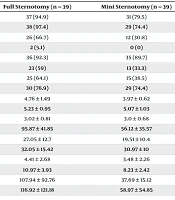
Baghaei R, Omidi Farzin A, Askarpour H, Dabbagh A, Fani K, et al. Evaluation of Recovery Rates After Open Heart Surgery in Children Undergoing Mini-Sternotomy Versus Full Sternotomy. Int J Cardiovasc Pract. 2025;10(1):e158827. doi: https://doi.org/10.5812/intjcardiovascpract-158827

Mirzaaghayan MR, Aghaei Moghadam E, Dehestani A, Ghamari A. Early Surgical Closure of the Ventricular Septal Defects; to Be Done or Not to Be Done? A Question to Be Answered. Inn J Pediatr. 2018;28(6):e58876. doi: https://doi.org/10.5812/ijp.58876
Amirghofran AA. Minimally Invasive Aortic Valve Replacement, technique and results. Multidiscip Cardio Annal. 2015;6(1):e9042. doi:
More by these authors
Last Update: 1 week ago
Last Update: 1 week ago
Last Update: 1 week ago
Last Update: 9 hours ago
Last Update: 12 hours ago
Last Update: 5 days ago
