Fulltext
The full text is available in PDF.
International Cardiovascular Research Journal
An annual journal in scientific affiliation with the Cardiovascular Research Center, Shiraz University of Medical Sciences
Image Credit:Int Cardiovasc Res J
Authors
Background: Although primary percutaneous transluminal coronary angioplasty is the method of choice for reperfusion in ST-elevation myocardial infarction, the intravenous thrombolysis is a more frequently used method. Thus it is important to identify the risks of reperfusion failure. In this regard, CRP as an inflammatory marker has shown promising value. The aim of this study is to investigate whether CRP level on admission is indicative of intravenous thrombolysis failure.
Methods: This study comprised 84 patients with STEMI. Samples were taken for CRP before initiation of thrombolysis. The correlation of CRP levels with thrombolysis results was investigated at the end of the study.
Results: The study population was divided according to their plasma CRP level on admission. The first group had CRP levels<0.5 mg/L (22 patients) and the second group had CRP levels≥0.5 mg/L (62 patients). There was a statistically significant difference (P=0.01) between the respondents to thrombolysis in the first (59.1%) and second groups (29.0%).
Conclusion: It was demonstrated that patients with low CRP levels on admission showed better response to intravenous thrombolysis while those with high levels of CRP showed unfavorable response.
© 2010, Author(s). This open-access article is available under the Creative Commons Attribution 4.0 (CC BY 4.0) International License (https://creativecommons.org/licenses/by/4.0/), which allows for unrestricted use, distribution, and reproduction in any medium, provided that the original work is properly cited.
Broumand M, Fakour K, Abbasi H, Amirzadegan A, Nadia- Hatmi Z, et al. Quantitative CRP Value in Assessing Myocardial Infarction of Unstable Angina Patients. J Kermanshah Univ Med Sci. 2006;10(3):e81806. doi:
Salehi A, Namazi MH, Safi M, Vakili H, Saadat H, et al. Correlation of platelet indices with TIMI frame count in patients undergoing primary PCI due to ST-segment elevation myocardial infarction. Int J Cardiovasc Pract. 2019;4(3):e130572. doi: https://doi.org/10.29252/ijcp-26632
Azarkar Z, Jafernejad M, Ebrahimzadeh A, Rezvani M. Association of quantitative C-reactive protein with acute myocardial infarction. J Inflamm Dis. 2024;18(4):e155845. doi:
Daei MM, MahdiDaei M, Dodangeh S, Hajikarimi M, Mohammadi N. Impact of Metabolic Syndrome in Patients With Acute Myocardial Infarction After Thrombolytic Therapy. J Inflamm Dis. 2024;25(4):e156297. doi:
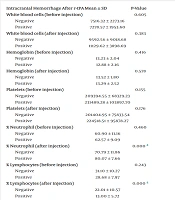
Farzan N, Khanmirzaei A, Ghodrati M, Mahmodi H, Azarinoush G. Investigating Neutrophil-to-Lymphocyte Ratio and Risk Factors for Hemorrhagic Transformation Following Thrombolytic Therapy: Insights from a Cross-Sectional Study. Arch Neurosci. 2025;12(1):e150665. doi: https://doi.org/10.5812/ans-150665
More by these authors
Last Update: 3 weeks ago
Last Update: 3 weeks ago
Last Update: 3 weeks ago
Last Update: 4 hours ago
Last Update: 1 day ago
Last Update: 4 days ago