1. Background
Cardiovascular disease (CVD) has been identified as one of the main sources of mortality in the world (1). The CVD is an overall term referring to the conditions that affect a human body’s heart and blood vessels. The CVD can also include the damage of the arteries in the organs, such as the kidneys, heart, eyes, and brain (2). It is estimated that CVD is responsible for 2200 cases of mortalities in the United States per day (3). Reports in recent years show that CVD is steadily continued to increase in Iran (4). The coronary care unit (CCU) is created as one of the most important developments in the patient-care sector for those who suffer from CVD. This unit has benefited from advanced devices for caring and supporting the patients and operates to treat patients with emergency CVD as promptly as possible (5).
The clinical manifestations of patients admitted to CCUs include chest pain, increased or decreased heart rate and blood pressure, cardiogenic shock, and early fatigue (6). Heart patients who experience high anxiety are more susceptible to ischemia, re-stroke, increasing heart rate, and ventricular fibrillation than those with low anxiety, in addition to some isolation and withdrawal (7). Increasing evidence indicates a strong interrelationship between CVD and anxiety. Patients with CVD have an associated 26% increased risk of anxiety. Moreover, anxiety contributes to higher all-cause and cardiac mortalities (8).
Being away from family members is one of the most important psychological and stressful factors in intensive care unit (ICU) patients (9) that is mostly due to ICU policies that limit visiting the patients (10). The literature suggests that depression and anxiety are among the common responses of patients at this unit (11). Anxiety has a polyhedral structure comprising behavioral, cognitive, and physiological arousals. These structures can be evaluated by questionnaire, observation, and physiological responses (12). Anxiety is defined as a temporary emotional state resulting from a potentially harmful situation with the potential for minor harm to an individual associated with decreasing the quality of life in both patients and their companions (13, 14).
Having a family member with an acute illness is a very stressful experience that leads to anxiety, anger, and helplessness in the patient’s companions and consequently insomnia, increased smoking, and poorer nutrition (15). Family members have an essential part in decision-making. Family members also prepare the medical record and security for the patient. These are some natural parts of family members of patients at CCU to speed up recovery (16). The hospital visits have three forms, namely behind-the-glass visiting, face-to-face visiting, and half-open visiting (17). According to some studies, family members and patients tend to face-to-face visiting; however, nurses tend to behind-the-glass visiting (18). Some CCU personnel believes that family members might interfere with patients’ care or even increase their anxiety (19). On the other hand, some studies show that face-to-face visiting can decrease their anxiety, and they feel better after the visit (20-22). These different results and approaches in some countries led the researchers to undertake this study to investigate the effect of face-to-face visiting and behind-the-glass visiting on patients’ anxiety at the CCU of a large hospital in Dezful, Iran.
2. Objectives
This study aimed to investigate the effect of face-to-face visiting and behind-the-glass visiting on patients’ anxiety at CCUs.
3. Methods
This quasi-experimental study was performed on 80 patients at the CCUs of Dr. Ganjavian hospital in Dezful. After the confirmation of the Ethics Committees of Dezful University of Medical Sciences (no. IR.DUMS.REC.1397.050) and permission of the Vice-Chancellor for sampling, the samples were randomly chosen by considering inclusion and exclusion criteria. The inclusion criteria were: (1) being conscious and aware of time, place, and person; (2) passing at least 18 hours of hospitalization; (3) being more than 18 years; (4) being able to communicate and understanding Persian; (5) not using any sedative drugs within past 6 hours; and (6) appropriate clinical status (monitoring patients for lack of recurrent arrhythmias and other risk factors). The exclusion criteria were: (1) suffering from or difficulty in visionary and hearing abilities in communication; (2) suffering from mental illness; and (3) being addicted to junk.
Considered hours of hospitalization as indicators of inclusion in the study are according to similar studies within a range of 12 - 24 hours. Accordingly, an average of 18 hours were selected. After getting the letter of consent from the patients, they were divided into the test group (face-to-face visiting; n = 40) and the control group (behind-the-glass visiting; n = 40). At first, the questionnaires about demographic information, such as age, gender, education, marital status, record of hospitalization, length of hospitalization, and kind of heart disease, were collected.
In the test group, a researcher explained the plan to a patient and asked the patient to name an individual whom they wished to see. In addition, the researcher mentioned that they could see only in person due to some limitations. Then, the visitor will visit the patient for 30 minutes. The same thing happened for the control group. The visitor visited the patient behind the glass for 30 minutes. The anxiety rates of both groups were recorded with Spielberger State-Trait Anxiety Inventory (STAI) 10 minutes before the visit (basic anxiety) and 10 minutes after the visit. Finally, the anxiety rates of patients before and after the visit were measured in both groups; then, the researchers compared the calculated rates with each other.
The questionnaire of Spielberger STAI is a standard scale used in numerous countries with Cronbach’s alpha coefficient in a study by Mehram performed in Iran at 91%, indicating scientific credit of this questionnaire (23). The questionnaire of the STAI includes 40 items, with the first 20 items for the state of anxiety and the second 20 items for the trait of anxiety. The scale of state anxiety (obvious anxiety) has 20 items that measure the feeling of the individual while answering the questions. The scale of trait anxiety (hidden anxiety) also has 20 items that measure the general and usual feelings of the individual. Each of these questionnaires contains 20 items with a score range of 20-80. Totally, the scores within the ranges of 20 - 31, 31 - 42, 43 - 53, and higher than 54 indicate no anxiety, low anxiety, normal anxiety, and high anxiety, respectively (24).
Stata software (version 13) was used for data analysis. The paired t-test with a significance level of 0.05 was utilized to compare the average between the obvious and hidden anxiety of the test group before and after the visit. The paired t-test was also used with the same significance level in the control group to compare the average between obvious and hidden anxiety before and after the visit. Finally, the average of obvious and hidden anxiety in both groups was compared with a significance level of 0.05 using the independent samples t-test.
4. Results
This study measured the level of anxiety in 40 patients with a mean age of 64.5 ± 9.73 years in behind-the-glass visiting and 40 patients with the mean age of 61.8 ± 11.3 years in face-to-face visiting. Moreover, a P-value of less than 0.05 indicated that all patients in each group did not differ significantly based on the type of heart disease, number of hospitalizations, number of hospitalizations in the CCU, and length of hospital stay in this ward (Table 1).
Table 1.
Demographic Information of Patients in the Study a
| Demographic & Hospital Information | Experimental Group b; n = 40 | Comparison Group c; n = 40 | P-Value |
|---|---|---|---|
| Gender | 0.001 | ||
| Male | 27 (67.5) | 23 (57.5) | |
| Female | 13 (32.5) | 17 (42.5) | |
| Marital status | 0.032 | ||
| Married | 32 (87.5) | 34 (85) | |
| Single | 2 (5) | 3 (2.5) | |
| Divorced | 1 (2.5) | 3 (2.5) | |
| Widow | 1 (2.5) | 0 (0) | |
| Education | 0.021 | ||
| Illiterate | 17 (42.5) | 14 (35) | |
| Elementary school | 14 (35) | 13 (32.5) | |
| Middle school | 2 (5) | 6 (15) | |
| High school | 4 (10) | 3 (7.5) | |
| University | 3 (7.5) | 4 (10) | |
| Record of hospitalization at a coronary care unit | 0.011 | ||
| None | 27 (67.5) | 24 (60) | |
| Once | 11 (27.5) | 6 (15) | |
| More than once | 2 (5) | 10 (25) | |
| Record of hospitalization | 0.014 | ||
| None | 23 (57.5) | 18 (45) | |
| Once | 10 (25) | 8 (20) | |
| More than once | 7 (17.5) | 14 (35) | |
| Length of the current hospitalization | 0.019 | ||
| Less than 24 hours | 3 (7.5) | 4 (10) | |
| 24-48 hours | 20 (50) | 18 (45) | |
| 48-72 hours | 7 (17.5) | 10 (25) | |
| More than 72 hours | 10 (25) | 8 (10) | |
| Disease | 0.021 | ||
| Heart attack | 5 (12.5) | 3 (7.5) | |
| Unstable angina | 24 (60) | 27 (67.5) | |
| Congestive heart failure | 10 (25) | 8 (20) |
a Values are expressed as No. (%).
b Face-to-face visiting.
c Behind-the-glass visiting.
Furthermore, the independent t-test was used to compare the average levels of obvious anxiety and hidden anxiety in both ways of visiting at the significance level of 0.05, in which the P-value was more than 0.05 in both experiments. There was no significant difference between the average anxiety of the two groups before the visit (Table 2). The results of the hypothesis test in the control group at the significance level of 0.05 with a 95% confidence interval showed anxiety inequality, in which the levels of obvious anxiety of patients were different before and after behind-the-glass visiting. In addition, the average level of obvious anxiety of patients before the visit was higher than after the visit (P = 0.01).
Table 2.
Patients’ Anxiety Levels Before and After Visits
| Kinds of Anxiety | Average | t-Value | P-Value |
|---|---|---|---|
| Patients’ Anxiety Levels Before Visits | |||
| Obvious anxiety before behind-the-glass visiting | 38.6 | 0.98 | 0.093 |
| Obvious anxiety before face-to-face visiting | 39.9 | ||
| Hidden anxiety before behind-the-glass visiting | 37.7 | 1.12 | 0.156 |
| Hidden anxiety before face-to-face visiting | 37.9 | ||
| Patients’ Anxiety Levels After Visits | |||
| Obvious anxiety after behind-the-glass visiting | 33.3 | 2.1 | 0.04 |
| Obvious anxiety after face-to-face visiting | 31.3 | ||
| Hidden anxiety after behind-the-glass visiting | 34.2 | 2.5 | 0.01 |
| Hidden anxiety after face-to-face visiting | 32.1 | ||
The levels of hidden anxiety were also different in these patients before and after behind-the-glass visiting, and the average level of hidden anxiety of patients before the visit was higher than after the visit (P = 0.04). Furthermore, in the test group, the results of the hypothesis test at the significance level of 0.05 with a 95% confidence interval showed anxiety inequality in which the levels of obvious anxiety were different before and after the visit (P = 0.01). Additionally, the patients’ average level of hidden anxiety before the visit was higher than after the visit (P = 0.02; Table 3).
Table 3.
Comparison of Patients’ Mean Anxiety Levels Before and After Visits
| Kinds of Anxiety | Average | Standard Deviation | Fiducial Interval | Quantity-T | P-Value |
|---|---|---|---|---|---|
| Obvious anxiety before behind-the-glass visiting | 38.6 | 12.0 | 38.12 ± 6.0 | 2.5 | 0.01 |
| Obvious anxiety after behind-the-glass visiting | 33.3 | 12.4 | 33.12 ± 3.4 | ||
| Hidden anxiety before behind-the-glass visiting | 37.7 | 13.1 | 37.13 ± 7.1 | 1.99 | 0.04 |
| Hidden anxiety after behind-the-glass visiting | 34.2 | 12.6 | 34.12 ± 2.6 | ||
| Obvious anxiety before face-to-face visiting | 39.9 | 11.9 | 39.11 ± 9.9 | 2.9 | 0.01 |
| Obvious anxiety after face-to-face visiting | 31.3 | 11.6 | 31.11 ± 3.6 | ||
| Hidden anxiety before face-to-face visiting | 37.9 | 13.8 | 37.13 ± 9.8 | 2.1 | 0.03 |
| Hidden anxiety after face-to-face visiting | 32.1 | 12.0 | 32.12 ± 1.0 |
The grouped comparison of obvious and hidden anxiety levels was performed using the Spielberger questionnaire. Table 4 shows obvious and hidden anxiety classification in face-to-face visiting and behind-the-glass visiting groups. The results of the K2 test at the significance level of 0.05 showed that there was a significant difference between different levels of obvious and hidden anxiety before and after behind-the-glass visiting [hidden (P = 0.01) and obvious (P = 0.008)]. In face-to-face visiting, this significant difference was also remarkably different between the obvious and hidden anxiety of patients [hidden (P = 0.01) and obvious (P = 0.002)].
Table 4.
Comparison of Obvious and Hidden Anxiety Levels of Patients
| Kinds of Anxiety and Rate of Anxiety | Comparison Group | P-Value | Experimental Group | P-Value |
|---|---|---|---|---|
| Obvious anxiety before visiting | 0.008 | 0.002 | ||
| Low (20 - 30) | 14 | 10 | ||
| Intermediate (31 - 42) | 11 | 12 | ||
| High (43 - 53) | 7 | 10 | ||
| Very high (54 < ) | 8 | 8 | ||
| Obvious anxiety after visiting | ||||
| Low | 19 | 19 | ||
| Intermediate | 14 | 13 | ||
| High | 4 | 5 | ||
| Very high | 3 | 3 | ||
| Hidden anxiety before visiting | 0.01 | 0.01 | ||
| Low (20 - 34) | 11 | 10 | ||
| Intermediate (35 - 45) | 7 | 8 | ||
| High (46 - 56) | 9 | 7 | ||
| Very high (57 < ) | 13 | 15 | ||
| Hidden anxiety after visiting | ||||
| Low | 19 | 18 | ||
| Intermediate | 14 | 14 | ||
| High | 4 | 5 | ||
| Very high | 3 | 3 |
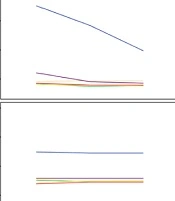
The average anxiety was normal in the four groups (before and after behind-the-glass visiting and before and after face-to-face visiting), and the p-value of the Kolmogorov-Smirnov test was less than 0.05. The average levels of obvious anxiety and hidden anxiety were compared in both ways of visiting at the significance level of 0.05 using the independent t-test, and the p-value was less than 0.05 in both experiments. Moreover, there was a significant difference in the average level of anxiety of both ways of visiting. Finally, the obvious anxiety of patients of the face-to-face visiting group was significantly less than behind-the-glass visiting after the visit (P = 0.04). In addition, the hidden anxiety of patients of the face-to-face visiting group was significantly less than the behind-the-glass visiting group after the visit (P = 0.01) (Table 2 and Figure 1).
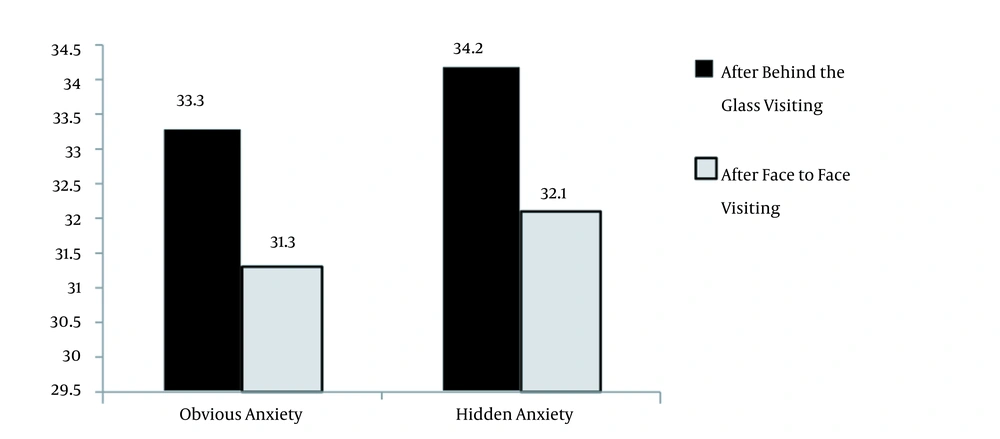
Figure 1.
Comparing the average between obvious and hidden anxiety in behind the glass and face to face visiting.
5. Discussion
The purpose of this study was to compare the effect of face-to-face visiting and behind-the-glass visiting on the anxiety of patients hospitalized at CCUs. The results showed that the average levels of obvious and hidden anxiety in face-to-face visiting and behind-the-glass visiting had no significant difference before the visit; however, in both groups, the levels of obvious and hidden anxiety reduced significantly after the visit. Finally, after face-to-face visiting, the average obvious and hidden anxiety levels were significantly less than behind-the-glass visiting. It should be noted that the obtained results are in a controlled condition, and regular visiting and the number of patient’s visitors should not increase as it might cause restlessness and negative effects on both the patient and staff.
Regarding open visitation, it should be considered that it is not a standardized philosophy. Moreover, it should be clarified that open visitation is not allowed for all visitors and is not available at any time. Additionally, it is important to understand that taking to account visitation is a complex process which means that patient interests are considered, communication skills for clinicians have improved, and families are supported and prepared for their visits. Furthermore, it is recommended to change the terms “open” and “unrestricted” to “flexible” and “free” that can help alleviate some of the barriers of healthcare providers in open visitation. Finally, feasibly each CCU will need to have an individualized approach to open visitation policies which corresponds to the needs of patients, families, and healthcare providers. However, open visitation is required, and CCUs have accepted it (25).
In this regard, Kamrani et al. conducted a study in 2011 to compare the physiological indices of patients before, during, and after the visit at a CCU. The results showed that the physiological indices of patients during the visit change normally and temporarily and return to the normal condition after 30 minutes. That is why it seems that restricting patients’ visits is irrational only due to physiological changes, and there is no need to restrict patients’ visits with their visitors (26). On the other hand, the results of a study by Salavati et al. aimed at observing the effect of planned visiting on physiological indices of these patients hospitalized at the CCU showed that planned visits have positive effects on the physiological indices of these patients and reduce the heart rate, respiratory rate, and systolic and diastolic blood pressure and increase the oxygen saturation percentage; however, these changes are not statistically significant (27).
Similarly, Rezaei et al., in a study with the aim of investigating the effect of planned visiting on the physiological indices of 90 patients hospitalized at CCUs, did not report any significant difference in the physiological indices of such patients (28). However, the results of a study performed by Rahmani et al. pointed out a significant reduction of the physiological indices of patients hospitalized at the CCU after three visits on 3 consecutive days. The aforementioned study aimed at investigating the effect of planned visiting on the physiological indices of 72 patients with acute coronary syndrome hospitalized at the CCU. The results indicated the improved treatment performance and reduced anxiety of patients if planned visiting is implemented rather than no visitor policies (29), which is in line with the result of the current study. Additionally, the results of a study by Azimi Lolaty et al. to investigate the effect of family and friends visiting on the anxiety and physiological indices of patients hospitalized at the CCU indicated a significant reduction of the physiological indices of patients 10 - 30 minutes after the visit. This reduction is considered a sign of reduction of these patients’ anxiety (30).
Due to the randomness of sample selection, more samples, using a comprehensive and reliable questionnaire, matching the demographic characteristics of control and intervention groups before the visits, and eliminating the maximum number of confounders in the inclusion and exclusion criteria in the present study, compared to previous studies, it can be claimed that the results are more accurate and reliable than other studies. It is worth noting that although most studies have shown different benefits of face-to-face visiting, few hospitals have implemented this strategy. One of the reasons could be the lack of proper implementation of these studies, all of which have been studied in the present study and can be submitted to hospitals for implementation.
According to the nurses’ report, one of the patients in the past few months had an increase in the heart rate and reduction in arterial oxygen saturation following a simultaneous visit with four of his visitors; therefore, it is expected that the increased number of visitors at CCUs does not have positive effects, as this leads to increased noise in the unit which in turn increases patients’ anxiety and dissatisfaction. Therefore, it is suggested to allow each patient to visit only one of his/her visitors.
5.1. Conclusions
The results of this study showed that face-to-face visiting, provided that it is within some frameworks, including specific visit time, specific number of visitors, sterilization, and confirmation of the physician, might decrease the anxiety of hospitalized patients at CCUs. This method not only decreases the anxiety of patients and their companions but also can improve the efficiency of recovery and help speed up the healing process.