
1. Background
Cigarette smoking is one of the most important and prevalent health-risk behaviors worldwide and, as the most common form of tobacco use, poses a serious threat to physical, psychological, and social health. Scientific evidence indicates that there is no safe or risk-free level of exposure to cigarette smoke and that smoking can lead to a wide range of biological, psychological, and social consequences. Cigarette smoking contributes substantially to the global burden of disease and plays an important role in the development and exacerbation of chronic conditions, including cardiovascular diseases, respiratory diseases, various cancers, and stroke. The World Health Organization defines smoking as a state of physical and psychological dependence resulting from the interaction between a tobacco substance and a living organism, accompanied by specific behavioral patterns; this form of dependence has major public health and treatment consequences (1).
Smoking is harmful not only to individual smokers but also to society, as the costs associated with declining health, disease treatment, and reduced workforce productivity impose a substantial economic burden on health systems. Global reports indicate that tobacco use causes more than 8 million deaths worldwide each year and remains a major public health problem in many developed countries. The World Health Organization reports that the European region has a high prevalence of tobacco use among adults and adolescents, and that in countries such as Spain, smoking remains an important cause of premature mortality and disease. In Iran, the direct and indirect costs associated with cigarette smoking impose a substantial burden on the national health system, further underscoring the importance of addressing the factors that contribute to this behavior. Cigarette smoking is a complex, multidimensional behavior influenced by individual, psychological, social, and environmental factors. Given the increasing prevalence of smoking at younger ages, identifying factors related to smoking initiation, continuation, and relapse is essential for designing effective preventive and therapeutic interventions. One of the most important of these factors is stress, particularly occupational stress. Occupational stress arises when job demands and workplace pressures exceed an individual’s abilities, resources, and skills. Work environments, especially those in the healthcare sector, are among the settings in which employees experience high levels of stress (2, 3).
Occupational stress is defined as a pattern of emotional, cognitive, behavioral, and physiological responses to unfavorable aspects of job content, organizational structure, and working conditions. Key sources of occupational stress include job-role characteristics, role conflict and ambiguity, excessive workload, heavy responsibilities, unfavorable physical work environments, poor interpersonal relationships, inadequate organizational support, and low job security. Reports indicate that approximately 30% of the workforce in developed countries experiences occupational stress, with even higher rates reported in developing countries. In addition, the International Labour Organization has estimated that costs associated with occupational stress account for 1% to 3.5% of gross national product (4, 5).
In addition to reducing job performance and productivity, occupational stress has extensive adverse consequences for mental and physical health. These consequences include fatigue, anxiety, reduced motivation, impaired concentration and decision-making, increased human error, weakened social relationships, and unhealthy behaviors such as cigarette smoking, overeating, and alcohol consumption (6, 7). Research evidence indicates that negative affect and stress are directly associated with increased cigarette smoking and that individuals with high stress levels are more likely to initiate smoking or to relapse. Some studies have also shown that women may be particularly vulnerable to smoking and relapse when exposed to stress and negative affect, with a higher likelihood of returning to smoking after quit attempts under stressful conditions (8-10).
In Iran, several studies have identified psychological problems and emotional stress as important motivational factors for cigarette smoking, and a significant association between occupational stress and tobacco use has been reported. However, most studies have examined stress in general, and relatively few have specifically addressed occupational stress and its dimensions. This research gap is particularly evident among emergency department staff in educational and therapeutic centers, who are continuously exposed to critical situations, high workloads, and heavy responsibilities (11-13).
The emergency department is one of the most stressful work environments in the healthcare system. Staff members are exposed to excessive workloads, role ambiguity, time pressure, and unfavorable physical conditions. These circumstances may predispose individuals to engage in high-risk behaviors such as cigarette smoking. Therefore, investigating the relationship between occupational stress and cigarette smoking among emergency department staff is scientifically and practically important and may help identify risk factors, guide occupational health promotion programs, and support preventive interventions (14, 15).
2. Objectives
The present study examined the relationship between occupational stress and cigarette smoking among emergency department staff at educational and therapeutic centers in Urmia to address the existing research gap and provide a basis for planning interventions to reduce occupational stress and its adverse consequences, including cigarette smoking.
3. Methods
3.1. Study Design and Participants
This descriptive-analytical correlational study used stratified sampling among staff members of the emergency departments of educational and therapeutic centers in Urmia. The total study population comprised 357 emergency department personnel; based on similar studies and sample size calculation formulas, the sample size was determined to be 357 participants.
The inclusion criterion was employment as a member of the hospital emergency department staff, and the exclusion criterion was unwillingness to participate in the study.
3.2. Data Collection Instruments
Data were collected using one checklist and two questionnaires.
3.2.1. Demographic Information Checklist
The demographic checklist included hospital name, age, sex, occupation, hospital work experience, emergency department work experience, education level, and smoking-related variables, including smoking status (current smoker, former smoker, or never smoker), duration of smoking, number of cigarette packs smoked per day, and, for former smokers, previous smoking duration and the date of smoking cessation.
3.2.2. Osipow Occupational Stress Questionnaire
The Osipow and Spokane Occupational Stress Questionnaire, developed in 1987 to assess individual stress in the work environment, was used to evaluate occupational stress (16). The Osipow Occupational Stress Scale assesses job-related stress arising from occupational roles and is intended to determine the severity of, and differences in, role-related stress among employees in different organizational settings.
The questionnaire consists of 60 items scored on a 5-point Likert scale ranging from 1 (never) to 5 (most of the time). Lower scores indicate lower stress levels. The instrument is designed to measure occupational stress and compare stress levels across different research groups. It includes six dimensions:
1) Role overload (items 1 - 10), which evaluates the individual's situation in relation to job demands;
2) Role insufficiency (items 11 - 20), which assesses the compatibility of an individual's skills, education, and training with job requirements;
3) Role ambiguity (items 21 - 30), which evaluates the individual's awareness of priorities, workplace expectations, and evaluation criteria;
4) Role boundary (items 31 - 40), which assesses conflicts between professional conscience and expected occupational roles;
5) Responsibility (items 41 - 50), which measures the individual's sense of responsibility regarding efficiency and the welfare of others in the workplace; and
6) Physical environment (items 51 - 60), which examines unfavorable physical working conditions to which the individual is exposed.
The content validity of this questionnaire was reported to be highly satisfactory by Amiri in 2025 (17), and its reliability, assessed using the test-retest method, was reported to be acceptable. The Cronbach alpha coefficient was 0.89.
3.2.3. Smoking Behavior Questionnaire
The Smoking Behavior Questionnaire consists of 2 multiple-choice questions, 6 open-ended questions, and 16 Likert-scale items and is a single-factor instrument. The validity and reliability of the questionnaire were reported by its developers as 0.96.
3.3. Statistical Analysis
After data collection, the data were entered into SPSS version 18 and analyzed using descriptive statistics (frequency, percentage, mean, and SD) and inferential statistics (Pearson correlation and multivariable regression analysis). The normality of the data distribution was assessed using the Kolmogorov-Smirnov test.
3.4. Ethical Considerations
This article is part of a research project approved by Urmia University of Medical Sciences and received ethical approval under the code IR.UMSU.HIMAM.REC.1403.094.
4. Results
A total of 357 participants were included in the study, comprising 36 physicians, 78 nurses, 121 service staff members, and 122 administrative personnel. The mean ± SD occupational stress score was 173.87 ± 74.18, and the mean ± SD cigarette smoking score was 58.77 ± 26.39. The data were normally distributed.
Analysis of the relationships between occupational stress dimensions and cigarette smoking showed that role overload was significantly and directly associated with smoking behavior at the 95% confidence level (P = 0.024, r = 0.161). A stronger, statistically significant direct relationship was observed between role insufficiency and cigarette smoking at the 99% confidence level (P = 0.001, r = 0.231). Similarly, role ambiguity showed a significant direct association with smoking at the 99% confidence level (P = 0.001, r = 0.254). However, no significant linear relationship was found between role boundary and cigarette smoking among emergency department staff. In contrast, responsibility-related stress showed the strongest, direct, and statistically significant relationship with cigarette smoking at the 99% confidence level (P = 0.001, r = 0.283). Finally, stress related to the physical work environment was also directly and significantly associated with cigarette smoking at the 95% confidence level (P = 0.041, r = 0.146) (Table 1).
Table 1.
Summary of the Regression Model and Assessment of Autocorrelation
| Criterion Variable | R | R2 | AR2 | Standard Deviation |
|---|---|---|---|---|
| Cigarette Smoking | 0.236 | 0.056 | 0.36 | 36.102 |
The multiple correlation coefficient was 0.236, and the adjusted R2 was 0.36, indicating that, according to the submitted model statistics, 36% of the variation in cigarette smoking could be explained by the occupational stress variables (Table 2).
Table 2.
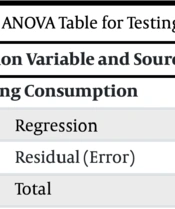
ANOVA Table for Testing the Significance of the Regression Model
| Criterion Variable and Sources of Variation | Sum of Squares | Degrees of Freedom (df) | Mean Square (MS) | F Statistic | P-Value |
|---|---|---|---|---|---|
| Smoking Consumption | 2.870 | 0.042 | |||
| Regression | 7208.033 | 2 | 3604.016 | ||
| Residual (Error) | 121824.957 | 254 | 479.625 | ||
| Total | 129032.990 | 256 |
The significance level of the F statistic for smoking consumption with 2 and 254 degrees of freedom was less than 0.05. This finding indicates that the regression model was statistically significant at the 95% confidence level (P < 0.05, F = 2.870) and that the occupational stress variables could predict smoking consumption (Table 3).
Table 3.
Correlation and Regression Coefficients of Smoking Consumption Based on Occupational Stress Among Employees of Educational-Treatment Centers of Urmia
| Predictors | Unstandardized Coefficients | t | P-Value | ||
|---|---|---|---|---|---|
| Standardized Beta Coefficient | Standard Deviation | B | |||
| Constant | - | 13.512 | 59.236 | 4.384 | 0.001 |
| Occupational Stress | 0.236 | 0.083 | 0.360 | 4.349 | 0.001 |
Based on the submitted significance level (P = 0.001), the constant term was statistically significant, indicating that use of the regression model was statistically meaningful. Occupational stress also had a statistically significant effect on the criterion variable (P = 0.001). Moreover, the standardized beta coefficient for occupational stress (β = 0.236) was statistically significant, indicating a significant effect of occupational stress on smoking consumption.
5. Discussion
Tobacco use, particularly cigarette smoking, is among the most common health-risk behaviors in contemporary societies and is associated with extensive physical, psychological, social, and economic consequences. In recent years, increasing occupational pressures, rapid changes in organizational structures, and the growing complexity of professional roles have increased research interest in cigarette smoking among high-stress occupational groups, especially healthcare workers. Healthcare environments, particularly emergency departments, are prone to high levels of occupational stress because of the nature of the work, continuous exposure to critical situations, urgent decision-making, and substantial responsibilities. Such conditions may lead individuals to adopt unhealthy coping strategies, including cigarette smoking (18, 19).
The findings of the present study showed a direct and significant relationship between occupational stress and smoking consumption, such that higher occupational stress was associated with greater smoking consumption. Regression analysis also confirmed that occupational stress significantly predicted smoking consumption (F = 2.870, P < 0.05). These findings are consistent with the results reported by Bhurtun et al. (19) and Caliri et al. (20) and underscore the role of occupational stress in the development and persistence of high-risk behaviors. In other words, employees exposed to higher levels of occupational stress may be more likely to use cigarette smoking as a means of temporarily reducing psychological tension.
5.1. Role Overload
Examination of the occupational stress components showed that role-overload stress had a direct and significant relationship with smoking consumption. When the volume of job duties exceeds an individual's physical and psychological capacity, feelings of burnout, pressure, and inadequacy may increase, potentially leading individuals to use smoking as a temporary means of escape. This finding is consistent with previous studies (20, 21), and other studies have shown that smokers experience more stressful life events than nonsmokers (22).
5.2. Role Insufficiency
Stress resulting from role insufficiency showed a stronger and more significant relationship with smoking consumption. Feelings of incompetence in performing job duties or a mismatch between individual capabilities and organizational expectations can increase psychological tension. Under such circumstances, some individuals may mistakenly perceive smoking as a means of reducing stress, whereas evidence indicates that, although nicotine may produce a short-term sense of relaxation, it can increase anxiety, dependence, and psychological stress in the long term. This finding is consistent with domestic and international studies (23-25).
5.3. Role Ambiguity
The results related to role ambiguity also indicated a direct and significant relationship with smoking consumption. Ambiguity in organizational expectations, inconsistency among tasks, and uncertainty regarding job roles can lead to confusion, frustration, and psychological distress. Such conditions may increase the likelihood of adopting unhealthy coping strategies, including cigarette smoking. This finding is consistent with studies identifying stress as an initiating and maintaining factor in smoking behavior (24).
5.4. Role Boundary
In contrast, the present study found no significant relationship between stress arising from role boundaries and smoking consumption. This result is inconsistent with some previous studies, and the discrepancy may be attributable to differences in study population characteristics, hospital conditions, or occupational stress measurement instruments (20, 26).
5.5. Responsibility
Stress related to responsibility showed the strongest association with smoking consumption. Employees with heavier responsibilities often experience greater psychological pressure and may perceive smoking as a means of enhancing concentration or tolerating work-related stress. This mistaken belief may contribute to nicotine dependence and continued smoking behavior. These findings are consistent with those reported by Caliri et al. (20), Wiecha et al. (25), and McKenna et al. (27).
5.6. Physical Work Environment
Stress arising from the physical work environment also showed a direct and significant relationship with smoking consumption. Unfavorable physical conditions, time pressure, heavy workloads, limited social support, and exposure to colleagues’ smoking behavior may contribute to smoking as a learned and conditioned behavior. In addition, nicotine affects the brain's reward system and increases the release of neurotransmitters such as dopamine and beta-endorphins, which may create a temporary sense of pleasure and relaxation and reinforce this maladaptive cycle (28, 29).
Overall, occupational stress and most of its components appear to play an important role in the initiation and continuation of smoking behavior among emergency department staff. Contrary to common belief, smoking is not an effective strategy for stress management; rather, it may intensify psychological pressure and increase dependence. Therefore, reducing occupational stress, improving workplace conditions, teaching healthy coping strategies, and increasing employees' awareness of the consequences of smoking may help reduce this high-risk behavior and promote the mental and physical health of healthcare workers.
5.7. Conclusions
The findings demonstrated a direct and significant relationship between occupational stress and smoking consumption among emergency department staff of educational-treatment centers in Urmia. Most dimensions of occupational stress, including role overload, role insufficiency, role ambiguity, responsibility, and the physical work environment, showed positive and significant correlations with smoking consumption, whereas role boundary was not significantly associated with smoking. Linear regression analysis also confirmed the significance of the model and indicated that occupational stress was a significant predictor of smoking consumption. The standardized beta coefficient reflected a positive effect of occupational stress on smoking consumption. These findings highlight the role of occupational stressors in the emergence of health-risk behaviors in high-stress healthcare settings. Accordingly, organizational interventions aimed at reducing occupational stress may help decrease smoking consumption.