1. Background
Hypoxia is a common environmental stress factor that aircrew may be exposed to repeatedly. Hypobaric hypoxia is a hazardous condition in aviation that may have disastrous consequences, thus to prevent such eventualities, all military aircrew are trained to recognize the signs and symptoms of hypoxia in a safe environment, using a variety of methods to simulate altitude (1). The symptoms are nonspecific, but the clinical manifestations tend to be neurological and cardiovascular, rather than respiratory (2). The earliest feature of hypobaric hypoxia is often a subtle personality change, perhaps coupled with euphoria, lack of judgment, loss of short term memory, and a lack of mental acuity (3). The most important effects in aviation are mental incapacitation, and unconsciousness. Acute hypoxia decreases the capacity of cells to tolerate damage from reactive species, and thus increases their susceptibility to injury (4). A decrement in behavioral processes, such as; short-term memory, selective attention, logical reasoning, and spatial orientation, can have drastic affects on aircrew performance. These observations emphasize the importance of hypoxic training for aircrews.
As a result of the effects of hypoxia on flying safety, hypobaric hypoxia training in an altitude chamber is mandatory for aviation aircrews. Thus aircrews have traditionally been trained to recognize the symptoms of hypoxia using a hypobaric chamber, at simulated altitudes of 25000 ft or more. This training is considered to be high risk due to the potential for barotrauma and/or decompression sickness (DCS). Therefore, all inside observers are required to denitrogenate by breathing 100% oxygen for 30 minutes prior to altitude exposure (5). Thus, hypoxic exposure in an altitude chamber or preoxygenation with 100% O2 may injure cells. In addition, hypobaric hypoxia can result in catecholamine release (6). Catecholamine hormones in some organs, such as the gastrointestinal tract and kidneys, result in vasoconstriction. Following this vasoconstriction and reduction in oxygen supply, these organs impose additional hypoxic stress and injury. Hypoxias induced through reduced perfusion following vasoconstriction in some organs, increase the probability of tissue damage, and intracellular biomarkers such as alanine aminotransferase (ALT) and aspartate aminotransferase (AST), which are then released into the bloodstream.
2. Objectives
Few studies have reported the changes that occur in the profiles of tissue enzymes, such as aminotransferase in serum, following an altitude chamber experience. Therefore, in this study we investigated possible changes in serum AST and ALT activities under these conditions.
3. Patients and Methods
3.1. Study Protocol and Subjects
The Ethics Committee of Aja University of Medical Sciences, Iran, approved the study protocol. Informed permission was obtained from all contributors. This study was designed as a cross-sectional survey to investigate the serum activities of aminotransferase, before and after altitude chamber experience, in 37 healthy male military aviators. The participants were not taking any medication at the time of the study. Smokers, obese subjects (body mass index > 30), and subjects with systemic diseases, were excluded; however, none of the participants were excluded in our study for these reasons. They had no previous history of medical problems, liver disease, or prior jaundice.
Before the aviators entered the altitude chamber the procedure was explained to them. Next a mask was fitted and an oxygen regulator and internal communication system were connected. Then ascendance to 5-6000 feet was performed to check Eustachian tube function and its ability to drain sinuses and middle ear. Ascendance and descent velocity was 3000 feet per minute. Re-ascendance velocity to 8000 feet was 3000 feet per minute. Acute pressure reduction occurred at 8000 to 18000 feet in an 8-10 second duration. Mask removal was done at 25 000 feet altitude in order to facilitate a hypoxia experience. The study was terminated if hypoxic symptoms developed. Duration of the hypoxic exposure was 3-5 minutes in this study.
3.2. Sample Collection
Two mL blood specimens were obtained by venipuncture, under resting conditions in a quiet room, in 10 mL glass vacuum tubes without additives, and allowed to clot before (9:00-10:00 AM), and after (11:00-11:30 AM) exposure to hypoxia. The blood was then centrifuged (2500 g, 10 min), and the serum was separated and immediately stored at -80°C for later examination.
3.3. Laboratory Assays
Serum specimens were assessed by a photometer and affiliated kits (Pars Azmun, Karaj, Iran) for the total activities of AST and ALT by the International Federation of Clinical Chemistry (IFCC).
3.4. Statistical Analysis
For the statistical analysis, the data are presented as mean ± SEM. Comparison of means between the before and after experience of hypobaric hypoxia was carried out with a paired two-tailed Student’s t-test. Results were considered statistically significant if P < 0.05. Analyses were performed using SPSS software version 16 (SPSS Inc. Chicago, IL, USA).
4. Results
The participants had a mean age of 31.5 years (range 22-43 years); mean height of 178.4 cm (range 165-192 cm), and a mean weight of 80.8 Kg (range 63-105). Mean duration of the hypoxic exposure was 4 min (range 3-5 min). A Student's paired t-test showed that there was a significant difference in the serum activity of ALT following altitude chamber experience (19.2 ± 1.5 vs. 23.1 ±1.9 U/L, respectively; P = 0.014; Figure 1 A). The mean serum activity of AST was significantly higher in the military aircrew subjects following altitude chamber experience than before (25.8 ± 1.6 vs. 41.6 ± 2.2 U/L, respectively; P = 0.001; Figure 1 B).
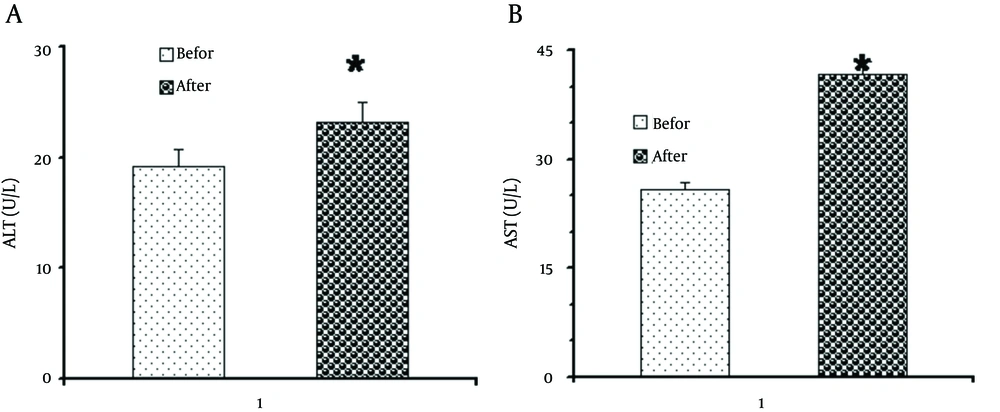
Figure 1.
Serum Concentrations of (A) Alanine Aminotransferase (ALT) and (B) Aspartate Aminotransferase (AST) in Military Aircrew, Before and After Altitude Chamber Experience (P < 0.05).
5. Discussion
Acute hypobaric hypoxia is documented as the single most serious physiological risk in flights at high altitudes. Simulation of acute hypoxia in an altitude chamber is used for training military aircrews. In this study, the alteration of aminotransferase activities as markers of cell damage, following an experience of acute hypoxia in an altitude chamber, was investigated. We found that the serum activity of aspartate aminotransferase was increased following an acute hypoxia experience.
It has been shown that a small amount of oxygen is stored in the lungs and blood. However, it is only adequate for the maintenance of metabolic processes functioning for about two minutes. Overall, tissue performance depends on effective cell oxygenation, and it is predominantly required in high metabolic tissues, such as; skeletal muscles, cardiac muscles, and the liver. In particular, the center of the hepatic lobules are predisposed to hypoxia-related tissue injury, due to the huge mass of the liver and the complex nature of its lobular structure (7).
At 30,000 feet (9,144 m) altitude, PaO2 is under 30 mmHg and O2 saturation of hemoglobin is under 60%. Thus, aviators experience significant hypoxia in this situation. Hypoxic stresses can injure several types of cells in the human body. In hypoxic tissues, there is a failure of oxidative phosphorylation and a reduction in ATP levels. Anaerobic glycolysis continues for a while, but stops subsequent to glycolytic substrate exhaustion. Anaerobic metabolism is reversible and therefore moderate cellular swelling may occur. However, prolonged ischemia causes irreversible damage to cell membranes causing cell death. Consequently, intracellular proteins, such as; creatine kinase, lactic dehydrogenase, troponins (I and T) in myocardial infarction, amylase in the exocrine pancreas, creatine kinase (MM isoforms) in striated muscle, and AST and ALT in the liver, are released into the bloodstream after injury (8-10).
To avoid this occurrence, all of the volunteers received 100% oxygen to reduce the risk of DCS. Acute manifestations of toxicity appear in the brain at high oxygen partial pressures. It has been shown that the lung is an initial target for the toxic effects of O2. In normobaric situations, reactive oxygen species formation overcome antioxidant defenses, and oxidize; lipids, nucleic acids, and proteins in lung tissues (11, 12).
According to our study, serum levels of AST increased after the altitude chamber experience. These findings indicate that slight tissue damage may occur during an altitude chamber experience. The tissue injury can originate from hypoxia or oxidative stresses. On the other hand, we can assume that tissues may be more susceptible to hypobaric hypoxia damage following breathing 100% oxygen for 30 minutes in hypobaric conditions. Further studies are needed to evaluate this assumption.
There were some limitations in the present study. For example, because we anticipated and experienced resistance from the study participants, we did not perform a sequential assessment of serum aminotransferase, and hence, there are no data about the timing of the aminotransferase rise in the serum after the beginning of hypoxia, or oxygen toxicity in the hypobaric chamber. As many tissues in the human body produce and release these enzymes in blood or other fluids, further studies need to be conducted in order to evaluate the source of AST and ALT increases in this situation.
Results suggest that subsequent to the altitude chamber experience, there is a rise in the serum levels of AST in the aircrew.