
1. Background
Aggression toward staff and workplace violence are common problems worldwide (1) that not only affect individuals' dignity but also affect their physical and emotional well-being (2). Aggression and workplace violence as one of the most serious problems threatens the health staff, especially hospitals (3) and may have adverse effects including damage, traumatic attacks on others, and high-risk behaviors (4). Generally the incidence of this problem is increasing so that the incidence of aggression toward staff in hospitals in Great Britain was reported at 42%, in Italy was 74%, in Australia was 93%, in South Korea was 9.7-63.8%, in Turkey was 72.3%, in Jordan was 75%, in Palestine was 76.1%, in Iran was 47.91 - 77.1 % (2, 5-14).
Aggression toward staff as an important factor in reducing the quality of working life and satisfaction with medical staff has a significant effect on the quality of patient's care and their satisfaction and productivity and efficiency of relevant staff (15). This leads to the incidence of moral conflicts among staff and the emergence of psychological symptoms such as anger, stress, depression, and hopelessness and doubts about professional qualifications, the individual proper decisions on the choice of occupation, difficulty in returning to work and the emergence of problems in relations with colleagues (16). In addition, increased medical errors, reduced quality of patient care, absence from work, and increased costs due to sick leave are other consequences of this problem (17).
Although aggression toward staff has several reasons, alcohol and drug abuse by patients or their entourages, lack of security facilities, patients' death and lack of educational facilities for the prevention of violence, (11) perceived delay in the delivery of services and lack of awareness, (12) and night visit and dissatisfaction with the units (14) are mentioned as the main reasons. Ayranci stated that aggression is solely in 52% of patients and the reason for 89% of the aggression is not the patients but also their entourage (8) Another study also notes that entourages show aggression and violence three times to patients (14). This shows the need to examine aggression correlates to the health staff, particularly in units involving patients with sudden problems such as a stroke.
Stroke is a debilitating condition leading to death that involves one person every 40 seconds and 800 thousand people annually in the United States (18). Since in 75% of cases a patient experiences the first stroke previously he had no history, (18) it seems the patient and family members are not prepared to deal with this problem. Although the results of a study showed that there isn't a connection between the quality of life for stroke patients and their family caregivers, (19) other studies suggest that the family caregivers such as patient spouses also reported high burden, more anxiety and depressive symptoms, and less psychological functioning and wellbeing (20, 21). Furthermore, although there is a risk of impulsive behaviors incidence by relatives of the patient from pre-hospital, hospitalization and discharge, it seems that some entourages are more prone to aggressive behaviors incidence. On the other hand, many government hospitals in Iran do not provide adequate welfare and hotel services for caregivers of patients with severe disabilities such as stroke. Caregivers not only do not have enough nutrition and sleep but also worry about the destructive consequences such as chronic disability and death of their patients. Such problems in Iran's cultural context usually make caregivers extremely irritable. On the other hand, examining the phenomenon underlying factors can increase health professional's understanding and since the phenomenon of workplace aggression and violence in hospitals, especially in Middle East countries, has been poorly recorded and managed (10).
2. Objectives
This study was conducted aimed to examine correlates of the aggression among entourages of hospitalized stroke patients’ toward health staff.
3. Methods
3.1. Design and Participants
The patients diagnosed with stroke were hospitalized in the neurology ward of Imam Reza Hospital in Kermanshah, Iran, and one of their entourages was invited to participate in this cross-sectional study from September to December 2020. The sample size included 194 stroke patients hospitalized in the neurology ward and 194 entourages (one per patient). Since our model contains 15 predictor variables and according to the sample size formula for regression analysis (N > 50 + 8m), (22) 194 subjects is an appropriate sample size. Inclusion criteria included stroke diagnosis for patients, being 20 to 65 years old, and having attended at least 12 hours in the hospital for entourage. Fatigue due to the long distance to the hospital, lack of coordination between patient self-report information and medical file, and failure to complete the questionnaire were exclusion criteria.
3.2. Data Collection and Instruments
After approval of the hospital and ethics committee of Kermanshah University of Medical Sciences, eligible patients and one of their entourages were identified. After assuring patients about confidentiality, their demographics and medical records were collected using appropriate tools. First, a neurologist registers demographics and National Institutes of Health Stroke Scale (NIHSS) scores. In the next step, the patient data were matched with medical files. Then, the demographics of the entourages and the number of days and nights staying in the hospital were obtained and a hospital satisfaction questionnaire was provided to each participant. Data collection was done by an experienced clinical psychologist. The psychologist first tried to establish a friendly relationship with the caregivers and then explained to them the necessary explanations about the importance and process of the work. Then the questionnaires were delivered to the participants to return to the psychologist within 24 hours. Finally, the patient hospitalization duration was determined based on the hospital information system (HIS).
3.2.1. Demographics and Patients' History Checklist
Self-reported age, gender, type of stroke (ischemic or hemorrhagic), history of stroke and myocardial infarction were recorded at the baseline after adjustment for a patient medical file and after confirmation of a neurologist. In addition, a patient hospitalization duration was determined on the basis of the HIS.
3.2.2. National Institutes of Health Stroke Scale (NIHSS)
NIHSS is used to evaluate the effect of acute cerebral infarction on the patients' physical function. This is a fifteen-part scale based on neurological examination. The examiner according to a patient answers and ability to move in any case scores from zero to five, zero means normal, and five means severe functional disability (23). The validity and reliability of this scale have been recorded as desirable in Iran (24).
3.2.3. Demographics Checklist of Entourages and Aggression Risk Factors
Derived from the study of Parry (16) demographic factors including age, gender, education level, marital status, employment status, psychiatric history, familial relationship with the patient, the interval between staying in the hospital as an entourage and completing the study scales, and the number of days (from 8 am to 8 pm) or nights (from 8 pm to 8 am) that a person stays to care for the patient in the hospital were recorded. Concerning the interval between staying in the hospital as an entourage and completing the study scales, every 24 hours presence was considered as a unit. In addition, every 12 hours of the day or night as an entourage was considered a single unit of day or night care.
3.2.4. Hospital Satisfaction Questionnaire
This questionnaire with 39 questions is made up of five subscales: physical comfort and stay aspects (13 items), physician care (8 items), nursing care (8 items), staff behavioral aspects (4 items), and the waiting time and delay (6 items). All questions are scored based on a Likert scale from 1 (not at all) to 5 (very much). The test content validity was appropriate and Cronbach's alpha of each subscale was reported between 0.70 - 0.93 and 0.91 in Iran (25).
3.2.5. Anger and Aggression
According to various definitions and categories for anger and aggression (4), this component for patients' entourage was in four separate categories of lack of anger, subjective anger, verbal aggression, and physical aggression. For the aggression external aspect, in addition to the entourages' report, we also talked with all the medical team members, the units of emergency and neurology.
3.3. Statistical Analysis
Using the chi-square test for nominal variables and stratified independents and t-tests for continuous variables, entourages features of the three groups of no anger, subjective anger, and verbal aggression were compared. Multinomial logistic regression analysis was used to identify anger correlates among the entourages. The analysis was performed using the software SPSS20 and a P < 0.05 was considered as the significance level. Before performing the analysis, statistical defaults required for regression analysis were studied (22).
4. Results
4.1. The Demographics and Model Fit
A total of 194 patients and 194 entourages were entered into the analysis. In total, 34% of participants did not report any anger. However, subjective anger and verbal aggression were reported 49.5% and 16.5%, respectively. Patients' descriptive data are given in Table 1.
Table 1.
Baseline Characteristics in the Patients
| Characteristic | Overall Population (n = 194) |
|---|---|
| Sex, female (%) | 91 (46.9) |
| Age (y) | 66.26 ± 13.86 |
| Stroke type (%) | |
| Hemorrhagic | 21 (10.8) |
| Ischemic | 173 (89.2) |
| NIHSS | 10.12 ± 6.80 |
| Admission duration (day) | 9.46 ± 9.41 |
| Stroke history (%) | 55 (28.4) |
| Myocardial history (%) | 45 (23.2) |
To our regression analysis, the model was statistically significant overall (chi-square = 554.877; P < 0.0005) and can explain 51.8 to 59.7% of the variance of subjective anger and verbal aggression (Cox & Snell R2 = 0.518; Nagelkerke R2 = 0.597).
4.2. The Entourages' Characteristics at Baseline
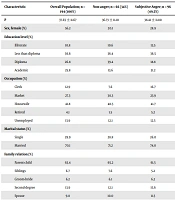
Demographics and other data are given in Table 2. As it turns out, at baseline, among the three groups of no anger, subjective anger, and verbal aggression in terms of education and all indices of satisfaction a significant difference is found. In terms of physical comfort and physician care, those with subjective anger had the least satisfaction, but in terms of nursing care, staff behavioral components and the waiting time for admission and hospitalization the min satisfaction was seen in patients with verbal aggression.
Table 2.
Baseline Characteristics in the Entourages Predicting Types of Anger
| Characteristic | Overall Population; n = 194 (100%) | Non-anger; n = 66 (34%) | Subjective Anger; n = 96 (49.5%) | Verbal Aggression; n = 32 (16.5%) | P-Value a,b |
|---|---|---|---|---|---|
| P | 37.65 ± 11.67 | 36.73 ± 11.10 | 38.41 ± 11.80 | 37.28 ± 12.62 | 0.657 |
| Sex, female (%) | 56.2 | 20.1 | 28.9 | 7.2 | 0.299 |
| Education level (%) | 0.025 c | ||||
| Illiterate | 10.8 | 10.6 | 13.5 | 3.1 | |
| Less than diploma | 36.6 | 36.4 | 36.5 | 37.5 | |
| Diploma | 26.8 | 39.4 | 18.8 | 25.0 | |
| Academic | 25.8 | 13.6 | 31.2 | 34.4 | |
| Occupation (%) | 0.350 | ||||
| Clerk | 12.9 | 7.6 | 16.7 | 12.5 | |
| Market | 27.3 | 30.3 | 23.9 | 31.3 | |
| Housewife | 41.8 | 48.5 | 41.7 | 28.1 | |
| Retired | 4.1 | 1.5 | 5.2 | 6.2 | |
| Unemployed | 13.9 | 12.1 | 12.5 | 21.9 | |
| Marital status (%) | 0.161 | ||||
| Single | 29.9 | 28.8 | 26.0 | 43.8 | |
| Married | 70.1 | 71.2 | 74.0 | 56.2 | |
| Family relation (%) | 0.982 | ||||
| Parent-child | 63.4 | 65.2 | 61.5 | 65.6 | |
| Siblings | 6.7 | 7.6 | 5.2 | 9.5 | |
| Groom-bride | 6.2 | 6.1 | 6.2 | 6.2 | |
| Second-degree | 13.9 | 12.1 | 15.6 | 12.5 | |
| Spouse | 9.8 | 10.0 | 11.5 | 6.2 | |
| Psychiatry history (%) | 2.6 | 3.0 | 1.0 | 6.3 | 0.263 |
| FAUCS d | 4.16 ± 4.74 | 4.15 ± 5.89 | 3.88 ± 3.72 | 5.03 ± 4.86 | 0.492 |
| 12-hour care frequency | |||||
| Daily care | 3.07 ± 4.22 | 3.30 ± 6.37 | 2.75 ± 1.67 | 3.56 ± 4.07 | 0.555 |
| Night care | 1.64 ± 2.28 | 1.38 ± 1.66 | 1.66 ± 1.58 | 2.12 ± 4.29 | 0.314 |
| Satisfaction scale | |||||
| Physical comfort | 39.59 ± 7.87 | 43.23 ± 7.40 | 37.14 ± 6.38 | 39.41 ± 9.93 | 0.0005 c |
| Physician care | 30.30 ± 5.31 | 31.65 ± 5.07 | 29.06 ± 4.86 | 31.25 ± 6.28 | 0.005 c |
| Nursing care | 28.07 ± 6.05 | 30.35 ± 5.18 | 26.97 ± 5.73 | 26.69 ± 7.35 | 0.001 c |
| Behavioral components | 15.57 ± 3.40 | 16.30 ± 3.16 | 15.87 ± 3.03 | 13.16 ± 3.94 | 0.0005 c |
| Waiting time | 19.83 ± 4.68 | 21.54 ± 4.68 | 19.23 ± 3.81 | 18.09 ± 5.93 | 0.0005 c |
a Chi-square test performed for nominal and categorical variables.
bt-test performed for continuous variables.
c Statistically significant difference.
d From admission until the completion of scale.
4.3. Subjective Anger
After adjustment for disability intensity, stroke type, family relation type, and duration from admission until the completion of the scale, Table 3 displays the adjusted odds ratio, 95% confidence interval, and P-value for each covariate included in the multinomial logistic regression model. Three variables were found to be independently associated with subjective anger. The results of this table show that people with a diploma education and siblings to the patient than their spouse have less likely to develop of subjective anger. In addition, subjective anger is significantly higher in people with lower satisfaction from the hospital's physical comfort.
4.4. Verbal Aggression
Table 3 also displays the adjusted odds ratio, 95% confidence interval, and P-value for each covariate. Again, three variables were found to be independently associated with verbal aggression. The results of the table show that illiterate entourages and people with a diploma education have less likely to develop of verbal aggression. In addition, verbal aggression is significantly higher in people with lower satisfaction from the personnel behavioral components. Finally, the results show that people with higher satisfaction from physician care are more vulnerable to verbal aggression.
Table 3.
Predictors of Subjective Anger and Verbal Aggression in the Entourages a
| Characteristic | Subjective Anger (%) | Adjusted OR | P-Value | Verbal Aggression (%) | Adjusted OR | P-Value |
|---|---|---|---|---|---|---|
| Age (y) | - | 0.99 (0.93 - 1.04) | 0.636 | - | 1.04 (0.97 - 1.12) | 0.276 |
| Sex, female (%) | 51.4 | 0.83 (0.18 - 3.74) | 0.803 | 12.8 | 0.83 (0.13 - 5.27) | 0.845 |
| Education level (%) | ||||||
| Illiterate | 62.0 | 0.44 (0.06 - 3.15) | 0.411 | 4.8 | 0.02 (0.00 - 0.99) | 0.049 b |
| Less than diploma | 49.3 | 0.28 (0.06 - 1.29) | 0.102 | 16.9 | 0.32 (0.04 - 2.25) | 0.250 |
| Diploma | 34.6 | 0.07 (0.02 - 0.35) | 0.001* | 15.4 | 0.09 (0.01 - 0.65) | 0.017 b |
| Academic | 60.0 | Referent | 22.0 | Referent | ||
| Occupation (%) | ||||||
| Clerk | 64.0 | 2.83 (0.33 - 24.13) | 0.342 | 16.0 | 0.76 (0.05 - 10.75) | 0.842 |
| Market | 43.4 | 0.76 (0.14 - 4.18) | 0.747 | 18.9 | 0.66 (0.09 - 4.96) | 0.685 |
| Housewife | 49.4 | 1.16 (0.15 - 8.99) | 0.888 | 11.1 | 0.32 (0.02 - 4.41) | 0.395 |
| Retired | 62.5 | 3.27 (0.11 - 99.76) | 0.497 | 25.0 | 0.75 (0.01 - 46.88) | 0.890 |
| Unemployed | 44.5 | Referent | 25.9 | Referent | ||
| Marital status (%) | ||||||
| Single | 43.1 | 0.45 (0.12 - 1.62) | 0.219 | 24.1 | 1.21 (0.26 - 5.71) | 0.814 |
| Married | 52.2 | Referent | 13.2 | Referent | ||
| Family relation (%) | ||||||
| Parent-child | 48.0 | 0.22 (0.04 - 1.25) | 0.088 | 17.1 | 0.21 (0.01 - 6.46) | 0.371 |
| Siblings | 38.5 | 0.02 (0.00 - 0.68) | 0.029 b | 23.1 | 0.04 (0.00 - 4.35) | 0.179 |
| Groom-bride | 50.0 | 0.05 (0.00 - 2.24) | 0.125 | 16.7 | 0.35 (0.00 - 54.35) | 0.685 |
| Second-degree | 55.6 | 0.21 (0.01 - 3.78) | 0.290 | 14.8 | 0.24 (0.00 - 18.66) | 0.520 |
| Spouse | 57.9 | Referent | 10.5 | Referent | ||
| Psychiatry history (%) | 20.0 | 1.00 (0.05 - 21.82) | 0.999 | 40.0 | 0.16 (0.01 - 2.72) | 0.205 |
| FAUCS c | - | 0.84 (0.67 - 1.07) | 0.156 | - | 0.77 (0.58 - 1.02) | 0.065 |
| 12-hour care frequency | ||||||
| Daily care frequency | - | 1.17 (0.82 - 1.66) | 0.396 | - | 1.34 (0.92 - 1.95) | 0.128 |
| Night care frequency | - | 1.17 (0.81 - 1.71) | 0.404 | - | 1.26 (0.85 - 1.87) | 0.257 |
| Satisfaction scale | ||||||
| Physical comfort | - | 0.85 (0.78 - 0.93) | 0.0005 b | - | 0.92 (0.84 - 1.02) | 0.121 |
| Physician care | - | 1.05 (0.93 - 1.19) | 0.431 | - | 1.26 (1.08 - 1.46) | 0.004 b |
| Nursing care | - | 0.95 (0.85 - 1.08) | 0.450 | - | 0.91 (0.78 - 1.05) | 0.184 |
| Behavioral components | - | 1.06 (0.88 - 1.28) | 0.544 | - | 0.78 (0.64 - 0.96) | 0.019 b |
| Waiting time | - | 0.96 (0.85 - 1.07) | 0.462 | - | 0.88 (0.76 - 1.02) | 0.081 |
a The characteristics listed in this table were all included as covariates in generating the multinomial logistic regression model.
b Statistically significant odds ratio.
c From admission until the completion of scale.
5. Discussion
The high rate of subjective anger and verbal aggression that was obtained in our study is consistent with the results of different studies around the world (5-14). While previous studies have focused more on the role of lack of security facilities, perceived delay in the delivery of services, (12) and dissatisfaction with the units, (14) burden, anxiety, and depression, (20, 21) our results showed that entourages with academic education, patients' spouses, and those with less satisfaction from aspects of hospital stay and physical comfort are more susceptible to subjective anger. In addition, those with academic education, those who are less satisfied with staff behaviors, and those who are more satisfied with physician care are likely to show verbal aggression.
Why entourages with academic education compared to groups with less education are more prone to subjective anger and verbal aggression? The results of a study suggest that increased education is associated with lower satisfaction with health care (25). Since by increasing educational level, generally, the perception and expectation of the quantity and quality of health care services are increased, in such cases, medical personnel should show more empathy and respect for patients and their entourages (26).
Other findings indicated that patients' spouses compared with their siblings are more susceptible to subjective anger. It is quite plausible that a debilitating disease and its treatment not only affect the patient but also his family care, especially when the spouse is the patient (27). With the spouses' satisfaction increased after 1 to 2 years of stroke, (28) usually patients' spouses have no positive assessment of the patient care experience and their perception due to the pressure related to the patient treatment trend causes assuming the lower quality of life (29). Changes in income resulting from treatment because of hospitalization or care and increased costs because of treatment trends, health status, stress and perceived threat, and physical changes associated with the emergence of diseases of aging also influence the spouse negative evaluation (29). On the other hand, in fatal and acute diseases such as stroke, regardless of a couple's relationship intimacy the disease intensity reduced the spouse's emotional well-being (30). In this situation, things like delivering psychological services for the patient's spouse by the hospital staff, providing clear information about the patient's future conditions and outcomes, providing subsidies to reduce the financial burden on the family, and teaching stress coping strategies can be useful. To older spouses, better quality welfare services by the hospital and family and social support are also helpful.
In line with the results of several studies (11, 12, 14, 31) it was found that those with lower satisfaction with aspects of hospital stay and physical comfort, are more susceptible to subjective anger and those who are less satisfied with staff behaviors show more verbal aggression. According to previous studies, less satisfaction with the lack of facilities and aspects of hospital stay and physical comfort affects 34.4% of verbal aggression (32) and less satisfaction with the behaviors of staff is the reason for 11.5% of aggression (31). Obviously physiological needs are the first necessities that if they are not met cause a reaction. In our study hospital, despite appropriate diagnosis and treatment facilities, entourages other than a chair had no bed to lie and rest. If they are present in the hospital for several days and nights in the hospital, fatigue and lack of sleep can be enough to facilitate subjective anger. In addition, entourages receive no food and it is necessary to go to the hospital restaurant for food and in addition to the direct cost paid for the food they leave the patient for a few minutes alone, this problem often causes their complaint.
Finally, our results showed those who are more satisfied with physician care are more exposed to verbal aggression. Overall, participants were more satisfied with physician's care than nurses. It seems when physicians show more empathy and respect for entourages, the patients perceive more empathy and respect of them, (26) their expectations of other staff will be increased but in practice, they see no changes in interaction with them. Given that some of the participants in our study pointed out that “non-physician staff” is not like physicians, do not do their tasks correctly and do not consider our needs it seems an increase in satisfaction with physician care due to rising expectations of other medical staff to provide better services is one of the causes of verbal aggression incidence.
Although some patients had several entourages we only examined one of them who was beside the patient at the time. Also, because our time of completing the scales was between 8 am to 8 pm, we could not examine those who only attended on the night shift at the hospital for patient care. Therefore, it is recommended that future studies examine all entourages on the day and night shifts.
5.1. Conclusions
Subjective anger and verbal aggression are common among the entourages of hospitalized stroke patients. Some demographic factors and hospital satisfaction are predictors of anger and aggression. Likely paying more attention to the high-risk entourages and providing necessary training in the field of appropriate behaviors with entourages by the medical staff can reduce tension and aggression in stroke patients' entourages. This training can be delivered by a structured psychology team. Medical and social workers of the rehabilitation team can also support the patient's caregivers until the patient is discharged.