1. Background
Cancer is one of the common chronic and non-communicable diseases (1). Researchers consider cancer as a major health problem of the century. The increasing growth of cancer in the last few decades and its harmful effects on all physical, emotional, spiritual, social and economic aspects of humans are among the factors that have drawn the attention of experts more than before (2). According to the statistics of the World Health Organization, cancer is the second cause of death in the world after heart diseases and if its prevalence increases in the same way, according to the United Nations estimate, one out of every five people will definitely suffer from one of these diseases. Forms of cancer are affected (3). Among the types of cancer, breast cancer has a very high prevalence. According to the statistics of the American National Cancer Institute, one out of every eight women will get this disease at least once in their lifetime (4). In Iran, this disease has a high prevalence rate. Totally, cancer, in Iran is the third leading cause of death after heart diseases and road accidents (5).
Although the life expectancy of many cancer patients has increased due to the increasing progress of medical science today, however, since this disease is still the cause of a high percentage of deaths, it is always accompanied by fears, stress and reduced adaptation (6). This disease has always been associated with ambiguity and difficult and long treatments, which can severely affect the beliefs and coping ability of patients. The most important cancer treatments today are: Surgery, chemotherapy, anti-neoplasmic drugs, radiation therapy and hormone therapy, each of which can affect the psychological adaptation of patients (7). Another characteristic of cancer is the time of initial diagnosis and acceptance of the disease by the patient and the pain caused by cancer, psychological stress and the behavior of caregivers, which affects the life of cancer patients (8). The psychological effects caused by the diagnosis of cancer and the physical effects caused by its treatments are accompanied by many side effects that have a negative effect on a person’s quality of life (9). This disease affects social interactions both in the family dimension and in the occupational dimension. Patients are afraid of discrimination and hide their illness and withdraw from society. In terms of employment, they may change jobs or be temporarily laid off or not receive a promotion, which has a great impact on their economic status, and their low economic status leads to more anxiety (8-10).
Although cancer affects mental health, it seems that the biggest issue for the patient at this time is hopelessness (11). In fact, one of the main causes of diseases, mental problems, and physical and social complications is the sense of emptiness, futility, and mental instability that originates from the lack of the spiritual dimension of people. Therefore, when spiritual health is seriously compromised, a person suffers from mental disorders such as loneliness, depression, and loss of meaning in life (12). Today, there are various methods for treating psychological disorders, one of the newest of which is spiritual therapy (a form of existential therapy), which can not only be effective in reducing disorders, but can also provide objective and effective solutions to improve the quality of life. Through influencing existential concerns, such as one’s search for meaning in life and hope, spiritual and religious beliefs and practices play a role in the coordinated promotion of adjustment to cancer (13). Overall, health resources are increasingly highlighting spirituality and its importance in health and illness (14).
In the last fifty years, most of the efforts of psychologists have been focused on the treatment of deficiencies and the elimination of disabilities. But positive psychology emphasizes on increasing happiness and health and scientific study on the role of personal strengths and positive social systems in promoting optimal health. Positive psychology scientifically identifies factors that can increase health (15, 16). According to Bai et al.’s research having meaning in life positively moderates the negative impact of cancer on the psychological well-being of affected patients (17). Other researches have also shown a positive relationship between aspects of spirituality and well-being among patients with different types of cancer (18-23). Hope or optimism also, according to many researches such as Cherry et al.’s, Chang et al.’s, Schiavon et al.’s, Fischer et al.’s, and Kardas et al.’s (24-28) predicts physical and mental health as determined by a variety of indicators, including self-reported health, positive response to medical interventions, mental health, positive mood, safe cognitive strength, effective coping, and health-promoting behavior.
2. Objectives
We intended to use the contents and topics of existential psychotherapy and the successful experiences of Dr. Ervin Yalom, who used the tool of story therapy in an artistic way in treatment, to investigate the effect of story therapy approach in a group method on depression, anxiety, stress and life expectancy of women with cancer undergoing chemotherapy.
3. Methods
The current research was an experimental study based on a pre-test and post-test design with a control group (pre-test-post-test randomized control group design). The statistical population in this research is women with cancer undergoing chemotherapy referred to one of the private clinics in Karaj city, in Iran. The inclusion criteria were: Having a minimum education level of reading and writing literacy; being at least 30 to 65 years old; not having diagnostic criteria for obvious psychiatric disorders such as (psychosis, major depression, obsessive-compulsive disorder, and personality disorders) and not having any other physical illness that prevents the person from participating in the research program. The sampling method in this research was random sampling in stages and available sampling in stages as described below. In this way, among the referring patients, after studying the patients’ files and the diagnosis of the specialist doctor, 30 people who had the necessary conditions to participate in the research were randomly assigned to two experimental and control groups after matching. In the experimental group, 12 people continued the treatment and in the control group, 12 people completed the questionnaires. Then all the subjects completed all the research tools in two times. The experimental group participated in 8 sessions of the group therapy, one session of 120 minutes per week. The research tools were Depression-Anxiety-Stress Scale (DASS-21); and Snyder’s Hope Scale (SHS).
The method of execution in all the sessions was that the beginning of each session started with relaxation and mindfulness meditation, which focuses on one’s breathing or a specific topic. Then presented the desired topic in the format of the story was discussed. In the following, the subjects were asked to express the events that happened in their lives and correspond to the topic discussed in the meeting, according to the mentioned topic. This assignment led to the emotional discharge of the therapy seekers and the expression of their feelings and emotions, in a way that led to the progress of the group and caused the active participation of the group members. Then the discussion and training of the desired category was done. In the end, by introducing the topic to be considered in the next session, the subjects were reminded of the tasks that they had to perform in the time interval until the next session. Finally, by emphasizing the use of relaxation throughout the day, the session ends. In the current research, the existential assumptions of Dr. Yalom as one of the contemporary existential psychotherapists were the basis of the research. His original way of using the story has impressed countless enthusiasts. The stories used in this research were selected and presented in the form of short stories and from self-help books and in a selective form that contain the themes of the basic assumptions of existential therapy, according to the physical condition, level of education, and Iranian religious and cultural background of the patients. Also, depending on the topic of the research, the real story of Paula, a cancer patient, from the book “Momma and the meaning of life” (Author: Irvin D. Yalom) and the summary of book “Man’s search for meaning” (Author: Viktor Frankl) search for meaning were also told during therapy sessions. The collected data was entered into SPSS software version 20, and descriptive statistics were used to describe the studied variables, including indicators such as frequency, mean, and standard deviation, and for further analysis, inferential statistics (analysis of variance) were used. The research was carried out with the consent of a specialist doctor and after explaining the research and justifying him in considering ethical and professional principles in psychological research interventions. In the sampling phase, all eligible participants in the research were given the necessary information in the required fields. The cooperation of all members was obtained with full satisfaction. The participants were informed that all information will be considered confidential and they can withdraw from the treatment whenever they want. The hours of the treatment sessions were determined by the agreement of the members.
4. Results
As the results of Table 1 show, among the variables of stress, anxiety and depression, the highest and lowest mean and standard deviation in the pre-test belong to the variables of stress and anxiety, respectively. In the post-test, the highest and lowest mean and standard deviation belong to stress and anxiety variables. The central indicators in the research variables have almost the same value, which can indicate the normality of the data distribution. Also, the results of this table also show that the highest mean and standard deviation in the pre-test belong to the stress variable and in the post-test to the anxiety variable. The least mean and standard deviation in the pre-test and post-test belong to the variable of anxiety. The central indices in the research variables are almost the same, which indicates the normality of the data distribution.
Table 1.
Summary of the Descriptive Findings of the Variables of the Experimental Group (n = 10) and the Control Group (n = 10)
| Variables | Pre-test | Post-test | ||||||
|---|---|---|---|---|---|---|---|---|
| Mean | Median | Mode | Standard Deviation | Mean | Median | Mode | Standard Deviation | |
| Experimental | ||||||||
| Stress | 19.8 | 21 | 21 | 8.4 | 14.9 | 15 | 15 | 6.9 |
| Anxiety | 11.2 | 9 | 10 | 7.1 | 8 | 8 | 8 | 5.2 |
| Depression | 14 | 14 | 14 | 6.6 | 11 | 11 | 11 | 6.6 |
| Life expectancy | 59 | 59 | 59 | 2.9 | 62 | 61 | 62 | 1.5 |
| Control | ||||||||
| Stress | 16 | 16 | 16 | 10.9 | 18 | 17 | 17 | 8.5 |
| Anxiety | 12 | 13 | 13 | 7.5 | 13 | 13 | 13 | 6.9 |
| Depression | 15 | 15 | 15 | 8.9 | 15 | 13 | 13 | 7.5 |
| Life expectancy | 58 | 58 | 58 | 3.4 | 57 | 55 | 55 | 5.9 |
Before performing the one-way analysis of covariance test, the presuppositions of the test were first examined. The results are presented in Table 2. The results of this table show that the assumption of equality of variances and the same slope of the regression line is accepted for all variables. Therefore, one-way covariance analysis can be used to examine the data.
Table 2.
Examining the Presuppositions of the Analysis of Variance Test
| Variables | Equality of Variances | Same Slope of the Regression Line | ||
|---|---|---|---|---|
| F | P Value | F | P Value | |
| Stress | 0.32 | 0.57 | 0.01 | 0.99 |
| Anxiety | 2.06 | 0.168 | 1.3 | 0.08 |
| Depression | 1.7 | 0.20 | 0.26 | 0.61 |
| Life expectancy | 4.2 | 0.08 | 1.8 | 0.076 |
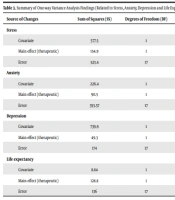
As the results of Table 3 show about the stress variable, the calculated F value (5.03) is significant at the 0.05 level. In other words, the results showed that by removing the effect of pre-test stress scores as a covariate, the effect of post-test stress scores has a significant effect. The ETA coefficient shows that the strength of the relationship between treatment and stress reduction is 0.23. Also, the results of this table about the anxiety variable show that the calculated F value (4.32) is significant at the 0.05 level. In other words, the results show that by removing the effect of pre-test anxiety scores as a covariate variable, the main effect of treatment has a significant effect on post-test anxiety scores. Also, the results of Table 3 regarding the depression variable show that the calculated F value (4.5) is significant at the 0.05 level. In other words, the results show that by removing the effect of pre-test depression scores as a covariate, the main effect of treatment has a significant effect on post-test depression scores. The ETA coefficient shows that the strength of the relationship of treatment in reducing depression is 0.21. Finally, the results of this table about the life expectancy variable show that the calculated ratio (16.09) is significant at the 0.05 level. In other words, the results show that by removing the effect of pre-test life expectancy scores as a covariate variable, the main effect of treatment has a significant effect on post-test life expectancy scores. The ETA coefficient shows that the strength of the relationship of treatment in increasing life expectancy is 0.49.
Table 3.
Summary of One-way Variance Analysis Findings (Related to Stress, Anxiety, Depression and Life Expectancy)
| Source of Changes | Sum of Squares (SS) | Degrees of Freedom (DF) | Mean Squares | F | P Value | Eta-Squared |
|---|---|---|---|---|---|---|
| Stress | 5.03 | 0.05 | 0.23 | |||
| Covariate | 577.5 | 1 | 577.5 | |||
| Main effect (therapeutic) | 154.9 | 1 | 154.9 | |||
| Error | 523.4 | 17 | 30.79 | |||
| Anxiety | 4.32 | 0.05 | 0.17 | |||
| Covariate | 226.4 | 1 | 226.4 | |||
| Main effect (therapeutic) | 90.5 | 1 | 90.5 | |||
| Error | 355.57 | 17 | 250.91 | |||
| Depression | 4.5 | 0.04 | 0.21 | |||
| Covariate | 739.9 | 1 | 739.9 | |||
| Main effect (therapeutic) | 49.3 | 1 | 49.3 | |||
| Error | 174 | 17 | 10.2 | |||
| Life expectancy | 16.09 | 0.01 | 0.49 | |||
| Covariate | 8.84 | 1 | 8.84 | |||
| Main effect (therapeutic) | 128.8 | 1 | 128.8 | |||
| Error | 136 | 17 | 136 |
5. Discussion
The results showed that there was a significant difference between the depression scores of the experimental and control groups. In this sense, group existential psychotherapy in the Yalom style, using the story therapy approach, has reduced the level of depression in women with cancer undergoing chemotherapy. There is evidence that states that spirituality (as one of the examples of existential therapy) can protect the patient from depression and facilitate the recovery process. This finding of the present research is in line with the findings of researches of Bolhari et al. (29), Saeidi et al. (30), Bahmani et al. (31), Yunitasari et al. (32) and Pedram et al. (33). The research of Bolhari et al. showed that group spiritual therapy was effective at a significant level in reducing depression in women with breast cancer (29). Findings of Saeidi et al. indicate the effectiveness of group-positive psychotherapy on depression, subclinical cancer chemotherapy (30). Also, the findings of Bahmani et al.’s research indicate that the cognitive-ontological therapy group was more effective than the cognitive therapy based on education and both were more effective than the control group in reducing the level of depression in women with breast cancer (31). The research of Yunitasari et al., showed that spiritual caring can reduce depression level in patients with stage IIIB cervical cancer undergoing chemotherapy (32). The results of Pedram et al.’s research indicated that the cognitive-behavioral therapy group had a positive effect on reducing depression in cancer women (33).
The findings of the present research showed that there is a significant difference between the anxiety scores of the experimental and control groups. This means that group existential psychotherapy in the Yalom style using the story therapy approach has reduced anxiety in women with cancer undergoing chemotherapy. This finding of the present research is in line with the findings of researches of Bolhari et al. (29), Saeidi et al. (30), Yunitasari et al. (32), Pedram et al. (33), Sleight et al. (34), Nasution et al. (35), Basharpoor et al. (36). The research of Bolhari et al. showed that group spiritual therapy was effective at a significant level in reducing anxiety in women with breast cancer (29). Findings of Saeidi et al. indicate the effectiveness of group-positive psychotherapy on anxiety, subclinical cancer chemotherapy (30). Also, the research of Yunitasari et al., showed that spiritual caring can reduce anxiety level in patients with stage IIIB cervical cancer undergoing chemotherapy (32). The results of Pedram et al.’s research indicated that the cognitive-behavioral therapy group had a positive effect on reducing anxiety in cancer women (33). The research of Sleight et al., showed that spiritual peace and life meaning may buffer the effect of anxiety on physical well-being in newly diagnosed cancer survivors (34). Findings of Nasution et al., indicate the effect of spiritual intervention in overcoming anxiety problems in gynecological cancer patients (35). The findings of Basharpoor et al. show positive group psychotherapy increases self-differentiation and reduces the death anxiety in women with breast cancer (36).
Other results of the present research showed that there is a significant difference between the stress scores of women in the experimental and control groups. This means that Yalom-style existential group psychotherapy using the story therapy approach has reduced the stress of women with cancer undergoing chemotherapy. This finding of the current research is consistent with the results of Bolhari et al. (29), Saeidi et al. (30), Yunitasari et al. (32), Moritz et al. (37), Ghorbani et al. (38). The research of Bolhari et al. showed that group spiritual therapy was effective at a significant level in reducing stress in women with breast cancer (29). Findings of Saeidi et al. indicate the effectiveness of group-positive psychotherapy on stress, subclinical cancer chemotherapy (30). The research of Yunitasari et al., showed that spiritual caring can reduce stress level in patients with stage IIIB cervical cancer undergoing chemotherapy (32). In study of Moritz et al. that was conducted on using an 8-week program of spiritual training and recorded tapes, profile of mood states (POMS) showed improvement in the patients suffering from emotional disturbances (37). Findings of the study of Ghorbani et al., showed that spiritual group therapy had a significant effect on reducing depression, anxiety, and stress in mothers of children with cancer (38).
Other results of the present research indicated that there is a significant difference between the life expectancy scores of women in the experimental and control groups. In this sense, Yalom’s existential group psychotherapy using the story therapy approach has increased the life expectancy of women with cancer undergoing chemotherapy. This finding of the current research is consistent with the researches of Saeidi and Birashk (39), Rostami et al. (40), Afrazandeh et al. (41).
The results of study of Saeidi et al., showed that positivism group psychotherapy was effective in promoting life expectancy and psychological wellbeing of cancer patients (39). In the study of Rostami et al., the results confirm the importance of spiritual intelligence and self-esteem as influential variables on the life expectancy in cancer patients (40). Based on results of Afrazandeh et al., between spiritual health and life expectancy a positive and meaningful relationship was observed (41).
In a doctoral thesis done by Rubin at the University of Johannesburg, about the relationship between hope and coping strategies after the diagnosis of breast cancer on women with this disease, many patients spoke of believing in God and its effect on treatment and experiencing the reality of their disease (42). A research conducted by Ai et al. to investigate and compare the effect of faith-based and non-religious passages on the hope of patients who had an important heart surgery, showed that the factor of faith plays a major role in the agent component of hope (43). The results of a spiritual intervention conducted by Fallah et al. as a group psychotherapy method in breast cancer patients showed that spiritual intervention can increase the quality of life of these groups (44). The results of the study conducted by Al-Atiyyat and Naga, support the encouragement of women with breast cancer to seek spirituality as an effective resource in dealing with physical and psychological responses to cancer (45). Researchers are of the opinion that the integration of spirituality in life can have an effect on the agent of hope in two ways: On the one hand, reaching the resources of spirituality can directly serve as the main and major supplier of energy aimed at the goal of action. and on the other hand, in a more indirect way, it can equip a person with some psychological strengths (such as happiness, optimism, etc.) through a positive influence on the way of interpreting events, which provides energy and motivation to achieve goals (45). Breitbart et al., found that cancer patients who reported higher levels of meaning in life were more able to tolerate the physical symptoms of their illness than patients who scored lower in meaning in life and peace (46). Also, despite pain and fatigue, these patients reported more satisfaction with their quality of life (46). Due to the small size of the sample, caution is necessary in generalizing the results.
5.1. Conclusions
The obtained results indicate that group psychotherapy using the story therapy approach has been significantly effective in reducing depression, anxiety and stress and increasing the life expectancy of women with cancer undergoing chemotherapy. Therefore, on this basis, the researchers present these items as suggestions: Designing a group therapy model based on the principles of existential psychotherapy with a story therapy approach in patients with cancer and other incurable diseases; compilation of a training package and manual for the implementation of this method; experimental implementation of group therapy using the principles of existential psychotherapy and benefiting from the story therapy approach in cancer patients undergoing chemotherapy and presenting the feasibility and effectiveness of this method and proposing materials regarding its promotion in this group of cancer patients and other patients.