
1. Background
Liposuction is one of the most popular cosmetic surgery procedures globally, accounting for 15% to 20% of all cosmetic surgeries according to worldwide statistics (1-3). Liposuction is used to reduce localized fat tissue in specific areas of the body, and can be performed using various methods, such as laser-assisted liposuction (also known as laser lipolysis) (4) and ultrasound-assisted liposuction (1, 5).
While liposuction offers significant aesthetic benefits, it is also associated with various complications, including necrotizing fasciitis, toxic shock syndrome, hemorrhage, pulmonary embolism (6), skin irregularities, prolonged edema, ecchymosis, hyperpigmentation, changes in skin sensitivity, seromas, hematomas, ulcers, skin necrosis, visceral perforations, systemic infections, fat embolism, sepsis, and potentially fatal outcomes (7). However, some studies have reported a reduction in complications when using the laser lipolysis technique (8). In addition to improved skin tightening and enhanced results, laser lipolysis has shown a reduction in blood loss and a shorter post-operative recovery time (9).
Despite the widespread use of laser lipolysis, there are limited studies exploring complications related to this technique, including changes in pre- and post-operative blood parameters.
2. Objectives
In the present study, we investigated blood indices such as hemoglobin level, WBC count, and platelet levels before and after laser lipolysis surgery.
3. Methods
This retrospective study was conducted at the Isfahan Clinical Center's Najaf Abad branch, including 100 patients who underwent laser lipolysis surgery between March 2015 and February 2018 (response 1.4). Patients with preexisting hematological disorders were excluded from the study. The study protocol was approved by the ethics committee at the Islamic Azad University of Isfahan.
3.1. Data Collection and Measurement
We collected demographic and clinical data, including gender, age, preoperative BMI, smoking status, amount of fat extracted, surgery location, and patient history (including prior surgeries and certain diseases). Blood parameters [hemoglobin, white blood cell (WBC) count, and platelet levels] were measured one week before the operation and 24 hours postoperatively.
3.2. Surgical Technique
Laser lipolysis was performed using a 1064 nm Nd laser with a maximum power of 10 W (Smartlipo-Laser; DEKA M.E.L.A. SRL, Firenze, Italy). The laser was operated at a pulse energy range of 800 to 4500 J, following the protocols established by Goldman (10) and Kim (11). The laser was delivered through a 1 mm diameter stainless steel microcannula. After the laser-induced cell lysate was generated, it was removed via negative pressure (0.8 - 0.9 kPa) using 4 - 5 mm cannulas. All patients received tumescent local anesthesia (12) as the sole anesthesia method.
3.3. Post-operative Patient Care
Patients were instructed to wear a compression garment for one month post-surgery. They received three doses of intravenous antibiotics (one dose every 12 hours), starting at the onset of surgery. Additionally, analgesics and anti-edema medications were prescribed for the first week after surgery.
3.4. Statistical Analysis
Quantitative variables were represented by mean and standard deviation, while qualitative variables were shown using frequency and percentage. A paired, two-sided Student's t-test was employed for statistical analysis, with a mixed linear regression model used to compare pre-operative and post-operative means, adjusting for confounding variables. Data analysis was performed using SPSS 20 software, with a significance level of P < 0.05 (response.3.2).
4. Results
4.1. Patients' Information
A total of 119 participants were included in this study, of whom 5 were men and 114 were women. The mean age of the participants was 35.71 ± 8.92 years, and the pre-operative BMI was 28.81 ± 5.41. Among the participants, 10% were smokers. Details of the baseline information are shown in Table 1.
Table 1.
Basic Descriptive Information of Patients a
| Characteristic | Values |
|---|---|
| Gender | |
| Female | 114 (95.8) |
| Male | 5 (4.2) |
| Smoking | 10 (8.7) |
| Age (y) | 35.71 ± 8.92 |
| BMI | 28.81 ± 5.41 |
a Values are expressed as No. (%) or mean ± SD.
4.2. Pre-operation and Post-operation Hemoglobin (HG), WBC, and Platelet (PLT) Alterations
We measured blood parameters before and after the laser lipolysis surgical intervention (Table 2). The pre-operative hemoglobin level was 12.59, which significantly decreased to 10.08 post-operatively, reflecting a 16.9% reduction (P < 0.001). Similarly, platelet counts decreased by 7.9%, with pre-operative and post-operative means of 275.04 and 250.23, respectively.
Table 2.
| Variables | Pre-operation | Post-operation | Change (%) | P-Value a | Adjusted P-Value b | |
|---|---|---|---|---|---|---|
| HG c | 12.59 ±1.63 | 10.08 ± 1.81 | 2.51 ± 1.97 | 16.9 ± 38.1 | < 0.001 | < 0.001 |
| WBC | 7,665.79 ± 2,008.65 | 14,885.09 ± 4,396.46 | 7,219.30 ± 3,936.80 | 100.5 ± 56.0 | < 0.001 | < 0.001 |
| PLT | 275.04 ± 67.06 | 250.23 ± 71.42 | 24.81 ± 55.89 | 7.9 ± 20.3 | < 0.001 | 0.068 |
a Based on paired t-test.
b Based on adjusted mixed regression model for BMI, sex, smoking, and age.
c Mean ± SD.
However, after adjusting for variables such as age, sex, BMI, and smoking, this alteration was not statistically significant (P = 0.068). In contrast, WBC counts showed a significant increase. The mean WBC count pre-operatively was 7,665.79, which rose to 14,885.09 post-operatively (P < 0.001).
4.3. Subgroup Analysis of Pre-operation and Post-operation Hemoglobin Level Changes
Table 3 presents summary data from subgroup analyses based on menstruation status, BMI, and smoking. No statistically significant differences were observed in HG changes based on menstruation status or BMI categories (P > 0.05). Smokers had a higher pre-operative HG level compared to non-smokers (13.38 vs. 12.64), but post-operatively, smokers had a lower HG level (11.54 vs. 12.64), though this difference was not statistically significant (P = 0.353). Therefore, patient characteristics did not significantly influence HG levels following surgery.
Table 3.
Subgroup Analysis of Hemoglobin Changes
| Variables | N | Hemoglobin | Difference | P-Value a | |
|---|---|---|---|---|---|
| Pre-operation | Post-operation | ||||
| Menstruation | 0.847 | ||||
| Yes | 11 | 12.97 ± 1.53 | 10.42 ± 2.23 | 2.55 ± 2.06 | |
| No | 100 | 12.45 ± 1.53 | 9.96 ± 1.65 | 2.48 ± 2.03 | |
| BMI | 0.526 | ||||
| < 30 | 35 | 12.76 ± 1.51 | 10.00 ± 2.05 | 2.76 ± 2.41 | |
| ≥ 30 | 76 | 12.52 ± 1.67 | 10.10 ± 1.43 | 2.41 ± 1.82 | |
| Smoking | 0.353 | ||||
| Yes | 10 | 13.38 ± 2.27 | 11.54 ± 1.93 | 2.03 ± 0.95 | |
| No | 105 | 12.64 ± 1.17 | 12.64 ± 1.76 | 2.62 ± 1.79 | |
a Based on mixed model linear regression.
4.4. Variation in Hemoglobin Decline Rates Based on Surgical Site
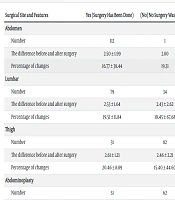
Table 4 shows HG level changes based on different surgical sites. No significant differences were observed in HG levels across surgical locations (P > 0.05). The maximum HG level reductions were observed in the buttocks, breast, and legs, with reductions of 36%, 25%, and 23%, respectively. The arm showed the smallest HG change, with a 0.49% reduction.
Table 4.
| Surgical Site and Features | Yes (Surgery Has Been Done) | (No) No Surgery Was Done | P-Value b |
|---|---|---|---|
| Abdomen | - | ||
| Number | 112 | 1 | - |
| The difference before and after surgery | 2.50 ± 1.99 | 2.80 | NA c |
| Percentage of changes | 16.77 ± 38.44 | 19.31 | NA c |
| Lumbar | - | ||
| Number | 79 | 34 | - |
| The difference before and after surgery | 2.53 ± 1.64 | 2.43 ± 2.62 | 0.849 |
| Percentage of changes | 19.51 ± 11.84 | 10.45 ± 67.68 | 0.848 |
| Thigh | - | ||
| Number | 31 | 82 | - |
| The difference before and after surgery | 2.61 ± 1.21 | 2.46 ± 2.21 | 0.123 |
| Percentage of changes | 20.46 ± 8.89 | 15.40 ± 44.60 | 0.182 |
| Abdominoplasty | - | ||
| Number | 51 | 62 | - |
| The difference before and after surgery | 2.24 ± 1.02 | 2.71 ± 2.50 | 0.476 |
| Percentage of changes | 17.73 ± 8.23 | 16.02 ± 51.31 | 0.363 |
| Flunk | - | ||
| Number | 39 | 74 | - |
| The difference before and after surgery | 2.47 ± 2.45 | 2.51 ± 1.70 | 0.811 |
| Percentage of changes | 11.57 ± 63.08 | 19.54 ± 12.41 | 0.818 |
| Arm | - | ||
| Number | 24 | 89 | - |
| The difference before and after surgery | 1.70 ± 2.32 | 2.71 ± 1.83 | 0.102 |
| Percentage of changes | 0.49 ± 77.66 | 21.18 ± 14.00 | 0.106 |
| Breast | - | ||
| Number | 1 | 112 | - |
| The difference before and after surgery | 3.4 | 2.49 ± 1.99 | NA c |
| Percentage of changes | 25.37 | 16.71 ± 38.44 | NA c |
| Crus | - | ||
| Number | 2 | 111 | - |
| The difference before and after surgery | 3.05 ± 2.33 | 2.49 ± 1.98 | 0.79 |
| Percentage of changes | 23.84 ± 16.64 | 16.66 ± 38.57 | 0.802 |
| Buttock | - | ||
| Number | 1 | 112 | - |
| The difference before and after surgery | 3.80 | 2.49 ± 1.98 | NA c |
| Percentage of changes | 36.19 | 16.62 ± 38.40 | NA c |
a Values are expressed as mean ± SD.
b Mann-Whitney test.
c NA, Unavailable due to sample size < 2 in each group.
5. Discussion
This study investigated the changes in CBC parameters, including HG, WBC, and PLT levels, and identified significant pre- and post-operative associations. Our findings contribute to the understanding of complications related to the laser lipolysis procedure. In this study, 95.8% of participants were female, with 9.9% in their menstrual period and 8.7% being smokers. The mean age and BMI were 35.71 and 28.81, respectively. Hemoglobin levels decreased from a pre-operative mean of 12.59 ± 1.63 to 10.08 ± 1.81, representing a 16.9% reduction. Similarly, PLT levels decreased by 7.9%, while WBC counts increased by 100.5%.
In our study, the adjustment of variables (age, sex, BMI, and smoking) influenced PLT levels but did not affect HG levels across different surgical sites. These findings align with previous studies. Campos et al. (13) reported a decrease in HG with an average reduction of 3.1 g/dL, alongside a 44.87 g/dL reduction in iron levels, noting that blood loss is a significant complication of liposuction techniques (14). Therefore, identifying a safe and effective technique is crucial. Abdelaal and Aboelatta (15) compared blood loss between traditional and laser-assisted liposuction, finding a 54% reduction in blood loss with laser-assisted liposuction, particularly in areas like gynecomastia, the back, limbs, and abdomen. However, our study did not demonstrate significant differences in HG reduction across different surgical sites. Peterson et al. (16) also reported a reduction in HG, hematocrit, and erythrocyte levels, alongside a significant increase in WBC counts following laser lipolysis, with pre-operative WBC counts increasing from 6.64 to 14.92 thousand per microliter.
5.1. Limitations
Our study faced several limitations. First, the research could not be conducted in multiple hospitals for result comparisons. A larger, multicenter study is necessary for more comprehensive conclusions. Additionally, challenges in collaborating with laser manufacturers, due to potential financial implications, may have impacted the study. Future research should focus on multicenter, long-term studies with larger sample sizes, comparisons between centers, and results from interventions using various laser types.
5.2. Conclusions
In conclusion, this study measured blood parameters before and after laser lipolysis surgery. A key finding was the significant decrease in HG levels post-surgery, likely due to intraoperative bleeding. While this method may be safer than traditional liposuction, further research is necessary to compare HG level changes using different laser types in laser lipolysis procedures.