


1. Background
Bodybuilding is a widely embraced physical activity, pursued by individuals for health enhancement (53.5%) and fitness improvement (46.5%) (1-3). While some incorporate bodybuilding alongside cardiovascular or flexibility exercises for overall well-being, others engage in it as their primary training or competitive focus (4, 5). Numerous studies highlight the physical and psychological benefits of bodybuilding, positioning it as a crucial element in programs designed to enhance quality of life and overall health across diverse populations (6, 7). The physical advantages of bodybuilding include increased strength and muscle mass, enhanced bone density, elevated metabolism, improved joint health, and greater muscle flexibility (8, 9). Bodybuilding can also positively impact mood, self-esteem, self-confidence, and body image. However, like other physical activities, both recreational and competitive, participation in strength training carries the risk of sports injuries (1, 10).
Reports indicate a notable prevalence of sports injuries among bodybuilders (2, 11), with studies revealing a 45.1% incidence and an overall injury rate of 0.12 injuries per bodybuilder per year (2). Although injury rates in bodybuilding appear lower compared to other strength sports such as weightlifting and powerlifting (11), common injury sites include the shoulder, back, knee, elbow, and wrist/hand, with strains, tendonitis, and sprains being the most frequent injury types (2, 11). These injuries can result in significant consequences, including medical expenses, absenteeism, reduced productivity, and an increased risk of early osteoarthritis (12, 13). Despite the importance of preventing sports injuries in bodybuilding, there remains a lack of evidence for preventive interventions, possibly due to limited knowledge of the etiology of injuries in this population (10). To address this issue, it is essential to implement strategies aimed at injury prevention (13). Following the injury prevention research model proposed by Van Mechelen et al. (14), understanding the causes or risk factors associated with sports injuries is a critical first step (15).
Recent studies on the psychological factors of sports injuries emphasize the interconnected relationships between biological, psychological, and social/contextual factors (4, 16). The biopsychosocial model suggests that personality traits and resilience can act as predictors of sports injuries (11, 17). Athletes with unfavorable personality traits, low resilience, and insufficient coping resources may be more susceptible to injuries, as they perceive exercise conditions as more stressful (14). While sports injuries were traditionally attributed to biomechanical and physiological risk factors, recent research influenced by the biopsychosocial model has identified psychological and social factors as significant predictors of sports injuries (4, 16). Among these factors, personality traits, resilience, and athlete identity play a role in either increasing or reducing the risk of injuries (17-19). Despite this understanding, there is limited definitive evidence regarding the role of personality traits, resilience, and athletic identity in the occurrence of sports injuries among female bodybuilders.
2. Objectives
The present study aims to explore the relationship between specific psychological factors and performance indicators in female bodybuilders, focusing on personality traits, resilience, and athletic identity in relation to the occurrence of sports injuries.
3. Methods
3.1. Study Design and Participants
This case-control study involved female bodybuilders from Tehran's bodybuilding clubs, selected through purposeful sampling based on specific inclusion and exclusion criteria. G-Power software was used to determine the statistical sample size, with a confidence level of 95%, a test power of 80%, and an effect size (Cohen d) of 0.25, derived from a previous study (11). The calculated sample size required 100 participants, and 110 participants were initially considered to account for a 10% anticipated dropout rate.
Inclusion criteria included age (20 - 60), regular exercise (≥ two weekly bodybuilding sessions), and a minimum of two years of bodybuilding experience. Exclusion criteria involved pregnancy and unwillingness to participate.
Once participants expressed their willingness to take part in the study, written consent was obtained to ensure conscious and voluntary participation.
The following measurements were taken: Height, weight, sports injury history, personality traits, resilience, athletic identity, as well as physical assessments using the Y balance test and functional movement screening. All assessments were conducted by a sports science expert at the Shahada Club of Amir Kabir Sports Complex in Tehran.
3.2. History of Sports Injuries
To accurately document the history of injuries over the past year, the injury registration questionnaire developed by Fuller et al. (13), a reliable and valid tool for injury documentation, was used. In this study, a sports injury is defined as any physical complaint resulting from weight training participation, regardless of the need for medical care or time lost (13). Acute injuries occur suddenly, without a specific event, while overuse injuries develop gradually due to repeated microtraumas, without a singular identifiable event. Injury severity was categorized based on time loss: Very mild (0 days), mild (1 - 7 days), moderate (8 - 28 days), and severe (more than 28 days) (13).
3.3. Resiliency
Resilience was assessed using Connor and Davidson's Resiliency Scale, which consists of 25 items scored on a five-point Likert Scale (0 to 4), with total scores ranging from 0 to 100. Keyhani et al. (2015) previously reported the scale's validity as 0.93, supported by a KMO Index of 0.91 and Bartlett's sphericity coefficient of 2.47 (20).
3.4. Personality Traits
The short form of the NEO Five-Factor Personality Questionnaire, consisting of 60 items measuring five personality factors (conscientiousness, neuroticism, agreeableness, extraversion, and openness to experience), was used to assess personality traits. Responses were scored on a five-point Likert scale (1 to 5), with each factor's score ranging from 12 to 60. McCrae et al. (2011) reported reliability using the internal consistency method, with the neuroticism, extraversion, openness to experience, agreeableness, and conscientiousness dimensions having reliability values of 0.92, 0.89, 0.87, 0.86, and 0.90, respectively. Test-retest reliability after one week yielded values of 0.91 for neuroticism, 0.92 for extraversion, 0.93 for openness to experience, 0.92 for agreeableness, and 0.92 for conscientiousness (21).
3.5. Athletic Identity
Athletic identity was assessed using the 10-item version of the Athletic Identity Measurement Scale (AIMS). Participants responded to the questionnaire using a 7-point Likert scale, ranging from 1 (completely disagree) to 7 (completely agree). A higher score on the scale indicated a stronger identification with the athlete role. Brewer et al. (1993) reported the validity of this scale as 0.76 (7).
3.6. Dynamic Balance of Upper and Lower Limbs
The upper limb Y balance test required participants to adopt a starting position similar to the Swedish push-up, standing on their palms and toes while reaching with the free hand in three directions: Medial, inferolateral, and superolateral. Reach distances were normalized based on upper limb length, measured from the seventh cervical vertebra to the end of the longest finger at 90 degrees of arm abduction. The test was performed successively in each direction, recording maximum reach distances, and any disruptions prompted a repetition of the test. The total combined score was calculated using the formula (22):
In the lower limb Y balance test, participants stood on one leg at the center of the test area, reaching with the other leg in the anterior, posteromedial, and posterolateral directions, ensuring the reaching foot did not touch the ground. Distances from the foot's contact point to the center were measured and normalized by the length of the lower limb, determined from the anterior superior iliac spine to the most distal part of the medial malleolus. The best achievement in each direction contributed to the total combined score, calculated using the formula (23) (Figure 1):
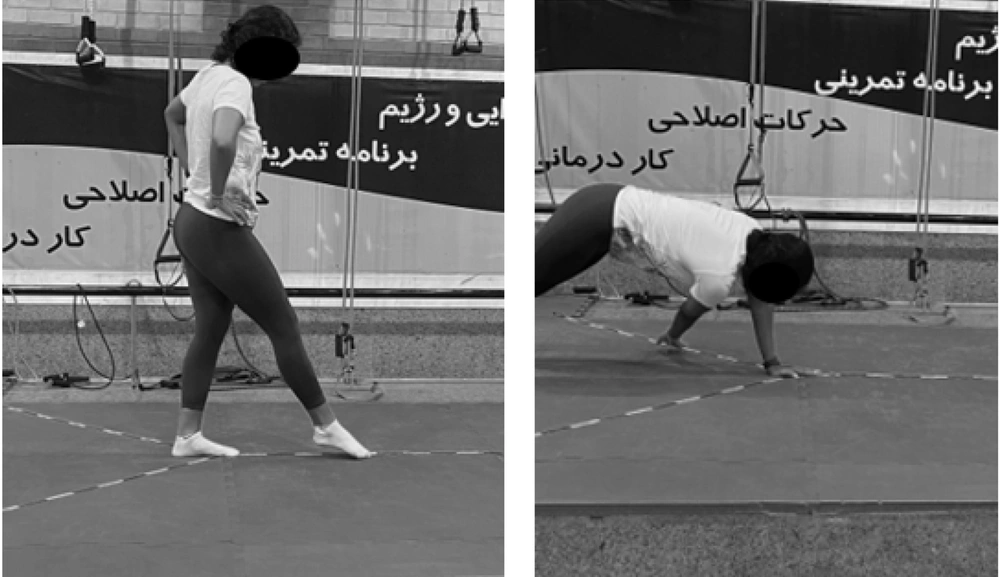
Figure 1.
Y balance test for the upper and lower limbs
3.7. Functional Performance
Functional movement screening (FMS) Tests were utilized to assess functional performance, encompassing seven movement patterns: Deep squat, hurdle step, in-line lunge, shoulder mobility, active straight leg raising, trunk stability push-up, and rotary stability (25). Functional movement screening also includes three clearance tests. Each movement pattern is scored on a scale from 0 to 3, with a maximum total score of 21. A score of 3 signifies the absence of compensatory movement, 2 indicates compensatory movement during the functional movement, 1 denotes an inability to perform the movement correctly, and 0 reflects pain during the movement or a clearance test. FMS has been shown to exhibit high inter-rater and intra-rater reliability (26) (Figure 2).
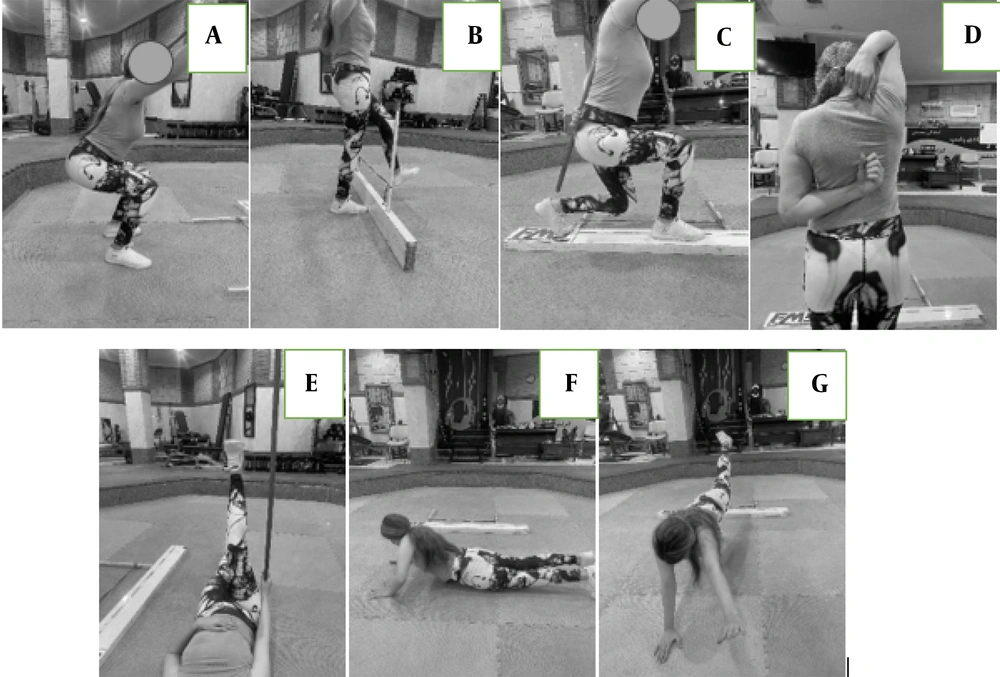
Figure 2.
Functional Movement Screening (FMS) Tests. A, deep squat; B, hurdle step; C, in-line lunge; D, shoulder mobility; E, active straight leg raising; F, trunk stability push-up; and G, rotary stability
3.8. Statistical Analysis
Data analysis was conducted using SPSS version 21 and included both descriptive and inferential statistical methods. An independent t-test was used to compare the averages of dependent variables between female bodybuilders with and without a history of injury. Following this, a single-variable logistic regression test was employed to explore the relationship between the research's dependent variables and sports injuries, with odds ratio values serving as an index of effect size. All analyses were performed with a significance level of P ≤ 0.05.
4. Results
The study included 110 bodybuilders aged between 25 and 58 years, with an average age of 36.7 ± 7.36 years. Their average height was 165.3 ± 3.165 cm, average weight 67.3 ± 9.67 kg, and average BMI 24.7 ± 3.24 kg/m². On average, participants had a sports history of 2.3 ± 1.5 years and participated in 3 ± 0.7 training sessions per week.
Out of the 110 participating bodybuilders, 40.1% (45 individuals) reported experiencing a sports injury in the previous year. The total number of injuries during that period was 68, with 63% of affected bodybuilders experiencing one injury, 23% reporting two injuries, and 14% having three or more injuries. Consequently, the prevalence of injuries per player was calculated as 0.62 injuries. In terms of severity based on time loss, 17.6% of injuries were categorized as very mild, 38.2% as mild, 19.1% as moderate, and 22.1% as severe.
Our study reveals that 19.1% of all injuries were connected to the lower back, followed by 17.6% related to the knee, 14.7% linked to the shoulder and scapula, and 10.3% involving the wrist, hands, and fingers. Additionally, 8.8% of injuries were associated with the head and neck region (Figure 3).
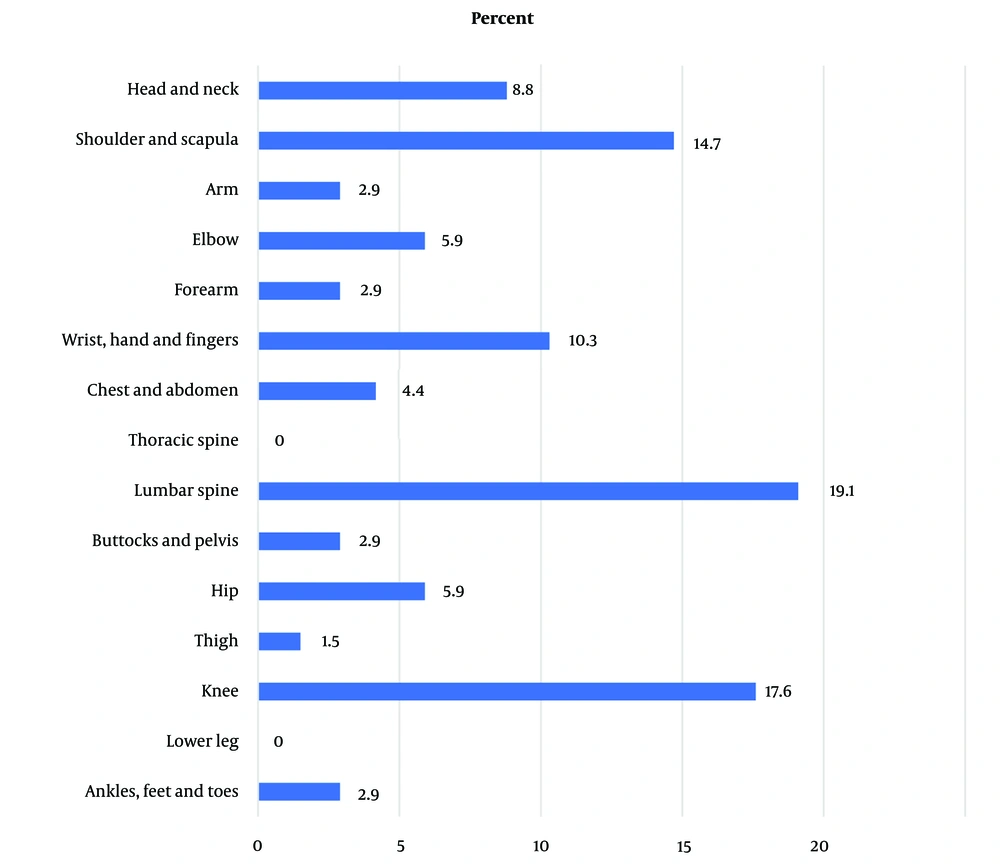
Figure 3.
The frequency of sports injuries among female bodybuilders based on the area of injury
The logistic regression analysis indicated that personality traits such as neuroticism, extroversion, and openness to experience were significant predictors of the risk of sports injuries among female bodybuilders. Specifically, a one-unit increase in neuroticism was associated with a 17% increase in the risk of injury, while a one-unit increase in extroversion led to a 13% increase in the risk of injury. Similarly, a one-unit increase in openness to experience was linked to a 21% rise in the risk of injury. In contrast, a one-unit increase in conscientiousness was associated with a 9% decrease in the risk of injury. Resilience was also identified as a significant predictor, with a one-unit increase in resilience resulting in a 5% reduction in the risk of injury. Moreover, athletic identity emerged as a noteworthy predictor, with a one-unit increase in athletic identity corresponding to a 7% increase in the risk of injury (Table 1).
Table 1.Correlation Between Subscales of Personality, Resilience and Sports Identity with the Risk of Sports Injury in Female Bodybuilders a
| Variables | Injured | Un-injured | B | S. E | Wald | OR (95%CI) | P-Value |
|---|---|---|---|---|---|---|---|
| Personality traits | |||||||
| Neuroticism (12 - 60) | 17.8 ± 4.1 | 14.7 ± 4.6 | 0.16 | 0.05 | 10 | 1.17 (1.06 - 1.30) | 0.002 |
| Extroversion (12 - 60) | 33.2 ± 4.2 | 29.6 ± 6.2 | 0.12 | 0.04 | 9.4 | 1.13 (1.05 - 1.22) | 0.002 |
| Openness to experience (12 - 60) | 28.9 ± 6.2 | 23.5 ± 4.5 | 0.19 | 0.05 | 17.4 | 1.21 (1.11 - 1.32) | 0.001 |
| Adaptability (12 - 60) | 30.0 ± 6.0 | 31.4 ± 5.4 | -0.4 | 0.04 | 1.52 | 0.96 (0.89 - 1.03) | 0.22 |
| Conscientiousness (12 - 60) | 29.9 ± 6.3 | 36.7 ± 9.6 | -0.1 | 0.03 | 13.6 | 0.91 (0.86 - 0.96) | 0.001 |
| Resiliency (0 - 100) | 64.7 ± 12.1 | 71.4 ± 10.5 | -0.05 | 0.02 | 8.3 | 0.95 (0.92 - 0.98) | 0.004 |
| Athletic identity (10 - 70) | 48.0 ± 9.5 | 40.9 ± 10.8 | 0.06 | 0.02 | 10.6 | 1.07 (1.03 - 1.11) | 0.001 |
a Values are expressed as Mean ± SD.
The logistic regression also revealed that the Y balance test score for the lower limb is a significant predictor of the risk of sports injuries in female bodybuilders. Specifically, for each unit increase in the Y balance test score for the lower limb, the risk of injury decreased by 7%. Conversely, there was no significant association between the Y balance test score for the upper limb and the incidence of sports injuries. Additionally, the statistical analysis indicated that the FMS score is a significant predictor of the risk of sports injuries, with each unit increase in the FMS score correlating with a substantial 46% reduction in the risk of injury (Table 2).
Table 2.The Relationship Between the Dynamic Balance of the Lower and Upper Limbs and Functional Performance with the Risk of Sports Injury in Female Bodybuilders
| Personality Traits | Injured | Un-injured | B | S. E | Wald | OR (95%CI) | P-Value |
|---|---|---|---|---|---|---|---|
| Dynamic balance of lower limbs (Percentage of lower limb length) | 91.9 ± 9.8 | 104.9 ± 15.6 | -0.08 | 0.04 | 4.9 | 0.93 (0.87 - 0.99) | 0.03 |
| Static balance of the upper limb (Percentage of upper limb length) | 95.3 ± 12.5 | 101.1 ± 17.7 | -0.03 | 0.03 | 0.9 | 0.98 (0.92 - 1.03) | 0.4 |
| FMS overall score (0 - 21 points) | 13.4 ± 2.2 | 15.7 ± 1.90 | -0.63 | 0.26 | 6.1 | 0.54 (0.32 - 0.88) | 0.01 |
| Deep squat (0 - 3 points) | 2.01 ± 0.45 | 2.33 ± 0.4 | -0.05 | 0.41 | 1.9 | 0.97 (0.91 - 1.03) | 0.1 |
| In-line lunge (0 - 3 points) | 2.05 ± 0.61 | 2.35 ± 0.58 | -0.04 | 0.43 | 1.6 | 0.98 (0.93 - 1.03) | 0.2 |
| Rotary stability (0 - 3 points) | 1.73 ± 0.51 | 1.90 ± 0.48 | -0.03 | 0.38 | 1.1 | 0.98 (0.91 - 1.05) | 0.4 |
| Shoulder mobility (0 - 3 points) | 1.90 ± 0.78 | 2.20 ± 0.84 | -0.04 | 0.44 | 1.7 | 0.97 (0.92 - 1.03) | 0.2 |
| Trunk stability push-up (0 - 3 points) | 1.95 ± 0.73 | 2.23 ± 0.67 | -0.04 | 0.35 | 1.7 | 0.98 (0.93 - 1.04) | 0.2 |
| Active straight leg raising (0 - 3 points) | 2.01 ± 0.67 | 2.57 ± 0.63 | -0.2 | 0.37 | 1.2 | 0.97 (0.91 - 1.04) | 0.4 |
| Hurdle step (0 - 3 points) | 1.85 ± 0.58 | 2.12 ± 0.52 | -0.03 | 0.35 | 1.3 | 0.97 (0.90 - 1.03) | 0.3 |
5. Discussion
The study aims to explore the correlation between resilience, personality traits, athletic identity, dynamic balance of the upper and lower limbs, and functional performance with the occurrence of sports injuries in female bodybuilders, addressing a gap in previous research on this specific population. The study found that among female bodybuilders, the average prevalence of sports injuries is 40.1%, with an average of 0.62 injuries per athlete. The most commonly affected areas are the lower back (19.1%), knee (17.6%), and shoulder (14.7%). These results align with previous studies by Siewe et al. (2014) and Keogh et al. (2017), which reported similar injury rates among German bodybuilders (2, 11) Siewe et al. (2014) observed a 45.1% injury rate, with an overall rate of 0.12 injuries per bodybuilder per year (equivalent to 0.24 injuries per 1000 training hours), noting higher injury levels in athletes over 40, primarily in the shoulder, elbow, lumbar spine, and knee areas (2). Keogh et al. (2017) stated in a review that bodybuilding has a lower injury rate compared to other weight training activities (0.12 - 0.7 injuries per lifter per year; 0.1 - 0.24 injuries per 1000 hours) (11). However, stronger athletes (4.5 - 6.1 injuries per 1000 hours) and Highland Games participants (7.5 injuries per 1000 hours) exhibited higher rates. The most frequently injured anatomical sites include the shoulder, back, knee, elbow, and wrist/hand, with strains, tendonitis, and sprains being the most common types of injuries (11).
Similar to the findings of this study regarding personality trait subscales, Barati et al. (2016) investigated the relationship between sports injuries and personality traits in elite Iranian wrestlers and found that all wrestlers experienced at least two injuries during one season (5). They identified a significant association between personality traits, including emotional instability, extroversion, openness to experience, agreeableness, and conscientiousness, with the incidence of injury (P < 0.05). The present study also identifies a positive association between neuroticism and the risk of sports injuries in female bodybuilders. Those with a history of injury exhibited higher scores in neuroticism, suggesting that traits such as emotional instability and anxiety may elevate injury risk. Research indicates that neurotic individuals, prone to stress and negativity, may lack effective coping mechanisms, heightening vulnerability to injuries.
Similarly, the study finds a positive link between extroversion and injury risk, suggesting that extroverted female bodybuilders, known for their energy and stimulation-seeking behavior, may engage in impulsive or aggressive actions during weight training. High self-confidence and risk-taking tendencies may lead to carelessness, contributing to injuries. Openness to experience is also positively correlated with injury risk, as individuals who seek new experiences may engage in diverse sports without taking adequate precautions. In contrast, conscientiousness exhibits a negative relationship with injury risk, with those scoring higher in this trait being less prone to sports injuries. This finding highlights the role of conscientiousness in preventing engagement in high-risk activities.
Female bodybuilders with a history of injury exhibit lower average endurance, and each unit increase in endurance is linked to a 5% reduction in the risk of injury. Consistent with these findings, Ramazani and Hejazi (2020) explored resilience and psychological toughness in athletes and non-athletes, finding a significant positive relationship between resilience, psychological toughness, and mental health (27). Resilience, viewed as a dynamic process by Luthar and Cicchetti (2000), enables positive adaptation despite exposure to risk. According to other researchers, resilience is considered a set of psychological resources that influences athletes' evaluation and handling of stressful situations to achieve their goals (28). Athletes with higher resilience may experience negative life events with fewer issues due to effective coping strategies and positive evaluations of situations. Resilience acts as a shield, protecting individuals from the negative effects of stress and risk factors. Resilient individuals tend to process adverse situations positively, viewing themselves as capable of overcoming challenges. Research indicates a positive relationship between resilience and physical health, as it mitigates the negative impact of stress. By fostering positive emotions and self-esteem, resilience helps athletes cope with negative experiences successfully. In challenging and stressful situations, resilience aids athletes in reducing the risk of injury through enhanced self-confidence, greater tolerance for difficulties, and positive adaptation to adversity.
Female bodybuilders with a history of injury demonstrate significantly higher average athletic identity than those without injury history, with each unit increase in athletic identity associated with a 7% increase in the risk of injury. The present study's findings align with those of McKay et al. (2013) in ice hockey athletes (29) and Martin et al. (2021) across diverse sports contexts (29). Martin et al. (2021) emphasized that a combination of high athletic identity, perfectionistic concerns, negative life stress, and a poor coach-athlete relationship makes athletes susceptible to overuse injuries in 74% of cases (30). Athletic identity, which represents the athlete's identification with their role, can have both positive and negative effects on performance (7). High athletic identity is linked to increased training or excessive competitive effort, including playing while injured (31). Additionally, athletes with high athletic identity may continue sports activities despite pain or injury, increasing the risk of more severe injuries. This behavior is associated with a sports culture that normalizes pain, indicating a potential connection between elevated athletic identity and a heightened risk of sports injuries (32).
Following our study, Hegedus et al. (2015) reported in a review that Y balance tests provide strong evidence for accurately identifying injury risk in field athletes. Specifically, a composite reach score of less than 94% or an anterior reach distance difference of 4 cm or more is associated with an increased risk of injury (17). However, Lisman et al. (2021) did not find a significant link between Y balance test asymmetry and sports injuries in adolescent athletes (19). Maturity differences in Lisman's study may have influenced this relationship. The upper limb Y balance test, which assesses shoulder balance, stability, strength, and mobility, has proven effective in predicting sports injuries in female bodybuilders (6). Higher lower extremity balance scores are also associated with improved proprioception, postural control, core stability, and neuromuscular control (33). This leads to reduced injury risks through optimal body alignment, fewer incorrect movements, and faster reactions to environmental changes (34). In summary, higher balance scores contribute to enhanced proprioception, stability, core strength, neuromuscular control, and coordination, collectively reducing the incidence of sports injuries (24).
In female bodybuilders, our study reveals that each unit increase in the average FMS score is associated with a 46% decrease in the risk of injury. This finding contrasts with Hammes et al.'s (2016) study on older soccer players, possibly due to differences in sports fields and research samples—our focus was on female bodybuilders, while Hammes et al. studied male soccer players (35). Kraus et al. (2014) found a relationship between FMS scores and sports injury risk in professional soccer players, noting that those with scores lower than 14 were six times more at risk of injury and 51% more at risk of severe injuries (18). Garrison et al. (2015) also emphasized the importance of creating reliable methods to identify high-risk athletes, supporting the development of intervention programs to reduce injuries and enhance performance (9). Their findings align with our study, highlighting the significance of preseason FMS scores in predicting injury risk in collegiate athletes. Functional Movement Screening tests evaluate the body's movement chain, which is crucial for accurate movements, stability, and mobility. Individuals with lower FMS scores exhibit compensatory movement patterns, increasing their injury risk (3, 10). Functional Movement Screening assessments, which simultaneously evaluate stability, balance, and strength, assist healthcare professionals in identifying movement disorders and asymmetries, allowing them to detect potential risks of sports injuries related to poor biomechanics and compensatory movement patterns during physical activities (8, 12).
This study faced several limitations, including its focus on females, retrospective design, small sample size, and reliance on self-report questionnaires. The retrospective design carries the risk of recall biases, potentially impacting the accuracy of the data and limiting causal conclusions. Additionally, the study's limited sample size and its focus solely on females reduce its generalizability and may introduce biases. Restricting the participant age range to 20 - 60 years further hinders generalizability, potentially excluding younger and older populations, which could affect the applicability of the research. Furthermore, self-report questionnaires are prone to response biases, which may affect the accuracy of the collected data. As a result, these findings should be interpreted with caution. Future research should aim to overcome these limitations and expand on the results to enhance the study’s generalizability and accuracy.
The study's findings highlight several practical implications for reducing sports injuries in female bodybuilders. Prevention programs should specifically target common injury areas—such as the low back, knee, and shoulder through exercises aimed at strengthening these regions and promoting proper technique. Psychological support, including stress management and resilience training, is recommended to help athletes cope with the mental pressures of training, along with personalized training plans tailored to their individual personality traits. Regular functional assessments, such as the Y Balance test and FMS, can help identify physical deficits early, enabling timely intervention. Additionally, education programs should raise awareness about injury risks and provide practical prevention strategies to reduce the incidence of injuries.
Future studies could explore longitudinal analyses to track injury patterns over time and intervention studies to evaluate the efficacy of targeted prevention programs. Investigating biomechanical factors and socio-cultural influences on injury risk, along with integrating wearable technology for real-time monitoring, could offer valuable insights. Furthermore, qualitative research could provide a deeper understanding of athletes' experiences with injuries, allowing for more personalized and effective prevention strategies. By employing these approaches, future research can refine evidence-based practices to better prevent sports injuries in female bodybuilders.
5.1. Conclusions
The study found a 40.1% prevalence of sports injuries among female bodybuilders, with an average of 0.62 injuries per athlete. Common injury sites included the low back (19.1%), knee (17.6%), and shoulder (14.7%). Female bodybuilders with prior injuries exhibited higher scores in neuroticism, extroversion, openness to experience, and athlete identity, while responsibility and resilience scores were lower. Increased neuroticism, extroversion, openness, and athlete identity were correlated with higher injury risks, whereas elevated responsibility and resilience were linked to reduced risk. Past injury history was associated with lower scores in the lower limb Y balance test and FMS, with improved scores correlating with reduced injury risk. These insights provide valuable guidance for specialists and physiotherapists to develop effective injury prevention strategies tailored to female bodybuilders.
