
1. Background
Within the health system, universities of medical sciences are multifaceted institutions responsible for educating the workforce, generating medical knowledge, and providing diagnostic, preventive, and therapeutic services. These responsibilities render universities and their affiliated hospitals vulnerable to natural disasters, biological crises, and emerging emergencies (1, 2). Disasters may have natural, biological, technological, or organizational origins and are typically characterized by uncertainty, time constraints, scarce or inequitably distributed resources, and the need for cross-sectoral decision-making. The complexity of university missions and the interdependence of educational, clinical, support, and administrative units increase the likelihood that disruption in one sector will spread to others (3). Consequently, a crisis in these institutions extends beyond administrative disruption and can affect the continuity of health services, staff and patient safety, workforce training, and public trust (4).
Healthcare facilities are vital components of societal infrastructure. Disruptions to their operations can restrict access to essential care, with adverse clinical and social consequences. World Health Organization guidelines emphasize risk reduction, preparedness, and the continuity of health system operations during emergencies (2). Earthquakes, pandemics, mass-casualty incidents, and mass gatherings can rapidly increase demand for care and strain the operational capacity of healthcare facilities (1, 2). Preparedness therefore depends not only on established guidelines but also on the ability to maintain vital services, mobilize resources, and coordinate within and between organizations. Research and lessons learned from crises highlight infrastructure vulnerability, shortages of personnel and resources, supply chain fragility, and coordination difficulties (1, 5). Experience at Kermanshah University of Medical Sciences also demonstrates that operational decisions must balance the urgency of saving lives with hospital capacity and logistical constraints (3).
Disaster managers use various models to support planning, decision-making, and action during crises (6). Each model serves specific purposes. According to Nojavan et al., Disaster management models have emerged from different researchers' experiences, with most focusing on four phases: Prevention, mitigation, response, and recovery. These models were not designed to encompass the full scope of Disaster management and have been criticized for their inherent limitations. Although individual models address specific aspects of emergencies, few provide a comprehensive interpretation. Each organization or sector must therefore define its operational scope and performance levels in accordance with its requirements, vision, mission, goals, and strategies before developing indicators and selecting a model. Organizations seek to mitigate crises within their jurisdictions by considering available resources and economic and social vulnerabilities (7).
The four-stage model, comprising mitigation, preparedness, response, and recovery, provides a clear cycle for organizing actions. However, implementation may depend on financial resources and trained personnel, and its phased focus may limit responses to multi sectoral crises when a coordinating mechanism is absent (8). Similarly, Little john's six-stage model relies on structure and simulation and may be less effective during unforeseen changes if it focuses on predetermined scenarios (9). Pearson and Mitroff's five-stage model, which extends from signal detection to learning, emphasizes organizational learning. However, identifying crisis signals within large volumes of data and translating lessons into lasting change remain challenging (10). Other frameworks, including Mitroff and Srivastava's "onion model" and the models developed by Fink and France, are useful for understanding crises. Nevertheless, their direct application without adaptation to Iran's institutional context and healthcare system is insufficient.
Local applicability, cultural compatibility, and coordination are key considerations when selecting a Disaster management model. Most proposed models take into account the cultural context and the economic, social, and health development of the countries in which they were developed (11). The evolution of disaster and emergency management within the Ministry of Health, Treatment, and Medical Education over the past decade suggests that adopting models from other countries without localization would present substantial challenges (12).
The primary challenge, therefore, is direct reliance on frameworks developed in different contexts. Political, economic, cultural, and organizational differences may make unadapted transfer unsuitable and underscore the need for localization. During crises, opportunities for trial and error are limited, and health managers' decisions are shaped by their lived experiences and mental models. Unless this tacit knowledge is articulated within a shared framework, it may lead to fragmented actions that depend on specific individuals. The Kermanshah earthquake, floods, and the COVID-19 pandemic have also underscored the importance of inter sectoral coordination and the continuity of health services (3, 13).
A model derived from managers' experiences and performance-related documents can clarify Disaster management mechanisms in universities of medical sciences. Grounded theory enables the systematic extraction of concepts and their relationships from interviews and documents, rather than reliance on the assumptions of an existing model (13). Accordingly, this article delineates the causal conditions, core phenomenon, contextual and intervening conditions, strategies, and consequences of Disaster management within a paradigmatic model.
2. Objectives
The primary objective was to design and articulate a conceptual model for Disaster management in universities of medical sciences using grounded theory, based on administrators’ lived experiences and an analysis of high-level documents. The specific objectives were to:
1) Identify the causal conditions that necessitate and lead to Disaster management in universities of medical sciences.
2) Define the core phenomenon, or central category, governing Disaster management in the academic health system.
3) Analyze the contextual conditions and the structural and cultural settings influencing the crisis process.
4) Identify intervening factors and environmental, financial, and bureaucratic barriers affecting response strategies.
5) Formulate interactive strategies and actions to support integrated management and optimize response capacity.
6) Determine the outcomes of implementing a comprehensive Disaster management model in universities of medical sciences.
3. Methods
3.1. Study Design and Approach
This qualitative study used grounded theory methodology and an inductive conceptual framework based on the systematic approach of Strauss and Corbin (14). A conceptual model for disaster management was developed using documentary data and semi-structured interviews, with a focus on hospitals affiliated with universities of medical sciences.
This method was selected for its ability to generate process models and explain human and organizational interactions, making it suitable for examining a complex, context-dependent phenomenon. Theoretical concepts and relationships were derived inductively, and analysis was conducted concurrently with data collection. Following the Corbin and Strauss model, analysis involved open, axial, and selective coding. The aim was to translate participants' experiences and perceptions of crisis management at Kermanshah University of Medical Sciences into explanatory analytical relationships.
3.2. Research Setting and Participants
The study setting included the administrative divisions and teaching hospitals of Kermanshah University of Medical Sciences that had been involved in previous crises, as well as the Center for Prehospital Emergency Medical Services. Participants included senior, middle, and operational managers; crisis committee secretaries and experts; key members of disaster management structures; and health sector experts specializing in incidents and disasters. All participants had relevant disaster management experience or responsibilities. Sampling began with purposive selection and continued through snowball sampling to enhance the diversity of experiences and richness of the data. Fourteen individuals (10 men and 4 women) participated in interviews. Sampling ceased when theoretical saturation was achieved. Each interview lasted 25 - 40 minutes. High-level Disaster management documents were also reviewed to supplement and compare the interview data.
3.3. Sampling and Sample Size
Criterion-based purposive sampling began with the identification of expert managers who had direct incident management experience and were members of disaster management structures. Recruitment subsequently expanded through snowball sampling. Theoretical sampling continued to achieve saturation and conceptual richness until analysis of 14 in-depth, semi-structured interviews and four high-level policy documents was completed.
3.4. Designing an Indigenous Disaster Management Model
Data collection comprised a review of four high-level operational and policy documents and 14 semi-structured interviews. The reliability of document analysis was assessed using the inter-coder reliability method based on Lawshe's formula, yielding a score of 83.63%. Interview participants were selected purposively and included university and hospital disaster management committee members and faculty members holding academic administrative positions (Table 1).
Table 1.
The Demographic Characteristics of the Key Informants in the Interview
| No. | Crisis Experts (Position) | Academic Degree: Expert | Academic Degree: Master's | Academic Degree: Doctorate | Field of Study: Nursing | Field of Study: Crisis Mgmt. / IT / Educational Mgmt. | Role: One of the 7 Main Members of the Crisis chart | Role: Commander / Deputy | Managerial Position | Sex: Female | Sex: Male |
|---|---|---|---|---|---|---|---|---|---|---|---|
| 1 | University headquarters managers | 0 | 0 | 2 | 0 | 0 | 2 | 0 | 2 | 0 | 2 |
| 2 | Hospital manager | 1 | 0 | 0 | 1 | 0 | 0 | 1 | 1 | 0 | 1 |
| 3 | Nursing director | 1 | 0 | 0 | 1 | 1 | 1 | 0 | 1 | 0 | 1 |
| 3 | Clinical supervisor | 1 | 0 | 0 | 1 | 1 | 1 | 0 | 1 | 1 | 0 |
| 3 | Crisis committee secretary | 1 | 2 | 0 | 1 | 2 | 3 | 0 | 3 | 2 | 1 |
| 4 | Quality improvement secretary | 0 | 1 | 0 | 0 | 1 | 1 | 0 | 1 | 1 | 0 |
| 4 | Emergency specialist | 0 | 0 | 2 | 0 | 2 | 1 | 0 | 2 | 0 | 2 |
| 5 | Subject-matter expert | 0 | 0 | 3 | 1 | 3 | 3 | 1 | 1 | 0 | 3 |
| - | Total (as supplied) | 4 | 3 | 7 | 4 | 10 | 12 | 2 | 12 | 4 | 10 |
Data collection continued until saturation was reached. The reliability of interview analysis was assessed through peer review.
3.5. Data Collection and Analysis
Semi-structured interviews focused on operational experiences, barriers and facilitators, decision-making under challenging conditions, and the consequences of crises. Documentary data were examined to compare with and complement the interview evidence. Analysis proceeded through three stages: open coding to extract initial concepts; axial coding to link concepts and form categories within the six-part paradigmatic framework; and selective coding to integrate categories around the core category and formulate a theoretical storyline.
Primary data were collected through in-depth, semi-structured interviews. Questions addressed managers' operational experiences during crises, decision-making challenges and coordination issues, contextual factors that facilitated or hindered performance, strategies, and the outcomes of actions taken during crises. Documentary data complemented the interview evidence. During open coding, initial concepts and significant events were extracted. During axial coding, categories were organized through paradigmatic relationships within the six-part framework. During selective coding, categories were integrated around a core category, linked to other categories, and used to formulate a theoretical storyline. The core category was "integrated and resilient crisis management centered on the continuity of health services."
4. Results
4.1. Participants and Documentary Sources
The qualitative phase included 14 participants (10 men and 4 women), including managers, experts, professors, and faculty members from academic departments related to disaster management, as well as commanders and key members of university and hospital Disaster management structures. Four high-level operational documents were also analyzed. The participants’ demographic and professional characteristics are presented in Table 1.
4.2. Six Dimensions of the Paradigmatic Model and the Core Category
Three-stage coding yielded 107 initial codes and 18 subcategories across six paradigmatic dimensions. A summary is presented in Table 2.
Table 2.
Dimensions of the Paradigm Model, Main (Axial) Categories, and Components Derived from Grounded Theory Analysis
| Paradigm Model Dimension | Main Category (Axial Code) | Components and Key Conceptual Codes |
|---|---|---|
| Core Phenomenon | Integrated and resilient management focused on health service continuity | Operational unit command; sustained frontline delivery of acute services; structural and clinical hospital resilience |
| Causal Conditions | 1) Occurrence of environmental hazards and epidemics; 2) Imperative of life preservation and urgent service delivery; 3) Vulnerability of health infrastructures | Sudden natural disasters; influx of critically ill patients; surge in trauma patients; physical vulnerability of medical facilities |
| Contextual Conditions | 1) Physical structural foundation of the university hospital; 2) Equipment and logistical capacities; 3) Culture of professional commitment and prior managerial experience | Geopolitical position; reliability of power and oxygen supply; emergency department readiness; lived experiences of healthcare personnel; altruistic and dedicated spirit of staff |
| Intervening Conditions | 1) Financial challenges and administrative bureaucracy; 2) Fragility of the drug and equipment supply chain; 3) External supporting factors and backing institutions | Liquidity shortages; supply-chain disruptions for critical biological items; gaps in intersectoral coordination; support from the armed forces and charitable donors |
| Action/Interaction Strategies | 1) Structural rearrangement and flexibility; 2) Activation of the Hospital Incident Command System (HICS); 3) Hybrid and scenario-based drills; 4) Integrated communications and intelligent data management | Rapid reconfiguration of departmental functions; dynamic deployment of triage; reallocation of operational duty shifts; simulation exercises; real-time data sharing |
| Consequences | 1) Continuity of sustainable clinical care; 2) Enhancement of institutional and systemic resilience; 3) Institutionalization of learning and organizational memory | Reduction in mortality and disability; rapid response to shocks; resilient recovery of functions; documentation of lessons learned and experiences |
4.3. Core Category and Conceptual Relationships
The core category was "integrated and resilient Disaster management centered on the continuity of health services." During crises, the university’s structural components, human resources, and support systems align around this goal to minimize disruptions to rescue operations and the care of critically ill patients (2).
4.3.1. Causal Conditions and Triggers
Natural disasters and widespread epidemics, combined with vulnerabilities in equipment and infrastructure, compel the university to activate its crisis management structure (1). Participant U01 stated: "In the initial minutes of the earthquake, we faced a staggering volume of trauma; had the emergency system not operated in an integrated manner, all the city's hospitals would have been paralyzed within two hours."
4.3.2. Contextual and Intervening Conditions
An organizational culture of self-sacrifice and prior disaster experience provide the contextual background. Cumbersome bureaucracy related to liquidity provision, as well as shortages of medicines and medical equipment, act as intervening barriers (4). Participant U06 stated: "When the hospital is overwhelmed, standard bureaucracy does not work; we need full financial authority and logistical support."
4.3.3. Strategies and Outcomes
Strategies such as repurposing hospital spaces, converting general wards into intensive care units, establishing hierarchical incident command structures, and using dynamic triage lead to outcomes including reduced casualties and the preservation of the health system’s organizational reputation (Figure 1).
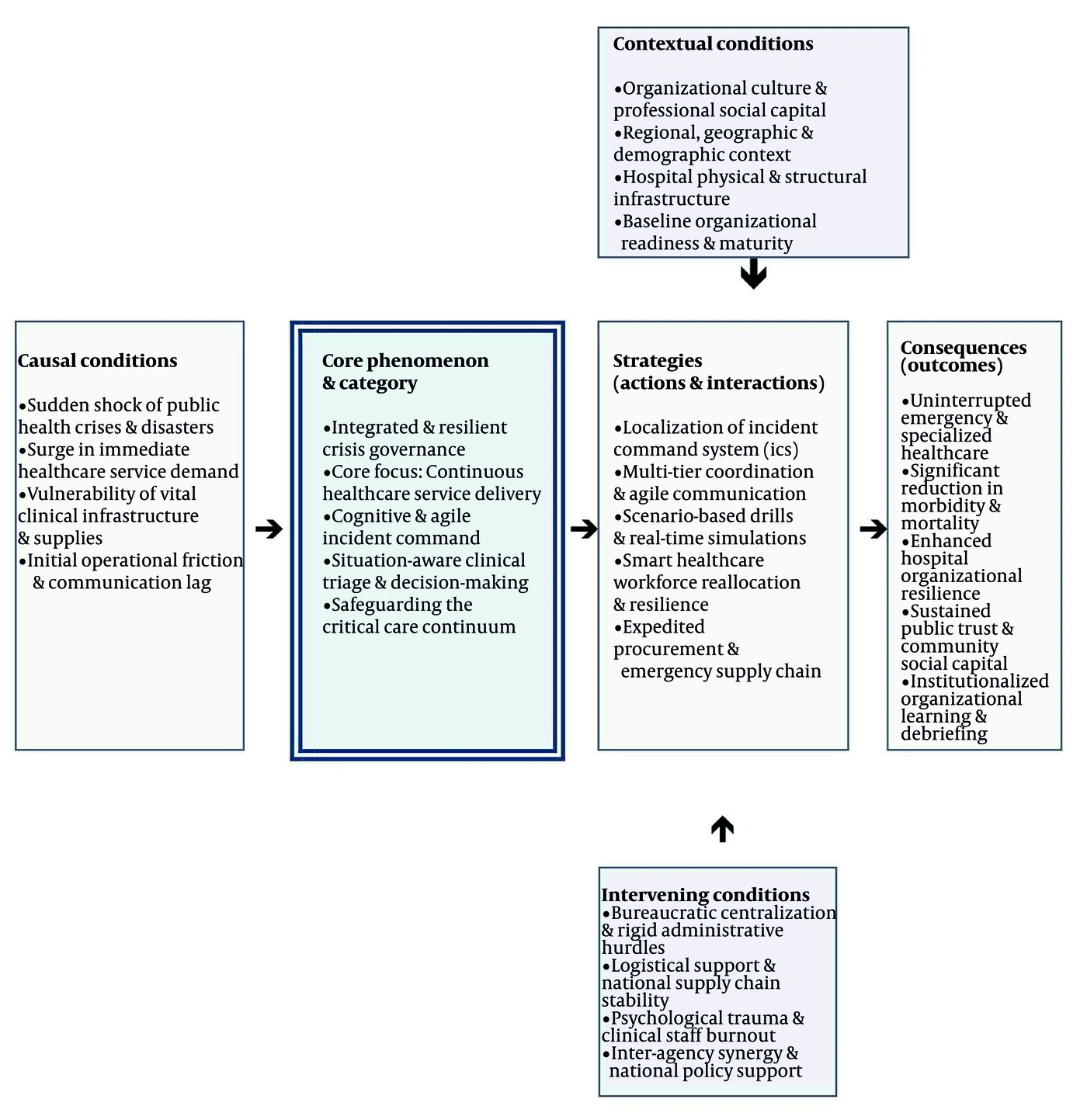
Figure 1.
The grounded theory paradigm model of integrated and resilient Disaster management at Kermanshah University of Medical Sciences
5. Discussion
This study used grounded theory to develop a comprehensive, indigenous disaster management model for Kermanshah University of Medical Sciences. Because they directly affect human life, health-related crises are characterized by urgency, substantial uncertainty, surges in patient volume during the "golden hours," and constraints in infrastructure capacity. Analysis of managers’ and experts’ lived experiences indicated that resilient management extends beyond a mechanical, linear sequence and requires a dynamic, network-based paradigm. The six dimensions are examined below in relation to existing theoretical frameworks and empirical evidence.
5.1. Core Phenomenon and Causal Conditions: Disaster and Healthcare Chain Resilience
Causal conditions, including sudden disaster shocks, casualty surges, infrastructure vulnerabilities, and delays in initial situational awareness, led to the core phenomenon of "integrated and resilient Disaster management centered on the continuity of health services." This finding aligns with studies by Seyedin, Zaboli, and Ravaghi (15) and Seyedin et al. (16). These authors emphasized that prior exposure to major crises, such as the Bam earthquake, enhances resilience and operational integration by strengthening tacit knowledge, accelerating resource distribution, and promoting organizational behavioral maturity. Khankeh et al. (17), in their analysis of lessons learned from the Kermanshah earthquake, identified initial shock, the risk of treatment-chain disruption, and structural instability of hospital facilities as critical challenges immediately after the disaster. These factors make a rapid, resilient response essential.
5.2. Contextual and Intervening Conditions: Structural Friction and Social Capital
Centralization, rigid administrative bureaucracy, staff burnout and psychological trauma, and national supply chain disruptions emerged as intervening factors that limit decision-making effectiveness. Norouzinia, Mirzaei, and Atighechian (18), in their analysis of the Plasco incident, identified the absence of unified field protocols, inaccurate initial scene assessment, and traditional, unscientific administrative approaches as the main barriers to effective scene management. These findings corroborate the intervening factors identified in the present study.
Although some previous studies have emphasized strict hierarchical control during crises, participants’ accounts indicated that excessive centralization and requirements for higher-level administrative approval during the initial hours create a potentially fatal bottleneck. The findings therefore support delegating authority to hospital directors on the scene.
5.3. Strategies and Interactive Actions: Localization of the Incident Command System
The model emphasizes localization of the Hospital Incident Command System (HICS), flexible reorganization of shifts, psychological support for medical staff, and drills based on combined scenarios. This finding aligns with Akbari Shahrestanaki et al. (19), who highlighted the need for a localized model for medical rapid response teams tailored to Iran's territorial planning. It also supports Khorram-Manesh et al. (20), who regard disaster simulation and team-based training as prerequisites for resilient decision-making.
In contrast to Western models that view the Incident Command System (ICS) as a rigid framework, the present model indicates that the system loses effectiveness unless it is adapted to cultural, motivational, and religious considerations, as well as to the altruistic spirit of healthcare personnel during regional crises in Iran, including the Sarpol-e Zahab earthquake and the COVID-19 pandemic.
5.4. Theoretical Implications and Evolutionary Trajectory
The model's implications include sustained specialized treatment workflows, fewer decision-making errors and deaths, preservation of public trust in the healthcare system, and institutionalization of organizational learning through debriefing.
Theoretically, the model bridges abstract theories and the operational realities of emergency management in universities of medical sciences. Hospital disaster management emerges as a dynamic, resilient, and learning-oriented capability rooted in managers’ accumulated experience, rather than solely a reactive process.
5.5. Conclusions and Policy Recommendations
Applying the grounded theory paradigmatic model requires policymakers at the Ministry of Health and heads of universities of medical sciences to:
1) Reevaluate non-indigenous models adopted directly from other contexts and localize operational guidelines using lessons learned from past crises.
2) Legally expand the financial and operational authority of health sector leaders during emergencies to reduce bureaucratic friction.
3) Establish cyclical feedback and debriefing mechanisms so that lived experiences from each crisis are promptly translated into revised educational protocols for future managers.
5.6. Study Limitations
This study focused geographically on managers at Kermanshah University of Medical Sciences and its affiliated hospitals. Although their experiences were rich because of the region's history of frequent disasters, statistical generalization to other settings requires caution. Managers’ heavy workloads also posed a procedural challenge during interviews.
5.7. Future Research
Future research should:
1) Evaluate the model's quantitative fit and structural validity across the country's universities of medical sciences using structural equation modeling or the fuzzy Delphi method.
2) Develop a specialized model of pharmaceutical supply chain resilience during biological crises, grounded in systems theory.