
1. Background
College professors constitute the educational foundation of medical universities and play a pivotal role in preparing future health care professionals. The quality of medical education is therefore closely linked to the teaching performance of college professors (1). Teaching quality is a key factor that strengthens university capacity and increases educational efficiency, and its outcomes can be reflected in students' progress. Conducting studies and analyzing educational issues in this field can help professors become aware of the quality of their teaching and modify it when necessary. Such studies can also provide appropriate feedback to higher education officials and practitioners for decision-making and strategic planning. Durisova et al. (2) investigated the role of teaching evaluation in higher education and concluded that evaluation is an effective method for preparing students for their future careers and shaping students' personalities. They also identified a strong relationship between teaching evaluation and the quality of higher education.
Teaching quality among university professors is influenced by numerous factors, including vocal health. Because teaching relies heavily on effective voice use, professors are at increased risk of vocal fatigue and voice disorders. Vocal hygiene programs comprise educational recommendations and practical exercises designed to maintain vocal health and prevent voice-related problems. Given the high vocal demands of academic teaching, implementing vocal hygiene programs may contribute to improved teaching quality and professional performance among university professors (3, 4). During verbal communication, the voice not only conveys the speaker's message but also expresses the speaker's feelings, thereby reinforcing the message for the listener. The voice is also an indicator of the speaker's physical condition, particularly the health and functional status of the laryngeal system (5).
Because the voice serves as a primary professional tool for educators and other occupational voice users, inadequate adherence to vocal hygiene principles may increase the risk of vocal fatigue, voice disorders, and reduced vocal performance. Therefore, promoting vocal hygiene behaviors is considered an important strategy for maintaining vocal health and optimizing professional communication (6). Teachers and university professors are professional voice users and may be more prone to voice disorders than other occupational voice users because their working conditions require continuous and prolonged voice use (7). According to statistical data, the prevalence of voice disorders is 10% to 15% in the general population, but it is approximately 20% to 50% among university professors and teachers and may reach 80% in some settings (3). Therefore, vocal hygiene training should be taken seriously to reduce the risk of voice problems and help maintain professors' teaching quality. Previous research has shown that vocal warm-up interventions can positively affect voice quality and reduce vocal fatigue in teachers, highlighting the potential value of such strategies for professionals whose work depends heavily on effective voice production (8). Sundram et al. (9) studied the effectiveness of a vocal hygiene program among elementary school teachers in northeastern Malaysia and described vocal hygiene programs as preventive and therapeutic methods for reducing voice defects among teachers.
Given the fundamental role of faculty members in higher education, teaching quality remains a critical factor influencing students' learning experiences and academic achievement. Effective teaching relies on multiple competencies, including communication skills, classroom management, organization of instructional content, time management, creativity, and critical thinking. Because voice is the primary medium through which these competencies are conveyed, maintaining vocal health is essential for sustaining effective teaching performance (6). Faculty members are frequently exposed to substantial vocal demands that may increase their susceptibility to vocal fatigue and voice-related disorders. Recent evidence suggests that vocal hygiene education can improve vocal health and voice-related outcomes among professional voice users (6). However, despite the recognized importance of vocal health in professions with high vocal demands, the potential impact of vocal hygiene programs on teaching quality has received limited attention.
2. Objectives
To the best of our knowledge, no previous study has specifically investigated the effect of a vocal hygiene program on the teaching quality of university faculty members. Therefore, this study aimed to evaluate the effect of a vocal hygiene education program on the teaching quality among faculty members at Kermanshah University of Medical Sciences.
3. Methods
3.1. Study Design and Setting
This quasi-experimental study used a pre-test/post-test design with a control group. In total, 110 professors from the basic sciences faculties at Kermanshah University of Medical Sciences (KUMS), Iran, in 2023 - 2024 were identified as potential participants and selected through convenience sampling. Of these, 40 professors who met the eligibility criteria were nonrandomly assigned to the experimental or control group, with 20 participants in each group. Participant flow through the study is presented in Figure 1.
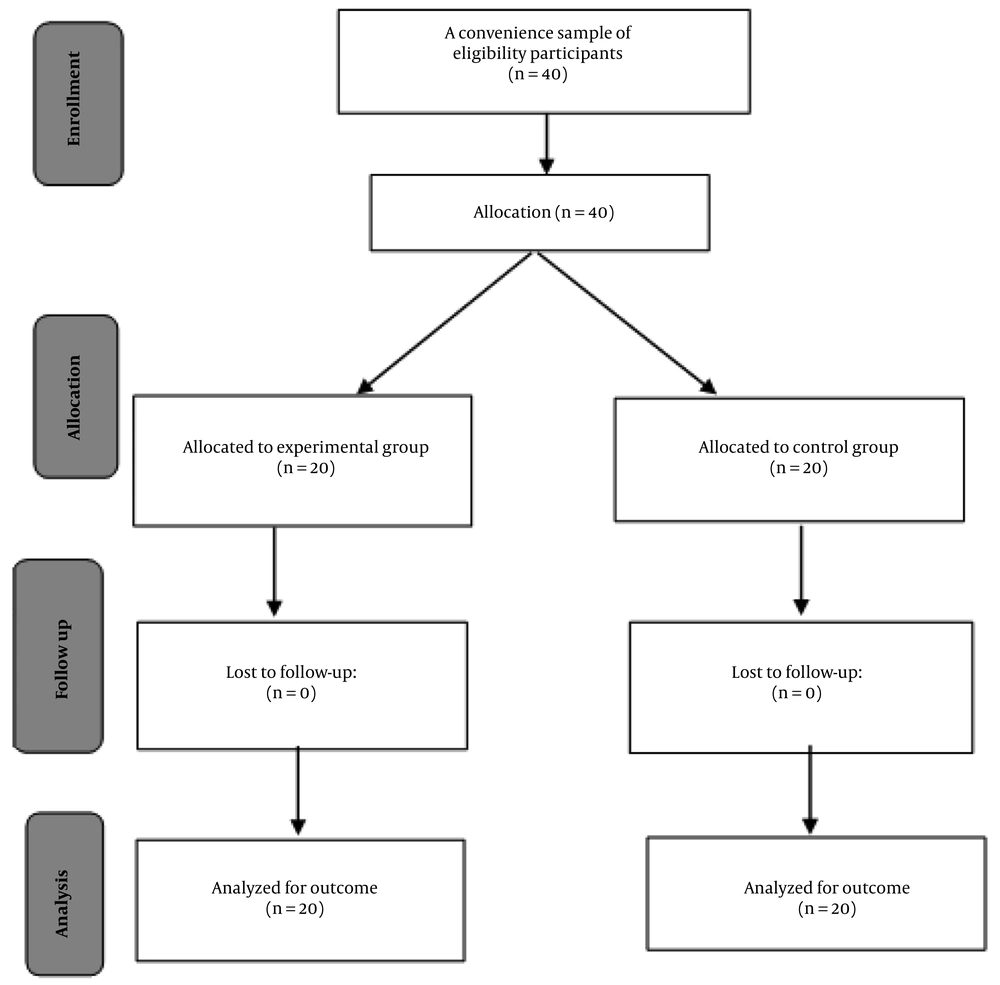
Figure 1.
Sample collection and assignment
3.2. Participants and Group Assignment
Participants were included if they met the following criteria, applied identically to the experimental and control groups: 1) at least 3 years of teaching experience; 2) teaching theoretical courses in 3 consecutive semesters before entering the study, with a minimum of 10 course units in each of these 3 semesters; and 3) at least 10 hours of teaching per week. Exclusion criteria were allergies, colds, or infectious diseases during the intervention period.
Group assignment was based on the order of voluntary enrollment. The first 20 eligible professors who registered for the vocal hygiene program were allocated to the experimental group, and the subsequent 20 volunteers were assigned to the control group. The control group received no intervention during the study period and continued their routine teaching activities. To reduce potential bias, outcome assessors were blinded to group allocation, and both groups completed identical pre-test and post-test assessments 1 week before and 1 week after the 4-week intervention period. After the post-test, the control group was offered the same vocal hygiene training for ethical reasons.
3.3. Data Collection, Instrument, and Intervention
Data were collected through interviews and a researcher-developed teaching quality questionnaire. The intervention program was based on common vocal hygiene recommendations and techniques for professional voice users and was planned and implemented in 7 weekly sessions. The program content is presented in Table 1.
Table 1.
Content of the Vocal Hygiene Program
| Sessions | Program Content |
|---|---|
| First | Pre-intervention assessment of teaching quality |
| Second | General explanations about the anatomy and physiology of the larynx and voice |
| Third | Education on essential recommendations for vocal hygiene, including appropriate and inappropriate vocal use and helpful behaviors and behaviors to avoid. Helpful behaviors included drinking plenty of water, especially while teaching; observing vocal rest in daily life, especially when feeling tired or strained during teaching; following a proper light and non-stimulating diet; and using a voice amplifier. Behaviors to avoid included excessive throat clearing, caffeine, smoking, irritants, throat lozenges, gastric reflux, talking in crowded and noisy places, and excessive telephone use. |
| Fourth | Training in vocal hygiene exercises, including warming up the vocal folds and larynx by making exaggerated chewing motions, performing the yawn-sigh exercise, and practicing deep breathing exercises |
| Fifth | Training in additional vocal hygiene exercises, including the pitch slide 8 to 10 times, with the aim of moving the voice from its lowest pitch to the highest note the participant could produce, and trilling the lips or tongue while making sound during exhalation after deep abdominal inhalation for sounds such as brrr |
| Sixth | Program review and monitoring of exercise implementation |
| Seventh | Post-intervention assessment of teaching quality |
The teaching quality questionnaire included 12 questions, with teachers’ self-assessments of their performance used as the criterion. Responses were categorized into 5 Likert-scale options: strongly agree, agree, neither agree nor disagree, disagree, and strongly disagree, scored from 5 to 1. Accordingly, the minimum possible score was 12 and the maximum possible score was 60.
Content validity was established through review by a panel of 10 experts, comprising health education specialists and epidemiologists. The content validity ratio (CVR) and Content Validity Index (CVI) were calculated, yielding values of 0.62 and 0.90, respectively, which are considered acceptable based on established guidelines (15). Internal consistency was assessed using Cronbach's alpha and was 0.83, indicating good reliability.
The 12-item questionnaire comprises 3 domains: clarity of content delivery (4 items), classroom communication skills (4 items), and student engagement (4 items). Responses are rated on a 5-point Likert scale from strongly agree (5 points) to strongly disagree (1 point). The total score is calculated by summing all 12 items, ranging from 12 to 60, with higher scores indicating better self-perceived teaching quality. An increase in the total score from pre-test to post-test is interpreted as an improvement in teaching quality.
3.4. Statistical Analysis
Independent-samples t-tests and chi-square tests were used to compare the experimental and control groups in terms of baseline demographic characteristics and pre-test teaching quality scores. To evaluate the effect of the vocal hygiene program while accounting for the observed baseline imbalance, a one-way analysis of covariance (ANCOVA) was conducted for the primary between-group comparison. The dependent variable was the post-test teaching quality score, the independent variable was group (experimental vs. control), and the pre-test teaching quality score was entered as the covariate. The model tested the main effect of group after adjustment for the pre-test score. Preliminary assumption checks were performed: normality of residuals was assessed using the Shapiro-Wilk test, homogeneity of variances using Levene's test, and homogeneity of regression slopes by testing the group x pre-test score interaction term, which was nonsignificant and therefore excluded from the final model.
Effect sizes were reported as partial eta-squared (η2), and 95% confidence intervals were calculated for adjusted mean differences. Within-group pre-test to post-test changes were assessed using paired-samples t-tests. All analyses were 2-tailed and conducted using SPSS version 26, with a significance level set at P < 0.05.
3.5. Ethical Considerations
The study was approved by the Ethics Committee of Kermanshah University of Medical Sciences (reference number: IR.KUMS.REC.1398.550). Written informed consent was obtained from the participants.
4. Results
4.1. Sample Characteristics and Baseline Comparisons
The sample consisted of 23 men (57.5%) and 17 women (42.5%). Table 2 summarizes participant demographic characteristics, including sex, marital status, academic rank, and years of professional experience. As shown in Table 2, there were no significant differences between the 2 study groups in demographic characteristics (all P values > 0.05).
Table 2.
Baseline Demographic and Occupational Characteristics of Participants by Group a
| Characteristics | Experimental Group (n = 20) | Control Group (n = 20) | P-Value |
|---|---|---|---|
| Marital status | 0.490 | ||
| Single | 5 (25) | 7 (35) | |
| Married | 13 (65) | 15 (75) | |
| Gender | 0.749 | ||
| Female | 9 (45) | 8 (40) | |
| Male | 11 (55) | 12 (60) | |
| Academic rank | 0.563 | ||
| Assistant professor | 13 (65) | 10 (50) | |
| Associate professor | 5 (25) | 6 (30) | |
| Professor | 2 (10) | 4 (20) | |
| Work experience (y) | 0.273 | ||
| 5 | 6 (30) | 2 (10) | |
| 6 - 10 | 7 (35) | 8 (40) | |
| ≥ 10 | 7 (35) | 10 (50) |
a Values are expressed as No. (%). P-values were calculated using chi-square tests.
However, despite demographic homogeneity, the groups were not equivalent at baseline on the primary outcome measure. As presented in Table 3, the experimental group had a substantially higher mean pre-test teaching quality score than the control group, indicating a significant baseline imbalance that was statistically controlled for in the subsequent analyses.
Table 3.
Comparison of Self-Reported Teaching Quality Scores Between and Within Groups a
| Variables and Measurement Periods | Experimental Group (n = 20) | Control Group (n = 20) | Main Effect of Group (Between-Group Comparison) b | |
|---|---|---|---|---|
| Quality of teaching | ||||
| Pre-test | 26.25 ± 4.81 | 16.50 ± 10.88 | P = 0.001; F = 40.02; df = 1; effect size (partial η2) = 0.520 | |
| Post-test | 49.30 ± 11.65 | 21.05 ± 9.77 | ||
| MD (95% CI) | 23.05 (18.09 to 28.01) | 4.55 (0.75 to 9.02) | ||
| Main effect of time (within-group comparison) c | P = 0.001; t = 9.72; df = 19; effect size (partial η2) = 0.520 | P = 0.060; t = 2.13; df = 19; effect size (partial η2) = 0.520 |
a Values are expressed as mean ± SD unless otherwise indicated. MD (95% CI), mean difference and 95% confidence interval.
b The main effect of group P value is based on analysis of covariance.
c The main effect of time P value is based on paired-samples t-test. df, degrees of freedom.
4.2. Teaching Quality Outcomes
The mean self-reported teaching quality score in the experimental group increased from 26.25 ± 4.81 at pre-test to 49.30 ± 11.65 at post-test, whereas the control group showed a smaller change, from 16.50 ± 10.88 to 21.05 ± 9.77. After adjustment for baseline pre-test teaching quality scores using ANCOVA, a statistically significant between-group difference in post-test self-reported teaching quality was observed, with the experimental group scoring significantly higher than the control group (F(1, 37) = 40.02, P < 0.001, partial η2 = 0.52, indicating a large effect size). Within the experimental group, paired-samples t-test analysis indicated a significant increase in self-reported teaching quality from pre-test to post-test (mean difference = 23.05; 95% CI, 18.09 to 28.01; P < 0.001).
5. Discussion
The primary finding of this quasi-experimental study is that a 7-session vocal hygiene program produced a substantial and statistically significant improvement in self-reported teaching quality among university professors, with a large effect size (partial η2 = 0.52). The experimental group showed a mean increase of 23.05 points, from 26.25 to 49.30, whereas the control group, which received no intervention, showed only a minimal change, from 16.50 to 21.05. This between-group difference remained significant after adjustment for the baseline imbalance, suggesting that the vocal hygiene program had a specific and meaningful impact on professors' perceived teaching quality.
Universities are among the most important educational organizations in each country and play a strategic role in the development of the educational system and students. Therefore, universities are expected to train specialized and capable individuals to promote the country's micro- and macro-level capacities. Teaching quality is one factor that contributes to the development of the educational system and students' academic performance. Farahani and Farahani (10) showed that the quality of teaching and training among university faculty members had the greatest impact on students' learning processes. Therefore, paying special attention to the teaching quality of university professors, including those at Kermanshah University of Medical Sciences, and identifying and removing existing barriers may improve students' academic performance and ultimately strengthen the country's educational system.
In this regard, Hubackova (11), in a study entitled "Factors Influencing the Quality of Teaching and the Foreign Language Knowledge," concluded that the use of information technology, professors' expertise, teaching skills, curriculum content, and the number of students affected professors' teaching quality. In another study, Hamiti et al. (12) concluded that approaches such as research, interactive communication, and problem solving had important effects on teaching quality. Therefore, professors' ability to convey concepts, mastery of content, effective communication with students, and classroom management can be considered factors affecting teaching quality. Empowering professors through a vocal hygiene program may be a key factor in supporting these skills. Voice is the most important tool of university professors and has a direct impact on the quality of teaching concepts.
Moreover, continuous voice use over a long period may gradually lead to voice disorders among professors; these disorders can be prevented or improved by a vocal hygiene program. Ahmadi et al. (13) concluded that dysphonia can be improved through a vocal hygiene program. Cantor Cutiva et al. (14), in a study entitled "Voice Disorders in Teachers and Their Associations With Work-Related Factors," concluded that voice disorders can affect teachers' work performance. In another study, Amaral et al. (15) compared the level of vocal tract discomfort in 2 groups of teachers: those with healthy voices and those exposed to vocal problems. In summary, most of the studies mentioned acknowledged that vocal hygiene training is effective for teaching quality, and their results are consistent with the findings of the current study.
While our findings align with studies reporting positive effects of vocal hygiene programs (13, 14), the broader literature presents mixed results. A recent systematic review and meta-analysis by Ramos et al. (16), which synthesized evidence from 26 studies, found no significant evidence supporting the effectiveness of such programs. Our finding of a large effect size (partial η2 = 0.52) contrasts with this null finding. This discrepancy may be explained by differences in population (university professors vs. mixed teacher samples), intervention intensity (7 weekly 60-minute sessions vs. shorter or less frequent programs), and outcome measures (self-reported teaching quality vs. objective voice parameters). Ibrahimagic et al. (17) examined voice hygiene training for preschool teachers in Bosnia and Herzegovina and reported only small to medium effect sizes, suggesting that more intensive interventions may be needed for clinically significant outcomes. Our relatively intensive protocol may account for the larger effect observed. Finally, Raheja and Kelkar (18) compared 4 modes of vocal hygiene education in India and found that all modes were effective, with no significant difference between groups, indicating that the content of the program may be more important than the delivery method. Our study, which used a standardized 7-session protocol, indirectly supports this interpretation. Taken together, these comparisons suggest that vocal hygiene programs can be effective under specific conditions, particularly when they are sufficiently intensive and tailored to the target population.
5.1. Study Limitations
The most significant threat to the internal validity of this study arises from the use of convenience sampling and nonrandom group allocation. The allocation method, which was based on the order of enrollment, likely introduced selection bias, as evidenced by the substantial baseline imbalance in teaching quality scores (Table 3), in which the experimental group started with higher pre-test scores. Although ANCOVA was used to statistically adjust for this discrepancy, causal inferences regarding the intervention's effectiveness remain tentative because unmeasured confounding variables and a potential selection-maturation interaction cannot be ruled out. Additional limitations include the relatively small sample size, which may reduce statistical power and generalizability; the inability to control for all potential confounders; the use of a self-reported teaching quality questionnaire; and the absence of long-term follow-up to assess the sustained effects of the intervention. Consequently, the quasi-experimental design limits the ability to establish a definitive causal relationship between the intervention and the observed outcomes.
5.2. Future Research Directions
Based on the limitations of this study and the observed moderate effect size (partial η2 = 0.52), several directions for future research are recommended. First, randomized controlled trials with larger sample sizes are needed to confirm whether the substantial improvement observed in the experimental group (mean increase of 23.05 points) is replicable under more rigorous designs that control for baseline imbalances. Second, future studies should incorporate objective measures of teaching quality, such as student evaluations or peer observations, to determine whether self-reported improvements correspond to actual changes in classroom performance. Third, long-term follow-up assessments, such as 6 or 12 months, are necessary to determine whether the large post-test difference between groups is sustained over time. Fourth, researchers should explore potential moderators of intervention effects, including baseline teaching quality. Finally, cost-effectiveness analyses would help determine whether the observed large effect justifies implementation of vocal hygiene programs at an institutional level.
5.3. Conclusions
In this quasi-experimental study, a statistically significant improvement in self-reported teaching quality was observed among professors who participated in a vocal hygiene program. However, given the nonrandomized design, convenience sampling, and reliance on self-report measures, these findings should be interpreted as preliminary and context-specific. Further controlled studies with randomized allocation, objective teaching-quality assessments, and long-term follow-up are needed before this intervention can be broadly recommended.