Fulltext
The full text of this article is available on PDF.
Journal of Clinical Research in Paramedical Sciences
The Official Journal of Paramedical School, KUMS
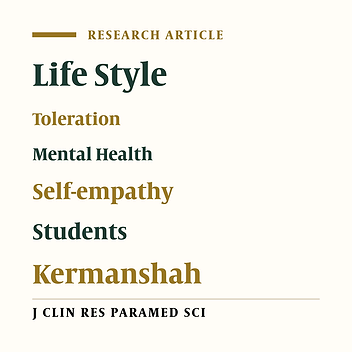
Image Credit:J Clin Res Paramed Sci
Authors
Introduction: This study was carried out to determine the relationship among life style and toleration, on the one hand, and mental health and self-empathy among the students in Razi University of Kermanshah in 2014, on the other.
Methods: This was a descriptive – analytical and correlational type of research. The research population included all the students at Razi University among whom 376 students (188 male and 188 female) were selected via the multi-stage cluster sampling. To collect the data the questionnaires of living style (Miller & Smith, 2003), toleration (Coner & Davidson, 2003), living style and self-empathy were used. The collected data were analyzed using data analysis software SPSS version 19 through the statistical technics of Pearson Correlation Coefficient, and Regression analysis
Results: The findings showed correlations between living style and mental health (p=32%), living style and self-empathy (p=18%). Also, toleration and mental health (p=46%), as well as toleration and self-empathy (p=29%) revealed significant correlation at (P˂0/05) level. The regression analysis result showed that the factors of living style and toleration could predict the 23% of the changes in mental health collaboratively, and their weight was β=0/15 and β=0/39 respectively. In addition it showed that the factors of living style and toleration, collaboratively, could predict 0/09 of the changes of self-empathy.
Conclusion: Considering the results of this study it can be claimed that any enhancement in living style and toleration would result in the improvement of mental health and self-empathy.
© 2016, Journal of Clinical Research in Paramedical Sciences. This open-access article is available under the Creative Commons Attribution-NonCommercial 4.0 (CC BY-NC 4.0) International License (https://creativecommons.org/licenses/by-nc/4.0/), which allows for the copying and redistribution of the material only for noncommercial purposes, provided that the original work is properly cited.
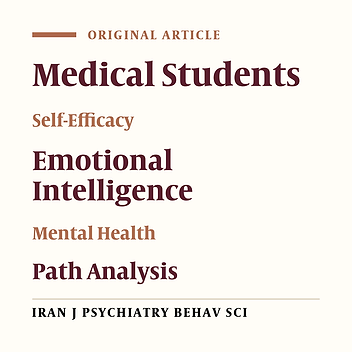
Heidari Gorji AM, Shafizad M, Soleimani A, Darabinia M, Goudarzian AH. Path Analysis of Self-Efficacy, Critical Thinking Skills and Emotional Intelligence for Mental Health of Medical Students. Iran J Psychiatry Behav Sci. 2018;12(4):e59487. doi: https://doi.org/10.5812/ijpbs.59487
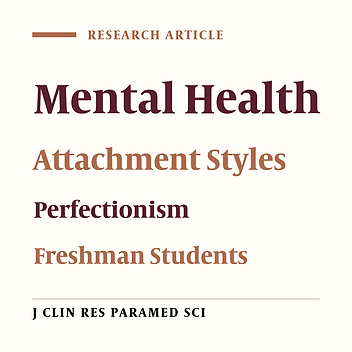
Abaspour P, Ahmadi S, Ahmadi SM, Seyedi Asl ST. The Role of Attachment Styles and Perfectionism in Predicting of Students' Mental Health. J Clin Res Paramed Sci. 2014;3(3):e82117. doi:
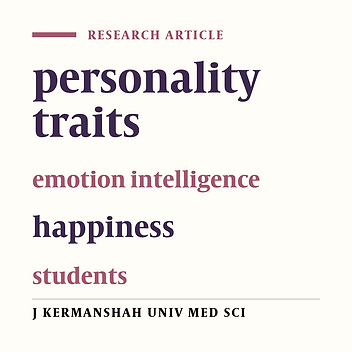
Bahadori Khosroshahi J, Hashemi Nosrat Abad T, Mashinchi Abassi N. The relationship between personality traits, emotional intelligence and happiness among university students. J Kermanshah Univ Med Sci. 2013;16(6):e77339. doi:
Iranfar S, Sepahi V, Khoshay A, Keshavarzi F. The Relationship between Critical Thinking Disposition and Self-Esteem. Educ Res Med Sci. 2014;2(2):e77225. doi:
Safaee pour Zamanee M, Arefi M. The relation between coping styles and perceived stress in nurses of educational hospitals in Kermanshah University of medical sciences. J Clin Res Paramed Sci. 2015;4(1):e81951. doi:
Last Update: 4 days ago
Last Update: 4 days ago
Last Update: 4 days ago
Last Update: 3 hours ago
Last Update: 6 hours ago
Last Update: 4 days ago