
1. Context
If there is any sector that has been and is still lagging behind in the history of Africa as a continent is healthcare sector (1). This started way back from the history of Africa where each community is defined by its tribe, norms, cultural beliefs and traditional set-up, which governs their overall well being in terms of healthcare services, education, rules and regulations and the wellness of the people at large (2). In majority of African sectors for example agriculture, power, and health, there has never been a deeper experience on the useful benefits and impact of technology. That is why about 65.0% of Africa’s teeming population engaged in farming, which is also a reason behind prevalent lack of electricity in remote areas. Eventually modern technologies are making positive impact on our lives averagely (1). Most of the countries in this region (Africa) are poor in nature, lacks resources, infrastructure and healthcare facilities, as a result they experience either one or more kind of disease outbreaks occasionally example, malaria fever, dengue, Ebola, and recently COVID-19 where thousands of people died from either one, or more or all of the disease mentioned due to unavailability of adequate health care facilities especially in the rural part of this region (3). Modern IT and digital health has been used in recent time for non-communicable disease treatments like cancer, child and maternal health care. The use of societal digitization is emphasized where one can easily find a solution using a common Bluetooth device and mobile phone within the available network which on the other hand saves times, cheaper, easy accesses. image-based mobile technologies (M-health), use of artificial intelligence are among the most recent information technology in health care services (4). It also provides correlation of medical devices such as the internet of things (IoT). The IoT refers to a system of interrelated, internet-connected objects that are able to collect and transfer data over a wireless network without human intervention. The main purpose of IoT devices is to generate real-time data that we can then analyze and use to create desired outcomes. An IoT device is a piece of hardware with a sensor that transmits data from one place to another over the Internet. Examples of IoT devices include wireless sensors, software, and computer devices. They can be embedded into mobile devices, environmental sensors, medical devices, and more. This study aimed at reviewing the positive effects of modern IT in the provision of healthcare services in Africa.
2. Methods
The study aimed at finding out how IT can be used in health care service provisions in rural communities of Africa. The objectives was to review previous studies and researches conducted by WHO, UN reports and others about healthcare in Africa and to also identify the use of modern IT in healthcare provision, treatment and awareness of the use of those devices (IT) in healthcare services.
A review of several research articles was conducted from March to June, of the year 2020 to find out how modern information technology (IT) has transformed lives in healthcare services provisions and availability in African countries. Internet search through Google was carried out to collect relevant information from published research articles and other related reports. All published articles and reports mainly concern with implementation of IT in healthcare facilities and provisions specifically in regional Africa, rural communities and cities in African countries for example: Nigeria, Tanzania, Kenya, Uganda, Rwanda, Kenya, Ghana, South Africa, Zambia, Gambia, etc. were included. Socio-demographic factors like gender, age, profession were not considered in this review. The countries reviewed in this study cover all the geographical location of Africa (South, North, Central, East and West).
3. Results
3.1. Based on Literature Review Perspective
The fast few decades there is change from the early use of cultural primitive form of health care to a modern information technology (IT) based services such as digital health (DH) or e-health in a different context. DH is the use of ICT in health care services (5). According to previous reports, pioneering strategies like digital health are considered necessary to ensure accomplishment of the striving Universal Health Coverage (UHC) in Africa being one of most significant agenda of sustainable development goals (SDG) and World Health Organization (WHO). Current and future regulations on medical devices in some of African countries were examined and compared. Proposed future approaches and strategies supported by emerging information technologies as a means to enhance health care provision in rural communities especially in Africa. Africa as a continent quite a number of modern technological equipment’s are installed and used, all required tools, machines, are put in place and the health care practitioners are also trained on how to use the modern technology and all programs are implemented. Applicable in medicine and public health (electronic health records), isolated health care services (telemedicine/telex-health), virtual learning for health workers (e-learning) (Table 1) (6). Part of its commitments towards achieving adequate health care facilities, the organizations signed an agreement in October 2017 (5).
Table 1.
Classification of Type of Healthcare, Programs and IT Use
| Program | Type of IT Used | Health Care |
|---|---|---|
| Digital health care | Wireless sensors and Bluetooth | Treatment, prescription and drug administration, and lab test |
| Imaged based M technology | IoT, Mobile phones, telex, and wireless sensors | Diagnosis and treatment |
| Isolated healthcare services | Ultrasound, telex, Zigbee, mobile phones, computers, and internet | Medication and treatment |
| Electronic health care records and electronic cardiograph | IoT, computers, Bluetooth, Zigbee, and wireless sensors. ECG machine which works using electrical signal | IoT. Diagnosis of ailments, detection of irregularities in hearth normal rhythm |
| Virtual learning | Computers, mobile phones, internet, tablets, and etc | Health care workers |
The agreement comprises the fallowing four agenda:
Scalability and interoperability;
Capacity building;
Stakeholder engagement; and
Digital clinic innovation.
3.2. Modern Information Technology in African Health Sector
Considering some of the psychological factors like rate of puberty, socioeconomic status of most of the people residing in rural communities and villages of Africa, therefore the simplest and easily accessed information technology (IT) are usually considered and used in the health care service provisions. Modern information technology in healthcare are used also to develop personal health using wearable tools that transform imperative symbols to essential repositories. Example, digital aided detection of tuberculosis by chest x-ray is employed in Zambia, South Africa, and the Gambia. Use of m Health/telemedicine solutions (ultrasound) in order to reduce outbreaks in Tanzania, Rapid Diagnostic tests (RDT) incorporated in cloud-based m-Health Smart reader are deployed in Kenya, Tanzania, and Ghana, while Smartphone-powered, cloud-enabled handy convenient electrocardiograph (ECG) are established in Uganda and Malawi (5).
So far the sway of modern information technology (IT) in health care services in Africa in the last decade could not go unnoticed. Nevertheless, Africans health care system encountered many profound challenges such as:
Getting access is one of the major challenges to health care services and delivery in Africa, less than 50.0% of Africans have access to modern health care facilities.
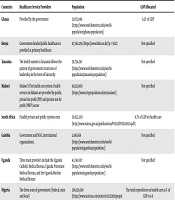
The number of health care service providers in African countries compared to their population is very few (Table 2).
Table 2.
African Countries, Population, Healthcare Providers and Their GDP
| Countries | Healthcare Service Providers | Population | GDP Allocated |
|---|---|---|---|
| Ghana | Provided by the government | 31,072,940 (https://www.worldometers.info/world-population/ghana-population/) | 6.2% of GDP |
| Kenya | Government-funded public healthcare is provided at primary healthcare | 47,564,296 (https://www.knbs.or.ke/?p = 5621) | Not specified |
| Tanzania | The health system in Tanzania follows the pattern of government structures of leadership in the form of hierarchy | 59,734,218 (https://www.worldometers.info/world-population/tanzania-population/) | Not specified |
| Malawi | Malawi X The health care system. Health services in Malawi are provided by public, private for profit (PFP) and private not for profit (PNFP) sector | 16,832,900 (https://www.citypopulation.de/en/malawi/) | Not specified |
| South Africa | Parallel private and public systems exist | 59,622,350 (http://www.statssa.gov.za/publications/P0302/P03022020.pdf) | 8.7% of GDP on health care |
| Gambia | Government and NGO, international organizations. | 2,416,668 (https://www.worldometers.info/world-population/gambia-population/) | Not specified |
| Uganda | Three main providers include the Uganda Catholic Medical Bureau, Uganda Protestant Medical Bureau, and the Uganda Muslim Medical Bureau | 45,741,007 (https://www.worldometers.info/world-population/uganda-population/) | Not specified |
| Nigeria | The three arms of government (Federal, state and local) | 206,139,589 (https://www.statista.com/statistics/1122838/population-of-nigeria/) | The total expenditure on health care as % of GDP is 4.6 |
| Mali | International development organizations and foreign missionary groups. | 14,528,662 9 (https://www.worldometers.info/world-population/mali-population/) | 4.3 % (GDP) |
The effect of corruption reducing the amount of resources that could be managed in health care delivery and reduces patient access to services.
Advancement in technology gave chances of producing fake drugs that are hard to identify.
Also, there is a shortage of well trained health care professionals in Africa, most of them want to live and work in abroad (US. and Europe) (7).
Some of African countries spend less than 10% of their GDP in health care services.
4. Discussion
The increase in patient-centric advances to healthcare would increase access. Easy channel of information and modify technology, enhanced custom-made tools and methods for improving wellness. In Africa, mobile tools and telemedicine sustain community nurses in supervisory and ensure flawless connection with community healthcare workers and medical doctors. Audio and text messages are used for patient education, reducing the menace of cardiovascular disease and supporting devotion to therapy. Rwanda is the first country in the world to integrate drone technology into its healthcare system recently, for blood transfusions. Tanzania also employs analogous approach (8). However not all are IT based solutions. Kigali Rwanda’s Capital had a car-free ride day in every month to encourage wellness through walking and cycling. Only very few European or American are able to achieve this type of development. They also engaged in recruitment and training the local people in rural areas to become health educators. The health educators are responsible to inform people about vital health, disease control and the significance of medical checkup from time to time. The programs also consist of local groups’ team with doctors to construct health camps in villages. These are mobile health centers that offer access to selection, diagnosis and treatment. These programs encourage piloting an e-healthcare scheme connecting villagers with medical doctors in healthcare centers, which conveys quality healthcare services more rapidly to rural communities (8, 9). Sponsorship for stronger digital health and technology based medical and health care governance, leadership, funding and development, implementation, supervision, monitoring, and evaluation of strategies and operational plans would provide opportunities to evaluate the outcomes and impacts of IT healthcare facilities. WHO-ITU Africa partnership, African Alliance for Digital Health Networks and Digital reach initiatives endow with platforms for swiftly attaining the possible measures and should be take care of in order to be fulfilled by all stakeholders.
5. Conclusions
Currently most of the African countries have collaborated with UNICEF, WHO, and other NGOs like Save the Children, Malaria Consortium and many more in order to provide staffs, infrastructure and equipment’s especially in rural communities of Africa. The findings of this study clearly shows the positive impact of information technology (IT) such as application and use of wireless sensor networks and other electronic devices in health care service delivery, diagnosing and determination of infectious diseases such as corona virus and other pathogens affecting mankind. African countries are presently making use of several IT devices in health care services in their hospitals and domestics. However up to this date a quite number of challenges are faced by healthcare sector in Africa such as shortage of medical and health care practitioners; lack of infrastructure; and shortage of funds. Authors recommended a future study to identify the role, impact, acceptance and availability of modern information technology in the health sector of African countries.