
1. Background
Productivity is a fundamental issue with a history of several years at different levels and in various economic, social, and industrial activities (1). Among the available capital, human power occupies a prominent position. The progress of any nation depends on the work and efforts of all sections of society (2). Productivity evaluates the performance of these activities and actions in different economic and social sectors. In addition, organizational productivity is a determining factor for salaries, prices, and other production factors (3). Productivity ratios are used for controlling production processes and comparing the performance of institutions (4).
Productivity growth is one of the most basic ways to increase production and, ultimately, ensure the well-being of people in societies. Therefore, identifying the influential factors to increase productivity is one of the main goals of researchers (5). The primary goal of management in any organization is to maximize the use of various resources and possibilities, including labor, capital, materials, energy, and information. There are different opinions in determining the influential factors on productivity, and each scientist and expert identifies the parameters as significant (1-3).
Human resources play a significant role in the quality and quantity of that organization’s achievements as one of any organization’s primary factors and institutions (6). The growth and development of human resources and increasing the workforce’s skills, creativity, and knowledge at all organizational levels have been strategic priorities for managers since the 90 s (7).
The productivity of human resources and their contribution to the production of goods and services are now more critical than ever. Productivity strategies involve paying attention to human resources (8). On the other hand, since limited and expensive resources are available and the cost price needs to be reduced to be competitive, management has focused on productivity in recent decades. Therefore, improving productivity is essential in helping organizations (9).
Even though the hospital system is one of the critical players in providing medical services, and its improvement enhances the health system (9-11), limited attention has been paid to this issue. Paying attention to the importance and dimensions of productivity has helped hospital managers better understand the factors affecting the productivity of hospitals and management plans (12).
2. Objectives
The factors affecting the productivity of hospitals should be identified based on the factors mentioned above. Therefore, the main objective of the present study was to rank the factors affecting productivity in Ahvaz hospitals using the analytic network process (ANP) technique.
3. Methods
The population of the present study was 60 personnel of Razi, Imam Khomeini, and Abuzar hospitals (60 in each) in Ahvaz, Iran, who were selected by purposive sampling method with sufficient and complete familiarity with productivity. The inclusion criteria included work experience (at least five years) and educational level (at least a bachelor’s degree).
The library method, including articles, theses, the internet, books, and journals, were used to collect the theoretical foundations and research background. A researcher-made questionnaire was adapted from previous similar studies’ questionnaires to collect data (13). In this research, the hourly pairwise comparison model was used to design the mentioned questionnaire. Based on the obtained numbers, the relative importance of the criteria was estimated (Table 1). The validity of the researcher-made questionnaire was assessed using the content validity method. The reliability of the questionnaire was calculated using Cronbach’s alpha coefficient test via SPSS software (0.87). Finally, the questionnaires were distributed among the population.
Table 1.
Scoring Method of the Nine-Hour Scale Based on the Analytic Network Process Technique
| Values | Comparison Status of “i” Compared to “j” | Description |
|---|---|---|
| 1 | Equally preferred | Index "i" has equal importance to "j." |
| 3 | Moderately preferred | Index "i" is slightly more critical than "j." |
| 5 | Strongly preferred | Index "i" is more important than "j." |
| 7 | Very strongly preferred | Index "i" has much more priority than "j." |
| 9 | Extremely preferred | Index "i" is more important than "j" and is not comparable to "j." |
| 2-4-6-8 | Interstitial status | Intermediate values; for example, 8 indicates higher importance than seven and lower than 9 for "i." |
In the present study, the independent variables included economic, technological, human, and managerial factors and the productivity in hospitals was evaluated as a dependent variable. Moreover, the researcher considered various sub-criteria for each independent variable based on the research background and the opinions of scientific experts. After prioritizing these factors using the ANP method, the effect of these factors on hospital productivity was evaluated. Table 2 presents the main factors (independent variables) and related sub-criteria.
Table 2.
The Main Factors and Sub-criteria Affecting the Productivity of Hospitals
| Factor | Symbol | Sub-criteria | Symbol |
|---|---|---|---|
| Human factors | F1 | Work experience | C1-1 |
| Number of specialist physicians | C1-2 | ||
| Number of nurses | C1-3 | ||
| Commitment and work conscience | C1-4 | ||
| Communication with colleagues | C1-5 | ||
| Highly educated staff | C1-6 | ||
| Management factors | F2 | Equitable division of work | C2-1 |
| Attention to the performance of employees | C2-2 | ||
| Use of incentive systems | C2-3 | ||
| Employee participation in decision making | C2-4 | ||
| Supervise the work of personnel | C2-5 | ||
| Competence of the manager | C2-6 | ||
| Customer relation management | C2-7 | ||
| Economic factors | F3 | The existence of a salary payment system based on employee performance | C3-1 |
| Allocation of sufficient funds from the Ministry of Health to the hospital | C3-2 | ||
| Saving hospital input resources | C3-3 | ||
| Removing the stock of consumables goods from the hospital | C3-4 | ||
| Outsourcing some hospital affairs | C3-5 | ||
| Technical and technological factors | F4 | Access to sufficient quality tools and equipment | C4-1 |
| The percentage of technology and technology development in the hospital | C4-2 | ||
| The percentage of up-to-date and efficient tools and equipment | C4-3 | ||
| Hospital bed occupancy percentage per year | C4-4 |
Analytic network process method and Super-Decision software were used to analyze the questionnaire data and prioritize the factors affecting hospital productivity. First, the main factors were compared in pairs based on the study’s primary purpose. The weights of the elements were calculated by a group of experts using the geometric mean technique and normalizing the results. The obtained weighted numbers show the importance coefficient of each main criterion. In the next step, the sub-criteria related to each main factor were compared in pairs.
4. Results
4.1. Prioritizing the Main Factors
The results of prioritizing the main factors affecting the productivity of Ahvaz hospitals showed that management factors (normalized weight (NW) = 0.294), economic factors (NW = 0.269), human factors (NW = 0.267), and technological factors (NW = 0.171) were placed in the first to fourth priority respectively. The inconsistent rate of the conducted comparisons was 0.011, which is smaller than 0.1; therefore, the performed comparisons can be trusted (Table 3).
Table 3.
Prioritizing the Main Factors
| Symbol | Factor | F1 (Human Factors) | F2 (Management Factors) | F3 (Economic Factors) | F4 (Technological Factors) | NW |
|---|---|---|---|---|---|---|
| F1 | Human factors | 1 | 0.801 | 1.049 | 1.678 | 0.267 |
| F2 | Management factors | 1.248 | 1 | 1.217 | 1.360 | 0.294 |
| F3 | Economic factors | 0.953 | 0.822 | 1 | 1.857 | 0.269 |
| F4 | Technological factors | 0.596 | 0.735 | 0.538 | 1 | 0.171 |
Abbreviation: NW, normalized weight.
4.2. Prioritizing Sub-criteria Related to Human Factors
The sub-criteria of employees with higher education (NW = 0.263), number of nurses (NW = 0.245), work experience (NW = 0.173), commitment and work conscientiousness (NW = 0.154), communication with colleagues (NW = 0.173), and number of specialist physicians (NW = 0.154) was placed in the first to sixth priorities, respectively. The inconsistent rate of the conducted comparisons was 0.081, which is smaller than 0.1, confirming the comparisons (Table 4).
Table 4.
Prioritizing Sub-criteria Related to Human Factors a
| Human Sub-factors | C1 | C2 | C3 | C4 | C5 | C6 | NW |
|---|---|---|---|---|---|---|---|
| C1 | 1 | 2.878 | 0.575 | 2.08 | 1.439 | 0.504 | 0.173 |
| C2 | 0.347 | 1 | 0.333 | 0.500 | 0.321 | 0.354 | 0.065 |
| C3 | 1.739 | 3.003 | 1 | 2.153 | 1.740 | 1.047 | 0.245 |
| C4 | 0.480 | 2 | 0.464 | 1 | 0.475 | 0.4 | 0.099 |
| C5 | 0.695 | 3.115 | 0.575 | 2.105 | 1 | 0.453 | 0.154 |
| C6 | 1.984 | 2.825 | 0.955 | 2.500 | 2.208 | 1 | 0.263 |
Abbreviation: NW, normalized weight.
a C1: Work experience; C2: Number of specialist physicians; C3: Number of nurses; C4: Communication with colleagues; C5: Commitment and work conscience; C6: Higher educated employees.
4.3. Prioritizing Sub-criteria Related to Managerial Factors
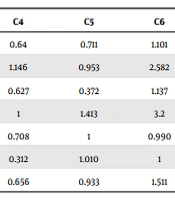
The sub-criteria of employee participation in decision-making (NW = 0.202), attention to the employees’ performance (NW = 0.173), supervision of personnel work (NW = 0.160), customer relationship management (NW = 0.147), fair division of labor (NW = 0.137), manager competence (NW = 0.095) and use of incentive systems (NW = 0.085) were placed in the first to seventh priority, respectively. The inconsistency rate of the performed comparisons was 0.068, which is smaller than 0.1 and confirms the comparisons (Table 5).
Table 5.
Prioritizing Sub-criteria Related to Managerial Factors a
| Managerial Sub-factors | C1 | C2 | C3 | C4 | C5 | C6 | C7 | NW |
|---|---|---|---|---|---|---|---|---|
| C1 | 1 | 0.846 | 2.188 | 0.64 | 0.711 | 1.101 | 1.177 | 0.137 |
| C2 | 1.182 | 1 | 1.512 | 1.146 | 0.953 | 2.582 | 1.072 | 0.173 |
| C3 | 0.457 | 0.661 | 1 | 0.627 | 0.372 | 1.137 | 0.398 | 0.085 |
| C4 | 1.558 | 0.8726 | 1.595 | 1 | 1.413 | 3.2 | 1.524 | 0.202 |
| C5 | 1.406 | 1.049 | 2.688 | 0.708 | 1 | 0.990 | 1.072 | 0.160 |
| C6 | 0.908 | 0.387 | 0.880 | 0.312 | 1.010 | 1 | 0.662 | 0.095 |
| C7 | 0.850 | 0.933 | 2.513 | 0.656 | 0.933 | 1.511 | 1 | 0.147 |
Abbreviation: NW, normalized weight.
a C1: Fair division of work; C2: Pay attention to the performance of employees; C3: Use of incentive systems; C4: Employee participation in decision-making; C5: Monitor the work of the personnel; C6: Manager competence; C7: Customer relation management.
4.4. Prioritizing Sub-criteria Related to Economic Factors
The following criteria for payroll payments based on staff performance (NW = 0.332), hospital entrance savings (NW = 0.243), sufficient funding from the ministry of health to the hospital (NW = 0.228), the removal of hospital consumer goods warehouses (NW = 0.117), and outsourcing some hospital affairs (NW = 0.080) were the first to fifth priority, respectively. A rate of 0.070 incompatibilities was obtained between the comparisons, which is less than 0.1, so the comparisons can be trusted (Table 6).
Table 6.
Prioritizing Sub-criteria Related to Economic Factors a
| Economic Sub-factors | C1 | C2 | C3 | C4 | C5 | NW |
|---|---|---|---|---|---|---|
| C1 | 1 | 2.065 | 1.988 | 2.411 | 2.357 | 0.332 |
| C2 | 0.484 | 1 | 1.253 | 2.471 | 2.389 | 0.228 |
| C3 | 0.503 | 0.798 | 1 | 3.588 | 3.424 | 0.243 |
| C4 | 0.415 | 0.405 | 0.279 | 1 | 2.770 | 0.117 |
| C5 | 0.424 | 0.419 | 0.292 | 0.361 | 1 | 0.080 |
Abbreviation: NW, normalized weight.
a C1: Payroll payments based on staff performance; C2: Sufficient funding from the ministry of health to the hospital; C3: Hospital entrance savings; C4: Removal of hospital consumer goods warehouses; C5: Outsourcing some hospital affairs.
4.5. Prioritizing Sub-criteria Related to Technological Factors
The percentage of up-to-date and efficient tools and equipment criteria (NW = 0.269), access to sufficient quality equipment (NW = 0.266), the percentage of bed occupation per year (NW = 0.238) and the percentage of technology development in the hospital (NW = 0.227) were the first to fourth priority, respectively. The incompatibility rate of the comparisons was 0.064, which is smaller than 0.1 and confirms the comparisons (Table 7).
Table 7.
Prioritizing Sub-criteria Related to Technological Factors a
| Technological Sub-factors | C1 | C2 | C3 | C4 | NW |
|---|---|---|---|---|---|
| C1 | 1 | 1.611 | 0.864 | 0.935 | 0.266 |
| C2 | 0.621 | 1 | 1.481 | 0.748 | 0.227 |
| C3 | 1.157 | 0.675 | 1 | 1.736 | 0.269 |
| C4 | 1.070 | 1.336 | 0.576 | 1 | 0.238 |
Abbreviation: NW, normalized weight.
a C1: Access to sufficient quality equipment; C2: The percentage of technology development in the hospital; C3: The percentage of up-to-date and efficient tools and equipment; C4: The percentage of bed occupation per year.
5. Discussion
The results showed that prioritization of the main factors affecting the productivity of Ahvaz hospitals, respectively, included managerial factors (first priority), economic factors (second priority), human factors (third priority), and technological factors (fourth priority). Due to the importance of managerial sub-criteria in Ahvaz hospitals, management issues, such as planning, control, leadership, coordination, and organization, have the most excellent effectiveness. Therefore, the mentioned parameters should be considered to increase the hospital’s productivity further. Economic factors indicate that economic subordinates, including paying salaries commensurate with employee performance and considering sufficient funding by the ministry of health, had moderate effectiveness in the productivity of Ahvaz hospitals. Although human and technological factors were the third and fourth priority in influencing the productivity of Ahvaz hospitals, hospital administrators should not ignore the influential criteria for these factors.
Due to the priority of the sub-criteria related to human factors, the higher education employees’ sub-criteria, number of nurses, work experience, commitment and work conscience, communication, and number of experts were the first to sixth priority. Higher education employees’ sub-criteria as a first priority and number of nurses as the second priority from the perspective of hospital administrators and experts indicates that the number of staff and nurses in Ahvaz hospitals is more important for respondents. The shortage of human resources in Ahvaz hospitals has many problems in providing patient services. In addition, the economic inflation in the community, poor economy of the country, and devaluation of the country’s common currency encourage many nurses and physicians to immigrate to European countries and live a prosperous life without stress and anxiety. Work experience, commitment, work conscience, and the relationship between colleagues were considered by managers of Ahvaz hospitals. The combination of experience, a sense of responsibility, and communication between colleagues in Ahvaz hospitals can be practical and beneficial in enhancing patient satisfaction.
Regarding sub-criteria related to managerial factors, sub-criteria employee participation in decision making, subjects paying employee performance, monitoring personnel work and customer relationship management, fair work division, the manager’s competence, and the use of incentive systems were the first to the seventh priority. The sub-criteria of staff participation in decision-making as the first priority indicates that senior and middle hospital administrators mainly make decisions in Ahvaz hospitals and that hospital staff is less involved in decisions. Regarding the sub-criteria of staff performance as the second priority, the optimal performance of employees in providing services to patients can increase the hospital’s productivity. In addition, fair labor division was less observed in Ahvaz hospitals. Ahvaz hospital administrators lack the necessary and sufficient competence to manage hospital staff and have low incentive systems for increasing productivity in Ahvaz hospitals.
In terms of priority of the sub-criteria related to economic factors, sub-criteria of the existence of a payment system based on employees’ performance, savings in hospital input resources, sufficient budget allocation by the ministry of health to the hospital, removal of the warehouse of the hospital’s consumer goods, and outsourcing of the hospital affairs were the first to the fifth priority. The reason for the payment system based on employees’ performance as the first priority indicates that the respondents pay more attention to the payroll status because personnel expects to get better and more wages for doing better and more work in the hospital. According to the respondents, sufficient funding from the ministry of health to purchase equipment was not allocated to Ahvaz hospitals. Ahvaz hospitals have faced many problems in providing patient services, such as hospital bed shortages and CT scans, ultrasound, and MRI deficiency.
Prioritization of technological sub-criteria, including up-to-date and efficient tools and equipment, access to sufficient quality equipment, percentage of bed occupation per year, and technology development in the hospital, were the first to the fourth priority. The possible reason for the up-to-date and efficient tool as the first priority and access to sufficient quality equipment as a second priority may be the high efficiency and easy availability of the hospital equipment. Devices related to colored CT scans, MRIs, and 3D ultrasounds are essential for staff and managers of Ahvaz hospitals. Today, many diseases are impossible with old equipment and require advanced technologies.
The results of this study were in line with those of some previous studies. The results did not match the findings of Jodaki and Hasanpour, who identified influential factors in increasing employee productivity in the National Iranian Standard Organization using the ANP technique (14). The results were inconsistent with those of Ravangard et al., who prioritized factors affecting staff productivity at the hospitals of Shiraz University of Medical Sciences (7). Husseini et al. ranked factors affecting the productivity of the human resource of the Doroud Cement Factory by ANP technique (15) and found that the results were incompatible with those of this study. In addition, the results of some other studies, including Luturlean et al. (16), Mosadeghrad et al. (17), and Kiani and Radfard (13), were consistent with those of this study but did not match with those of Ali et al. (4).
5.1. Limitations
As a primary data collection tool, the questionnaire can be inaccurate due to bias and similar errors that exist in general, reducing the accuracy of the results. Some respondents lacked cooperation in completing the questionnaire, which was another limitation of this study. The present study had other limitations, including a lack of understanding by some respondents of how to answer questionnaire questions and inadequate awareness of the research goals by some respondents.
5.2. Conclusions
Based on the results, factors such as improper management of hospitals, bureaucracy governing hospitals, lack of regulatory inspection mechanisms and human resources, unrealistic tariffs for diagnostic-therapy services, incomplete implementation of the new hospital administration plan, and low wages were the most critical obstacles to promoting productivity in Ahvaz hospitals. Therefore, it is necessary to increase the efficiency of Ahvaz hospitals by improving the hospital management level and full implementation of the new hospital administration plan.