
1. Background
Panic disorder is one of the most debilitating anxiety conditions and is characterized by sudden, recurrent episodes of intense fear and physiological hyperarousal (1). Patients frequently experience distressing somatic symptoms, including palpitations, dyspnea, chest discomfort, and dizziness, which they may misinterpret as signs of imminent life-threatening events, such as heart attacks (2). In addition to the acute distress of individual attacks, persistent anticipatory anxiety about future episodes triggers avoidance behaviors that severely impair social, occupational, and daily functioning (3). This ongoing fear of recurrence fosters chronic vulnerability, making recovery particularly challenging for clinicians and patients (4).
Meta-worry, defined as worrying about worrying and holding dysfunctional metacognitive beliefs, is an important cognitive mechanism underlying the persistence of panic disorder (5). Patients frequently develop catastrophic interpretations of their own cognitive processes, believing that uncontrollable worry poses serious physical or mental dangers (6). In panic disorder, meta-worry amplifies baseline anxiety through a self-perpetuating cycle in which negative expectations reinforce interoceptive hypervigilance (7). This heightened monitoring increases the likelihood of misinterpreting benign physiological sensations, thereby escalating symptom intensity and maintaining vulnerability to panic (8). Consequently, meta-worry is a central cognitive factor that prevents spontaneous remission and increases overall clinical severity (9).
Emotional reactivity compounds this cognitive dysregulation and is defined as the tendency to experience negative emotions with heightened sensitivity, greater intensity, and prolonged duration (10). Patients with panic disorder exhibit pronounced reactivity to internal physiological changes and external stressors (11). They perceive subtle bodily changes as immediate threats. This perception rapidly increases emotional distress and hinders a return to affective equilibrium (12). Elevated emotional reactivity intensifies acute panic responses and depletes regulatory resources, trapping patients in a continuing cycle of emotional volatility and anticipatory fear (13). Addressing emotional reactivity is therefore essential to disrupting the physiological and affective processes underlying panic disorder (14).
Conventional approaches, including pharmacological agents and standard cognitive behavioral therapy (CBT), have long served as primary interventions for panic disorder. Although these approaches show moderate efficacy in reducing symptoms, a substantial proportion of patients continue to experience residual symptoms, relapse, or treatment resistance (15). Pharmacotherapy may involve adverse effects and risks of dependency, whereas conventional CBT may be less effective at rapidly changing deeply ingrained automatic affective responses and subconscious cognitive biases (16). These gaps highlight the need for integrative psychological interventions that target both conscious metacognitive structures and implicit emotional processes.
Cognitive hypnotherapy is a promising integrative intervention that combines cognitive restructuring techniques from CBT with the heightened suggestibility and focused absorption of hypnosis (17). By inducing an altered state of consciousness, it may facilitate access to implicit cognitive schemas, potentially bypassing conscious analytical resistance and enabling deeper cognitive restructuring (18). Previous studies indicate that cognitive hypnotherapy targets automatic negative thoughts, enhances emotion regulation, and reduces anxiety-related symptoms across clinical populations (8, 19). In panic disorder, combining hypnotic suggestions with cognitive interventions may help patients reframe interoceptive threat appraisals and associate hypnotic relaxation responses with feared physiological sensations, thereby reducing cognitive and emotional reactivity (14).
Despite growing empirical support for cognitive hypnotherapy, few studies have systematically evaluated its efficacy in simultaneously reducing meta-worry and modulating emotional reactivity in patients with panic disorder. Addressing these cognitive and emotional targets is essential to developing comprehensive nonpharmacological protocols that produce sustained clinical outcomes. Given the chronic burden of panic disorder and the role of metacognitive and affective dysregulation in its maintenance, evaluating integrative interventions remains relevant. If effective, clinic-based cognitive hypnotherapy protocols could inform the design of more accessible mental health services, community-based anxiety programs, and broader health promotion strategies to reduce the public health impact of untreated panic disorder in resource-limited settings.
2. Objectives
This study aimed to determine the effectiveness of cognitive hypnotherapy in reducing meta-worry and emotional reactivity in patients with panic disorder.
3. Methods
3.1. Research Design and Participants
This pilot clinical trial included pretest, posttest, and 2-month follow-up assessments. The pilot design reflected the limited sample size and the exploratory evaluation of cognitive hypnotherapy for meta-worry and emotional reactivity in panic disorder. The study population consisted of outpatients aged 18 - 45 years with panic disorder who attended psychological counseling centers affiliated with Islamic Azad University and private clinical centers in Shiraz, Fars Province, Iran. Twenty eligible individuals were selected through purposive sampling based on psychiatric evaluations and the Structured Clinical Interview for the Diagnostic and Statistical Manual of Mental Disorders, Fifth Edition (SCID-5). The sample size was based on practical feasibility rather than a formal a priori power calculation. A target of 10 participants per group was chosen to permit preliminary estimation of effect sizes and assessment of the feasibility of the intervention protocol.
Eligible participants were randomly allocated in equal numbers to the experimental (n = 10) and control (n = 10) groups. An independent researcher who was not involved in recruitment or assessment generated a simple randomization sequence using the SPSS random number generator. The same researcher prepared sequentially numbered, opaque, sealed envelopes to conceal allocation. A research assistant enrolled participants and assigned them to groups, remaining unaware of the sequence until allocation.
Inclusion criteria were a formal clinical diagnosis of panic disorder according to DSM-5 criteria, age between 18 and 45 years, completion of at least lower secondary education, baseline scores above the mean on the Meta-Worry Questionnaire (MWQ) and Emotion Reactivity Scale (ERS), willingness to provide written informed consent, and no history of substance abuse or ongoing psychotherapeutic or pharmacological treatment. Exclusion criteria were initiation of psychiatric medication or psychotherapy during the trial, acute major life stressors, voluntary withdrawal, or absence from more than two intervention sessions. Ethical standards were observed by ensuring data confidentiality and participants’ freedom to withdraw at any time without affecting their clinical care. A CONSORT flow diagram (Figure 1) detailing the numbers of individuals assessed for eligibility, excluded (with reasons), randomized, treated, followed up, and analyzed is provided.
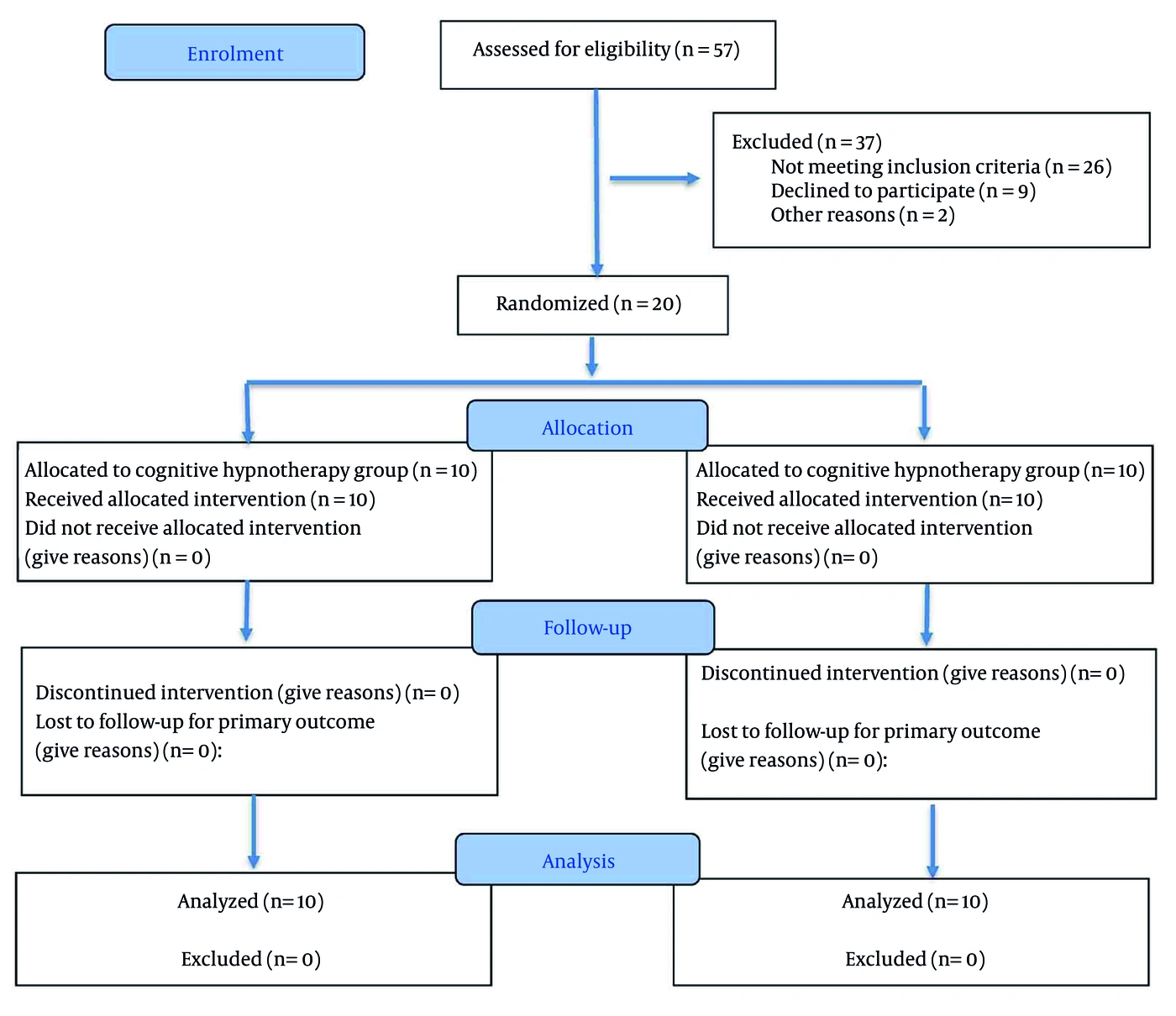
Figure 1.
CONSORT flow diagram
3.2. Measures
The prespecified primary outcomes were meta-worry and emotional reactivity. The Panic Disorder Severity Scale-Self-Report (PDSS-SR) was included as a secondary measure of overall clinical severity.
3.2.1. Panic Disorder Severity Scale-Self-Report
The PDSS-SR is a 7-item self-report instrument based on the Panic Disorder Severity Scale (PDSS) described by Shear et al. (20) and assesses the overall severity of panic disorder symptoms. Each item is scored on a 5-point Likert scale from 0 (“not at all”) to 4 (“extreme”), yielding a total score of 0 - 28; higher scores indicate greater clinical severity. The original PDSS showed test-retest reliability of 0.63 and internal consistency ranging from α = 0.92 to 0.94. The Persian PDSS-SR has been validated, with an internal consistency of α = 0.864 (21). Cronbach’s alpha in the present study was 0.86.
3.2.2. Meta-Worry Questionnaire
The MWQ, developed by Wells (22), is a 7-item instrument assessing the frequency of meta-worry and the strength of beliefs about the dangers of worrying. The frequency subscale was used in this study. Each item was scored from 1 to 4, and the scores for the seven items were summed to yield a total of 7 - 28; higher scores indicate more frequent meta-worry. Validation studies have reported internal consistency of α = 0.95 for the frequency subscale and α = 0.85 for the belief subscale, with construct validity in differentiating generalized anxiety disorder from somatic anxiety. The reported internal consistency of the Persian version was α = 0.71 (23). Cronbach’s alpha in the present study was 0.84.
3.2.3. Emotion Reactivity Scale
The ERS, developed by Nock et al. (24), is a 21-item self-report scale assessing three dimensions of emotional responsiveness: sensitivity (10 items), intensity (7 items), and persistence (4 items). Responses are scored on a 5-point Likert scale from 0 (“not at all like me”) to 4 (“completely like me”), with higher total scores indicating greater emotional reactivity. Psychometric evaluation of the original scale showed an overall Cronbach’s alpha of 0.94 and subscale coefficients ranging from 0.81 to 0.88. The Iranian version has shown high internal consistency (α = 0.92) and test-retest stability (r = 0.72) (25). Overall internal consistency in this trial was α = 0.81.
3.3. Intervention Protocol
The experimental group completed eight 90-minute cognitive hypnotherapy sessions delivered twice weekly. The intervention was administered by a licensed clinical psychologist with specialized training and certification in clinical hypnosis, including at least 100 hours of formal hypnotherapy training, and more than five years of experience treating anxiety disorders. The protocol integrated hypnosis with cognitive restructuring through hypnotic induction, ego strengthening, interoceptive desensitization, and metacognitive reframing. Treatment fidelity was monitored using therapist-completed checklists after each session and weekly supervision by an independent senior clinician experienced in cognitive hypnotherapy. The control group remained on a wait list and received no active intervention during the study. After the 2-month follow-up assessment, control participants were offered the same cognitive hypnotherapy protocol free of charge. Session content is summarized in Table 1.
Table 1.
Summary of the 8-Session Cognitive Hypnotherapy Protocol
| Session | Primary Objective | Summary of Content and Homework |
|---|---|---|
| 1 | Orientation, Assessment, and Demystification | Welcome and rapport building; psychoeducation on panic disorder and the fear cycle; addressing misconceptions about hypnosis (e.g., loss of control); establishing basic relaxation; homework: daily panic attack monitoring log. |
| 2 | Psychoeducation on Thoughts and Sensations | Reviewing logs; explaining the cycle connecting autonomic arousal, bodily sensations, and automatic negative thoughts; mild hypnotic trance induction via backward counting and calm imagery; conditioning relaxation to cue words; homework: self-hypnosis practice and logging catastrophic thoughts. |
| 3 | Identifying Automatic Thoughts | Reviewing homework; training in completing automatic thought records (e.g., "I'm dying"); deepening hypnotic trance; applying ego-strengthening techniques to foster self-efficacy in managing somatic distress; homework: daily thought records and self-hypnosis. |
| 4 | Metacognitive Reframing of Meta-Worry | Identifying worry about worrying (meta-worry); trance induction with metacognitive suggestions to decouple thoughts from reality ("thoughts are mental events, not facts"); replacing meta-worry with neutral or accepting thoughts; homework: detached mindfulness practice. |
| 5 | Imaginal Exposure and Desensitization | In-trance imaginal exposure to feared somatic cues (e.g., tachycardia, breathlessness) paired with conditioned relaxation (counter-conditioning); suggestions aimed at attenuating emotional reactivity to physiological sensations; homework: applying cue-controlled relaxation to mild bodily shifts. |
| 6 | Cognitive Restructuring and Behavioral Modification | In-trance reframing of catastrophic interoceptive interpretations into realistic/benign explanations; direct suggestions targeting safety-seeking behaviors and avoidance; homework: initiation of graded in vivo exposure to previously avoided situations. |
| 7 | Consolidation and Age Progression | Reviewing exposure progress; optional age regression in trance to reframe early traumatic/sensitizing experiences; age progression to visualize successful future coping; final ego-strengthening suggestions; homework: real-world skill implementation. |
| 8 | Termination and Relapse Prevention | Comprehensive review of acquired skills; formulating a self-care and relapse prevention strategy; identifying early warning signs; establishing self-hypnosis routines for long-term maintenance; final question-and-answer session. |
3.4. Procedure
Ethics approval was obtained from the Ethics Committee of Islamic Azad University, Ahvaz Branch, on 15 March 2026 (ID: IR.IAU.AHVAZ.REC.1405.152). The trial was prospectively registered in the Iranian Registry of Clinical Trials on 28 March 2026 (IRCT20260714070181N1), before participant enrollment began. Participants were recruited from clinical centers in Shiraz between 10 April and 25 May 2026. Eligible candidates were informed of the study objectives and provided written informed consent. They then completed baseline assessments using the study measures. The experimental group received eight sessions of cognitive hypnotherapy between 1 June and 15 July 2026. Both groups completed posttest assessments in late July 2026. Follow-up assessments were conducted two months after the intervention, in September 2026, to evaluate the short-term stability of therapeutic gains. No intervention-related adverse events were reported by participants or observed by the research team.
3.5. Statistical Analysis
Data were analyzed using IBM SPSS Statistics, version 27. Means and standard deviations were calculated. Normality was assessed using the Kolmogorov-Smirnov test and skewness and kurtosis indices. Mauchly’s test was used to assess sphericity, and Greenhouse-Geisser corrections were applied when this assumption was violated. Treatment efficacy and longitudinal stability were evaluated using mixed-model repeated-measures analysis of variance to examine the main effects of time and group and the time × group interaction. Post hoc pairwise comparisons were performed using Fisher’s least significant difference (LSD) test. Given the pilot design and limited number of planned comparisons, no additional multiplicity adjustment was applied; however, this increases the risk of type I error, and the results should be interpreted cautiously. Analyses used the intention-to-treat population, with no missing observations at any assessment. Effect sizes were reported as partial eta squared (η2), and 95% confidence intervals for mean differences were calculated where appropriate. Statistical significance was set at P < 0.05 for all tests.
4. Results
The sample comprised 20 participants with panic disorder who were randomized equally to the experimental and control groups. Female participants accounted for 55% (n = 11) of the sample, and male participants accounted for 45% (n = 9). Regarding age distribution, 46% of participants were aged 18 - 30 years, and 54% were aged 31 - 45 years. The mean age was 26.12 years for female participants and 34.57 years for male participants. Baseline demographic and clinical characteristics, including age, sex, and pretest scores on all outcome measures, were evenly distributed between groups, with no statistically significant baseline differences (all P > 0.05), supporting the integrity of randomization.
Table 2 presents means and standard deviations for meta-worry, emotional reactivity, and the secondary outcome of panic disorder severity across pretest, posttest, and 2-month follow-up assessments. In the experimental group, mean scores decreased from pretest to posttest for meta-worry (23.29 to 12.53), emotional reactivity (59.06 to 33.94), and scores on the Panic Disorder Severity Scale-Self-Report (PDSS-SR) (17.40 to 8.60). The reductions were maintained at follow-up, although this finding was preliminary. Scores in the control group remained relatively stable across all three assessments, reflecting the persistence of symptoms without an active intervention.
Table 2.
Descriptive Statistics for Meta-Worry, Emotional Reactivity, and Panic Disorder Severity Across Assessment Phases a
| Variable and Group | Pretest | Posttest | Follow-up |
|---|---|---|---|
| Meta-worry | |||
| Experimental | 23.29 ± 2.82 | 12.53 ± 2.29 | 13.06 ± 3.24 |
| Control | 23.41 ± 2.75 | 23.10 ± 2.90 | 23.25 ± 3.10 |
| Emotional reactivity | |||
| Experimental | 59.06 ± 5.10 | 33.94 ± 4.69 | 31.65 ± 5.64 |
| Control | 58.85 ± 5.20 | 58.50 ± 4.95 | 59.10 ± 5.35 |
| PDSS-SR | |||
| Experimental | 17.40 ± 3.15 | 8.60 ± 2.41 | 9.10 ± 2.85 |
| Control | 17.20 ± 3.08 | 16.90 ± 3.22 | 17.05 ± 3.15 |
a Values are expressed as mean ± SD. Abbreviations: SD, standard deviation; PDSS-SR, Panic Disorder Severity Scale-Self-Report.
Before inferential analysis, the assumptions of parametric testing were assessed. The Kolmogorov-Smirnov test supported normality for all variables (all P > 0.05). Skewness and kurtosis indices also supported normality: values for meta-worry (0.004 - 0.947), emotional reactivity (0.219 - 1.044), and PDSS-SR (0.112 - 0.876) were within the range of -1.5 to +1.5. Mauchly’s test indicated that the sphericity assumption was met for emotional reactivity and PDSS-SR (P > 0.05), permitting the use of statistics that assume sphericity. Sphericity was violated for meta-worry (P < 0.01), so the Greenhouse-Geisser correction was applied to adjust the degrees of freedom. No data were missing at any assessment, and all analyses used the complete intention-to-treat sample (n = 20).
A 2-group (experimental and control) × 3-time-point (pretest, posttest, and follow-up) mixed-model repeated-measures analysis of variance evaluated treatment efficacy. Table 3 shows significant main effects of time and group for all outcomes (P < 0.001). Significant time × group interactions were found for meta-worry (F = 157.15, P < 0.001, partial η2 = 0.70), emotional reactivity (F = 213.97, P < 0.001, partial η2 = 0.73), and PDSS-SR (F = 98.42, P < 0.001, partial η2 = 0.65).
Table 3.
Repeated-Measures Analysis of Variance for the Main Effects of Time and Group and the Time × Group Interaction a
| Variables and Sources | Sum of Squares | df | Mean Square | F | P | Partial η2 |
|---|---|---|---|---|---|---|
| Meta-worry | ||||||
| Time | 612.30 | 1.14 | 537.10 | 77.40 | < 0.001 | 0.81 |
| Group | 890.50 | 1.00 | 890.50 | 124.15 | < 0.001 | 0.67 |
| Time × Group | 1251.88 | 1.14 | 1089.18 | 157.15 | < 0.001 | 0.70 |
| Emotional reactivity | ||||||
| Time | 2080.40 | 2.00 | 1040.20 | 108.30 | < 0.001 | 0.66 |
| Group | 3120.15 | 1.00 | 3120.15 | 165.40 | < 0.001 | 0.70 |
| Time × Group | 4110.62 | 2.00 | 2055.31 | 213.97 | < 0.001 | 0.73 |
| PDSS-SR | ||||||
| Time | 485.20 | 2.00 | 242.60 | 52.15 | < 0.001 | 0.59 |
| Group | 612.80 | 1.00 | 612.80 | 78.30 | < 0.001 | 0.63 |
| Time × Group | 910.45 | 2.00 | 455.23 | 98.42 | < 0.001 | 0.65 |
a Abbreviations: df, degrees of freedom; PDSS-SR, Panic Disorder Severity Scale-Self-Report.
After significant interactions were identified, LSD post hoc pairwise comparisons examined changes within the experimental group (Table 4). Pretest-to-posttest reductions were significant for meta-worry (mean difference = 10.76; 95% confidence interval [CI], 9.65 - 11.87; P < 0.001), emotional reactivity (mean difference = 25.12; 95% CI, 23.15 - 27.09; P < 0.001), and PDSS-SR (mean difference = 8.80; 95% CI, 7.42 - 10.18; P < 0.001). Posttest-to-follow-up differences were not significant for meta-worry (P = 0.313), emotional reactivity (P = 0.465), or PDSS-SR (P = 0.412). These findings indicate preliminary maintenance of improvement over the 2-month follow-up period rather than formal statistical equivalence.
Table 4.
Least Significant Difference Post Hoc Pairwise Comparisons in the Experimental Group a
| Variables and Time Comparison | Mean Difference | Standard Error | 95% CI | P Value |
|---|---|---|---|---|
| Meta-worry | ||||
| Pretest vs. Posttest | 10.76 | 0.52 | [9.65, 11.87] | < 0.001 |
| Pretest vs. Follow-up | 10.23 | 0.93 | [8.25, 12.21] | < 0.001 |
| Posttest vs. Follow-up | -0.53 | 0.50 | [-1.60, 0.54] | 0.313 |
| Emotional reactivity | ||||
| Pretest vs. Posttest | 25.12 | 0.90 | [23.15, 27.09] | < 0.001 |
| Pretest vs. Follow-up | 27.41 | 1.09 | [25.05, 29.77] | < 0.001 |
| Posttest vs. Follow-up | 2.29 | 1.17 | [-0.25, 4.83] | 0.465 |
| PDSS-SR | ||||
| Pretest vs. Posttest | 8.80 | 0.65 | [7.42, 10.18] | < 0.001 |
| Pretest vs. Follow-up | 8.30 | 0.78 | [6.62, 9.98] | < 0.001 |
| Posttest vs. Follow-up | -0.50 | 0.58 | [-1.75, 0.75] | 0.412 |
a Abbreviations: CI, confidence interval; PDSS-SR, Panic Disorder Severity Scale-Self-Report.
5. Discussion
This study evaluated the efficacy of cognitive hypnotherapy in reducing meta-worry and emotional reactivity in patients with panic disorder and examined the short-term stability of these improvements over a 2-month follow-up period. The analyses supported the main hypotheses: cognitive hypnotherapy significantly reduced meta-worry and emotional reactivity at posttest, with preliminary evidence of maintenance over follow-up.
The reduction in meta-worry in the treatment group is consistent with the ability of cognitive hypnotherapy to target central metacognitive mechanisms that maintain panic disorder. Meta-worry, the catastrophic evaluation of one’s own worry processes, creates a self-perpetuating cycle in which patients perceive anxiety as uncontrollable, physically dangerous, or mentally damaging (26). Conventional cognitive interventions may struggle to rapidly change these deeply ingrained automatic metacognitive biases. Cognitive hypnotherapy may bypass analytical resistance by inducing focused absorption and heightened suggestibility. In this state, therapists can introduce metacognitive reframing suggestions that separate thoughts from perceived threats (18). Patients learn detached mindfulness, viewing worry as a transient mental event rather than an objective reality or imminent danger (6). This finding is consistent with Zhang et al. (8), who found that hypnotherapy combined with cognitive techniques reduced cognitive-attentional anxiety cycles, and Sadat Madani et al. (27), who reported the efficacy of cognitive hypnotherapy in restructuring metacognitive dysregulation in anxiety disorders. The magnitude of the reduction in this pilot study appears broadly comparable to the effect sizes reported in those investigations, although differences in samples and outcome measures limit direct numerical comparisons.
Similarly, the reduction in emotional reactivity reflects the potential synergy between hypnotic trance and interoceptive desensitization. Patients with panic disorder have heightened affective sensitivity and may interpret internal physiological changes, such as tachycardia, dyspnea, or dizziness, as immediate catastrophic threats, rapidly increasing autonomic arousal (28). Hypnotic trance may provide a neurocognitive environment that facilitates counterconditioning. Imaginal exposure to feared interoceptive cues during trance, paired with deep hypnotic relaxation and calming imagery, may weaken the conditioned association between somatic arousal and panic (29). Patients may consequently develop greater emotional self-efficacy and tolerance of emotional distress. This result is consistent with Eghdampanah Foumani et al. (30), who reported reduced difficulties in emotion regulation following cognitive hypnotherapy. Baskoro et al. (31) reviewed hypnosis-based interventions for physical noncommunicable diseases, including panic symptoms in cancer patients. If the present results appear stronger than those of some earlier studies, this may reflect the explicit focus on both meta-worry and emotional reactivity in a structured eight-session protocol and the inclusion of self-hypnosis training for continued practice.
A notable finding was the preliminary maintenance of treatment effects over the 2-month follow-up period. Improvements after conventional interventions may diminish when conscious coping mechanisms become less effective during acute real-world stress. Training in self-hypnosis may provide patients with an internalized, readily accessible self-management tool. Rather than relying on external safety behaviors or avoidance, patients can independently induce physiological self-soothing and cognitive reframing. Integrating top-down cognitive restructuring with bottom-up hypnotic autonomic regulation may therefore contribute to short-term psychophysiological resilience to relapse. This remains a proposed mechanism rather than a demonstrated pathway.
From a public health perspective, the clinic-based cognitive hypnotherapy protocol could inform the development of more accessible mental health services if supported by larger trials. Brief, structured interventions may be adaptable to community-based anxiety programs, primary care, or stepped-care models, thereby helping to reduce the societal burden of untreated panic disorder, particularly in resource-limited settings.
5.1. Limitations
Several limitations should be considered. First, reliance on self-report instruments may introduce reporting or social desirability bias. Second, this pilot study included a small sample (n = 20) recruited from clinical centers in Shiraz, limiting generalizability to broader clinical populations, other age groups, and different cultural settings. Third, Fisher’s LSD post hoc tests without additional multiplicity correction increase the risk of type I error. Finally, the 2-month follow-up period precludes conclusions about longer-term stability.
5.2. Conclusions
Preliminary findings suggest that cognitive hypnotherapy may be a beneficial complementary intervention for reducing meta-worry and emotional reactivity in patients with panic disorder. The posttest reductions and short-term maintenance are promising but should be interpreted cautiously, particularly given the small sample and geographic limitations. Before this approach is widely integrated into clinical practice, larger trials with more diverse samples and longer follow-up are needed to substantiate these initial effects.