


1. Background
Everyone is moving on a narrow border of trust and distrust in relation to the others in daily interactions because the mind is constantly judging, estimating the risks, and doing the suitable precautions based on interpersonal relationships. When this judgment is affected by the negative emotions, the history of life, unpleasant events, and inherent bugs; our judgment will tend to the distrust to others and that is how we enter the Paranoia spectrum (1). The Paranoid thoughts occur based on their severity at the beginning of the spectrum as mild forms of distrust and suspicious to the end to severe forms of persecutory delusions (2).
Persecutory delusions are among the most common type of delusions and 90% of psychotic patients in the first episode have been reported to have such delusions (2). Results of studies on the non-clinical general population showed that 1 of 3 people had paranoid thoughts and 1 of 20 people experienced persecutory delusions regularly (3-5). Freeman et al. (6) have investigated the Paranoia epidemiology in 7281 individuals and reported the prevalence of paranoid thoughts in the last year was in 18.6% (with reports that other people have been against them) to 18% (with reports that there are some potential plots for hurting them) interval, and in all stages, Paranoia has been related to less physical health, poor social performance, and a range of other psychiatric symptoms such as stress, anxiety, and insomnia. Therefore, the prevalence Paranoia in the general population and its impact on mental health and society members’ performance is significant and should be considered by researchers and clinical specialists (7).
According to Freeman et al. (8) threat anticipation model, the formation and persistence of paranoid ideations and persecutory delusions are mostly affected by not only the vulnerability but also by cognitive processes (e.g. reasoning biases) and emotional processes (such as anxiety and stress). Paranoid thoughts often occur as a result of effective crises and appear following stressful events. Also, stress will lead to Paranoia by creating a negative belief about self (I am vulnerable), others (people are malicious), and the world (the world is a dangerous place), and makes a defective cycle (9). Such negative beliefs are associated with anxiety and depression, and on the contrary to negative emotional states, increase the severity of negative beliefs about self, others, and the world, which disrupt the reasoning and distort the judgments.
The main challenge in Paranoia studies is to promote some therapies for persecutory delusions. One approach to this challenge is to gain empirical supports for interventions and treatments, which target the key factors (10) playing an important role in the formation and/or maintenance Paranoia ideations. Anxiety and stress are among these factors that many studies have confirmed the relation between these factors and paranoid thought (1, 9). Paranoia and anxiety have the same cognitive aspects in which the most obvious ones are selective attention to threatening information, tendency to consider exaggerated imaginary relationships between the events, especially when it is considered hurting, and control of fear (9, 11). Blaming others is the most obvious trait in people with Paranoia ideation. This trait will lead to a tendency to hasty conclusions based on the minimum information, denying the existence of coincidence and anger along with fear, which in general, causes the person to avoid other people and isolation.
Currently, the cognitive psychotherapies for Paranoia are similar to cognitive behavior therapy (CBT), which is used for anxiety (9). On the contrary to the past studies which targeted persecutory delusions in psychotic patients, recent studies have emphasized therapeutic studies in non-clinical populations (1).
2. Objectives
Therefore, as the first study was done in Iran, the present study has investigated the effectiveness of cognitive-behavior methods of anxiety decrease on subclinical Paranoia.
3. Materials and Methods
3.1. Participants
Participants were selected from healthy female students in Mashhad universities, Iran, through notice-boards in the counseling centers (title: the survey on the management of feeling in daily interactions). The inclusion criteria were female students between the ages of 19 to 34 years who have experienced paranoid ideation (scoring > 1 in paranoid subscale in the SCL-90 questionnaire and scoring > 40 in the Paranoia scale) and residence in the city where the study was conducted. The exclusion criteria were drug dependence, diagnosis of psychotic disorders based on DSM-V, being in psychotherapy, and physical disability. Of the total sample population, 15 subjects were assigned to each group based on Cohen table (Christensen, 2001) and the probability of dropout. They were divided into two groups. Eighteen participants completed all therapy and assessment sessions (Figure 1).
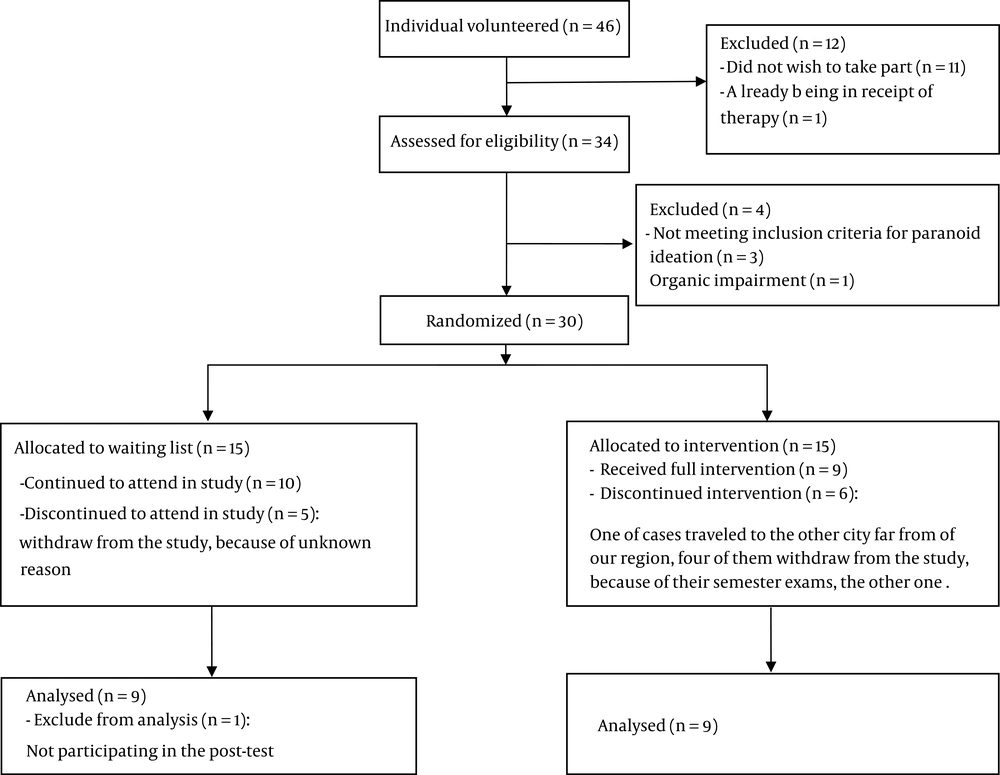
Figure 1.
The participants’ flow is shown
3.2. Therapy
The intervention was designed on anxiety-reduction techniques for Paranoia (key and crask, 2003) in ten weekly sessions. The main content of the intervention was psychoeducation about paranoid ideations, relaxation via deep breathing and cognitive restructuring (e.g. finding alternatives and reality test in vague social situations). The content of each session was reviewed via Telegram for the CBT group between the sessions. Intervention sessions were conducted by an experienced specialist in CBT.
3.3. Measures
Paranoid scale (PS) was designed to measure subclinical Paranoia in the general population (12). In fact, the PS has 20 items that clarifying a 5-point Likert scale ranging from 1 (never) to 5 (always). Scores can vary between 20 and 100, where greater paranoid thoughts are indicated by higher scores. In the original study by Fenigstein and Vanable (12), good internal consistency (Cronbach’s alpha is 0.84) and stability (r = 0.70) were reported, and the PS positively correlated with other paranoid measures (13, 14). In the present study, this scale was translated and adapted as the Persian version and in a pilot study of standardization on Iranian college, student (n = 30) internal consistency was good (Cronbach’s alpha of 0.91). Work and social adjustment scale (WSAS) is a 5-item scale designed to measure the dysfunction caused by the disorder (15). In the last week, any dysfunction was graded from 0 (no disorder) to 8 (serious disorder). Many studies showed WSAS has good validity (sensitive to patient differences in disorder severity and treatment-related change) and reliability (Cronbach’s alpha ranged from 0.70 to 0.94; test/re-test correlation = 0.73). In this study, the word “distrust” was replaced by the word “disorder”. The Persian version of WSAS has shown good validity and reliability on Iranian college students (16).
3.4. Study Design
In the first step of screening, volunteers of eligible age in the research completed the SCL-90-R scale and in the second step, those who have scored more than in paranoid subscale in SCL-90-R and scored more than 40 in the PS, were evaluated by 2 experienced clinical psychologists to investigate the exclusion criteria through the diagnostic interview. After selecting the eligible participants, explanations about the research ethical issues were given and they completed the written informed consent forms, paranoid scale, and work and social adjustment scale. Afterward, subjects were assigned to two groups: experimental and waiting list. Finally, ten sessions of anxiety-based CBT were performed in the experimental group. Four-session absence from the group was considered an exclusion criterion. At the end of treatment sessions, Paranoid scale and work and social adjustment scale were performed again.
3.5. Analysis
All analyses were conducted using SPSS version 17. One-way ANOVA test (to determine the homogeneity of the groups for dependent variables in the pre-test) and ANCOVA covariance test (to determine the effectiveness of CBT on dependent variables in comparison to the control group) and t-test were used. The scores of the pre-test were inserted into the analysis as the diffraction variable. The data from the eighteen participants who completed all therapy and assessment sessions were analyzed (CBT group = 9 and waiting list group = 9).
3.6. Ethical Considerations
This study was approved by an Institutional Review Board of Iran University of Medical Sciences (ethical approval no: IR.IUMS.FMD.REC.1394, 9211521201) with IRCT no.: IRCT20150315021482N4. Written informed consent was obtained from all participants. Participants were assured that their participation was voluntary and that they could leave the study at any time.
4. Results
The demographic characteristics indicated that the mean age of the analyzed samples (N = 18; 9 for each group) was 24.1 years for CBT group and 27.78 years for the waiting list group (SD = 2.1), and there was no significant difference between education level (z = -1.329, P = 0.258) and mean age (t = -1.030, P = 0.319) in 2 groups of the CBT and waiting list. Married to single ratio in the CBT group was 1:8, while this ratio was 5 to 4 in the waiting list group and that makes a significant difference in marital status distribution between these two groups (chi-square = 4, df = 1, P = 0.047). Also, there was no significant difference in pre-test scores of the two groups on the paranoid thoughts (t = 0.000, df = 16, P = 1) and dysfunction in general performance (t = 0.973, df = 16, P = 0.345). The findings using paired sample t-test showed a significant decrease in the average paranoid thoughts and dysfunction in general performance in the CBT group compared to the waiting list (Table 1).
Table 1.Analogy of Post-Test and Pre-Test Values of Paranoid Ideations and General Function Impairment
| Treatment, Variables | Pre-Test | Post-Test | Change P Value | Cohen’s d |
|---|---|---|---|---|
| Anxiety-based cognitive behavioral therapy | ||||
| Paranoid ideations | 57.00 ± 9.00 | 55.00 ± 11.00 | 0.000 | 0.811 |
| General function | 21.00 ± 2.00 | 16.00 ± 3.00 | 0.001 | 0.991 |
| Waiting list | ||||
| Paranoid ideations | 57.00 ± 14.00 | 60.00 ± 14.00 | 0.000 | -0.476 |
| General function | 9.00 ± 7.00 | 12.00 ± 7.00 | 0.031 | -0.872 |
According to these findings, the paranoid thoughts and dysfunction in general performance significantly decreased in the post-tests of the CBT, but in the waiting list group, the mean score of paranoid ideation and dysfunction in general performance has significantly increased in the post-tests. The ANCOVA test was used to determine the effect of the treatment modalities in the two groups, the effect of the pre-test variable needs to be monitored. Table 2 indicates that after controlling the pre-test variable effect, the paranoid thoughts in the CBT group significantly decreased in comparison to the waiting list group. The same result was obtained after covariance analysis of dysfunction in general performance.
Table 2.Analysis of Covariance of Paranoid Ideations and General Function Impairment
| Source | The Results of Paranoid Ideations | The Results of General Performance | ||||||||
|---|---|---|---|---|---|---|---|---|---|---|
| Type III Sum of Squares | df | Mean Square | F | P Value | Type III Sum of Squares | df | Mean Square | F | P Value | |
| Pre-test effect | 1505.000 | 1 | 1505.000 | 17.000 | 0.001 | 428.045 | 1 | 428.045 | 54.026 | 0.000 |
| Grouping effect | 88.000 | 1 | 88.000 | 1.042 | 0.000 | 76.000 | 1 | 76.000 | 9.000 | 0.007 |
4.1. Effect Size
Large effect sizes were found for paranoid ideations (Cohen’s d = 0.811) and general function (Cohen’s d = 0.991) in anxiety-based CBT group.
5. Discussion
The present study is the first review, which investigates the effectiveness of anxiety reduction techniques on subclinical Paranoia in a non-clinical population. This study has been designed and conducted based on intervention-causal model approach, demonstrating causality via clinical intervention (17). In this research, the main hypothesis was if anxiety is one of the main causal factors for Paranoia, so using anxiety-based CBT will cause a decrease in paranoid ideation and dysfunction in general performance and that is what exactly has been proven by this study. The changing pattern in the measurements was quite stabilized and promising.
The effectiveness of anxiety and anxiety reduction techniques on the persecutory delusions in psychotic patients has been significantly supported (1). The most prominent study in this field is “a parallel, Single-blind, randomized and controlled worry intervention trial” (18), which has been done on 150 patients with consistent persecutory delusions and the analysis was done by masked investigators in which the follow-up rate was 95%. The persecutory delusions were significantly decreased in only 6 sessions by targeting the anxiety.
Comparing the present study with the previous studies is not possible due to the differences in the sample characteristics and properties (subclinical suspiciousness in the general population vs. persecutory delusions in psychotic patients) and also because of different methodologies (group therapy vs. individual therapy); however, the results of this study are completely explainable, according to threat anticipation cognitive model (1, 8, 9) in which reasoning biases and emotional processes are defined as two causal factors in the development and maintenance of Paranoia. After awareness about Paranoia and understanding its relationship with stress and anxiety, the patients learned that when they were faced with paranoid thoughts, the first step was to decrease the anxiety level by relaxation and in the second step, they should examine the authenticity of these thoughts in the real world by gathering more information and considering alternatives. In this way, by correcting reasoning biases and gradual abandoning of safety behaviors, these patients will be able to prevent suspicion expansion and its impact on their daily performance, especially in interpersonal relationships, and can stop the progression to paranoid spectrum.
Although the results have proven the potential effectiveness of this therapeutic approach, the problem in methodology -the lack of blind evaluations- might have caused the estimated effect of the intervention. In the future research, the use of larger clinical and general sample size from both genders with a wider age range and not limited to university students alone, providing paranoid protocols based on other important emotions other than anxiety such as depression, worry, self-esteem, and interpersonal sensitivity are recommended.


