


1. Background
According to the estimations of the World Health Organization (WHO), diarrhea can be decreased by more than 30% by improving the hygiene and sanitation of water sources. Unsafe water and its inadequate sanitation can be responsible for between 4500 and 5000 deaths per day among children (1). Accordingly, disinfection and water resource conservation are of vital importance in ensuring the safety of water and its adequate sanitation. Disinfection is a removal process which confers protection against pathogenic agents by inactivating or killing undesirable microorganisms. Water disinfection is commonly performed via ultraviolet radiation, ozonation, and chlorination-depending on economic and technical considerations such as chemical costs, efficiency, ease of use, and access (2). Generally, the conventional disinfection methods are hampered not only by economic constraints but also by a lack of general acceptability (3).
The past few years have witnessed a renewed interest in the topic of solar water disinfection as a nonchemical disinfection method whereby the contaminated water or raw water is exposed to solar heat and radiation (4). However, for all the considerable research conducted hitherto on solar water disinfection, precious little data are available on factors such as the bottle material and the bottle color. We, therefore, sought to investigate the effects of the bottle material on solar disinfection efficiency.
2. Methods
Contaminated water samples were obtained from the rural areas of Kamyaran County, Kurdistan Province, Iran. The collected samples were preserved in an icebox at 4°C and immediately transferred to the laboratory for microbial examinations. The fecal coliform and heterotrophic plate count (HPC) tests were conducted in accordance with the 23rd edition of Standard Methods for the Examination of Water and Wastewater®. The levels of fecal coliform and HPC bacteria were measured using most probable number per 100 milliliters (MPN/100 mL) and colony forming units per 100 milliliters (CFU/100 mL), respectively. The bottles used in the present study were made of glass (dark glass and light glass) and polyethylene terephthalate (PET/ plastic bottle). The Chick law, as is demonstrated in the following equation, was applied in order to evaluate the kinetics of inactivation (5):
ln (N/N0) = kt
where N and N0 are the final and the initial concentrations of the organism (MPN/100 mL), respectively, t is time (hour), and k is the rate constant (1/h).
3. Results and Discussion
The effects of the 3 different bottle materials examined in the present study on the inactivation of coliform bacteria are illustrated in Figure 1. The glass bottle was more efficient in reducing the coliform bacteria than was the plastic bottle. However, the application of glass bottles is limited because of their fragility, weight, and cost by comparison with plastic bottles, hence the wider use of the latter. A previous study found no indication for the migration of possible photoproducts or additives from plastic bottles into water (6). The relatively lower inactivation efficiency of the plastic type in our study can be attributed to its physical characteristics. For instance, the monomers and pigments of plastic bottles diminish the penetration of sunlight and the absorption of ultraviolet radiation. According to our results-for a time period ranging from 1 to 4 hours-the dark glass bottle exhibited a higher efficiency in decreasing the coliform bacteria, probably because of its superior ability to accumulate the solar heat and light by limiting light passage in comparison with the other bottles. The difference in inactivation efficiency between the light and dark glass bottles is illustrated in Figure 2, which shows that the dark glass provided an upper efficiency of about 93% for the reduction in coliform bacteria. The HPC test, conducted in tandem with the fecal coliform test, revealed approximate values of 180 CFU/100 mL for the bright glass bottle, 50 CFU/100 mL for the dark glass bottle, and 180 CFU/100 mL for the plastic bottle after 4 hours of solar radiation (Table 1). The result of the fecal coliform test was confirmed by the HPC results in that the dark glass bottle was significantly effective against microbial agents. The kinetics of disinfection in the 3 bottle materials are displayed in Figure 3. It is clear that the inactivation rate constant (k) of coliform bacteria in the dark glass material had a steep slope of about -1.0436, as opposed to -0.5162 in the bright glass bottle and -0.2796 in the plastic bottle. Disinfection increases with a fall in the inactivation rate. The inactivation rate constant (k) can vary when there are different types and concentrations of disinfectants, types of microorganisms, and temperatures. What can also affect the inactivation rate constant (k) is a series of factors such as cell-wall penetration and exposure time (7).
Table 1.The Result of HPC Test in Three Types of Bottles in Term of CFU/100 mL
| Time, h | 0 | 1 | 2 | 3 | 4 |
|---|---|---|---|---|---|
| Bright glass | > 200 | > 200 | > 200 | > 200 | 180 |
| Dark glass | > 200 | > 200 | > 200 | 130 | 50 |
| PET bottle | > 200 | > 200 | > 200 | > 200 | 180 |
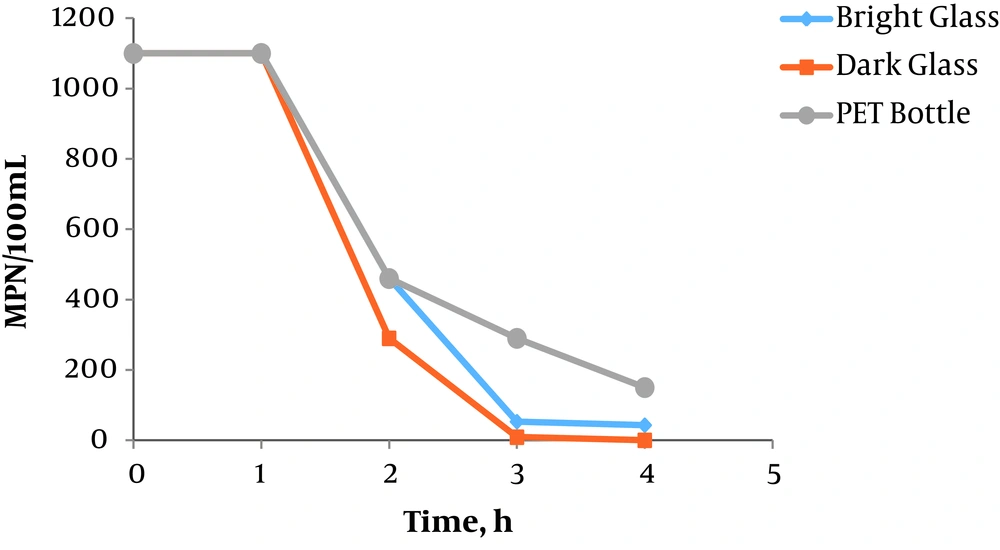
Figure 1.
The result of MTF test for three types of bottles in term of MPN/100 mL
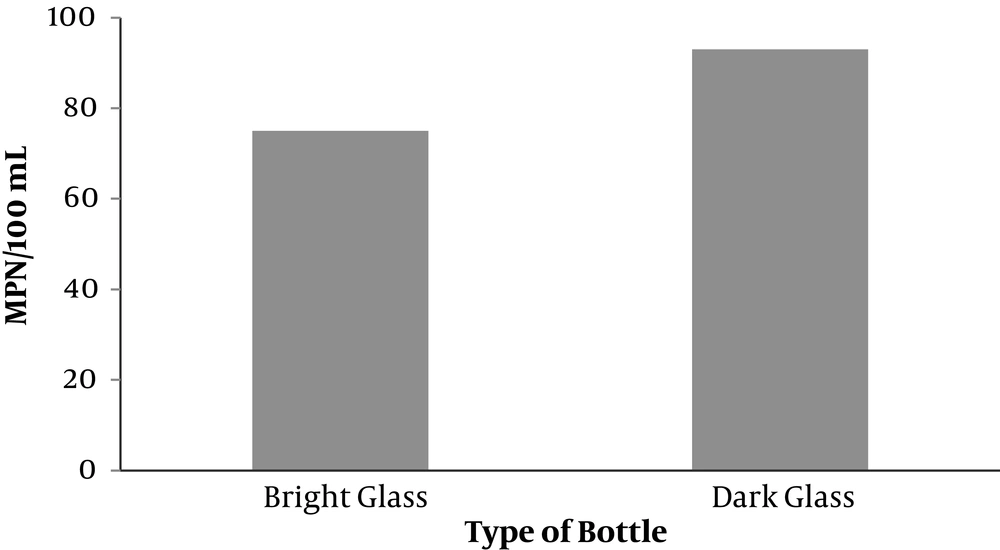
Figure 2.
The removal efficiency or glass types of bottles
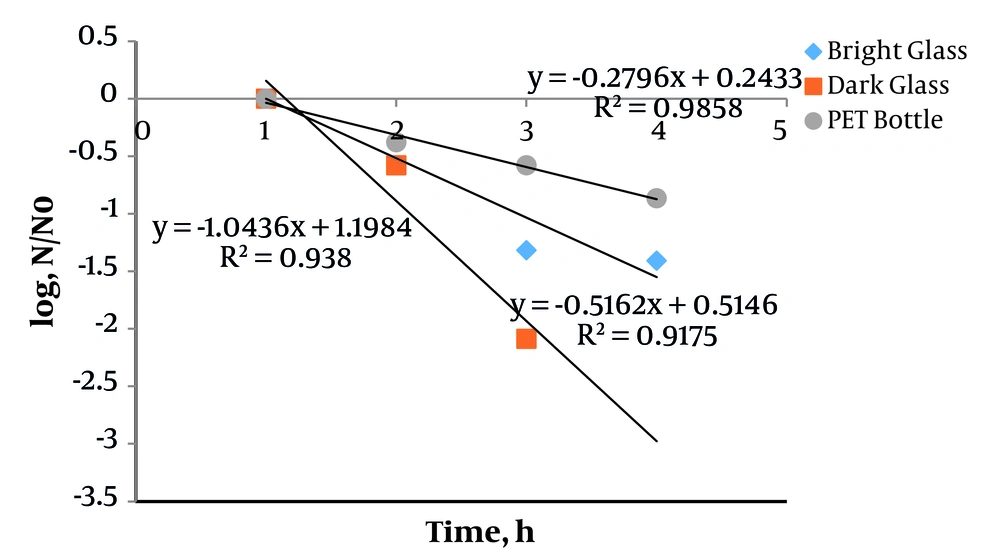
Figure 3.
Kinetic evaluation for solar disinfection
3.1. Conclusions
The results of the present study demonstrated that the dark glass bottle, by comparison with the light glass bottle and the plastic bottle, conferred acceptable solar disinfection.
