Journal of Inflammatory Diseases
The Official Journal of Qazvin University of Medical Sciences
The study Teratogenic effects of hyperthermia on rat
Authors
Abstract
Background: The hyperthermia is the increase in mammalian’s body temperature above normal that affects the embryo during the critical stage of gestational term and may cause some congenital malformations. Objective: The aim of this study was understanding the teratogenic effects of hyperthermia on the rat embryonic development. Methods: In this study 50 female rats of Sprague Dawley strain were used and their body temperature was determined by rectal measurement. Then female pregnant rats were divided to seven groups (one control group and six experimental groups). The female pregnant rats from 9 to 14 days of gestation, were put in the incubator in three stage during a day and were remained in the incubator for 10 minutes on 850C that their body temperature increasted to 410C. Rats in control group were put in incubator at similar situation except the temperature which was kept on 400C to increase only 10C to their body temperature. Then, on 20th day of gestation their fetuses were taken out and examined. Findings: Results showed that congenital malformations such as microphthalmia, anophthalmia, maxillary hypoplasia, IUGR and fetal death were observed in the groups that affected by hyperthermia on the days 9,10 and 11. Conclusion: Hyperthermia is a teratogenic factor which its effects in organogenic period causes congenital malformations.
Highlights
Copyright
© 2024, Journal of Inflammatory Diseases. This open-access article is available under the Creative Commons Attribution-NonCommercial 4.0 (CC BY-NC 4.0) International License (https://creativecommons.org/licenses/by-nc/4.0/), which allows for the copying and redistribution of the material only for noncommercial purposes, provided that the original work is properly cited.
Similar Articles
Histological, Histochemical and Biochemical Changes in the Liver, Kidney, Lung and Spleen under the Effect of Repetitive Hyperthermia in Rat Neonates
Ahmed R, Mazher K. Histological, Histochemical and Biochemical Changes in the Liver, Kidney, Lung and Spleen under the Effect of Repetitive Hyperthermia in Rat Neonates. Int J Cancer Manag. 2009;2(2):e80541. doi:
Teratogenic Effects of Harpagophytum procumbens Ethanolic Extract in Mice and Fetuses
Davari SA, Miri A, Shahraki E. Teratogenic Effects of Harpagophytum procumbens Ethanolic Extract in Mice and Fetuses. Zahedan J Res Med Sci. 2016;18(10):e3481. doi: https://doi.org/10.17795/zjrms-3481
Effect of Erythromycin on Albendazole-Induced Teratogenicity in Pregnant Rats
Ranjbar R, Najafzadeh H, Morovvati H, Khaksary Mahabady M, lak E. Effect of Erythromycin on Albendazole-Induced Teratogenicity in Pregnant Rats. Zahedan J Res Med Sci. 2013;15(5):e92986. doi:
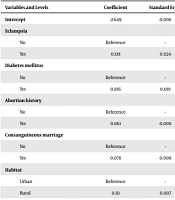
Contribution Factors on Congenital Malformations in Neonates in Iran
Riyahifar S, Ali Akbari Khoei R, Mirnia K. Contribution Factors on Congenital Malformations in Neonates in Iran. Inn J Pediatr. 2021;31(5):e105984. doi: https://doi.org/10.5812/ijp.105984
The Effects of Quercetin and Retinoic acid on Skeletal System of Rat Embryos in Prenatal Period
Gohari-Behbahani N, Khaksary-Mahabady M, Ranjbar R, Najafzadeh-Varzi H, Mohammadian B. The Effects of Quercetin and Retinoic acid on Skeletal System of Rat Embryos in Prenatal Period. Zahedan J Res Med Sci. 2014;16(12):31-36. doi:
- Scopus by DOI: 0
Last Update: 3 weeks ago
- Scopus by Title: 0
Last Update: 3 weeks ago
- Scopus by Title (Ref): 0
Last Update: 3 weeks ago
- CrossRef: 0
Last Update: 6 hours ago
- OpenAlex: 0
Last Update: 9 hours ago
- OpenCitations: 0
Last Update: 4 days ago