1. Background
Harpagophytum procumbens (Devil’s Claw) is a perennial herbal belonging to the Pedaliaceae family and originating from Kalahari Desert of southern Africa. Devil’s Claw (DC) gets its name from the sharply curved tiny hooks that cover its fruit. Other popular names include: grapple plant, wood spider, duiwelsklou, Afrikanische, Teufelskralle, griffe du diable and sengaparile [1, 2]. The DC contains various compounds such as harpagoside (a major active component), harpagide, verbascoside, carbohydrates, aromatic acids, phytosterols and flavonoids [3]. For centuries, this traditional African herb has been used as a phototherapeutic remedy to treat a wide range of disorders including musculoskeletal complaints, gastrointestinal disturbances, pregnancy complications, blood disorders, gout, diabetes, and skin lesions [4, 5]. Non-steroidal anti-inflammatory drugs (NSAIDs) such as aspirin, acetaminophen, and ibuprofen have increasingly been used in recent years and possible risks including gastric bleeding and kidney problems can be occurred. In recent years, Devil’s Claw has been considered as a safe alternative to expensive NSAIDs because of its minor risk and potential anti-inflammatory, analgesic and sedative activity [6, 7]. The analgesic effects of DC are carried out by inhibition of arachidonic acid biosynthesis through lipoxygenase and cycloxygenase-mediated pathways [4]. Available therapeutic products of DC include tablets, capsules, topical ointments, concentrated extracts, and ethanol tincture [3]. Mild gastrointestinal disturbances such as bloating and dyspepsia (because of stimulation the stomach acid secretion), heartbeat arrhythmia, low blood pressure and increasing the risk of bleeding are side effects of DC that have been demonstrated in previous studies [5, 8, 9]. Also, this herb is contraindicated in patients suffering from peptic ulcers or gall stones. Care should also be considered for human beings with cardiovascular disorders [1]. Furthermore, herbal medicine products are not free of side effects for pregnant women and fetal abnormality may be developed [10]. To the best of our knowledge, there isn’t enough information for embryo toxicity and prenatal effects of DC [5].
2. Objectives
Therefore, the objective of the present research was to evaluate the teratogenic effects of DC ethanolic extract in pregnant Balb/C mice.
3. Methods
In this experimental study, female and male Balb/C mice, weighing between 30 and 35 g, were kept at the Animal laboratory of Zabol University of Medical Sciences. For them provided the water and standard food in a room with 23 ± 2°C temperature, 50% - 55% relative humidity and in 12 hours light/dark cycle. The presence of a mucous vaginal plug in females in the morning following copulation with males indicated successful mating and the time point was designated as day one of gestation. The secondary tubers of Devil’s Claw were collected from Zabol Medicinal Plants Research Center at Faculty of Pharmacy during April 2014. After authentication of this plant at the Ferdowsi University of Mashhad Herbarium (FUMH), the DC secondary tubers (300 g) were extracted through percolation with 80% ethanol (3 L) for 24 hours. Then, the ethanol extract was filtered and concentrated by rotary evaporator. The pregnant mice (N = 40) were randomly divided into 4 groups, 1: Control group, 2, 3 and 4: the three treatment groups which received the DC extract (200, 400 & 600 mg/kg, respectively) by gastric gavage route [11]. During this period, control group was fed with standard food and water. All experiments were performed in accordance to the Institutional animal ethics committee protocols for minimizing stress and animal injury. Thus, each animal was used for only one time point. After 14 days of administration and evaluating the body weight, on 18th gestation day mice were anesthetized with ether and embryos were harvested by Caesarian section. Afterwards, fetuses were removed from the uterine tubes and their body weight, height and macroscopic alterations were measured by digital scale and Kullis. For tissue preparation, washed embryos with normal saline were injected by 10% neutral buffered and whole embryos were then placed in the fixative over night for standard paraffin embedding protocol and hematoxylin-eosin staining process.
After removal of internal organs, embryonic skeletal systems were stained by Alizarin red and Alcian blue staining protocol [12] and investigated by stereomicroscope (ZSM-1001, Iran). The occurrence of skeletal malformations was determined and compared between all groups. Besides, tissue specimens of mice included liver and kidney were fixed in 10% neutral buffered formalin, embedded in paraffin, sectioned at 5 µm, stained with hematoxylin and eosin (H&E) and submitted to microscopic examination according to the routine protocol. Statistical analysis was performed using one-way analysis of variance (ANOVA) in SPSS version 18 software followed by Tukey-Kramer test, using Prism 4 (Graph Pad Software, Inc., San Diego, CA, USA) for multigroup comparisons. Graphs were also drawn by Prism 4 software.
The values P < 0.05 were considered statistically significant.
4. Results
In gross evaluation, no significant pathological alterations were observed in all groups and the DC showed no gross teratological disorders (such as structural malformation) in any experimental groups. Furthermore, there were no significant abnormalities in body weight and crown-crump length of fetuses in control and treatment groups (P < 0.05) (Tables 1 and 2). Brain, heart and skeletal system of embryos were histologically normal in all groups and didn’t show specific alterations in control and treatment groups (Figure 1). Histopathological examination of lung in embryos of group 4 revealed mild degenerative changes and fibrin accumulation in bronchioles and alveoli. Moreover, a significant hypoplasia was found in high magnification (Figure 2). The liver lesions were characterized by degeneration of hepatocytes with tissue debris accumulation in embryos of group 4 and necrosis with lymphocytic perivascular cuffing in pregnant mice of group 4 (Figure 3). Degeneration of proximal and distal convoluted tubules with tissue debris accumulation in their lumens was presented in the embryonic kidney section of group 4 (Figure 4). In addition, necrosis of convoluted tubules with mononuclear inflammatory cells infiltration and lymphocytic perivascular cuffing were remarkable lesions in pregnant mice of group 4. No histopathological findings were evident in glomerulus (Figure 4).
Table 1.
The Comparison of Number of Pregnant Mice, Number of Dead Mice During Gavage, Body Weight Mean (± Standard Deviation) of Pregnant Mice and Number of Stillbirth in the Groups Under Studya
| Mice Factors | Control | Extract 200 mg/kg | Extract 400 mg/kg | Extract 600 mg/kg |
|---|---|---|---|---|
| Number of pregnant mice | 10 | 10 | 10 | 10 |
| Number of dead mice during gavage | 0 | 0 | 0 | 0 |
| Body weight (gr) of pregnant mice (gestation 0th day) | 30/75 ± 0/95 | 30/33 ± 0/57 | 30/75 ± 0/95 | 31/33 ± 1/22 |
| Body weight (gr) of pregnant mice (gestation 18th day) | 59 ± 1/82 | 59±1/73 | 59/75 ± 1/89 | 59/33 ± 1 |
| Number of stillbirth | 0 | 0 | 0 | 0 |
aP < 0.05 as compared with control group.
Table 2.
The Comparison of Number of Mice Embryos, Number of Dead Embryos, Number of Resorbed Embryos, Body Weight and Height Mean (± Standard Deviation) in the Groups Under Studya
| Embryonic Factors | Control | Extract 200 mg/kg | Extract 400 mg/kg | Extract 600 mg/kg |
|---|---|---|---|---|
| Number of embryos | 41 | 35 | 43 | 47 |
| Number of dead embryos | 0 | 0 | 0 | 0 |
| Number of resorbed embryos | 0 | 0 | 0 | 0 |
| Body weight, gr | 1/185 ± 0/08 | 1/24 ± 0/05 | 1/17 ± 0/12 | 1/162 ± 0/19 |
| Body length, mm | 23/01 ± 0/99 | 23/01 ± 0/12 | 22/61 ± 1/43 | 23/15 ± 1/81 |
aP < 0.05 as compared with control group.
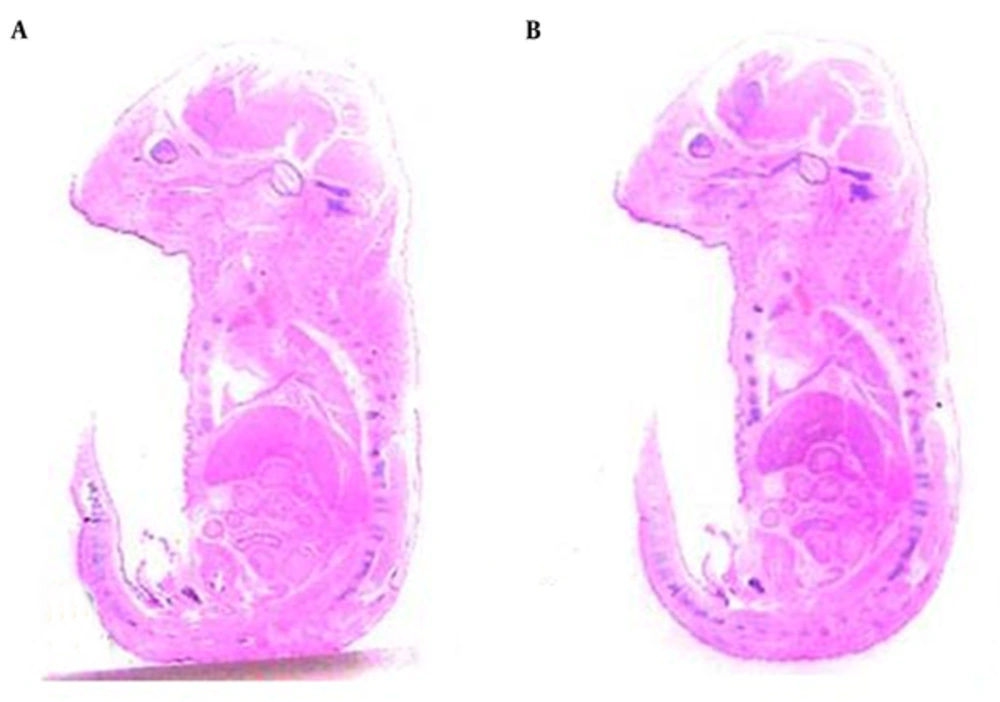
Figure 1.
The Skeletal System of Treated Group With 600 mg/kg DC extract (b) Compared With Control Group (a) Showed No Structural Malformation (Alizarin Red and Alcian Blue Staining)
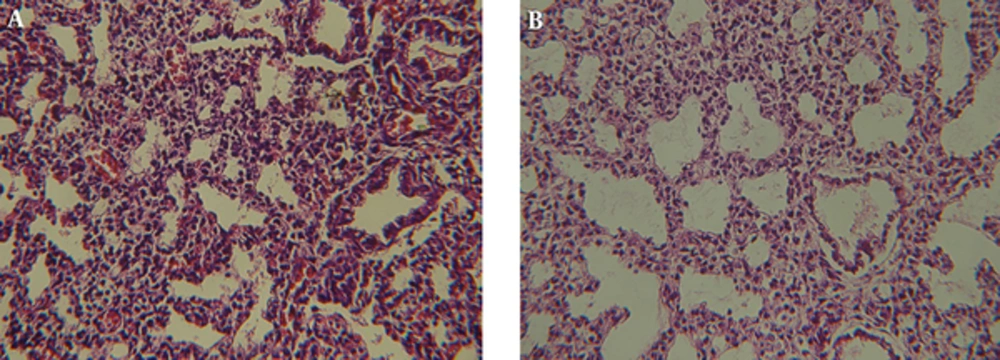
Figure 2.
A, Lung section of embryos in group 1 showing the localization and normal morphology of pneumocytes and alveoli (H&E, bar₌50 µm); B, Embryonic lung of group 4 showing a decrease of the cellular population and accumulation of fibrin in bronchioles and alveoli (H&E, bar = 50 µm)
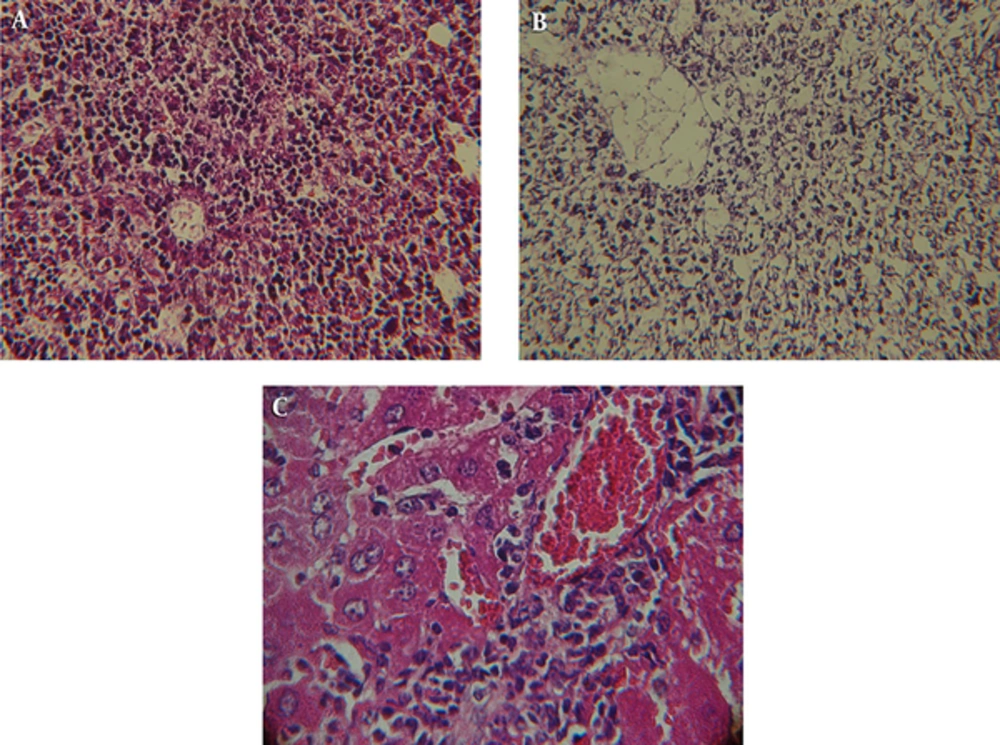
Figure 3.
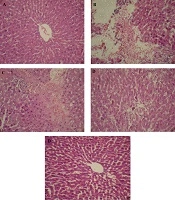
A, Microphotograph of embryonic liver in group 1 Showing normal arrangement and morphology of hepatocytes (H & E, bar₌ 250 µm); B, Degeneration of hepatocytes and tissue debris accumulation in the embryonic liver parenchyma in group 4 (H & E, bar₌ 40 µm); C, Hepatic necrosis and lymphocytic perivascular cuffing (PVC) in pregnant mice of group 4 (H & E, bar₌ 20 µm)
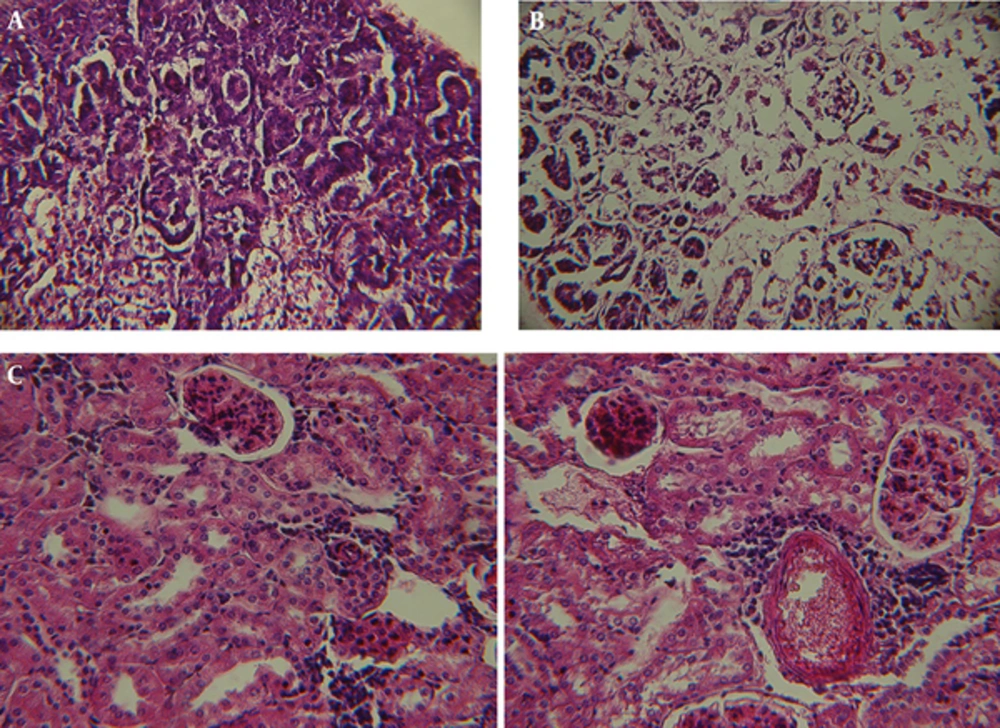
Figure 4.
A, Microphotograph of embryonic kidney tissue in group 1 showing normal morphology of glomerulus and convoluted tubules (H & E, bar₌ 50 µm); B, Degeneration of convoluted tubules with tissue debris accumulation in their lumens in embryonic kidney of group 4; No histopathological findings were evident in glomerulus (H & E, bar₌ 250 µm); C, Left: Histopathology of the pregnant mice kidney in group 4 showing necrosis of convoluted tubules with mononuclear inflammatory cells infiltration (H & E, bar₌ 40 µm); Right: Lymphocytic perivascular cuffing (PVC) was significant but no histopathological findings were evident in pregnant mice glomerulus of group 4 (H & E, bar₌ 40 µm)
5. Discussion
In the present study, the results of macroscopic evaluation clarified that there were no significant differences between animal’s body weight and height of control and the DC extract treated mice and embryos. Moreover, the DC showed no developmental abnormalities in any treatment groups. Although, light microscopic observation demonstrated some degenerative changes and necrosis in the lung, liver and kidney tissues of embryos and pregnant mice of group 4 (600 mg/kg DC extract).
Harpagophytum procumbens is a traditional herb that is utilized as an inexpensive analgesic treatment for thousands of years. Recently, tendency of using DC for pain relief in pregnancy period has been increased but it was demonstrated that uterine contractions might be induced by this plant [13]. Thus, the risks and benefits of DC should be taken into account by clinicians before recommendation. No previous studies have been conducted for evaluation of teratological disorders associated with this plant. However, numerous investigations have proven the harmful teratogenic effects of some herbal medicines [4, 10, 14]. Goel et al. [15] demonstrated the teratological disorders of Asparagus racemosus (rasayana) involving gross malformation in Charles Foster rats. Using the ginsenoside Rb1 in a whole rat embryo culture model, Chan et al. [16] reported the direct effects of Ginseng as a medical herb on rat embryos during the critical period of organogenesis. An Australian study showed that the use of Zingiber officinale (ginger) caused numerous abortions when administered to pregnant rats [17]. Ruta graveolens is a medicinal plant that contains toxic substances. Several authors confirmed the toxicity, teratogenicity and abnormal embryo development of this herb [18-20]. A study by Hosseinzadeh et al. [21] found that Salvia leriifolia Benth (Nuruzak) can exert significant decrease in weight and length of pregnant mice, as well as some limb abnormalities of fetuses. In a recent study, Golshan Iranpoor et al. [22] reported using Stachys lavandulifolia extract causes growth retardation and stopping bone formation in Balb/c mice. To our knowledge, there are no reports on the teratological effects of DC extract in pregnancy. Present study assessed teratogenicity in Balb/C mice administered by Harpagophytum procumbens for the first time. Oxidative stress defined as an imbalance between oxidants and antioxidants mechanisms that probably cause tissue damage [23]. The antioxidant and anti-inflammatory activity of DC has been established by numerous researches. Langmead et al. [24] found that the antioxidant capacity of devil’s claw root extract might contribute to its anti-inflammatory efficacy. These findings are corroborated by other studies [23, 25] but in our study, inflammation associated with necrosis was observed in some embryonic and mice tissues (lung, liver and kidney) of group 4 (600 mg/kg DC extract). Macroscopic examination showed no significant differences in body weight, length and skeletal system between the treated and control groups. In agreement with our study, Whitehouse et al. [26] reported that high harpagoside doses administered to rats showed no clinical and gross pathological reactions. Microscopically, lung lesions of fetuses in group 4 were included mild degenerative changes and hypoplasia in pneumocytes. Also, fibrin accumulation in bronchioles and alveoli was observed. Typical microscopic lesions were seen in the liver and kidney because of their vulnerability to toxic effects. Degeneration of hepatocytes and tissue debris accumulation in the parenchyma were presented in fetuses of group 4. Moreover, hepatic necrosis associated with lymphocytic perivascular cuffing (PVC) was remarkable in pregnant mice of group 4. Histopathological changes in the kidney consisted of proximal and distal convoluted tubules degeneration with tissue debris accumulation in their lumens in embryonic kidney of group 4 and convoluted tubules necrosis with mononuclear inflammatory cells infiltration and lymphocytic perivascular cuffing in pregnant mice of group 4. Allard et al. [27] similarly found that some of herbs like the DC might induce nephrotoxicity and inhibit major renal transport processes. According to macroscopic findings, brain, heart and skeletal system of embryos were histologically similar in all control and treatment groups. The inflammatory reactions and lesions in adults were more severe than embryos because of their mature immune system. H. procumbens includes numerous constituents but harpagoside appears to be more responsible for the therapeutic activity of this herb [23]. According to previous researches, the DC secondary tubers contain twice as much harpagoside as the primary roots [23, 28]. Due to our results, it is probable that the existence of harpagoside, as a major component of the DC seconday tubers extract, might be related to the observed lesions. Therefore, our findings demonstrated the importance of Devil’s Claw teratogenic effects. Thus, the use of this herbal medicine and derivatives should be restricted during pregnancy.