Journal of Inflammatory Diseases
The Official Journal of Qazvin University of Medical Sciences
Prevalence of urinary tract infection in neonates with prolonged jaundice referred to Aliasghar Hospital in Zahedan (2005)
Authors
Abstract
Abstract Background: Prolonged jaundice is defined as a type of icterus lasting over 14 days in term neonates or over 21 days in preterm neonates. Various pathologic causes such as urinary tract infection may induce prolonged jaundice. Objective: To determine the prevalence of urinary tract infection in neonates with prolonged jaundice. Methods: This was a cross sectional study carried out at Aliasghar hospital in Zahedan (Iran) during 2005. A total of 230 neonates with prolonged jaundice were investigated, conveniently. Using a urine bag, single sample was collected from all patients followed by culture. In case of a positive urine culture (>105 CFU/ml of a single pathogen), a second urine sample was taken by suprapubic method and cultured again. The reappearance of previously identified single pathogen was indicative of the presence of urinary tract infection. The data were analyzed using Chi2 statistical test. Findings: Out of 230 neonates, 138 (60%) were males and 92 (40%) females. Positive urine culture was identified in 17 (7.4%) samples while the majority of samples (213) produced negative results. The organisms isolated in urine cultures were E coli in 13 samples (76.5%), Klebsiella in 3 cases (17.6%) and Staphylococcus aureus in 1 sample (5.9%). Regarding the gender, no statistically significant difference between the prevalence of urinary tract infection and the types of pathogens was found. Conclusion: Based on our data, a urine culture should be considered while bilirubin work-up of infants with unknown etiology of prolonged jaundice is carried out.
Highlights
Copyright
© 2024, Journal of Inflammatory Diseases. This open-access article is available under the Creative Commons Attribution-NonCommercial 4.0 (CC BY-NC 4.0) International License (https://creativecommons.org/licenses/by-nc/4.0/), which allows for the copying and redistribution of the material only for noncommercial purposes, provided that the original work is properly cited.
Similar Articles
Relation between Urinary Tract Infection and Neonatal Icterus
Nejad N, Hosseininejad M, Sabooni F, Siadati SA. Relation between Urinary Tract Infection and Neonatal Icterus. J Compr Ped. 2010;2(2):. doi:
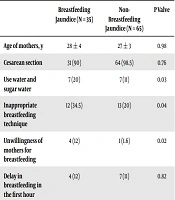
Risk Factors of Early Breastfeeding Jaundice: How Can Gynecologists and Nurses be Effective in Reducing It?
Siroosbakht S, Aminian AR, Rezakhaniha B. Risk Factors of Early Breastfeeding Jaundice: How Can Gynecologists and Nurses be Effective in Reducing It?. J Compr Ped. 2020;11(3):e103578. doi: https://doi.org/10.5812/compreped.103578

Frequency of Different Causes of Infant Cholestasis in a Tertiary Referral Center in South-East Iran
Shahraki T, Miri-Aliabad G, Shahraki M. Frequency of Different Causes of Infant Cholestasis in a Tertiary Referral Center in South-East Iran. Inn J Pediatr. 2018;28(5):e65409. doi: https://doi.org/10.5812/ijp.65409
Comparison of Serum Zinc Level Between Neonates With Jaundice and Healthy Neonates
Boskabadi H, Maamouri G, Mohsen Zadeh H, Shakeri M, Ghayour-Mobarhan M, et al. Comparison of Serum Zinc Level Between Neonates With Jaundice and Healthy Neonates. Shiraz E-Med J. 2015;16(11-12):e59924. doi: https://doi.org/10.17795/semj27392
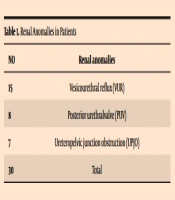
Correlation Between the Urine Analysis in Neonates with Renal Anomaly
Saeedi M, Mirnia K, Sangsari R, Alinia G. Correlation Between the Urine Analysis in Neonates with Renal Anomaly. Inn J Pediatr. 2022;32(3):e122680. doi: https://doi.org/10.5812/ijp-122680
- Scopus by DOI: 0
Last Update: 1 month ago
- Scopus by Title: 0
Last Update: 1 month ago
- Scopus by Title (Ref): 11
Last Update: 1 month ago
- CrossRef: 0
Last Update: 5 days ago
- OpenAlex: 0
Last Update: 2 days ago
- OpenCitations: 0
Last Update: 2 days ago