Journal of Inflammatory Diseases
The Official Journal of Qazvin University of Medical Sciences
Comparing impulsivity and risky decision-making in obese and normal individuals
Authors
Abstract
Background: Impulsive and risky behaviors contain a wide range of undeveloped and pleasure seeking behaviors. One of the obese individuals’ problems is their inability to refuse taking forbidden foods. Objective: The aim of this study was to compare impulsivity and risky decision making between two groups of obese and normal weight individuals. Methods: The participants in this analytical study were consisted of 100 obese individuals with a Body Mass Index (BMI) higher than 30 Kg/m2 and 100 normal cases with BMI lower than 25 Kg/m2. Both groups were tested by two computerized tests including the impulsivity test (GO/NOGO) and the BART risky decision-making task which were used to test the participants’ impulsive behaviors and the degree of their risky decision-making, a Public Health questionnaire to evaluate an individual’s physical and psychological public health within the last month, and also a Daily Activity questionnaire to assess the participant’s daily physical activities and sports. Variables were transferred to SPSS software and analyzed by independent t-test. This study was performed in Tehran in 2011. Findings: Individuals with higher impulsivity failed to condone the immediate pleasures and choose the long term healthy behaviors. The number of false reactions and the time average spent on tasks were longer among obese individuals compared with normal weight people indicating the obese individuals were more impulsive and made more risky decisions in choosing appropriate behaviors and lifestyle. Conclusion: According to the results of this research, it is beneficial to introduce an impulsivity treatment as a cognitive cure for obesity to professionals. In this regard, it is not wise to only focus on physical and nutrition aspects of obesity treatment.
Highlights
Copyright
© 2024, Journal of Inflammatory Diseases. This open-access article is available under the Creative Commons Attribution-NonCommercial 4.0 (CC BY-NC 4.0) International License (https://creativecommons.org/licenses/by-nc/4.0/), which allows for the copying and redistribution of the material only for noncommercial purposes, provided that the original work is properly cited.
Similar Articles
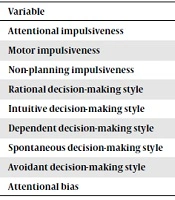
The Role of Impulsivity, Attentional bias and Decision-Making Styles in Risky Driving Behaviors
Barati F, Pourshahbaz A, Nosratabadi M, Mohammadi Z. The Role of Impulsivity, Attentional bias and Decision-Making Styles in Risky Driving Behaviors. Int J High Risk Behav Addict. 2020;9(2):e98001. doi: https://doi.org/10.5812/ijhrba.98001
Predicting High-risk Behaviors Based on Time Perspective in Iranian Adolescents by Emphasizing the Mediating Role of Decision Making and Inhibitory Response: Path Analysis
Bagherian F, Mozafari N, Zadeh Mohammadi A, Heidari M. Predicting High-risk Behaviors Based on Time Perspective in Iranian Adolescents by Emphasizing the Mediating Role of Decision Making and Inhibitory Response: Path Analysis. Int J High Risk Behav Addict. 2022;11(1):e114519. doi: https://doi.org/10.5812/ijhrba.114519
The Relationship Between Symptoms of Eating Disorders and Worry About Body Image, Attachment Styles, and Cognitive Emotion Regulation Strategies Among Students of Ahvaz Jundishapur University of Medical Sciences
Davodi I, Firoozi AA, Zargar Y. The Relationship Between Symptoms of Eating Disorders and Worry About Body Image, Attachment Styles, and Cognitive Emotion Regulation Strategies Among Students of Ahvaz Jundishapur University of Medical Sciences. Jentashapir J Cell Mol Biol. 2016;7(1):e27080. doi: https://doi.org/10.17795/jjhr-27080
A comparison of maladaptive early schemas and appearance schemas in obese and normal weight control subjects
Doosalivand H, Tahmasbi N, Ghanbari Jolfaei A, Ghahremani S, Pishgahroudsari M. A comparison of maladaptive early schemas and appearance schemas in obese and normal weight control subjects. koomesh. 2015;16(3):e151256. doi:
Impulsivity: A Predisposition Toward Risky Behaviors
Bakhshani N. Impulsivity: A Predisposition Toward Risky Behaviors. Int J High Risk Behav Addict. 2014;3(2):e20428. doi: https://doi.org/10.5812/ijhrba.20428
- Scopus by DOI: 0
Last Update: 3 weeks ago
- Scopus by Title: 0
Last Update: 3 weeks ago
- Scopus by Title (Ref): 2
Last Update: 3 weeks ago
- CrossRef: 0
Last Update: 5 days ago
- OpenAlex: 0
Last Update: 1 day ago
- OpenCitations: 0
Last Update: 4 days ago