
1. Background
What threatens most adolescents today are social morbidities, including a range of high-risk, harmful behaviors (1). The self-centeredness of adolescence makes them feel unique and take dangerous actions based on this personal fable that they are invulnerable. The occurrence and persistence of these behaviors cause serious physical, psychological, and sociological consequences and reduce their quality of life now and in the future (2-5). This has caused serious concern for families and the community (4). By presenting the problem behavior syndrome, Jessor identified risky behaviors, including smoking, drug use, alcohol, dangerous driving, and early sexual behaviors (6). Although adults also experience high-risk behaviors, they are more common in adolescence, so that these behaviors increase from early adolescence to mid-adolescence and decrease in late adolescence (5, 7-9). Numerous studies have shown that the prevalence of risky behaviors among Iranian adolescents increases (10-12).
Zimbardo and Boyd empirically distinguished 5 time perspectives (TPs): (1) past-positive (nostalgic, sentimental view of the past); (2) past-negative (negative, pessimistic attitude toward the past); (3) present-fatalistic (helpless and hopeless attitude toward the future and life), (4) present-hedonistic (present pleasure, immediate gratification, impulsive, risk-taking); and (5) future (striving for future goals) (13-16). A large amount of empirical data confirms that TP dimensions predict numerous fundamental life outcomes, including risky behaviors such as smoking (17), alcohol consumption (18), substance use (19), sexual risky behaviors (20), unsafe and risky driving (21), and gambling (22).
Executive function (EF) has become an umbrella term used for a diversity of hypothesized cognitive processes, including planning, working memory, attention, inhibition, self-monitoring, self-regulation, set-shifting, decision-making, and initiation carried out by prefrontal areas of the frontal lobes (23-25). Some researchers refer to EFs as the conductor of an orchestra, which is responsible for directing and organizing all human actions (24). In this study, 2 kinds of EFs were discussed: decision-making and response inhibition.
Inhibition is often considered an executive functioning ability or process. Response inhibition is defined as the ability to reject an automatic tendency in a given situation (26). People with low-inhibition act impulsively are more likely to engage in risky behaviors, such as substance use (27-29), alcohol abuse (30, 31), sexual risk behaviors (32, 33), and risky driving (34, 35).
A decision is defined as a commitment to take action. In making a decision, a person in a situation chooses among the options available based on his/her available information (36). In this choice, items such as probabilities and costs/benefits are discussed (37). Some researchers consider decision-making to be one of the hot EFs. If hot EF involves decision-making in highly charged emotional contexts, typified by reinforcement and motivational forces, real-world risk-taking contexts should provide a fertile field to observe hot EF in action during adolescence (38). Studies have shown that risky decision-making is more likely to occur in adolescence than in other developmental periods, and risk-taking decreases with age (39).
EFs cover a wide range of cognitive abilities of the brain. Therefore, in this study, the mediating role of decision-making and inhibitory response regarding the relationship between TP and risky behaviors was examined. This study investigated the possibility of predicting risky behaviors based on TP components with an emphasis on the role of EF (decision-making and inhibitory response) as a mediator between Iranian adolescents.
The present study examined 2 hypotheses: (1) decision-making plays a mediating role between TP and risky behaviors; and (2) inhibitory response plays a mediating role between TP and risky behaviors.
2. Objectives
Considering the roles of TP and EF in risky behaviors and given that risky behaviors are one of the fundamental adolescent health issues, the present study aimed to examine the direct and indirect effects of components of TP on risky behaviors based on the mediating role of decision-making and inhibitory response, which has not received much attention in Iran.
3. Materials and Methods
3.1. Subjects
Male and female high school adolescents from public high schools in Sanandaj, Iran, were enrolled in this study between 2019 and 2020.
Sampling Method: In this study, a multi-stage cluster sampling method was used for hypothesis testing of a total of 804 students, including 470 (58.5%) males and 334 (41.5%) females. Subjects were selected based on the inclusion criteria, including age between 14 - 18 years, tendency to participate in the study, and the ability to speak and write Farsi sufficiently. Exclusion criteria were having a history of psychiatric (bipolar disorder or major depression and psychoses) or neurological disorders and using antidepressants and other psychiatric drugs during the study. Among the participants, 14 (9 boys and 5 girls) were excluded from the study due to deficiencies in completing the questionnaires.
3.2. Research Tools
In order to measure the variables, the following tools were used in this study.
3.2.1. Iranian Adolescent Risk Scale
This scale consists of 38 items, and its purpose is to measure the risk of adolescents in 7 dimensions: drug (8 items), alcohol (6 items), smoking (5 items), violence (5 items), sexual relationship and behavior (4 items), relationship with the opposite sex (4 items), and dangerous driving (6 items). Its scoring method is based on the Likert scale with 5 options from completely agree (5) to completely disagree (1); it measures the level of risk at 3 levels: (1) low, (2) medium, and (3) high (12). In this study, its reliability in assessing the Iranian Adolescent Risk Scale was calculated at 0.94 using the Cronbach α, which was significant (P = 0.005).
3.2.2. Time Perspective Scale
This scale was designed by Zimbardo to examine people’s tendency to past, present, and future; this scale consists of 56 items, including 5 subscales of future (13 items), past-positive (9 items), past-negative (10 items), present-hedonistic (15 items), and present-fatalistic (9 items) (16). Its scoring method is based on the Likert scale with 5 options from completely true (5) to completely false (1). The scoring method for items 9, 24, 25, 41, 56, and 61 is inverted. Respondents rate their degree of endorsement of each statement on a 5-point Likert-type response scale, from 1 (strongly disagree) to 5 (strongly agree). Zimbardo and Boyd reported the Cronbach α for subscales 0.80, 0.82, 0.79, 0.78, and 0.74 (15).
3.2.3. Balloon Analogue Risk Task (BART)
In this task, which is used to measure decision-making, an image of a balloon appears on a computer screen that the subject can inflate the balloon by pressing a button below it. There are 2 temporary and permanent boxes on the screen. Each time the balloon is inflated, a point is credited to the ballot box. Instead of inflating the balloon more, one can press the scoring key. At this time, a new balloon is replaced, and the amount saved from inflating the balloon goes to the permanent box. The total number of balloons is 30. Balloons burst at an unspecified point, and this makes high-risk decisions possible (40). The reliability of this task was reported by White et al. as 0.77 after retesting (41).
3.2.4. Go/No-Go Task
In this task, which is used to assess inhibition, participants are instructed to respond by pressing a button with their right index finger as accurately and quickly as possible to Go stimuli (85% probability) and to withhold a response to No-Go stimuli (15% probability). Go and No-Go stimuli are presented for 45milliseconds. Results are presented only for No-Go correct rejections (successful inhibitions) and No-Go false alarms (unsuccessful inhibitions) (42). The reliability coefficients of this test were reported by Ghadiri et al. between 0.72 and 0.78 (43).
3.3. Data Analysis
Statistical methods for data analysis were descriptive statistics, including frequency, mean, SD, minimum, maximum, and correlations between variables, as well as path analysis for direct and indirect effects. All analyses were performed using SPSS version 26 and AMOS version 25 (SPSS Inc, Chicago, Ill, USA).
To investigate whether the components of EF acted as mediators in the relationship between TP and risky behaviors, the bootstrapping procedure for mediators was used. AMOS was used to test the indirect effects of EF. The output provided a 95% CI of the indirect effects.
4. Results
Examination of the demographic characteristics of the sample showed that in terms of gender, 470 (58.5%) were boys, and 334 (41.5%) were girls and, in terms of age, 158 (19.7%), 372 (46.3%), and 274 (34.1%) were 15, 16, and 17 years old, respectively. Table 1 presents the descriptive statistics of the research variables.
Table 1.
Descriptive Statistics of Research Variables
| Variables | Mean ± SD | Min | Max |
|---|---|---|---|
| Risky behaviors | 90.72 ± 31.20 | 44 | 171 |
| Drug | 13.83 ± 5.58 | 8 | 35 |
| Alcohol | 14.18 ± 6.10 | 6 | 30 |
| Smoking | 11.03 ± 5.68 | 5 | 25 |
| Violence | 13.49 ± 4.53 | 5 | 25 |
| Sexual relationship and behavior | 8.62 ± 4.13 | 4 | 18 |
| Relationship with the opposite sex | 13.26 ± 4.42 | 4 | 20 |
| Dangerous driving | 16.27 ± 5.67 | 7 | 30 |
| Past-Positive | 28 ± 4 | 13 | 41 |
| Past-Negative | 27 ± 8 | 13 | 50 |
| Present-Hedonistic | 46 ± 13 | 17 | 71 |
| Present-Fatalistic | 24 ± 6.06 | 13 | 40 |
| Future | 40.1 ± 10.1 | 23 | 58 |
| BART (response inhibition) | 8177 ± 1125 | 1010 | 10100 |
| Go/No-Go task (decision-making) | 67 ± 9 | 25 | 79 |
Table 2 displays correlations between various variables included in this study. A number of conclusions can be drawn from this table. The findings indicated that there was a significant relationship between all variables with risky behaviors.
Table 2.
Matrix Correlations Between all Variables a
| Variables | 1 | 2 | 3 | 4 | 5 | 6 | 7 | 8 |
|---|---|---|---|---|---|---|---|---|
| 1. Risky behaviors | 1 | |||||||
| 2. Past-Positive | -0.484 ** | 1 | ||||||
| 3. Past-Negative | 0.529 ** | -0.571 ** | 1 | |||||
| 4. Future | -0.671 ** | 0.738 ** | -0.539 ** | 1 | ||||
| 5. Present-Hedonistic | 0.746 ** | -0.565 ** | 0.751 ** | -0.708 ** | 1 | |||
| 6. Present-Fatalistic | 0.336 ** | -0.025 | 0.310 ** | -0.197 ** | 0.452 ** | 1 | ||
| 7. BART | -0.575 ** | 0.170 ** | -0.284 ** | 0.310 ** | -0.480 ** | -0.386 ** | 1 | |
| 8. Go/No-Go task | -0.528 ** | 0.280 ** | -0.356 ** | 0.304 ** | -0.473 ** | -0.256 ** | 0.495 ** | 1 |
a * P < 0.05, ** P < 0.01.
4.1. The Mediating Role of Decision-making
The results of the mediation analyses are presented in Table 3. The total effects of Future (β = -1.005; P = 0.000) and Present-Hedonistic (β = 1.338; P = 0.001) were significant, but the total effects of past-positive (β = 0.303; P = 0.32), Past-Negative (β = -0.230; P = 0.18), and present-fatalistic (β = 0.169; P = 0.37) were not significant. The direct effects of future (β = -1.09; P = 0.001) and present-hedonistic (β = 1.064; P = 0.001) were significant, but the direct effects of past-positive (β = 0.469; P = 0.171), past-negative (β = -0.205; P = 0.351), and present-fatalistic (β = 0.090; P = 0.52) were not significant (Figure 1).
Table 3.
Results of the Bootstrapping Analyses Testing Decision-making as Mediators Between TP Components and Risky Behaviors
| Variables | Total Effect | Indirect Effect | Direct Effect | |
|---|---|---|---|---|
| Past-positive → risky behavior | 0.303 (0.322) | -0.167 (0.037) | 0.469 (0.171) | Indirect effect |
| Past-negative → risky behavior | -0.230 (0.180) | -0.025 (0.647) | -0.205 (0.351) | NS |
| Future → risky behavior | -1.005 (0.001) | 0.106 (0.031) | -1.091 (0.001) | Partial mediation |
| Present-hedonistic → risky behavior | 1.338 (0.001) | 0.247 (0.001) | 1.064 (0.001) | Partial mediation |
| Present-fatalistic → risky behavior | 0.169 (0.378) | 0.079 (0.258) | 0.090 (0.520) | NS |
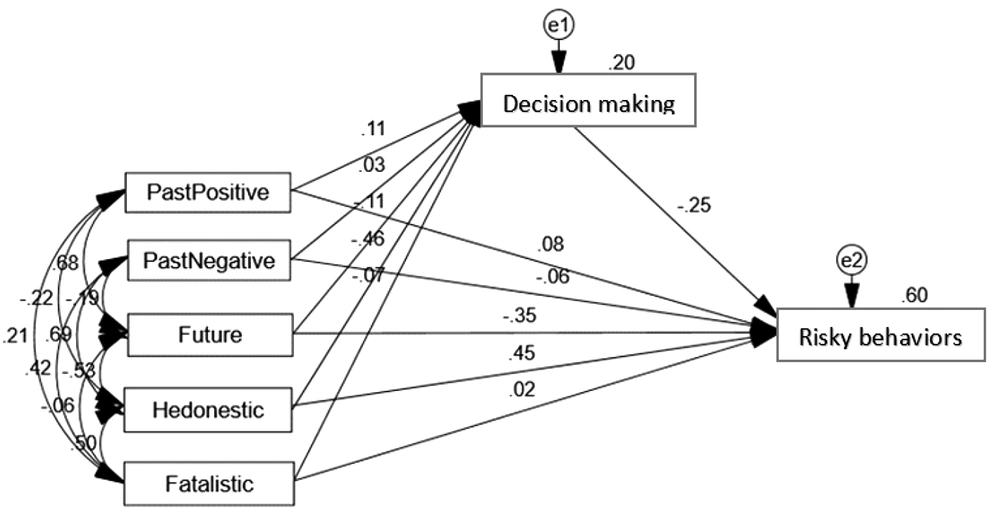
Figure 1.
Decision-making as a mediator between past-positive, past-negative, future, present-hedonistic, and present-fatalistic TP and risky behaviors
4.2. The Mediating Role of Response Inhibition
The results of the mediation analyses are presented in Table 4. The total effects of future (β = -1.005; P = 0.000) and present-hedonistic (β = 1.338; P = 0.001) were significant, but the total effects of past-positive (β = 0.303; P = 0.32), past-negative (β = -0.230; P = 0.18), and present-fatalistic (β = 0.169; P = 0.37) were not significant. The direct effects of future (β = -0.97; P = 0.001) and present-hedonistic (β = 0.986; P = 0.001) were significant, but the direct effects of past-positive (β = 0.159; P = 0.736), past-negative (β = -0.076; P = 0.773), and present-fatalistic (β = -0.121; P = 0.578) were not significant (Figure 2).
Table 4.
Results of the Bootstrapping Analyses Testing Inhibition as Mediators Between TP Components and Risky Behaviors
| Variables | Total Effect | Indirect Effect | Direct Effect | |
|---|---|---|---|---|
| Past-positive → risky behavior | 0.303 (0.322) | 0.143 (0.267) | 0.159 (0.736) | NS |
| Past-negative → risky behavior | -0.230 (0.180) | -0.155 (0.115) | -0.076 (0.773) | NS |
| Future → risky behavior | -1.005 (0.001) | -0.036 (0.554) | -0.97 (0.001) | Direct effect |
| Present-hedonistic → risky behavior | 1.338 (0.001) | 0.325 (0.001) | 0.986 (0.001) | Partial mediation |
| Present-fatalistic → risky behavior | 0.169 (0.378) | 0.290 (0.001) | -0.121 (0.578) | Indirect effect |
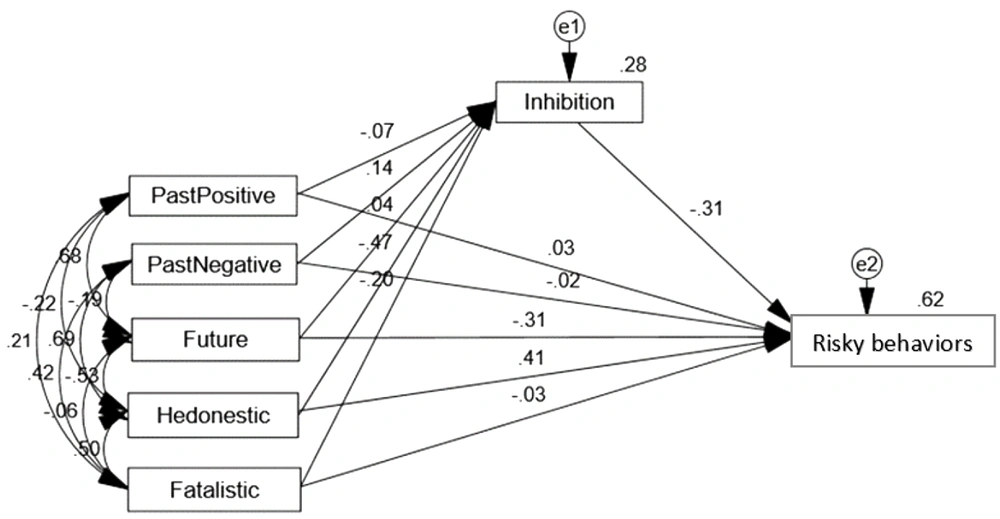
Figure 2.
Response inhibition as a mediator between past-positive, past-negative, future, present-hedonistic, and present-fatalistic TP components and risky behaviors
5. Discussion
According to the results, there was a considerable association between decision-making, response inhibition, TP, and risky behaviors. Results also showed that TP could predict risky behaviors through the mediation role of decision-making and response inhibition. Previous studies have shown the relationship between TP and risky behaviors. Our findings are in line with some of the previous studies. For instance, Konowalczyk et al. showed that adolescents who had a positive perspective exercised more and had more self-esteem and, as a result, did not seek to engage in risky behaviors (44). Xu et al. found in a cross-sectional study of adolescents that future perspective was less likely to lead to smoking and, in fact, was a protective component (17). Paasche et al. showed that hedonistic and futuristic perspectives had significant positive and negative relationships with substance use (19).
Also, Lemarie et al. showed that hedonistic perspective increased the likelihood of high-risk driving, and these people experienced things like speeding and overtaking while driving (21). On the other hand, TP has a significant relationship with psychological variables such as self-confidence and hope that can affect inhibition and decision-making (45). TP is also associated with engagement and commitment to homework, to the point where futurists are more motivated to engage in healthy activities and focus on long-term benefits such as health and success, and destiny-oriented people with present perspective believe in the role of fate and destiny, others, and luck (14).
In this regard, previous studies have shown the relationship between EF and risky behaviors. Our findings are in line with some of the previous studies. For instance, Leshem and King showed that risky behaviors were associated with the Go/No‐Go and BART (46). In addition, Pentz et al. found in a cross-sectional study of adolescent smokers that the deficit of EF was associated with an increased likelihood of smoking (47). Also, the results of Hayashi et al. showed that students with a low level of EF were more likely to engage in dangerous driving behaviors and experience negative driving outcomes (48).
According to Miyake and Friedman, inhibition is a key component of other EFs, demonstrating the ability to voluntarily control automatic and dominant responses in emergencies and can keep the individual alert to the possibility of danger and facilitate avoidant behaviors (49). Poor inhibition is significantly associated with impulsivity and causes adolescents to engage in high-risk behaviors without considering all precautions. Decision-making, on the other hand, is the process by which the option that has the highest and fastest returns is selected. This seemingly simple process has complexities, such as the conflict between values, choices, and the role of emotions in the final choice (38). In high-risk decision-making, a behavior that has immediate pleasure and benefit is preferred to other actions and behaviors. Although logic is the basis of EFs, the role of emotions is more prominent in high-risk decisions (50).
Although the TP is defined as a cognitive process in the formation and regulation of experiences over time, there are few empirical studies on its relationship with basic cognitive processes (50). However, some dimensions of TP may potentially be related to EF. In explaining the mediating role of decision-making and inhibition regarding TP and risky behaviors, it can be said that TP is considered as a process related to emotional, motivational, and functional factors; however, it is considered more as a cognitive schema that indicates its possible relationships with other cognitive functions (14, 15). One of the basic mechanisms in decision-making is time perception.
In high-risk decision-making, adolescents believe that they can enjoy the present by engaging in enjoyable, albeit risky activities, and consequently, they ignore the consequences of such behaviors because they are not available (51). Studies have shown that foresight may be an important component of self-regulation in some areas, such as achieving health-related goals and behaviors (52). In fact, foresight is associated with delays in immediate satisfaction of needs, low impulsivity, and rational decision-making, which can be considered as examples of self-regulation (53). On the other hand, high-risk behaviors have a certain excitement. Due to the role of emotions in high-risk decisions, risk-taking adolescents tend to engage in risky behaviors. Foresight and hedonism can also be expected to be related to decision-making and inhibition and, it causes adolescents' decisions emotional-based and to involve them in risky behaviors (32).
Present fatalism is defined as a frustrating attitude with a low level of control over events by the person and a belief in the power of the role of destiny in life that can influence a person’s decisions so that the person takes himself less responsible for his own behavior, and such a view can lead to a tendency for adolescents to engage in risky behaviors (15). Negative TP focuses on the role of unpleasant past events and negative interpretations of past events that are associated with negative emotions, psychotic symptoms, depression, and anxiety. These negative emotions are associated with poor inhibition and can affect the performance of risky behaviors (54).
Finally, it should be said that both futurism and inhibition have common principles of neuropsychology so that the role of the prefrontal is dominant in both, which is effective in deciding to perform healthy or high-risk behaviors. The prefrontal cortex is the last brain area to fully mature. By showing the mediating role of decision-making and inhibition in risky behaviors, this study demonstrated the predictive role of TP. Thus, TP and cognitive rehabilitation interventions could be considered preventive programs to help risky adolescents and reduce the possibility of risky behaviors in this sensitive group.
Considering the mediating role of EF in the relationship between TP and risky behaviors, researchers are advised to examine the effectiveness of TP interventions or cognitive rehabilitation in reducing adolescent high-risk behaviors.