Journal of Inflammatory Diseases
The Official Journal of Qazvin University of Medical Sciences
Optimal waist circumference cut-off points for predicting cardiovascular risk factors in Minoodar district, Qazvin
Authors

Abstract
Background: Central obesity - one of the metabolic syndrome components- is associated with cardiovascular diseases. Central obesity is defined based on waist circumference. Using ethnicity-specific waist circumference cut-off values is recommended as a cardiovascular risk factor . Objective: The aim of this study was to determine the optimal waist circumference cut-off points for predicting cardiovascular risk factors in Qazvin. Methods: This cross-sectional study was conducted on 1107 residents of Minoodar district of Qazvin that were selected by multistage cluster random sampling method in 2011-2012. Anthropometric indices and laboratory tests were measured. The receiver operating characteristic (ROC) curves of waist circumference for predicting each cardiovascular risk factor were depicted and areas under curve were calculated. The optimal cut-point was identified by the maximum Youden Index . Sensitivity and specificity of waist circumference cut points according to ATP III and International Diabetes Federation (IDF) criteria were calculated for diagnosis of cardiovascular risk factors. Findings: Of 1107, 529 (47.8%) were male. Mean age was 40.08±10.33. The optimal waist circumference cut points for predicting cardiovascular risk factors were 90.5-93.5 cm in men and 85.5-92.5 cm in women . Conclusion: With regards to the results, it seems that waist circumference cut point of ATP III is almost appropriate for women but is high for men. Waist circumference cut point of IDF is almost appropriate for men but is low for women .
Highlights
Copyright
© 2024, Journal of Inflammatory Diseases. This open-access article is available under the Creative Commons Attribution-NonCommercial 4.0 (CC BY-NC 4.0) International License (https://creativecommons.org/licenses/by-nc/4.0/), which allows for the copying and redistribution of the material only for noncommercial purposes, provided that the original work is properly cited.
Similar Articles
Cut-Off Point of Waist Circumference Used for the Diagnosis of Metabolic Syndrome Among Adult Population in Ahvaz, Southwestern Iran
Shahbazian H, Latifi SM, Nouhjah S. Cut-Off Point of Waist Circumference Used for the Diagnosis of Metabolic Syndrome Among Adult Population in Ahvaz, Southwestern Iran. Jentashapir J Cell Mol Biol. 2015;6(4):e30588. doi: https://doi.org/10.17795/jjhr-30588
Anthropometric Indices and Their Relationship With Coronary Artery Diseases
Arjmand G, Shidfar F, Molavi Nojoomi M, Amirfarhangi A. Anthropometric Indices and Their Relationship With Coronary Artery Diseases. Health Scope. 2015;4(3):e25120. doi: https://doi.org/10.17795/jhealthscope-25120
A Comparison of Waist-to-Hip Ratio Cutoff Points in a Large Sample of Southern Iranian Adults with Two Standard Procedures and Asian Studies
Jahanlou AS, Kouzekanani K. A Comparison of Waist-to-Hip Ratio Cutoff Points in a Large Sample of Southern Iranian Adults with Two Standard Procedures and Asian Studies. Shiraz E-Med J. 2017;18(6):e13796. doi: https://doi.org/10.5812/semj.13796
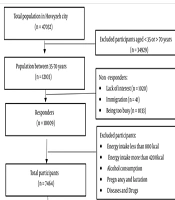
Anthropometric Measures, Cardiometabolic and Hepatic Indices, and Cut-off Points for Predicting Type 2 Diabetes Mellitus in Southwest Iran: A Cross-Sectional Study from the Enrolment Phase of the Hoveyzeh Cohort Study
Farhadi B, Zakerkish M, Alipour M, Rashidi H. Anthropometric Measures, Cardiometabolic and Hepatic Indices, and Cut-off Points for Predicting Type 2 Diabetes Mellitus in Southwest Iran: A Cross-Sectional Study from the Enrolment Phase of the Hoveyzeh Cohort Study. J Nurs Midwifery Sci. 2024;11(3):e148315. doi: https://doi.org/10.5812/jnms-148315
Predicting risk factors of cardiovascular disease according to anthropometric measures in children and adolescents
Kelishadi R, Hashemipour M, Faghihimani Z, Nazemi E, GhatrehSamani S, et al. Predicting risk factors of cardiovascular disease according to anthropometric measures in children and adolescents. J Inflamm Dis. 2024;14(1):e155514. doi:
- Scopus by DOI: 0
Last Update: 1 week ago
- Scopus by Title: 0
Last Update: 1 week ago
- Scopus by Title (Ref): 0
Last Update: 1 week ago
- CrossRef: 0
Last Update: 5 days ago
- OpenAlex: 0
Last Update: 1 hour ago
- OpenCitations: 0
Last Update: 3 days ago