Journal of Inflammatory Diseases
The Official Journal of Qazvin University of Medical Sciences

Parasitological, Immunological, and Molecular Methods in Diagnosis of Human Strongyloidiasis
Authors
Abstract
Strongyloidiasis is caused by intestinal nematode called Strongyloides stercoralis (S. stercoralis) which can lead to hyperinfection syndrome and disseminated infections. If not diagnosed and properly treated, it can even lead to death. The sensitivity of parasitological methods is not high enough and multiple stool sampling over consecutive days is essential to improve the detection rate. The agar plate culture method is more sensitive to the detection of S. stercoralis in fecal samples than other parasitological techniques. Serological tests have demonstrated higher sensitivity, but they have low specificity because of cross-reactivity with other helminthes. Moreover, they are not helpful for follow-up of treatment, because they cannot distinguish between new and old infections. Recently, some Polymerase Chain Reaction (PCR)-based techniques have been developed for detection of S. stercoralis with high sensitivity and specificity. These methods are rapid but expensive and need well-equipped laboratories. In this paper, conventional and novel methods for laboratory diagnosis of strongyloidiasis are reviewed.
Highlights
Copyright
© 2024, Journal of Inflammatory Diseases. This open-access article is available under the Creative Commons Attribution-NonCommercial 4.0 (CC BY-NC 4.0) International License (https://creativecommons.org/licenses/by-nc/4.0/), which allows for the copying and redistribution of the material only for noncommercial purposes, provided that the original work is properly cited.
Similar Articles
Epidemiological Study of Strongyloides stercoralis With a Comparative Diagnostic Approach, in Lorestan, West of Iran
Badparva E, Nayebzadeh H, Barkhordari MH, Ezatpour B. Epidemiological Study of Strongyloides stercoralis With a Comparative Diagnostic Approach, in Lorestan, West of Iran. Arch Clin Infect Dis. 2014;9(2):e16815. doi: https://doi.org/10.5812/archcid.16815
Identification of Infective Larva (L3) Proteins of Strongyloides Stercoralis by Immunoblot
Rouhani S, Mahmoudi M. Identification of Infective Larva (L3) Proteins of Strongyloides Stercoralis by Immunoblot. Arch Clin Infect Dis. 2010;5(2):. doi:
Strongyloides stercoralis in Immunosuppressed Patients
Corti M. Strongyloides stercoralis in Immunosuppressed Patients. Arch Clin Infect Dis. 2016;11(1):e27510. doi: https://doi.org/10.5812/archcid.27510
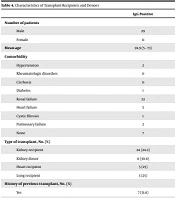
The Importance of Screening Strongyloides stercoralis Infection in Solid Organ Transplant Donors and Recipients
Abolghasemi S, Zolfaghari F, Sali S, Ghaffari A, Noori M. The Importance of Screening Strongyloides stercoralis Infection in Solid Organ Transplant Donors and Recipients. Arch Clin Infect Dis. 2021;16(4):e118047. doi: https://doi.org/10.5812/archcid.118047
Prevalence and Associated Risk Factors of Strongyloides sp. Infection in Diabetic Patients in the Central Part of Mazandaran, Northern Iran
Kalantari N, Darbandi Z, Bayani MA, Sharbatkhori M, Bayani M, et al. Prevalence and Associated Risk Factors of Strongyloides sp. Infection in Diabetic Patients in the Central Part of Mazandaran, Northern Iran. Arch Clin Infect Dis. 2019;14(4):e86569. doi: https://doi.org/10.5812/archcid.86569
- Scopus by DOI: 0
Last Update: 3 days ago
- Scopus by Title: 0
Last Update: 3 days ago
- Scopus by Title (Ref): 0
Last Update: 3 days ago
- CrossRef: 0
Last Update: 5 days ago
- OpenAlex: 0
Last Update: 2 days ago
- OpenCitations: 0
Last Update: 3 days ago