Journal of Inflammatory Diseases
The Official Journal of Qazvin University of Medical Sciences
Investigating the Successful Emergency Cerclage by Double-suture Method in the Presence of Prolapsed Amniotic Membrane: Case Series
Authors
Abstract
Background: Premature childbirth is the most common cause of neonatal morbidity and mortality. Cervical insufficiency is not an all –or- none phenomenon, but a continuous variable that can contribute to preterm delivery at different gestational ages. Emergency cerclage is recommended for those with cervical incompetence and prolapsed membranes before 24 weeks of gestation. Methods: This case series study included eight women treated with cervical cerclage presented in the late second trimester with advanced cervical insufficiency for whom emergency cervical cerclage by a double-suture technique was conducted between September 2021 and February 2022 in Qazvin Referral Kowsar and Mehregan Hospital. Women with a gestational age of 18 to 24 weeks, prolapsed amniotic membrane, and cervical dilatation (greater than 3 to 4 cm) on the speculum test met the inclusion criteria. Pregnancy with twins, previous failure cerclage, preterm rupture of membrane (PROM) and clinical or biological signs of infection were exclusion criteria. This study aims at reporting our outcome with Emergency Cerclage by Double-Suture Method. Results: Cerclage was performed in eight women at a mean gestational age of 19.4 weeks. The mean gestational age at delivery was 36. 4 weeks and all women had normal delivery. Conclusion: Our findings demonstrat that the double-suture method seems to provide better cervical support in high-risk women with preterm birth and second-trimester loss. Nevertheless, this procedure requires a trained surgical team and operator. Given the small sample size of our study, it would be more informative if this study was carried out on a wider population sample and compared to other procedures of rescue cerclage.
Highlights
Copyright
© 2023, Journal of Inflammatory Diseases. This open-access article is available under the Creative Commons Attribution 4.0 (CC BY 4.0) International License (https://creativecommons.org/licenses/by/4.0/), which allows for the copying and redistribution of the material only for noncommercial purposes, provided that the original work is properly cited.
Similar Articles
Effects of Maternal Cervical Incompetence on Morbidity and Mortality of Preterm Neonates with Birth weight Less than 2000g
Wei Z, Hua W, Ling F, Song Y, Jian-Rong M, et al. Effects of Maternal Cervical Incompetence on Morbidity and Mortality of Preterm Neonates with Birth weight Less than 2000g. Inn J Pediatr. 2014;24(6):. doi:
Outcome of Vaginal Birth After Cesarean Section (VBAC)
Noori N, Ghasemi M, Dashipour A, Dastgerdi M, Parnian G. Outcome of Vaginal Birth After Cesarean Section (VBAC). Zahedan J Res Med Sci. 2022;24(3):e119030. doi: https://doi.org/10.5812/zjrms-119030
Maternal and fetal complications with expecting treatment and labour induction after 40th week of gestational age
Shafiei A, Ali Mohamadi S, Zamani M, Nasrollahi S, Radnia N. Maternal and fetal complications with expecting treatment and labour induction after 40th week of gestational age. J Inflamm Dis. 2024;7(4):e154989. doi:
The Role of Uterocervical Angle on Preterm Birth Incidence
Shirazi M, Sina M, Hantoushzadeh S, Golshahi F, Sahebdel B, et al. The Role of Uterocervical Angle on Preterm Birth Incidence. J Nurs Midwifery Sci. 2024;11(4):e151504. doi: https://doi.org/10.5812/jnms-151504
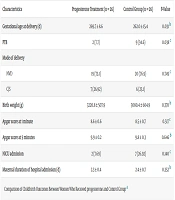
The Effect of Vaginal Progesterone in Reducing Preterm Birth in Women with an Increased Uterocervical Angle: A Randomized Controlled Trial
Borna S, Eshraghi N, Hantoushzadeh S, Ghotbizadeh Vahdani F, Panahi Z, et al. The Effect of Vaginal Progesterone in Reducing Preterm Birth in Women with an Increased Uterocervical Angle: A Randomized Controlled Trial. J Nurs Midwifery Sci. 2025;12(4):e160082. doi: https://doi.org/10.5812/jnms-160082
More by these authors
- Scopus by DOI: 0
Last Update: 2 weeks ago
- Scopus by Title: 0
Last Update: 2 weeks ago
- Scopus by Title (Ref): 1
Last Update: 2 weeks ago
- CrossRef: 0
Last Update: 4 hours ago
- OpenAlex: 0
Last Update: 8 hours ago
- OpenCitations: 0
Last Update: 4 days ago
