
J Inflamm Dis

Image Credit:J Inflamm Dis

A Policy Brief: Addressing Urinary Tract Infections and Antibiotic Resistance in Qazvin, Iran

Author(s):
Hamid SadeghiHamid Sadeghi1, Solmaz FarrokhzadSolmaz Farrokhzad2, Ali Akbar KaramiAli Akbar Karami2, Seyyedeh Sara NazemsadatiSeyyedeh Sara Nazemsadati3, Fatemeh Karimi DermaniFatemeh Karimi DermaniFatemeh Karimi Dermani ORCID4,*, Saeideh Gholamzadeh KhoeiSaeideh Gholamzadeh KhoeiSaeideh Gholamzadeh Khoei ORCID5,**
1Medical Microbiology Research Center, Qazvin University of Medical Sciences, Qazvin, Iran
2Non-communicable Diseases Research Center, Research Institute for Prevention of Non-communicable Diseases, Qazvin University of Medical Sciences, Qazvin, Iran
3Qazvin University of Medical Sciences, Qazvin, Iran
4Hellen Diller Family Cancer Research, University of California San Francisco, USA
5Cellular and Molecular Research Center, Research Institute for Prevention of Non-communicable Diseases, Qazvin University of Medical Sciences, Qazvin, Iran
Corresponding Authors:

Journal of Inflammatory Diseases:Vol. 30, issue 1; e170551
Published online:May 05, 2026
Article type:Brief Report
Received:Feb 18, 2026
Accepted:Apr 20, 2026
How to Cite:Sadeghi H, Farrokhzad S, Karami AA, Nazemsadati SS, Karimi Dermani F, et al. A Policy Brief: Addressing Urinary Tract Infections and Antibiotic Resistance in Qazvin, Iran. J Inflamm Dis. 2026;30(1):e170551. doi: https://doi.org/10.69107/jid-170551

Abstract

Background:

Urinary tract infections (UTIs) are among the most prevalent bacterial infections worldwide and represent a major driver of antibiotic consumption. Inappropriate empirical treatment and limited community-level surveillance have contributed to the rapid expansion of antimicrobial resistance (AMR), particularly in outpatient settings. In Iran, most available resistance data originate from hospitalized populations, leaving an important evidence gap regarding community-acquired UTIs.

Objectives:

This policy brief aims to assess the prevalence of UTIs and antimicrobial susceptibility patterns in a non-hospital laboratory setting in Qazvin Province, Iran, and to propose evidence-informed policy options to improve antibiotic stewardship and reduce AMR.

Methods:

This policy brief summarizes the evidence from a retrospective cross-sectional analysis of 3,521 urine samples obtained from patients referred to Mehr Clinical Laboratory between April 2017 and January 2019. Bacterial isolates were identified using standard culture techniques, and antimicrobial susceptibility testing was performed in accordance with Clinical and Laboratory Standards Institute (CLSI) guidelines using the disk diffusion method.

Conclusions:

The study demonstrates a considerable burden of community-acquired UTIs and substantial resistance to commonly prescribed antibiotics. Strengthening community-based surveillance, promoting rational prescribing, and expanding public education are essential to contain AMR and improve UTI management in Iran.

1. Background and Problem Statement

Urinary tract infections (UTIs), which affect millions of people each year, remain among the most common infections in community and hospital settings (1). Although many UTIs are uncomplicated and readily treatable (2), inappropriate antibiotic selection and incomplete treatment courses contribute to recurrent infections and the emergence of multidrug-resistant organisms (3). Globally, an estimated 150 million UTI cases occur annually, placing a significant burden on healthcare systems and patients alike (4).
In Iran, national antimicrobial stewardship efforts have primarily focused on hospital settings, whereas patterns of resistance in community-acquired infections remain insufficiently characterized (4, 5). Non-hospital medical laboratories serve as critical access points for patients with mild or moderate infections and therefore provide valuable insight into real-world prescribing needs (6). The absence of routine surveillance data from these settings limits the ability of clinicians and policymakers to develop evidence-based empirical treatment guidelines.
Approximately 13.5% of Iran's population resides in the northwest region of the country, and about 1.6% lives in Qazvin Province, a typical urban setting where community-acquired UTIs are frequently encountered. Understanding local pathogen distribution and susceptibility profiles is essential to prevent treatment failure, reduce healthcare costs, and slow the spread of antimicrobial resistance (7).

2. Materials and Methods

This study was conducted at Mehr Clinical Laboratory in Qazvin Province, Iran. Data were collected from April 2017 to January 2019. A total of 3,521 patients of both sexes and various age groups were included. Clean-catch midstream urine samples were cultured on blood agar and MacConkey agar, and bacterial growth ≥ 10⁴ CFU/mL was considered significant.
Bacterial identification was performed using standard microbiological procedures. Antimicrobial susceptibility testing was carried out by the disk diffusion method on Mueller-Hinton agar in accordance with Clinical and Laboratory Standards Institute (CLSI) guidelines. The antibiotics tested included amikacin, ciprofloxacin, ceftriaxone, gentamicin, nalidixic acid, nitrofurantoin, trimethoprim/sulfamethoxazole, cephalexin, and erythromycin. Statistical analysis was performed using SPSS software.

3. Results and Policy-Relevant Findings

Among the 3,521 patients evaluated, 347 bacterial isolates were recovered, yielding an overall UTI prevalence of 9.9%. Females constituted the majority of affected individuals. A statistically significant association was observed between age and UTI occurrence, with the highest frequency in the 20 - 30-year age group.
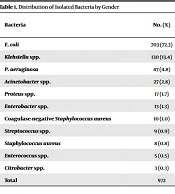
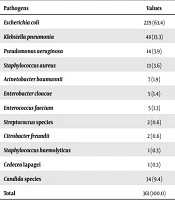
Gram-negative bacteria accounted for 81.2% of isolates, whereas gram-positive organisms comprised 18.7%. Escherichia coli was the predominant pathogen (54.5%), followed by Klebsiella pneumoniae. Pseudomonas aeruginosa was the least frequently isolated organism.
Susceptibility testing showed that most gram-negative isolates were highly sensitive to nitrofurantoin, ciprofloxacin, and gentamicin. Conversely, more than half of the isolates demonstrated resistance to nalidixic acid and trimethoprim/sulfamethoxazole. Among gram-positive bacteria, the highest sensitivity was observed for amikacin. These results suggest that a substantial proportion of community-acquired UTIs may no longer respond reliably to traditional first-line antibiotics such as co-trimoxazole and fluoroquinolones, consistent with reports of rising resistance rates worldwide (8).

4. Policy Options and Implementation Strategies

One policy option is the establishment of a routine community-based surveillance system to monitor UTI pathogens and their resistance patterns through selected non-hospital laboratories. Such a system would enable timely updates of empirical treatment recommendations and provide early warning of emerging resistance trends (9).
A second option is the strengthening of antibiotic stewardship in outpatient care. This includes integrating local resistance data into clinical guidelines, promoting culture-based diagnosis for recurrent or complicated UTIs, and providing continuing medical education for general practitioners on rational antibiotic prescribing (10, 11).
A third option involves expanding public education initiatives aimed at reducing self-medication and improving adherence to prescribed antibiotic regimens. Public awareness campaigns can emphasize the dangers of inappropriate antibiotic use and the importance of completing treatment courses (12, 13).

5. Conclusions

Community-acquired UTIs remain common in Iran and are increasingly complicated by antimicrobial resistance. Evidence from non-hospital laboratory surveillance highlights the urgent need for coordinated action at the community level. Implementing targeted surveillance, reinforcing stewardship programs, and improving public awareness can collectively reduce inappropriate antibiotic use and help preserve the effectiveness of existing therapies.
Footnotes

References

  • 1.
    Sadeghi H, Gheibi N, Karimi Dermani F, Gholamzadeh Khoei S. A retrospective cross-sectional survey on urinary tract infections in a non-hospital medical laboratory. Iranian Journal of Medical Microbiology. 2022;16(5):465-71. https://doi.org/10.30699/ijmm.16.5.465.
  • 2.
    Hooton TM. Uncomplicated urinary tract infection. New England Journal of Medicine. 2012;366(11):1028-37. [PubMed ID: 22417256]. https://doi.org/10.1056/NEJMcp1104429.
  • 3.
    Ng LY, Goh LH, van der Lubbe SCC, Koh SWC. Factors affecting antibiotic appropriateness in uncomplicated urinary tract infections in primary care. Scientific Reports. 2025;15(1):15055. [PubMed ID: 40301511]. [PubMed Central ID: PMC12041377]. https://doi.org/10.1038/s41598-025-99067-9.
  • 4.
    Öztürk R, Murt A. Epidemiology of urological infections: a global burden. World Journal of Urology. 2020;38(11):2669-79. [PubMed ID: 31925549]. https://doi.org/10.1007/s00345-019-03071-4.
  • 5.
    Bijani B, Azizi L, QasemiBarqi R, Allami A. Disruption and adaptation of antimicrobial stewardship programs in Iranian hospitals during the COVID-19 pandemic: a descriptive phenomenological qualitative study. Cureus. 2025;17(7):e88754. [PubMed ID: 40861595]. [PubMed Central ID: PMC12375382]. https://doi.org/10.7759/cureus.88754.
  • 6.
    Chin TL, McNulty C, Beck C, MacGowan A. Antimicrobial resistance surveillance in urinary tract infections in primary care. The Journal of Antimicrobial Chemotherapy. 2016;71(10):2723-8. [PubMed ID: 27353470]. https://doi.org/10.1093/jac/dkw223.
  • 7.
    Bwanali AN, Lubanga AF, Kondowe S, Nzima E, Mwale A, Kamanga W, et al. Trends and patterns of antimicrobial resistance among common pathogens isolated from adult bloodstream and urinary tract infections in public health facilities in Malawi, 2020-2024. BMC Infectious Diseases. 2025;25(1):946. [PubMed ID: 40713498]. [PubMed Central ID: PMC12297731]. https://doi.org/10.1186/s12879-025-11335-1.
  • 8.
    Bryce A, Hay AD, Lane IF, Thornton HV, Wootton M, Costelloe C. Global prevalence of antibiotic resistance in paediatric urinary tract infections caused by Escherichia coli and association with routine use of antibiotics in primary care: systematic review and meta-analysis. BMJ. 2016;352. [PubMed ID: 26980184]. [PubMed Central ID: PMC4793155]. https://doi.org/10.1136/bmj.i939.
  • 9.
    Majigo MV, Mshana S, Komba E, Moremi N, Matee M. Protocol for surveillance of antimicrobial-resistant bacteria causing community-acquired urinary tract infections in low-income countries. PLOS One. 2024;19(5):e0304388. [PubMed ID: 38820392]. [PubMed Central ID: PMC11142477]. https://doi.org/10.1371/journal.pone.0304388.
  • 10.
    Deresinski S. Antibiotic stewardship in outpatient settings. Infectious Disease Alert. 2017;36(4).
  • 11.
    Murray K, Shimabukuro J, Khalfay N, Chiang JN, Lenore Ackerman A. Antibiotic overprescription for "Urinary Tract Infections" is associated with poor diagnostic stewardship and low adherence to guidelines. Neurourology and Urodynamics. 2025;44(2):382-9. [PubMed ID: 39629893]. [PubMed Central ID: PMC11788957]. https://doi.org/10.1002/nau.25598.
  • 12.
    Khoshgoftar M, Zamani-Alavijeh F, Kasaian N, Shahzamani K, Rostami S, Nakhodian Z, et al. The effect of public health educational campaign regarding antibiotic use and microbial resistance on knowledge, attitude, and practice in the Iran. Journal of Education and Health Promotion. 2021;10:3. [PubMed ID: 33688512]. [PubMed Central ID: PMC7933621]. https://doi.org/10.4103/jehp.jehp_629_20.
  • 13.
    Afifi H. The effectiveness of health campaigns on antibiotic resistance: a media and pharmacy practice perspective. Infection and Drug Resistance. 2025;18:5817-28. [PubMed ID: 41234342]. [PubMed Central ID: PMC12607601]. https://doi.org/10.2147/IDR.S566496.

Crossmark
Crossmark
Checking
Share on
Cited by
Metrics

Purchasing Reprints

  • Copyright Clearance Center (CCC) handles bulk orders for article reprints for Brieflands. To place an order for reprints, please click here (   https://www.copyright.com/landing/reprintsinquiryform/ ). Clicking this link will bring you to a CCC request form where you can provide the details of your order. Once complete, please click the ‘Submit Request’ button and CCC’s Reprints Services team will generate a quote for your review.
Search Relations

Author(s):

Related Articles