
1. Background
Severe acute respiratory syndrome coronavirus 2 (SARS-CoV-2), the pathogen responsible for COVID-19, was first documented in December 2019 and subsequently caused a global pandemic (1). Although COVID-19 commonly presents with respiratory symptoms such as shortness of breath, cough, and fever, patients frequently exhibit diverse extrapulmonary manifestations (2, 3). Elevated transaminases are a well-documented feature of COVID-19, ranging from mild, transient elevations to severe hepatic impairment (4). In this study, elevated transaminases were defined as alanine aminotransferase (ALT) or aspartate aminotransferase (AST) levels exceeding 40 U/L, based on local institutional guidelines. Clinical evidence associates these enzyme elevations with COVID-19 severity and overall morbidity (5).
2. Objectives
This study aimed to determine the associations of clinical and laboratory parameters with elevated transaminase levels in hospitalized patients with COVID-19. It also sought to identify measurable factors associated with elevated transaminase levels that could inform early intervention strategies and targeted management to improve patient prognosis.
3. Methods
3.1. Study Design and Participant Selection
This retrospective cross-sectional study used outcome-based case-control sampling. We analyzed the medical records of patients with confirmed COVID-19 who were admitted to Bu-Ali Sina Hospital in Qazvin, Iran, between February 19, 2020, and July 24, 2021.
During this period, 4,830 patients were admitted with a diagnosis of COVID-19, of whom 3,203 had a positive PCR test. The required sample size was calculated to compare the two study groups using a formula for comparing two proportions (6):
Based on previous COVID-19 studies, we assumed that adverse outcomes, such as ICU admission, would occur in approximately 20% of patients with normal liver enzymes and 40% of patients with elevated transaminases. Accordingly, 133 patients per group (N = 266) were required to achieve 80% power at an α level of 0.05. We reviewed the records of consecutive eligible patients with elevated transaminases (ALT or AST > 40 U/L) until 133 patients were identified. Initial screening assessed record completeness and exclusion criteria, including pre-existing viral hepatitis, autoimmune hepatitis, fatty liver disease, and documented exposure to hepatotoxic medications. The definition of elevated transaminases (ALT or AST > 40 U/L) was based on the upper limit of normal in our institutional laboratory reference ranges. Exposure to hepatotoxic medications was assessed by medical record review, and patients with documented exposure were excluded.
Records were reviewed until 133 patients with elevated liver enzymes were identified. During this process, 1 patient with hepatitis B, 6 with NASH, and 7 with incomplete data were excluded, for a total of 14 patients. Among patients admitted during the same period who did not have elevated liver enzymes, the first 133 eligible patients were selected as controls. The final sample therefore comprised two equal groups: 133 patients with elevated transaminases and 133 patients with normal liver enzymes. This outcome-based case-control structure influences the interpretation of frequency estimates and odds ratios. Participant eligibility and selection are presented in Figure 1.
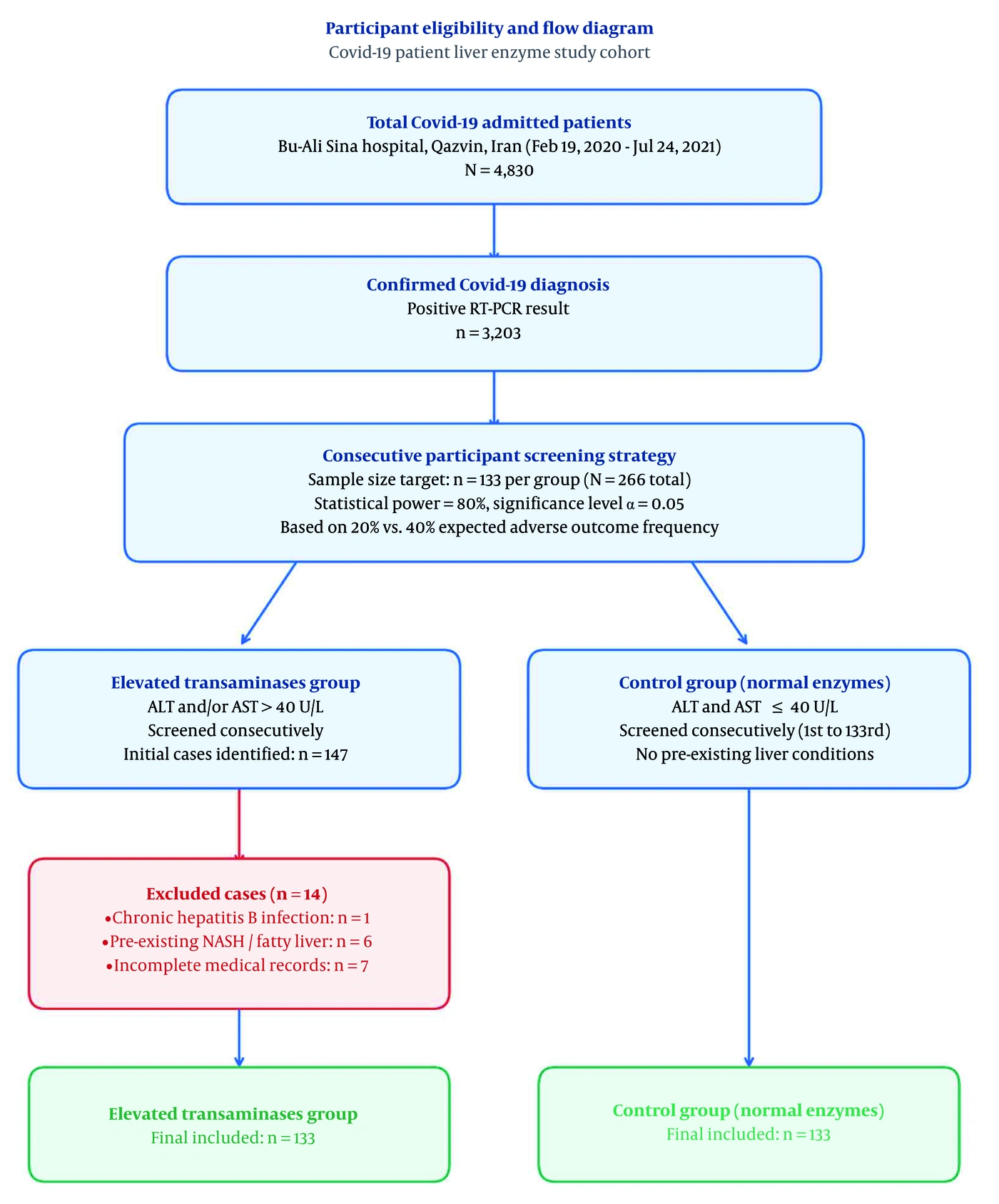
Figure 1.
Participant eligibility and flow diagram
The demographic data extracted included age, sex, marital status, and educational attainment.
3.2. Clinical and Laboratory Parameters
Clinical parameters recorded at admission included systolic and diastolic blood pressure, pulse rate, respiratory rate (RR), and core body temperature. Patient histories included smoking, substance use, diabetes, and hypertension. The ESI version 4 triage algorithm was used to standardize severity scoring (Figure 2). Levels 1 - 2 indicate high acuity, whereas levels 3 - 5 indicate lower acuity (7).
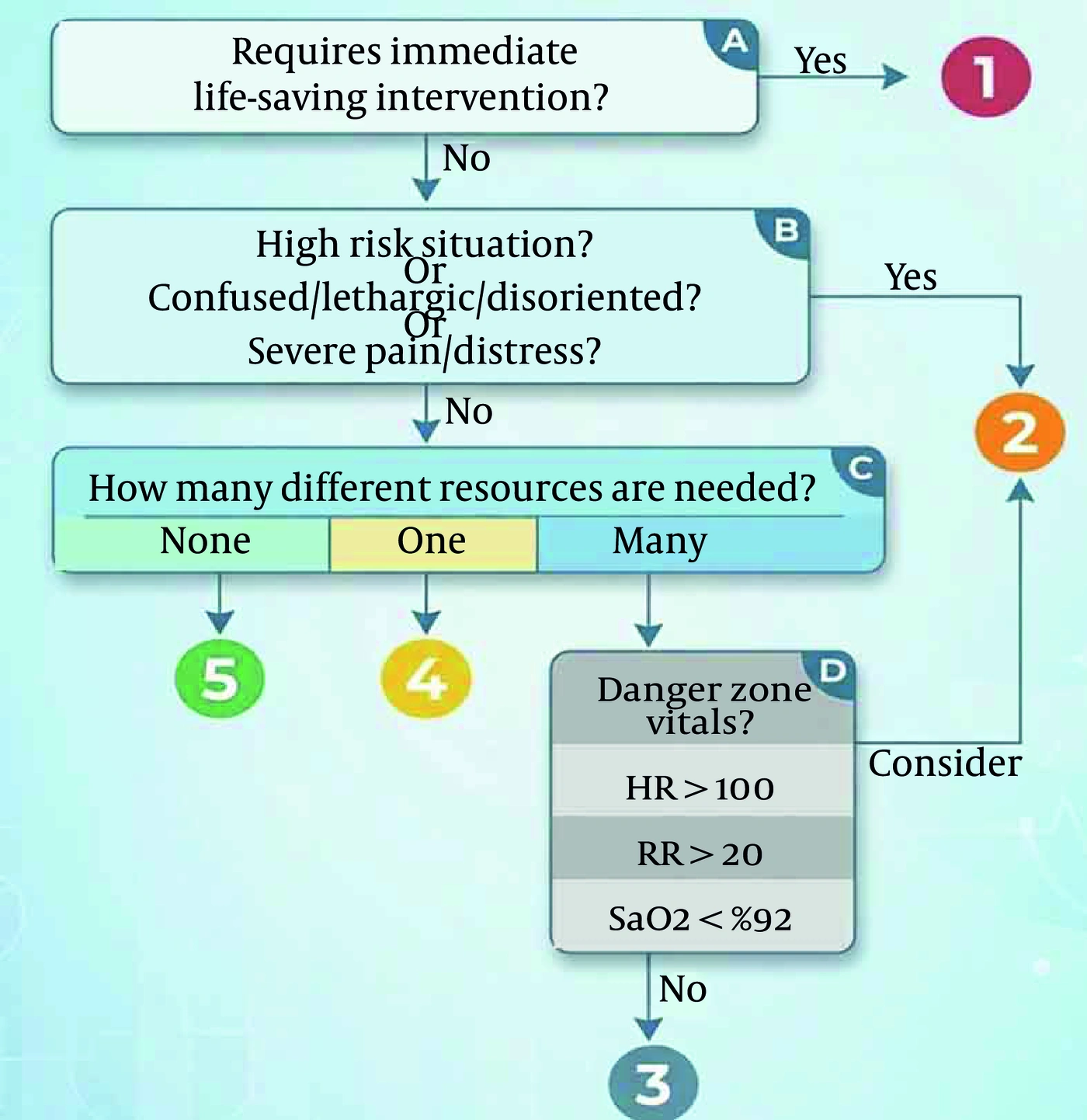
Figure 2.
Emergency Severity Index (ESI) triage algorithm, version 4
Abbreviation: ESI, Emergency Severity Index.
Intubation and ICU admission during hospitalization were recorded. ICU admission was treated as an outcome associated with elevated transaminases rather than as a baseline risk factor. All laboratory parameters were measured at admission, before any ICU transfer or death. Group assignment was based on admission ALT and AST measurements, with elevated transaminases defined as ALT or AST > 40 U/L. Laboratory parameters collected included C-reactive protein (CRP, mg/L), erythrocyte sedimentation rate (ESR, mm/h), AST, ALT, MCV, PDW, RDW, magnesium (Mg), calcium (Ca), LDH, triglycerides (TG), and D-dimer.
3.3. Statistical Analysis
Qualitative data were summarized as frequencies, and quantitative data as either the mean ± standard deviation (SD) or the median and interquartile range. Normality was assessed using the Kolmogorov-Smirnov test. Normally distributed continuous variables were compared using independent t tests; otherwise, the Mann-Whitney U test was used. Categorical variables were compared using χ2 or Fisher exact tests. Logistic regression using the forward conditional method was performed to identify predictors. Variables with P < 0.2 in univariate analysis were initially included. Age was considered but removed during the forward conditional procedure because it did not meet the significance threshold of P < 0.05. Other potential confounders, including diabetes and smoking, were considered but not retained. Aspartate aminotransferase and ALT were excluded as predictors because they formed part of the outcome definition. Intubation was also excluded because it was an outcome rather than a baseline predictor. Multicollinearity was assessed using the variance inflation factor (VIF), with no substantial multicollinearity detected (VIF < 5). Odds ratios (ORs) and 95% confidence intervals (CIs) were calculated. Statistical significance was set at P < 0.05. All analyses were performed using SPSS version 27.0 (Armonk, NY, USA).
4. Results
Data were obtained from Bu-Ali Sina Hospital for the period from February 19, 2020, to July 24, 2021. Following eligibility assessment and selection from an initial pool of 3,203 patients with confirmed COVID-19, the final balanced sample comprised 266 patients. Baseline patient characteristics are presented in Table 1.
Table 1.
Baseline Characteristics of Hospitalized Patients with COVID-19 (N = 266) a
| Baseline Characteristics of Patients | Values |
|---|---|
| Age (y) | 56.1 ± 17.8 |
| Male | 160 (60.2) |
| Smoker | 27 (10.2) |
| SBP (mmHg) | 121.8 ± 19.2 |
| DBP (mmHg) | 77.5 ± 12.4 |
| PR (beats/min) | 90.2 ± 15.8 |
| RR (breaths/min) | 20.1 ± 3.6 |
| Temp (°C) | 36.9 ± 0.5 |
| SpO (%) | 88.5 ± 5.3 |
| Hb (g/dL) | 13.6 ± 2.0 |
| PLT (×103/μL) | 192.1 ± 79.3 |
| Lymph (cells/μL) | 1272.5 ± 661.4 |
| PMN (cells/μL) | 6115.8 ± 3530.2 |
| ESR (mm/h) | 42.1 ± 20.5 |
| CRP (mg/L) | 35.0 ± 25.8 |
| BUN (mg/dL) | 21.3 ± 15.2 |
| Cr (mg/dL) | 1.2 ± 1.1 |
| Na (mEq/L) | 140.4 ± 3.7 |
| K (mEq/L) | 4.7 ± 0.5 |
| Ca (mg/dL) | 8.6 ± 0.6 |
| AST (U/L) | 68.0 ± 92.0 |
| ALT (U/L) | 58.7 ± 69.8 |
| D-Dimer (μg/mL) | 1.4 ± 1.4 |
| ICU Admission | 69 (25.9) |
| Mortality | 47 (17.7) |
a Values are expressed as mean ± SD or No. (%). Abbreviations: SBP, systolic blood pressure; DBP, diastolic blood pressure; PR, pulse rate; RR, respiratory rate; Temp, temperature; SpO2, peripheral capillary oxygen saturation; Hb, hemoglobin; PLT, platelet count; Lymph, lymphocyte count; PMN, polymorphonuclear neutrophil count; CRP, C-reactive protein; ESR, erythrocyte sedimentation rate; BUN, blood urea nitrogen; Cr, creatinine; Ca, calcium; Na, sodium; K, potassium; ALT, alanine aminotransferase; AST, aspartate aminotransferase; ICU, intensive care unit. SD, standard deviation.
Patients with elevated transaminases at admission had significantly higher odds of ICU admission (adjusted OR, 2.7; 95% CI, 1.6 - 4.6; P < 0.001) and in-hospital mortality (OR, 2.5; 95% CI, 1.3 - 4.8; P = 0.005). Among qualitative variables, male sex and hypertension were significantly associated with elevated transaminases at admission. Elevated transaminases were also more frequent among patients with high-acuity ESI levels 1 - 2 (Table 2).
Table 2.
Association of Qualitative Variables with Elevated Transaminases in COVID-19 Patients a
| Variables | Normal Function | Raised Liver Transaminases | P value |
|---|---|---|---|
| Gender | < 0.001 b | ||
| Female | 69 (51.9) | 37 (27.8) | |
| Male | 64 (48.1) | 96 (72.2) | |
| Marital status | 0.050 c | ||
| Single | 11 (8.3) | 15 (11.3) | |
| Married | 117 (88.0) | 117 (88.0) | |
| Widow | 5 (3.8) | 1 (0.8) | |
| Education | 0.083 | ||
| Uneducated | 18 (13.5) | 10 (7.5) | |
| Under diploma | 68 (51.1) | 66 (49.6) | |
| Diploma | 28 (21.1) | 41 (30.8) | |
| University | 19 (14.3) | 16 (12.0) | |
| Smoking | 10 (7.5) | 17 (12.8) | 0.160 |
| Addiction | 7 (5.3) | 9 (6.8) | 0.610 |
| Hypertension | 20 (15.0) | 35 (26.3) | 0.025 b |
| Diabetes Mellitus | 28 (21.1) | 32 (24.1) | 0.560 |
| ICU Admission | 24 (18.0) | 45 (33.8) | 0.003 b |
| Intubation | 15 (11.3) | 27 (20.3) | 0.054 |
| Mortality | 15 (11.3) | 32 (24.1) | 0.005 b |
| Initial triage scores | < 0.001 b | ||
| Level 1 and 2 | 68 (51.1) | 102 (76.7) | |
| Level 3 to 5 | 65 (48.9) | 31 (23.3) |
a Values are expressed as No. (%). Abbreviations: ICU, intensive care unit.
b A P < 0.05 was considered statistically significant.
c Fisher exact testing was used to examine marital status because of low expected cell counts, particularly in the widowed category. The widowed and single categories were subsequently combined into an unmarried category to improve statistical power and obtain a more robust estimate. After consolidation, the association between marital status and elevated transaminases remained nonsignificant (P = 0.08).
Among quantitative variables, elevated ESR, CRP, blood urea nitrogen (BUN), and creatinine (Cr), as well as lower lymphocyte count and lower peripheral capillary oxygen saturation (SpO2), were significantly associated with elevated transaminases in univariate analysis (Table 3).
Table 3.
Association of Quantitative Variables with Elevated Transaminases a
| Variables | Normal Liver Function | Raised Transaminases | P value b |
|---|---|---|---|
| Age (y) | 58 (44, 72) | 54 (43, 69) | 0.480 |
| SBP (mmHg) | 120 (110, 130) | 120 (110, 130) | 0.780 |
| DBP (mmHg) | 80 (70, 85) | 80 (70, 85) | 0.610 |
| PR (beats/min) | 89 (80, 100) | 88 (80, 100) | 0.590 |
| RR (breaths/min) | 19 (18, 24) | 20 (18, 24) | 0.280 |
| BT (°C) | 36.8 (36.5, 37.2) | 36.8 (36.5, 37.1) | 0.840 |
| SpO2 (%) | 89 (85, 94) | 87 (83, 91) | 0.002 |
| PLT (×103/μL) | 184.5 (138, 234) | 172.0 (130, 235) | 0.260 |
| LYM (cells/μL) | 1268 (985, 1762) | 950 (765, 1301) | < 0.001 |
| PMN (cells/μL) | 4516 (3454, 7000) | 5965 (3825, 8800) | 0.024 |
| RDW (%) | 13.2 (12.6, 14.1) | 13.3 (12.7, 14.0) | 0.680 |
| D-Dimer (μg/mL) | 0.88 (0.38, 3.00) | 0.60 (0.40, 3.00) | 0.900 |
| BUN (mg/dL) | 16 (12, 23) | 19 (13, 25) | 0.007 |
| Cr (mg/dL) | 0.9 (0.7, 1.1) | 1.1 (1.0, 1.2) | < 0.001 |
| Na+ (mEq/L) | 140.5 (138, 142) | 141 (138, 143) | 0.200 |
| K+ (mEq/L) | 4.8 (4.2, 5.0) | 4.7 (4.4, 5.0) | 0.500 |
| Hb (g/dL) | 13.5 ± 2.2 | 13.7 ± 2.0 | 0.340 |
| ALT (U/L) | 15 (12, 20) | 68.5 (54, 126) | < 0.001 |
| AST (U/L) | 25 (20.7, 32.0) | 74 (57, 107) | < 0.001 |
| CRP (mg/L) | 22.0 (9.7, 43.0) | 33.0 (25.0, 52.7) | < 0.001 |
| ESR (mm/h) | 36.9 ± 19.6 | 47.2 ± 20.1 | < 0.001 |
| Ca2+ (mg/dL) | 8.6 ± 0.6 | 8.7 ± 0.7 | 0.430 |
a Values are expressed as median (interquartile range) or mean ± SD. Abbreviations: SBP, systolic blood pressure; DBP, diastolic blood pressure; PR, pulse rate; RR, respiratory rate; BT, body temperature; SpO2, peripheral capillary oxygen saturation; PLT, platelet count; LYM, lymphocyte count; PMN, polymorphonuclear neutrophils; RDW, red cell distribution width; BUN, blood urea nitrogen; Cr, creatinine; Na+, sodium; K+, potassium; Hb, hemoglobin; ALT, alanine aminotransferase; AST, aspartate aminotransferase; CRP, C-reactive protein; ESR, erythrocyte sedimentation rate; Ca2+, calcium.
b A P < 0.05 was considered statistically significant.
Logistic regression identified male sex, low initial triage scores (ESI levels 1 - 2), lymphopenia, and elevated ESR as independent predictors of elevated transaminases. Oxygen (O2) saturation and Cr were no longer statistically significant in the adjusted model, possibly because of their relationships with triage level and BUN, respectively, and with overall disease severity (Table 4).
Table 4.
Independent Predictors Associated with Elevated Transaminases in Hospitalized Patients Diagnosed with COVID-19 (Forward Conditional Logistic Regression) a
| Variables | OR (95% CI) | P value |
|---|---|---|
| Sex (male) | 3.210 (1.732 - 5.952) | < 0.001 |
| High-acuity ESI Level 1 - 2 | 3.180 (1.468 - 6.889) | 0.003 |
| LYM (cells/µL) (per 100 cells decrease) | 0.999 (0.998 - 0.999) | 0.004 |
| ESR (mm/h) (per unit increase) | 1.024 (1.006 - 1.042) | 0.008 |
| HTN | 0.525 (0.239 - 1.154) | 0.110 |
| Cr (mg/dL) | 1.137 (0.818 - 1.581) | 0.440 |
| CRP (mg/L) | 1.004 (0.991 - 1.018) | 0.520 |
| SpO2 (%) | 1.022 (0.926 - 1.129) | 0.660 |
| PMN (cells/µL) | 1.000 (1.000 - 1.000) | 0.850 |
a Table 4 presents the full adjusted model. The dependent variable was the presence of elevated transaminases (ALT or AST > 40 U/L). Abbreviations: HTN, hypertension; SpO2, peripheral capillary oxygen saturation; ALT, alanine aminotransferase; AST, aspartate aminotransferase; LYM, lymphocyte count; PMN, polymorphonuclear neutrophils; Cr, creatinine; CRP, C-reactive protein; ESR, erythrocyte sedimentation rate; ESI, Emergency Severity Index; OR, odds ratio; CI, confidence interval.
5. Discussion
Male sex, high-acuity ESI levels 1 - 2, lymphopenia, and elevated ESR were associated with higher odds of elevated transaminases in patients with COVID-19.
Consistent with previous findings, male sex was significantly associated with elevated transaminases. A study in Japan reported a threefold increased risk of elevated transaminases among male patients with COVID-19 (8). Another study found that male patients with COVID-19 were more likely to experience severe disease and higher mortality (9). Hormonal differences, particularly the immunosuppressive effects of testosterone (10) and the protective role of estrogen, together with differences in ACE2 expression (11), may explain this finding. ACE2 is the receptor through which the virus enters cells.
The data suggest an association between systemic COVID-19 severity and elevated transaminases, consistent with previous reports. Patients with elevated transaminases had more severe disease, were more likely to require ICU admission, and had higher in-hospital mortality (12, 13). Elevated transaminases may therefore serve as a marker of systemic illness and an early warning sign of a more complicated clinical course rather than an isolated hepatic event (13).
High-acuity ESI levels 1 - 2 have been associated with higher in-hospital mortality among patients with COVID-19 (14). Their association with elevated transaminases also highlights the importance of early assessment at the point of care. These patients typically have extensive lung involvement, increased inflammation, and hypoxia, which may contribute to elevated transaminases in COVID-19 (15). The finding that SpO2 was significant in univariate analysis but not in the adjusted model suggests that the relationship between hypoxia and hepatic injury may be partly captured by triage level. This interpretation remains speculative because no formal mediation analysis was performed.
Lymphopenia was significantly associated with elevated transaminases in this study. It is a hallmark of severe COVID-19 and reflects immune dysregulation, which may exacerbate transaminase elevation through increased inflammation and direct viral effects on hepatocytes (16, 17). To improve interpretability, the OR for lymphopenia is reported per 100-cell decrease. Elevated ESR was also associated with elevated transaminases. An elevated ESR indicates systemic inflammation, which contributes to multiorgan dysfunction in COVID-19, including transaminase elevation (18). The small but significant OR for ESR (1.024 per unit increase) suggests that even modest increases in inflammatory markers warrant monitoring.
Age, educational attainment, marital status, smoking history, substance use, diabetes, and hypertension did not significantly contribute to the odds of elevated transaminases beyond the primary factors identified. Metabolic factors appear to have complex relationships with hepatic outcomes. Although diabetes is recognized as a risk factor for severe COVID-19, some recent studies have linked its absence to an increased risk of acute hepatic injury (8). This finding suggests a complex relationship between metabolic status and liver function that warrants further investigation.
Creatinine was significant in univariate analysis but not in the adjusted model. This may reflect its association with BUN and overall disease severity, as indicated by triage level. However, no formal mediation analysis was performed, and this interpretation should be considered hypothesis-generating.
These findings emphasize the importance of routine liver function monitoring in hospitalized patients with COVID-19. Early detection of transaminase elevation warrants particular attention in male patients, patients with high-acuity ESI levels 1 - 2, and those with lymphopenia or elevated ESR at admission. Proactive identification and management of these high-risk patients may improve prognosis.
The lack of an association with age may reflect the greater influence of illness severity and inflammation on elevated transaminases rather than a homogeneous age distribution, as the study population showed considerable age variation (SD, 17.8). Creatinine was significant in univariate analysis but not in the adjusted model, possibly because of its relationship with BUN and disease severity, as indicated by triage level. This remains a hypothesis-generating interpretation because no formal mediation analysis was performed.
These findings have clinical implications for routine liver function monitoring in hospitalized patients with COVID-19. Early detection of transaminase elevation should prompt close attention to male patients, patients with high-acuity ESI levels 1 - 2, and those with lymphopenia or elevated ESR at admission. Proactive identification and management of these patients may improve prognosis.
5.1. Limitations
Several limitations should be acknowledged. First, the retrospective cross-sectional design introduces potential biases related to data completeness and diagnostic interpretation. Second, although the sample size provided sufficient power for key outcome comparisons, the generalizability of the findings is limited by the characteristics of this study population. Third, excluding patients with pre-existing liver disease may have led to underestimation of the total burden of COVID-19-associated transaminase elevation. Fourth, only ALT and AST were assessed; bilirubin and alkaline phosphatase were not measured to distinguish hepatocellular from cholestatic injury patterns. Fifth, the analysis relied on a single recorded episode of elevated enzymes rather than sustained elevation. Sixth, a single elevation does not establish clinically meaningful hepatic injury; therefore, the term "elevated transaminases" is used where it is more accurate than "liver injury." Future studies should monitor changes over time and include patients with chronic hepatitis (19).
Extending this investigation to other acute respiratory infections, such as influenza, could improve understanding of the mechanisms of hepatic injury during systemic respiratory distress (20). Future research should prioritize prospective designs with extended follow-up to identify and validate biomarkers of hepatic damage and establish the temporal relationship between predictor measurement and outcome onset.
5.2. Conclusions
Elevated transaminases were significantly associated with severe disease and represent an important aspect of COVID-19 morbidity. The identification of male sex, high-acuity ESI levels 1 - 2, lymphopenia, and elevated ESR as associated factors suggests that early, targeted clinical monitoring may guide management and potentially improve prognosis. Routine monitoring of liver enzymes at admission and during hospitalization is recommended for this subgroup. However, the retrospective cross-sectional design and outcome-based case-control structure preclude causal conclusions, and no intervention was evaluated. Accordingly, this study cannot establish whether targeted interventions modify transaminase levels or improve prognosis.