
1. Background
Coronavirus disease 2019 (COVID-19) emerged in November-December 2019 as multiple cases of the pneumonia of an unknown cause were reported in Wuhan, China (1, 2). Later on, COVID-19 was identified as a new transmissible viral disease caused by the severe acute respiratory syndrome coronavirus 2 (SARS-CoV-2) (3). The disease rapidly spread to more than 180 countries across the world. Due to its rapid spread and severity, the World Health Organization (WHO) declared COVID-19 as a pandemic. As of May 11, 2020, the virus affected more than four million worldwide, and more than 278,000 deaths were also reported (4, 5).
The spectrum of COVID-19 is heterogeneous, and the infected cases may be asymptomatic (1.52%), mild-to-moderate (9.8%), severe (13.8%), and critical (4.7%) (6, 7). The most common clinical manifestations of COVID-19 are fever, cough, shortness of breath, and fatigue. However, gastrointestinal manifestations such as nausea and vomiting, anorexia, diarrhea, and abdominal pain are also commonly reported. Recently, loss of taste or smell has also been recognized as a specific symptom of COVID-19 (6, 8).
COVID-19 is a major respiratory illness (9), while recent findings show that more than one-third of the infected patients develop a wide range of neurological symptoms. Organ failure affecting the brain, heart, kidneys, and endocrine system may also occur in the settings of COVID-19 (10). Liver injury is also a significant complication caused by COVID-19. COVID-19-associated liver injury is defined as any liver injury that occurs during the course of COVID-19 in patients with or without a history of liver disease (11). Studies evaluating the prevalence and severity of liver involvement in patients infected with SARS-CoV-2 have indicated that liver damage is increased by 16 - 53% in patients diagnosed with severe forms of COVID-19 (9). A recent systematic review of liver injury in patients with SARS-CoV-2 infection showed abnormal levels of alanine aminotransferase (AST), aspartate aminotransferase (ALT), dehydrogenated lactate (LDH), and total bilirubin in patients with COVID-19 (12). Therefore, physicians (especially hepatologists) must be aware of the incidence and potential risk of liver injury in COVID-19 patients (13).
2. Objectives
The present study aimed to evaluate liver enzyme impairment in COVID-19 patients.
3. Methods
This descriptive, cross-sectional study aimed to evaluate liver enzymes in patients with COVID-19 who were admitted to Imam Reza Hospital in Kermanshah during September - November 2020. All the cases were confirmed by PCR or chest CT-scan. The laboratory and clinical parameters of the patients diagnosed with SARS-CoV-2 infection were monitored and recorded upon admission. In addition, data of the patients were extracted from electronic records and hospital files. Demographic data included age, gender, and underlying diseases (e.g., hypertension, diabetes, cardiovascular diseases, and renal failure).
ALT, AST, alkaline phosphatase (ALP), LDH, and prothrombin time (PT) were measured after determining the cutoffs for their normal ranges. The reference ranges of AST and ALT were considered less than 40 U/L in men and women, ALP was considered less than 138 and 111 U/L in men and in women, respectively, and LDH was considered less than 245 U/L in men and women.
Data analysis was performed in SPSS version 24 using frequency and percentage to describe the qualitative data, and mean and standard deviation were used to describe the quantitative data. In addition, the Mann-Whitney U test was applied to compare the variables. In all the statistical analyses, the P-value of 0.05 was considered significant.
4. Results
In total, 111 patients diagnosed with COVID-19 were admitted to Imam Reza Hospital and Golestan Hospital in Kermanshah during September-November 2020. The mean age of the patients was 60.87 ± 15.85 years. Among the patients, 50.5 and 49.5% were female and male, respectively. In terms of age, 51 patients (45.9%) were aged less than 60 years, and 60 patients (54.1%) were aged more than 60 years. Regarding comorbidities, 38.7% of the patients had hypertension, 19.8% had diabetes, 7.2% had cardiovascular diseases, 1.8% had renal disorders, 2.7% had thyroid disorders, and 0.9% had hyperlipidemia. In addition, positive PCR test and compatible CT-scan findings were observed in 38.4 and 41.4% of the patients, respectively.
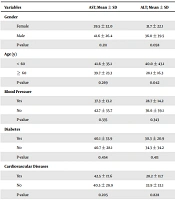
In terms of liver enzymes, 34.2% of the patients had abnormal ALT, 17.1% had abnormal AST, 12% had abnormal ALP, and 100% had abnormal LDH based on biomarker references (Table 1). Furthermore, the comparison of the mean ALT indicated a significant difference between the patients regarding age, gender, and renal disorders. The mean ALT was higher in the male patients, those aged less than 60 years, and those with renal disorders (Table 2).
Table 1.
Status of Liver Biomarkers in Patients Hospitalized Due to COVID-19 in Imam Reza Hospital and Golestan Hospital in Kermanshah, Iran
| Variables | Min, Max | Mean ± SD | Gender (Abnormal) | |
|---|---|---|---|---|
| Male, No. (%) | Female, No. (%) | |||
| AST | 8, 188 | 35.0 ± 30.2 | 38 (34.2) | 38 (34.2) |
| ALT | 7, 310 | 28.0 ± 33.2 | 19 (17.1) | 19 (17.1) |
| ALPH | 73, 445 | 167 ± 59.6 | 7 (12.0) | 44 (7.3) |
| PT | 12, 373 | 12.5 ± 36.06 | - | - |
| LDH | 395, 1829 | 783.1 ± 285.64 | 100 | 100 |
Table 2.
Comparison of Mean Liver Enzymes in Terms of Demographic and Clinical Variables a
| Variables | AST, Mean ± SD | ALT, Mean ± SD | ALPH, Mean ± SD | LDH, Mean ± SD |
|---|---|---|---|---|
| Gender | ||||
| Female | 39.5 ± 32.0 | 31.7 ± 22.1 | 184.4 ± 65.7 | 800.4 ± 249.7 |
| Male | 41.6 ± 26.4 | 36.0 ± 39.5 | 174.2 ± 40.1 | 766.0 ± 178.1 |
| P-value | 0.211 | 0.058 | 0.532 | 0.768 |
| Age (y) | ||||
| < 60 | 41.6 ± 35.1 | 40.0 ± 43.1 | 177.6 ± 53.6 | 750.6 ± 222.0 |
| ≥ 60 | 39.7 ± 23.3 | 28.1 ± 16.3 | 180.7 ± 55.2 | 810.7 ± 209.0 |
| P-value | 0.269 | 0.042 | 0.969 | 0.198 |
| Blood pressure | ||||
| Yes | 37.3 ± 13.2 | 28.7 ± 14.2 | 178.3 ± 47.9 | 806.0 ± 206.4 |
| No | 42.7 ± 35.7 | 36.6 ± 39.1 | 179.9 ± 61.1 | 768.6 ± 222.4 |
| P-value | 0.335 | 0.343 | 0.627 | 0.335 |
| Diabetes | ||||
| Yes | 40.1 ± 33.9 | 30.3 ± 20.9 | 191.9 ± 63.0 | 864.9 ± 316.4 |
| No | 40.7 ± 28.1 | 34.3 ± 34.2 | 176.1 ± 51.8 | 762.9 ± 180.1 |
| P-value | 0.454 | 0.411 | 0.373 | 0.299 |
| Cardiovascular diseases | ||||
| Yes | 42.5 ± 17.6 | 28.2 ± 11.7 | 195.1 ± 57.6 | 781.2 ± 5.3 |
| No | 40.5 ± 29.9 | 33.9 ± 33.1 | 178.0 ± 54.1 | 783.3 ± 224.5 |
| P-value | 0.205 | 0.828 | 0.295 | 0.722 |
| Renal disorders | ||||
| Yes | 108.0 ± 103.2 | 175.0 ± 190.9 | 195.5 ± 40.3 | 783.1 ± 0 |
| No | 39.4 ± 26.1 | 30.9 ± 18.1 | 178.9 ± 54.6 | 783.1 ± 218.2 |
| P-value | 0.214 | 0.046 | 0.430 | 0.747 |
| Thyroid disorders | ||||
| Yes | 25.0 ± 8.2 | 36.0 ± 22.5 | 167.7 ± 18.0 | 663.7 ± 166.1 |
| No | 40.0 ± 29.6 | 33.5 ± 32.3 | 179.6 ± 55.0 | 786.4 ± 217.1 |
| P-value | 0.985 | 0.560 | 0.891 | 0.185 |
at-test: significance of 0.05.
5. Discussion
COVID-19 is currently a pandemic across the world, and factors such as old age and underlying diseases are known to contribute to the spread of the disease. The present study indicated that the patient aged more than 60 years were at a higher risk of developing liver injury compared to others. A study conducted by Dinesh Jothimani et al. on COVID-19 and liver diseases showed that the risk of COVID-19 infection increased with age in individuals with liver disorders (14). Another study conducted in Germany on the pathological patterns of liver diseases in patients with COVID-19 demonstrated that the mean age of these patients was 68 years (15). According to an investigation of 108 SARS-CoV-2-infected patients to predict the effects of blood biochemical parameters on the severity of COVID-19 in China, the mean age of hospitalized patients was 40 - 65 years (16). Furthermore, a study performed in 2020 to assess liver function tests showed that patients aged more than 50 years were more likely to develop liver dysfunction compared to other age groups (17). Therefore, it could be concluded that the level of immunity decreases with age, and viral infections may rapidly occur as a result.
According to the current research, more women were hospitalized in Imam Reza Hospital and Golestan Hospital than men. A meta-analysis conducted by Jing Yang indicated that among patients with hepatic disorders, men were more likely to develop COVID-19 compared to women (18). Another study by Zhou also showed that the risk of developing SARS-CoV-2 infection was higher in men compared to women (16). The aforementioned studies imply that women may be less susceptible to viral and bacterial diseases than men partly due their greater innate immune responses and adaptation.
It is known that a significant number of patients with COVID-19 also have other underlying diseases. In this regard, the results of the present study indicated that the most prevalent comorbidities in the hospitalized patients were hypertension (38.7%), diabetes (19.8%), cardiovascular diseases (7.2%), thyroid disorders (2.7%), and renal disorders (0.08%). Therefore, it was concluded that hypertension, diabetes, and cardiovascular diseases are more common than other underlying diseases. Consistently, a study regarding the prevalence of comorbidities and their effects on patients infected with SARS-CoV-2 showed that the most common underlying diseases were hypertension (27.1%), diabetes (9.7%), and cardiovascular diseases (4.8%) (18). Furthermore, a study conducted by Abe on a Japanese population indicated that hypertension and diabetes were more prevalent as underlying diseases compared to other comorbidities in COVID-19 patients (9). Similarly, Cai also reported that hypertension and diabetes were more common than other underlying diseases (17). A study of hospitalized American patients also demonstrated that the prevalence of underlying diseases such as diabetes and cardiac diseases was 10.9 and 9%, respectively (19). Another research in this regard was performed by Guo et al. on 187 COVID-19 patients, and the findings showed the prevalence of hypertension to be 32.6%, diabetes to be 15%, and cardiac diseases to be 11.2% (19). Another study conducted by Emami et al. on the prevalence of comorbidities in patients with SARS-CoV-2 infection also indicated that the prevalence of hypertension was 16.37%, while the rates of 12.11 and 7.87% were reported for diabetes and cardiac diseases, respectively (20). Discrepancies in the findings regarding the prevalence of underlying diseases could be attributed to differences in the studied communities and populations.
According to the results of the present study, 34.2% of the COVID-19 patients had abnormal AST, 17.1% had abnormal ALT, and all the patients had abnormal LDH. A study of 44 hospitalized COVID-19 patients in Germany showed that 70% had abnormal AST, 15.8% had abnormal ALT, and 95.5% had abnormal LDH (15). Furthermore, a Chinese study of hospitalized patients indicated that 32.2% of the patients had abnormal liver enzymes (21). A review study conducted by Garrido also implied that liver injury is a common pathological feature in the settings of SARS-CoV-2 infection. However, the levels of AST and ALT are reported to be 2.5 - 50% and 2.5 - 61.1%, respectively (22). A meta-analytical study performed by Wu et al. showed that the prevalence of abnormal liver biochemical indices upon admission was 21.8, 35.8, and 4.7% for ALT, AST, and ALP, respectively (13). Another meta-analysis performed by Boregowda indicated that 12.5% of COVID-19 patients had abnormal AST, and 8.7% had abnormal ALT (2). Moreover, a study by Chen et al. demonstrated that among 99 patients with SARS-CoV-2 infection, 43.4% had abnormal liver enzymes (23). Another research conducted by Li et al. on COVID-19 patients also revealed that AST and ALT were abnormal in these patients (24).
Our study had several limitations. Since it was a local study focused on a small number of samples, the results could only be generalized to the hospitals under study and not to other hospitals of the Kermanshah city or other populations within the community. In addition, the patients were evaluated based on the conditions of their first visit, and some of the patients showed enzymatic changes during their hospitalization. It is not known whether the evaluated enzymatic disorders are associated with COVID-19, underlying liver diseases, or potential complications occurring during the course of the infection. Therefore, further investigations are required to confirm the role of COVID-19 in liver enzyme abnormalities and alterations.