
1. Context
Multiple sclerosis (MS) is a chronic immune-mediated disorder of the central nervous system characterized by inflammation, demyelination, and neurodegeneration, which can lead to substantial physical, cognitive, psychological, and social consequences (1, 2). Although genetic susceptibility contributes to disease development, accumulating evidence indicates that environmental exposures substantially influence both the risk and clinical course of MS (3).
Several environmental and lifestyle factors have been associated with MS susceptibility and progression. The most consistently investigated factors include cigarette smoking, inadequate vitamin D status and low sunlight exposure, obesity, Epstein–Barr virus infection, physical inactivity, dietary patterns, and air pollution (4). Recent evidence further suggests that environmental exposures may act through complex interactions with genetic susceptibility and may have differential effects depending on the timing and duration of exposure (5).
The management of environmental and lifestyle factors is therefore increasingly relevant to comprehensive MS care. Smoking cessation, promotion of physical activity, healthy weight management, appropriate attention to vitamin D status, reduction of potentially harmful environmental exposures, and patient education may complement pharmacological treatment and support more favorable disease trajectories (6). However, modifying these factors is rarely achieved through a single clinical intervention; rather, it requires ongoing assessment, individualized education, behavioral support, monitoring, and coordination across healthcare settings (7).
Nurses are strategically positioned to contribute to these processes because of their sustained contact with patients, health education responsibilities, and involvement in symptom monitoring, self-management support, and care coordination (8). Nurses may identify potentially modifiable environmental exposures, assess patients’ knowledge and behaviors, provide individualized counseling, reinforce healthy lifestyle practices, support adherence to recommended interventions, and facilitate communication with other members of the multidisciplinary team (9). Nevertheless, the literature describing nurses’ specific contributions to the assessment, prevention, and management of environmental factors associated with MS appears fragmented across different environmental exposures, clinical settings, and nursing roles.
In this review, environmental factors are defined as modifiable external and contextual factors that influence MS risk, clinical course, and symptom management. This operational definition encompasses the thermal environment (eg, heat exposure, humidity), lifestyle behaviors that interact with the environment (eg, smoking, diet, physical activity), the sleep environment, psychosocial stress, the nutritional environment, and the therapeutic care environment (ie, the interpersonal and organizational dimensions of care that nurses can modify to support patients’ management of environmental factors).
Despite the growing body of evidence on environmental determinants of MS (10, 11), a comprehensive mapping of the existing literature specifically addressing the nursing role in managing these factors is lacking. Therefore, a scoping review is warranted to identify and map the available evidence, characterize the environmental factors addressed by nurses, describe the types of nursing interventions and responsibilities reported, and summarize the outcomes associated with these approaches. Such a synthesis may clarify current nursing practice, identify gaps in evidence and implementation, and provide directions for future research and the development of comprehensive, nurse-led approaches to environmental risk-factor management in MS.
2. Evidence Acquisition
2.1. Study Design
A scoping review was conducted using the methodological framework outlined by Arksey and O'Malley (12). The review adhered to the Preferred Reporting Items for Systematic Reviews and Meta-Analyses extension for Scoping Reviews (PRISMA-ScR) guidelines (13). A scoping review approach was selected to map the breadth and nature of the evidence on nurses' engagement with environmental factors in multiple sclerosis care, an area that spans diverse clinical domains and has not been comprehensively synthesized.
2.2. Review Question
The review was guided by the following research question: What is the role of nurses in addressing modifiable environmental and lifestyle-related factors associated with multiple sclerosis, and what interventions, strategies, and practices have been documented in the literature?
2.3. Eligibility Criteria
Eligibility criteria were developed using the population, concept, and context (PCC) framework, as recommended for scoping reviews.
2.3.1. Inclusion Criteria
Studies were included if they met the following criteria:
Population: Adults aged 18 years or older diagnosed with MS, or healthcare professionals, including nurses, caring for people with MS.
Concept: Studies addressing modifiable environmental and lifestyle-related factors relevant to MS management. These factors included, but were not limited to, the thermal environment, lifestyle behaviors (smoking, diet, and physical activity), the sleep environment, psychosocial stress, the nutritional environment, and the therapeutic care environment. Studies examining nurse-led or nurse-involved interventions, assessments, education, or support strategies related to these environmental factors were prioritized.
Context: Studies conducted in inpatient, outpatient, rehabilitation, community, or home-based settings, or delivered through remote platforms, including telehealth, online, or telephone-based interventions.
Study types: Primary research studies using quantitative, qualitative, or mixed-methods designs, including intervention studies (randomized controlled trials, quasi-experimental studies, and pre-post studies), observational studies, qualitative studies, and program evaluations. Systematic reviews and meta-analyses were also considered for citation tracking.
Language: Studies published in English.
Timeframe: Studies published from January 2000 to August 2026, reflecting the period during which MS nursing roles have been increasingly formalized and environmental factors have gained recognition in MS management. The end date was aligned with the final search date to ensure that all eligible studies identified by the search were captured.
2.3.2. Exclusion Criteria
Studies were excluded if they:
Focused exclusively on pharmacological management of MS without addressing environmental factors or nursing roles.
Addressed pediatric MS populations only.
Were published as editorials, commentaries, conference abstracts, or opinion pieces without original data.
Did not include nursing involvement or relevance to nursing practice in environmental factor management.
2.4. Information Sources and Search Strategy
A systematic search was conducted in MEDLINE via PubMed, the Cumulative Index to Nursing and Allied Health Literature (CINAHL), Embase, Web of Science, PsycINFO, and the Cochrane Library. The search strategy was developed in consultation with a health sciences librarian and tailored to each database. Searches were conducted on August 15, 2026, without a date limit at the search stage; records published before January 2000 were excluded during screening. The full database-specific search strategies, including controlled vocabulary terms, free-text terms, Boolean operators, field tags, and applied limits, are provided in Supplementary File 1.
The search combined terms related to three key concepts: multiple sclerosis, environmental factors, and nursing care. Medical Subject Headings (MeSH) and equivalent controlled vocabulary terms were used where available and were supplemented with keyword searches in title and abstract fields. Boolean operators were used to combine concepts. The foundational search string combined terms for multiple sclerosis (including "multiple sclerosis," "MS," "demyelinating disease," and "demyelinating disorder"), environmental factors (including "environment," "thermal," "heat," "cooling," "temperature," "lifestyle," "smoking," "tobacco," "diet," "nutrition," "physical activity," "exercise," "sleep," "stress," "fatigue," "bowel," "self-management," "risk factor," and "modifiable"), and nursing (including "nurs*", "nursing care," "nursing intervention," "nursing role," "nurse-led," "nurse-patient," "nursing education," and "nursing assessment"). The three concepts were combined using the AND operator, with terms within each concept combined using the OR operator. In the executed MEDLINE query, the nursing term was entered literally as nurs[tiab], without truncation, alongside the nursing phrases shown below.
The MEDLINE search strategy was as follows: ("Multiple Sclerosis"[Mesh] OR "multiple sclerosis"[tiab] OR "MS"[tiab] OR "demyelinating disease"[tiab] OR "demyelinating disorder"[tiab]) AND ("Environment"[Mesh] OR environment[tiab] OR thermal[tiab] OR heat[tiab] OR cooling[tiab] OR temperature[tiab] OR lifestyle[tiab] OR smoking[tiab] OR tobacco[tiab] OR diet[tiab] OR nutrition[tiab] OR "physical activity"[tiab] OR exercise[tiab] OR sleep[tiab] OR stress[tiab] OR fatigue[tiab] OR bowel[tiab] OR self-management[tiab] OR "risk factor"[tiab] OR modifiable[tiab]) AND (nurs[tiab] OR "nursing care"[tiab] OR "nursing intervention"[tiab] OR "nursing role"[tiab] OR "nurse-led"[tiab] OR "nurse-patient"[tiab] OR "nursing education"[tiab] OR "nursing assessment"[tiab]). Limits: English language; humans. Equivalent strategies, adapted to each database's controlled vocabulary and syntax, were used for CINAHL, Embase, Web of Science, PsycINFO, and the Cochrane Library and are reported in Supplementary File 1.
To enhance comprehensiveness, supplementary search strategies were used. Reference lists of included studies and relevant systematic reviews were hand-searched to identify additional eligible studies. A limited gray literature search was conducted through Google Scholar and relevant professional nursing organizations' websites, including the International Organization of Multiple Sclerosis Nurses, the MS Trust, and the National MS Society. Where necessary, corresponding authors were contacted for clarification or additional data.
2.5. Study Selection
All records identified through database searching were exported to Covidence systematic review software for screening (14). Duplicate records were removed. Study selection proceeded in 2 stages.
In the first stage, 2 reviewers independently screened titles and abstracts against the eligibility criteria. Records that clearly did not meet the criteria were excluded, and those with uncertain eligibility progressed to full-text review. In the second stage, potentially eligible full-text articles were retrieved and assessed independently by the same 2 reviewers. Reasons for exclusion were documented. Disagreements at either stage were resolved through discussion, with a third reviewer consulted when consensus could not be reached. Interrater reliability was calculated using Cohen's kappa coefficient at both screening stages.
2.6. Data Extraction
The research team developed a standardized data extraction form and pilot-tested it on 5 included studies to ensure consistency and completeness. The form was refined iteratively after pilot testing. One reviewer extracted data using the standardized form, and a second reviewer independently verified all extracted data against the original publications. Discrepancies were resolved through discussion, with a third reviewer consulted when consensus could not be reached.
The following data were extracted from each included study: Author, publication year, country, study design, setting, sample size, participant characteristics, and funding sources; environmental factors addressed, classified according to the 6 thematic domains identified during analysis and aligned with the operational definition of environmental factors; nursing roles, including assessment, education, intervention delivery, care coordination, advocacy, and support; intervention details, including type, duration, frequency, delivery mode, and theoretical frameworks where reported; primary and secondary outcomes, outcome measures, and assessment timing; key findings relevant to nursing practice and environmental factor management; barriers and facilitators influencing the implementation or effectiveness of nursing interventions; and limitations reported by the original authors.
2.7. Data Synthesis
Data synthesis followed a thematic analysis approach informed by Braun and Clarke (15). The synthesis process comprised several iterative steps.
Reviewers first read and reread the extracted data from all included studies to develop a comprehensive understanding of the evidence base. Descriptive codes were assigned to data segments concerning nursing roles, environmental factors, interventions, and outcomes. Two reviewers coded the data independently and then compared and refined the coding framework. Codes were organized into broader categories based on conceptual similarities and relationships. Through iterative team discussions, these categories were consolidated into 6 overarching themes representing the primary domains of nursing engagement with modifiable environmental and lifestyle-related factors in MS. Themes were refined through repeated team discussions, with attention to internal coherence, external distinctiveness, and alignment with the review question and operational definition of environmental factors. Themes were checked against the original extracted data to ensure fidelity to the source material.
A narrative synthesis organized the findings by theme. Within each theme, the nature of the evidence, key findings, nursing implications, and notable gaps in the literature were described. Qualitative findings were synthesized narratively, and study characteristics were summarized descriptively to characterize the evidence base. No quantitative meta-analysis was conducted because the review focused on thematic mapping of the literature.
3. Results
Database and supplementary searches identified 4,862 records. After 1,214 duplicates were removed, 3,648 records were screened by title and abstract, and 312 articles were assessed in full text. Of these, 284 were excluded for the following reasons: not focused on environmental or lifestyle factors (n = 96); no nursing involvement or relevance (n = 74); wrong population, including pediatric-only samples (n = 41); pharmacological focus only (n = 33); conference abstract, editorial, commentary, or opinion piece (n = 22); not in English (n = 11); and full text unavailable (n = 7). A total of 28 studies were included in this scoping review. The study selection process is summarized in the PRISMA-ScR flow diagram (Figure 1). The distribution of included studies across themes is shown in Table 1.
Table 1.
Distribution of Included Studies Across Themes a
| Themes | Number of Studies | References |
|---|---|---|
| Theme 1: Thermal environment management and cooling interventions | 6 | 16-20 |
| Theme 2: Lifestyle modification and modifiable risk factor control | 10 | 19, 21-30 |
| Theme 3: Fatigue management through environmental and behavioral strategies | 9 | 16, 17, 19, 26, 28, 31-33 |
| Theme 4: Sleep environment and psychosocial stress regulation | 8 | 20, 29, 30, 32-38 |
| Theme 5: Nutritional environment and bowel health | 7 | 29, 30, 34, 39-42 |
| Theme 6: Therapeutic environment: nurse-patient relationships, education, and self-management support | 11 | 19, 20, 25-29, 32-35, 38, 43 |
a Studies may contribute to more than one theme; therefore, the total number of theme contributions exceeds the total number of included studies (n = 28).
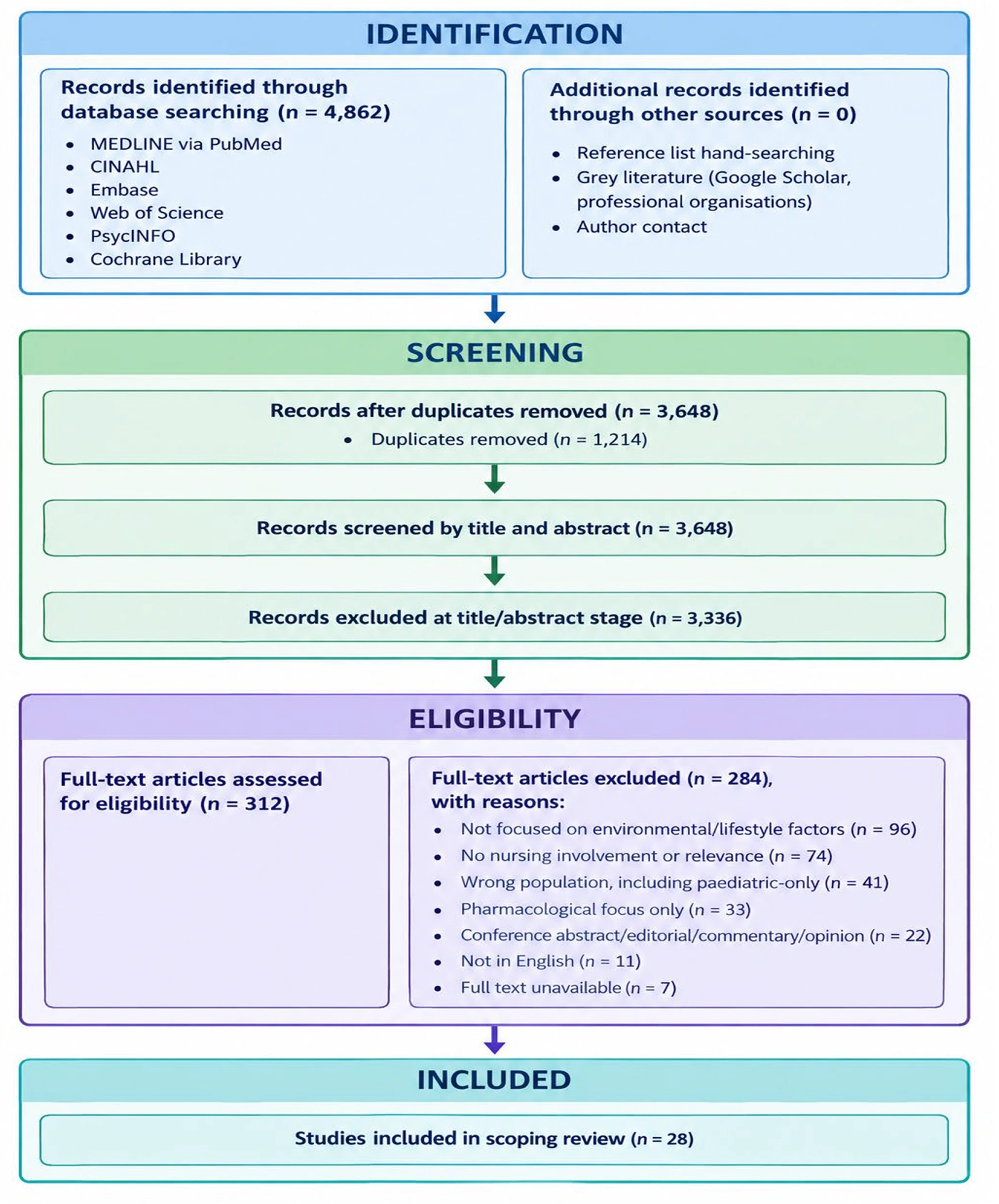
Figure 1.
PRISMA-ScR Flow Diagram of Study Selection. Abbreviation: PRISMA-ScR, Preferred Reporting Items for Systematic Reviews and Meta-Analyses extension for Scoping Reviews.
3.1. Theme 1: Thermal Environment Management and Cooling Interventions
Heat sensitivity is among the most consistently documented environmental challenges in MS, and nurses are uniquely positioned to identify, educate, and intervene in this domain. Elevated environmental temperatures—from weather, indoor heating, exercise, hot showers, and even meals—impair the electrical transmission capacity of demyelinated nerves, precipitating or worsening a wide range of neurological symptoms (16, 17). Approximately 60% - 80% of people with MS are heat-sensitive, with heat and humidity exacerbating fatigue, muscle weakness, dizziness, vertigo, incoordination, and loss of balance, all of which significantly restrict participation in daily activities (16-18).
Cooling interventions represent a practical, inexpensive, and effective strategy that nurses can promote, teach, and facilitate. The use of a cooling suit—a vest providing central cooling through cooling packs placed on the back and chest—significantly reduced fatigue severity and improved independence in activities of daily living (16, 17). Nurses’ awareness of this intervention, its proper application, and the importance of wearing it at normal room temperature to avoid the effects of environmental heat are essential components of clinical education (17). Simple wearable cooling devices, such as neck wraps, have provided immediate symptomatic relief and enabled patients to sustain family activities that would otherwise have been curtailed (18). Beyond wearable devices, practical strategies taught by nurses include drinking cold beverages, wearing cotton clothing, taking cool showers, using air conditioning, applying ice packs, using swimming pools, and avoiding outdoor activities during peak heat hours (16-19).
An important distinction that nurses can help patients internalize is the shift from reactive to proactive cooling—intervening before overheating occurs rather than after, as delayed cooling is less effective at preventing symptom escalation (18). Nurses can also guide patients to recognize that food-related heat, such as hot beverages, constitutes an environmental trigger and that cooling during such exposures can help prevent post-meal fatigue (16). Temperature management should also extend to the social environment: reducing family conflicts over thermostat settings and enabling patients to attend social events through planned cooling strategies improve participation and relational quality of life (18). Nurses in rehabilitation and outpatient settings should conduct systematic assessments of each patient’s heat-sensitivity pattern, environmental triggers, and capacity to independently implement cooling strategies, providing compensatory assistance as needed (17, 20).
3.2. Theme 2: Lifestyle Modification and Modifiable Risk Factor Control
Ten studies contributed to this theme (19, 21-30). MS is increasingly recognized as a condition in which modifiable lifestyle risk factors—including smoking, diet, physical activity, vitamin D, and obesity—influence disease activity and progression. Nurses are well positioned to assess these factors, deliver evidence-based education, and support sustained behavioral change across all care settings.
3.2.1. Tobacco and Smoking Cessation
Smoking is an established environmental risk factor for MS onset, relapse frequency, and progression; however, communication between clinicians and patients with MS regarding smoking remains inconsistent and often inadequate (21-24). Despite most MS clinicians recognizing smoking as harmful, structured smoking cessation interventions are rarely offered; most interactions consist of brief verbal prompts to quit without follow-up support, referral to cessation services, or practical guidance (21, 22). People with MS who smoke report low levels of knowledge about the specific MS-related consequences of tobacco use and frequently express unmet needs for more informative conversations with clinicians—ideally with their neurologist—and for access to MS-specific cessation programs (21, 24). Nurses can address this gap by routinely incorporating smoking assessment, delivering MS-tailored smoking cessation advice, providing information about nicotine replacement therapies, facilitating peer exchange among patients who have successfully quit, and ensuring home-based follow-up support—particularly given that cessation attempts initiated in clinical settings often fail upon return to familiar home environments (21, 23). Patients report that the MS diagnosis itself serves as a powerful motivational trigger for cessation and that nurses who build on this motivation with concrete, individualized guidance can meaningfully improve cessation outcomes (22, 24).
3.2.2. Physical Activity and Exercise Promotion
People with MS consistently demonstrate reduced physical fitness and lower physical activity levels than the general population, influenced by disease-related symptoms and environmental barriers, including a lack of accessible activity options, insufficient patient education, transport difficulties, and fatigue (19, 25-27). Nurses and allied health professionals can address these barriers through individualized activity assessments that take into account personal preferences, family circumstances, and mobility limitations, followed by tailored written activity plans covering endurance, strength, and balance (25). Internet-delivered behavioral interventions grounded in social cognitive theory—teaching self-monitoring, goal-setting, and barrier identification—produced clinically meaningful and sustained reductions in fatigue through enhanced physical activity engagement, without patients needing to leave their homes (27). Nurses should recognize that intrinsic motivation aligned with personal values is a key determinant of sustained activity and that addressing psychological barriers alongside practical ones is essential for long-term behavior change (25, 27, 28).
3.2.3. Comprehensive Lifestyle Intervention
Multimodal lifestyle interventions addressing diet, exercise, sun exposure, vitamin D supplementation, omega-3 intake, smoking, and stress reduction have demonstrated sustained improvements in quality of life, reduced relapse rates, and improved self-efficacy over periods of 3 - 5 years following a single intensive educational workshop (29). These programs underscore that nurses should approach MS management holistically, positioning lifestyle modification not as an alternative to disease-modifying therapy but as an adjunct that empowers patients and may slow progression (29, 30). Facilitators with lived experience of MS may enhance the personal resonance of lifestyle education, suggesting that peer co-facilitation models should be considered alongside nurse-led formats (29).
3.3. Theme 3: Fatigue Management Through Environmental and Behavioral Strategies
Fatigue is the most prevalent, disabling, and refractory symptom in MS, affecting 60% - 90% of patients, and environmental factors—particularly heat, disrupted sleep, inactivity, and poorly structured daily routines—are primary drivers of its severity (16, 17, 19, 26, 31-33). Nurses play a central role in the assessment, education, and ongoing support required to help patients manage fatigue through environmental modification and behavioral strategies.
Energy conservation programs teach patients to analyze their own activity patterns, apply principles of biomechanics and ergonomics, pace and schedule activities, balance rest with engagement, and plan ahead to distribute energy expenditure more effectively (19, 26, 32, 33). These programs produce sustained improvements in fatigue impact—distinct from passive attention-control conditions—confirming that skill acquisition, rather than nonspecific group effects, is the mechanism of benefit (26). However, nurses should anticipate that transferring energy conservation skills from a structured program to the unpredictable demands of daily life can be difficult and should provide follow-up support with problem-solving to bridge this gap (19, 26).
Nurse-led fatigue management programs delivered through online platforms have demonstrated significant reductions in fatigue severity, improved sleep quality, increased step counts, and enhanced self-efficacy, with benefits maintained at 6 months (32, 33). These remote formats are particularly valuable for patients with mobility limitations or those living in areas with limited access to specialist care, addressing important access-related environmental barriers (27, 32, 33). Nurses play a vital role in empowering patients through education, self-monitoring guidance, and telephone follow-up support after each educational session (32, 33).
Group-based fatigue and occupational therapy interventions that incorporate environmental assessment have demonstrated significant reductions in perceived environmental barriers to participation, with improvements in social integration, family roles, and outdoor autonomy (19). Environmental modifications recommended by nurses in this context include removing furniture obstacles from the home, using elevators, employing adaptive equipment, applying cooling towels during heat exposure, and maintaining social connection by hosting friends at home when too fatigued to go out (19). Fall risk management is closely intertwined with fatigue, as inadequate energy conservation increases fall frequency; nurses and healthcare professionals working in fall prevention must address fatigue management as a core component, supporting patients to take scheduled rest periods and plan activities within their energy envelope (28).
3.4. Theme 4: Sleep Environment and Psychosocial Stress Regulation
Eight studies contributed to this theme (20, 29, 30, 32-38). Sleep quality and stress regulation constitute an often overlooked but critical domain of environmental factor control in MS, and nurses are well positioned to conduct systematic assessment and deliver targeted interventions in both areas.
3.4.1. Sleep Hygiene and the Bedroom Environment
Poor sleep hygiene behaviors—including watching television in bed, talking on the phone, listening to the radio before sleep, and maintaining uncomfortable ambient temperatures—are significantly correlated with increased symptom burden in MS, including fatigue, forgetfulness, anxiety, pain, and difficulty concentrating (31). Nurses should incorporate sleep hygiene education as a routine component of clinical encounters, providing specific environmental recommendations, including removing electronic devices from the bedroom, restricting technology use in the hour before bedtime, maintaining a cool and comfortable sleep temperature, and avoiding stimulating pre-sleep activities (31, 34). Collaborative care programs in which nurses and patients jointly set sleep goals—including establishing consistent sleep-wake schedules and eliminating disruptive environmental stimuli—have produced meaningful improvements in patients’ sleep patterns, with patients successfully transforming chaotic sleep routines into consolidated, restorative sleep (34). For patients with persistent insomnia, nurses should consider referral to cognitive behavioral therapy for insomnia and should screen for co-occurring anxiety, depression, and cognitive symptoms that amplify sleep disruption (31).
3.4.2. Stress, Psychological Environment, and Mindfulness
Psychosocial stress is both a consequence and a potential environmental trigger of MS disease activity, capable of negating health-promoting behaviors, exacerbating anxiety and depression, and impairing quality of life (30, 35, 36). Mindfulness-based stress reduction programs delivered in healthcare settings are feasible for people with MS and produce large immediate improvements in perceived stress, anxiety, depression, positive affect, and self-compassion (36). At follow-up, improvements in mindfulness, positive affect, self-compassion, and anxiety were sustained, suggesting that these programs build durable psychological skills that help patients regulate their internal stress environment (37). Nurses can teach fundamental mindfulness techniques, recommend structured programs, and support patients in establishing regular meditation practices as part of a broader stress management plan (29, 32, 34). Barriers to program participation—including transport difficulties, work commitments, fatigue, and concerns about course demands—should be actively assessed and addressed through flexible, accessible delivery models, such as online or home-based formats (32, 33, 36).
Hospitalization itself constitutes a stressful environmental experience for people with MS, associated with fear, dread, anger, anxiety, loneliness, and feelings of captivity, particularly among newly diagnosed patients (38). Nurses in inpatient settings play a uniquely important role in providing empathic emotional support—including active listening, reassurance, and expressions of hope—as these behaviors directly address patients’ perceived isolation and distress in an unfamiliar and threatening physical environment (38). Informational support during hospitalization, including clear explanations about medications and disease management, helps to reduce anxiety related to uncertainty (20, 38).
3.5. Theme 5: Nutritional Environment and Bowel Health
Seven studies contributed to this theme (29, 30, 34, 39-42). Diet and nutrition constitute an environmental domain in which nurses can provide evidence-based guidance, correct misinformation, and support sustained behavior change in people with MS.
3.5.1. Dietary Education and the Mediterranean Diet
Environmental risk factors for MS include obesity, dyslipidemia, high sodium intake, and low vitamin D status—all of which are modifiable through dietary change (29, 30, 39, 40). The included studies reported that a structured nutritional intervention based on the Mediterranean diet—emphasizing fish, fruits, vegetables, whole grains, and reduced red meat, dairy, and processed foods—significantly improved functional ability, nutritional status, cognitive function, and quality of life in patients with MS, while also preventing deterioration in emotional well-being (30). Nurses can deliver dietary education using practical tools such as food information sheets, guidance on food labeling, and advice on combining diet with hydration, exercise, and sleep hygiene (30, 34, 39).
People with MS are highly motivated to seek dietary information and frequently experiment with special diets or supplements, yet encounter contradictory, non-evidence-based information online (39, 40). Nurses should help patients critically appraise dietary evidence, identify the risks of restrictive diets, including nutritional deficiencies, and support informed decision-making amid genuine scientific uncertainty (39, 40). Patients express a clear need for practical dietary guidance—concrete meal suggestions, information about specific nutrients, and help with food label literacy—rather than theoretical information alone (39, 40). Vitamin D supplementation and omega-3 intake are among the most commonly pursued dietary strategies by people with MS, and nurses should be prepared to discuss the existing—though limited—evidence base for these approaches (29, 40).
3.5.2. Bowel Health and Environmental Modification
Neurogenic bowel dysfunction—encompassing constipation and fecal incontinence—is highly prevalent in MS and profoundly affects quality of life, yet is consistently underreported due to normalization and embarrassment (41, 42). Extrinsic environmental factors, including diet, fluid intake, physical inactivity, and medication side effects, contribute to bowel dysfunction and represent important targets for nursing intervention (41). Self-management strategies—including dietary adjustments, increased fluid and fiber intake, appropriate toilet posture, and bowel emptying before leaving home—can be taught and reinforced by nurses in ways that preserve patient dignity and autonomy (34, 41, 42). Transanal irrigation and other advanced interventions should be introduced at appropriate points in the management hierarchy, with full patient education regarding available licensed products (41, 42). MS specialist nurses have been identified by patients as the preferred provider of bowel care, underscoring the clinical importance of this nursing role (41, 42).
3.6. Theme 6: The Therapeutic Environment: Nurse-Patient Relationships, Education, and Self-Management Support
Eleven studies contributed to this theme (19, 20, 25-29, 32-35, 38, 43). The interpersonal and organizational dimensions of the care environment are modifiable factors that nurses can influence, with direct consequences for patients’ capacity to manage their MS-related environmental exposures.
3.6.1. Trust, Continuity, and Therapeutic Relationships
Continuity of nursing care—being consistently cared for by the same nurse—emerged as a fundamental patient need in MS rehabilitation, enabling nurses to accumulate deep knowledge of individual patient preferences, symptom patterns, medication schedules, and environmental management strategies without requiring repeated explanations (20, 38). Trusting nurse-patient relationships, built through consistent presence, respectful attitudes, and a nonjudgmental approach, enable patients to disclose personal concerns—including fear of the future, sexual changes, and family dynamics—that would otherwise remain unaddressed (20, 34, 38). Nurses’ 24-hour presence in inpatient and rehabilitation environments affords them a uniquely comprehensive view of patients’ daily experiences, making them natural advocates for patients’ needs within multidisciplinary teams (20). Patients in rehabilitation settings who lack a clearly identified MS nurse contact person experience significant frustration navigating fragmented teams, and this deficit is intensified after discharge to community settings, where MS-specific expertise is scarce (43).
3.6.2. Education, Self-Management, and Empowerment
Education is fundamental to MS self-management and to patients’ capacity to control their own environmental risk factors. Nurse-led education programs covering disease understanding, symptom management, treatment adherence, stress management, nutrition, physical activity, and self-care strategies have significantly improved both quality of life and psychological resilience among people with MS (29, 32-35). Peer-led education—when delivered by well-trained people with MS—was equally effective as nurse-led education in improving quality of life and resilience, suggesting that nurses should actively design and oversee peer education and support group programs as an extension of their educational role (35). Collaborative care models in which nurses and patients jointly set goals—for nutrition, sleep, physical activity, constipation management, fatigue reduction, and stress management—produce concrete, measurable changes in health behaviors because they are grounded in patients’ own priorities and practical circumstances (34). Group-based educational programs offer the additional benefit of peer learning and social support; patients frequently report that advice from peers is more personally resonant and motivationally effective than clinician-delivered information alone (19, 20, 26, 28, 35).
3.6.3. Barriers, Equity, and Advocacy
Access to environmental management interventions is shaped by structural environmental factors, including transport barriers, time constraints, financial limitations, digital literacy, and geographic isolation (25-27, 32, 33, 36). Nurses must assess these structural barriers as part of a holistic patient evaluation and advocate for locally accessible, flexibly delivered, and digitally enabled programs that reach patients who cannot attend in-person services (26, 27, 32, 33). The persistent shortage of MS nurses, limited appointment time, and competing clinical priorities constrain the depth of environmental counseling that nurses can provide; addressing these systemic barriers requires advocacy at the organizational and policy levels (20, 21). Nurses who are aware of their role in fall prevention, fatigue management, bowel care, smoking cessation, nutritional counseling, and psychosocial support—but lack time, resources, or clear guidelines—require institutional support to fulfill these functions effectively (20, 21, 28, 42).
4. Conclusions
4.1. Discussion
This scoping review synthesized evidence from 28 studies and identified 6 interconnected domains of nurses' involvement in addressing environmental factors associated with MS: the thermal environment, lifestyle modification, fatigue management, sleep and psychosocial stress, nutrition and bowel health, and the therapeutic environment. As a scoping review, this study aimed to map the available evidence rather than to establish definitive intervention effectiveness. The findings should therefore be interpreted as a characterization of the evidence base, not as evidence of clinical efficacy. Overall, the findings support a shift from a predominantly symptom-focused approach toward proactive, person-centered environmental management, consistent with contemporary recommendations emphasizing self-management, exercise, smoking cessation, fatigue management, sleep, and psychosocial support in MS care.
Thermal management was one of the most prominent findings and is strongly supported by previous evidence identifying heat as an important trigger of MS symptoms. The included studies reported that nurses can contribute by assessing individual heat triggers, teaching proactive cooling strategies, and facilitating practical adaptations. These approaches may improve not only symptom control but also participation in family and social activities. However, evidence is stronger for short-term symptom relief than for long-term clinical outcomes, and cooling approaches may not be equally effective for all patients. Therefore, individualized rather than standardized recommendations are warranted.
Findings regarding lifestyle modification were broadly consistent with existing MS evidence supporting physical activity and smoking cessation. Current guidance similarly emphasizes healthy lifestyle behaviors as components of comprehensive MS management (44). However, our review identified a gap between recognition of these risk factors and the consistent provision of structured nursing interventions, particularly smoking cessation support. Nutritional evidence was comparatively less consistent, especially regarding specific supplements or restrictive diets. Nurses should therefore provide evidence-based dietary counseling while helping patients distinguish reliable information from the substantial misinformation available online (45).
Fatigue management showed particularly strong convergence across the included evidence. Fatigue was closely linked to heat, poor sleep, inactivity, and ineffective daily routines, supporting an integrated approach combining energy conservation, activity pacing, environmental modification, and behavioral support. The included studies reported that nurse-led and remote interventions were associated with improvements in fatigue, sleep, physical activity, and self-efficacy (33). Nevertheless, many studies were small or short-term, and evidence for effects on relapse or disability progression remains limited. Thus, nursing interventions appear well supported for symptom and self-management outcomes, but their longer-term clinical effects require further investigation (46).
Sleep and psychosocial stress represented additional environmental domains that may be overlooked in routine MS care. Findings regarding sleep hygiene and stress-management interventions were generally consistent with evidence supporting their benefits for fatigue, anxiety, and quality of life. However, the relationship between psychological stress and MS disease activity is complex (47). Accordingly, nurses should primarily present stress-management strategies as approaches to improve coping, well-being, and symptom management rather than as established methods for preventing disease progression.
Nutrition and bowel health further broaden the concept of environmental nursing care. Nurses can provide practical dietary education, address misinformation, and support hydration, fiber intake, physical activity, and bowel self-management. Nevertheless, evidence for specific diets remains less consistent than evidence for general healthy lifestyle behaviors (48). This reinforces the importance of shared decision-making and critical appraisal of the evidence rather than promoting unproven dietary approaches.
The therapeutic environment can be understood through social cognitive theory (49), which emphasizes the reciprocal interaction among individuals, behaviors, and their environments. Continuity of care, trust, individualized education, shared goal-setting, and self-management support can strengthen self-efficacy and facilitate the adoption of adaptive behaviors. From this perspective, nurses act as important environmental agents who provide education, feedback, and reinforcement, helping patients translate recommended strategies into everyday practice and enhance their autonomy.
4.2. Implications for Nursing Practice
The findings suggest that integrating environmental assessment into routine MS nursing care may be beneficial, including assessment of heat sensitivity, fatigue triggers, sleep, smoking, physical activity, nutrition, bowel function, psychosocial stress, and access barriers. Nurses may develop individualized self-management plans incorporating education, behavioral goals, follow-up, and problem-solving. Remote and digital programs may help overcome mobility and geographical barriers. Nurses can also coordinate multidisciplinary care and advocate for access to appropriate rehabilitation, psychological, nutritional, and continence services. However, further high-quality research is needed to establish the effectiveness of these approaches.
4.3. Limitations
This review has several limitations. The included studies were heterogeneous in design, interventions, environmental factors, and outcomes, limiting direct comparisons. In addition, some interventions were multidisciplinary, making it difficult to attribute effects exclusively to nursing care. Several studies had small samples, short follow-up, or quasi-experimental designs, and evidence was stronger for symptom and self-management outcomes than for relapse or disability progression. Differences in healthcare systems, nursing resources, digital infrastructure, and social environments may also limit transferability across settings. As a scoping review, this study did not include a formal quality appraisal of included studies, and the findings should be interpreted as a mapping of the available evidence rather than a definitive assessment of intervention effectiveness.
4.4. Concluding Remarks
This scoping review demonstrates that nurses have a broad and potentially important role in addressing modifiable environmental and lifestyle-related factors associated with MS. Their contribution encompasses thermal regulation, lifestyle behaviors, fatigue, sleep, psychosocial well-being, nutrition, bowel health, education, and self-management support. Although evidence is strongest for symptom management and behavioral outcomes, further high-quality research is needed to determine long-term clinical effectiveness. Integrating structured environmental assessment and individualized management strategies into routine MS nursing care may therefore strengthen person-centered care and support patients' autonomy and quality of life.