1. Background
Diabetes includes a group of metabolic diseases with high level of blood glucose that result from different resistance degrees of patients against insulin or any disorder in insulin secretion (1). Any disorder in metabolism of carbohydrates, protein and fats result from a lack of insulin and further damage different organs and lead to life span reduction (2). It has been estimated that the number of patients with diabetes mellitus around the world will increase from 171 million in 2000 (3) to 366 million by 2030 (3, 4). Distribution of diabetes mellitus in Iran was about 7.7% in 2005 (equal to two million people), and has been estimated to reach 5.2 million by 2025 (5). Regarding the epidemic of diabetes mellitus and its high degree of mortality, it has become one of the major stresses of general health in the world (6, 7).
Diabetes effects quality of life of patients due to its chronic nature and creation of disability (5). Quality of life is important for patients with diabetes (8). Quality of life is an important factor of calmness and it is required for logical promotion and maintenance of bodily, emotional and wisdom functions (9). Low level of quality of life may lead to little self-care and lack of blood sugar control and increase of disease complications. Modifying quality of life is not only useful for diabetes patients but will also reduce relevant health and medical costs accordingly (8).
Sanchez (10) stated that insulin-dependent patients with diabetes have low quality of life. According to the results of new studies, there is a weak level of quality of life in patients with diabetes. In a research by Depablos-Velasco et al. (11) on 751 patients at Spain Health and Therapeutic Centers, it was specified that patients with diabetes, with more chronic situations and more complex treatments especially with insulin, had little control of their disease and reported the worst quality of life with more threats to their hypoglycemic pains. According to the results and in spite of progress in metabolic control, there is still a long way to a suitable situation (11).
In a study that evaluated eight dimensions of quality of life in patients with diabetes type II referring to Sanandaj Diabetes Centers in 2009, Khaledi et al. (12) found that quality of life of most studied units were at average level. It was obvious that quality of life was unsuitable in various dimensions such as physical role, emotional role, physical pain, energy and vitality, while it was estimated to be suitable for other dimensions (12).
Training is the foundation of care in diabetes. According to previous studies examining the effects of educational programs about nutrition and physical activities on patients with diabetes type II, short-term training programs have numerous positive outcomes. Thus it can be assumed that patients with diabetes need some training for further promotion of their health (13). Also evidences show that diabetes training has positive effects on self-management and blood sugar control in patients with lower scientific/health knowledge (14, 15).
Different training methods may have different effects on people's health-related attitudes and behaviors, which ultimately affect their quality of life (16). Gopu et al. reported that training through lectures could have positive effects on knowledge, attitudes and quality of life (17). Misiaszek et al. also reported that lectures were more effective than multimedia softwares in improving the QOL of patients with Parkinson’s disease (18). While Moule et al. showed that a training package was more effective than the lecture-based method in improving QOL (19). Afshar et al. also found that sessions with group discussions could lead to improvement of quality of life for patients with diabetes. Along with other methods, e-learning has resulted major changes in education (20). This exclusive method enables learners learn anything, anywhere (21). Computer educational programs may enable learners with limited time for training and consultancy. Such technology-based solution has had greater benefits for communities with diabetes, old age and complex problems. Multimedia programs have lots of advantages such as benefits from contexts and audio/video elements like videos, icons and graphical features (22). Computer-based educational programs may be effective for reduction of work-load for service providers and/or time limits for education and consultancy (23). In addition, these programs enable people to benefit from information according to personal needs, profits and competency (22). Also computer technology provides continuous support and facilitation for personal care (24).
The results of a qualitative study showed that patients with diabetes had limited training that allowed them to apply technology for their disease management. Also they were in need to have some interferences by computer technology for training of their management strategies such as quality of life (24). According to previous findings and since training is one of the important and inseparable parts of diabetes management and also because upgrading of quality of life of patients with diabetes may cause prevention, promotion and treatment of their disease (25), it is necessary to pay more attention to modifying quality of life by the use of modern training strategies.
2. Objectives
Due to disagreement over the best way to educate patients, the present study was done to evaluate the effects of self-care programs with software support compared with the lecture method on the quality of life of patients with diabetes.
3. Patients and Methods
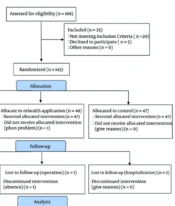
This study was a randomized controlled clinical trial. The study population included all patients with diabetes type II, who had referred to the diabetes clinic of Arak city within one week, and met the inclusion criteria. An informed consent form was obtained from all candidates after explanation of the goals and plans of the study. Subjects were randomly divided to two groups, experimental (n = 33) and control (n = 34). Inclusion criteria included: having diabetes type II, age between 20 to 60 years, personal access or one of the family members to a computer for use of software, ability to read, ability of self-care, and lack of previous use of multimedia training methods for diabetes. Exclusion criteria included: unwillingness to continue participation in the study, failure to complete the questionnaire, lack of use of the software. Seven patients didn’t complete the questionnaire, two months after the clinical trial. Finally, 30 patients remained in the experimental and 30 patients in the control group. A self-care program with an educational software support was applied for the experimental group with the following executive steps:
3.1. Designing and Determining the Validity of the Multimedia Software
The title of the multimedia software was “self-care in diabetes patients”. The content of the educational software included an introduction on diabetes, diabetes and sport, diabetes and blood sugar control, diabetes and digestion, and diabetes and foot care. Firstly, the researchers prepared the required items for determining the validity of the software by the use of relevant books and papers about training of diabetes patients. Some images, contents, animation and audio were used for making this software. To ensure scientific validity of the content, the ideas of five members of the Nursing Scientific Board were applied. Also three patients with diabetes reviewed the content, to determine their level of understanding and possible educational issues. Finally all required changes were applied accordingly.
3.2. Group Training
There were two group-training sessions with a two-week time interval. All group-training sessions included 10-15 patients and were held at the Health Center of the Markazi province, Iran.
3.2.1. First Session
The educational content included introduction of diabetes, diabetes and sport, diabetes and blood sugar control, diabetes and digestion and diabetes and foot care. All questions from patients were answered. The first session was approximately 180 minutes. At the end, all patients received their self-care software. They were requested to use their self-care software at least once for one week after the educational program. In case of any problems or probable questions about the software, they were free to call for telephone consultancy. They received the required telephone numbers. They could contact this phone line between 8:00 am and 2:00 pm.
3.2.2. Second Session
This session was solely appointed to answer all patient questions regarding their self-care necessities. Also patients were free to explain their experiences and feelings. The second session was approximately 90 minutes in duration. A one-day training course was performed for the control group under the title of “self-care in diabetes patients”. An educational program with equal content was applied for both groups. This session was approximately 180 minutes in duration. Educational methods were lectures and presentations with the PowerPoint software.
Diabetes Quality of Life Brief Clinical Inventory (DQOL-BCI) was used in the Persian language for determination of the quality of life. The major DQOL inventory had 60 questions, the validity and reliability of which were calculated by Thomas E. Burroughs et al. in 2004 and the content was reduced to 15 questions. This 15-question inventory is applicable for patients with diabetes type I and II. Questions of this inventory include two dimensions of care behavior of patients and satisfaction of disease control. It is necessary to spend about ten minutes to fill the inventory (26). Items are ranked on a five-point Likert scale and are of two general formats. One format asks about the frequency of negative impact of diabetes itself or of the diabetes treatment (e.g. “How often do you feel physically ill?”) and has response options from one (never) to five (all the time). The second format asks about satisfaction with treatment and quality of life (e.g. “How satisfied are you with the time you spend exercising?”) and is scored from one (very satisfied) to five (very dissatisfied) (27). The total score ranges from 15 to 75. Higher scores on DQOL-BCI items and subscales are, therefore, negative valences, indicating problem frequency or dissatisfaction. For validity, the questionnaire was translated to Persian then translated back to English. During the process, problems and ambiguities were identified and resolved in translation. The results of the study conducted by Mirfeizi et al. showed acceptable reliability and validity of the Iranian version of the DQOL-BCI as a measure of diabetic-specific QOL measure in Iranian patients (28).
Data were collected before and two months after the intervention in both groups. To complete the questionnaire, two months after the clinical trial, the patients of both groups were called to refer to the diabetes clinic. Data were analyzed by the SPSS software version 16, as well as descriptive (absolute and estimated frequency, mean and standard deviation) and inferential statistics. Independent t test was applied for comparing demographic variants between the two groups for age and duration of disease. Chi-square test was used for gender and literacy level. Independent t test was used for comparing the mean score of quality of life between the two groups. Paired-t test was used for comparing the mean quality of life in each group before and after the intervention.
3.3. Ethical Considerations
The present study was approved by the Ethics Committee of Arak University of Medical Sciences, Arak, Iran (No. IRCT2014072410713N3). This study was conducted after obtaining an informed consent from all subjects participating in the study.
4. Results
Most participants were females (n = 39, 65%) and the remainders were male (n = 21, 35%). Their mean and standard deviation of age was 51.64 ± 12.29 years. Their mean and standard deviation of duration of disease was 8.01 ± 6.82 years. The results of independent t-test didn’t show a significant difference in mean age (P = 0.25) and duration of disease (P = 0.35) between the experimental and control groups. The results of Chi-square test didn’t show any significant difference in frequency distribution of gender (P = 0.17) and education level (P = 0.26) between the experimental and control groups.
According to the results of independent statistical t test, there was no significant difference between the two groups in mean score of quality of life before the intervention (P = 0.97) while after the intervention the difference between the two groups was significant (P = 0.029). According to the results of paired t test, applying the self-care program with software support improved quality of life of the experimental group after the intervention (P < 0.0001) while there was no significant difference in mean score of quality of life in the control group after eight weeks (P = 0.051) (Table 1). The quality of life for the majority of patients (56.7%) in both groups was moderate before the intervention and none of the patients reported a Low quality of life after the intervention. Changing the quality of life from moderate to high level in experimental group was significant (Table 2).
Table 1.
Comparison of the Mean Quality of Life of Patients With Diabetes Type II Before and Two Months After the Intervention in the Two Groups
| Group | Before a | Two Months After a | P Value |
|---|---|---|---|
| Experiment | 36.76 ± 7.49 | 28.33 ± 8.88 | < 0.0001 |
| Control | 36.70 ± 8.53 | 32.96 ± 7.009 | 0.051 |
| P Value | 0.97 | 0.029 |
a Data are presented as Mean ± SD.
Table 2.
The Level of Quality of Life of the Patients with Diabetes Type II Before and Two Months After the Intervention in the Two Groups a
| High (15-34) | Moderate (35-54) | Low (55-75) | Total | |
|---|---|---|---|---|
| Experiment | ||||
| Before | 13 (43.3) | 17 (56.7) | 0 (0) | 30 (100) |
| Two months after | 23 (76.7) | 7 (23.3) | 0 (0) | 30 (100) |
| Control | ||||
| Before | 12 (40) | 17 (56.7) | 1 (3.3) | 30 (100) |
| Two months after | 15 (50) | 15 (50) | 0 (0) | 30 (100) |
a Data are presented as No.(%).
5. Discussion
The aim of this study was to investigate the effects of self-care program with multimedia software support on quality of life of patients with diabetes type II. The results showed that this program was effective in promotion of quality of life of patients. Applying the multimedia software as an effective educational strategy could lead to a balance in audio/video learning along with learning of issues and implementation of care recommendations, and finally promote quality of life. In compliance with the mentioned results, Beranth (29) showed that any participation in educational programs and performing of self-care behaviors is related to diabetic patients’ functions with a higher scores.
Clinical advantages of computer-based diabetes educational programs were determined by some other researchers. Glasgow et al. (30) found that computer programs could be used to solve problems of patients with diabetes and promote various fields of quality of life, depression, and fat and HbA1C rates. In another study in 2006 he concluded that short-term periods of interference by the help of computer programs and further feedbacks, designed goals, and consistency of health consultants may lead to a significant reduction in high-fat diets and weight (31). The multimedia training course in the study of Kandula et al. (32) led to a considerable increase in scores of patients with any literacy levels. It is important to note that patients with a lower level of literacy had learned less number of items when compared to those with adequate level of literacy. According to a systematic review, 16 studies out of 19 showed that computer-based teaching programs for patients with diabetes promoted goals set by the patients (33).
Also the results of a study by Khan et al. (22) evaluating the effects of a multimedia educational program on self-management of patients with diabetes showed that there was a significant difference in correct consumption of medicines and reduction of HbA1C in the multimedia group. The results of another study showed that patients in the interference group had more knowledge yet their difference with the control group was not significant (22).
Furthermore, the advantages of multimedia application were confirmed by Huber et al. study (34), in which patients were shown to have greater satisfaction from training with this method before a prostatectomy surgery. Knowledge was significantly increased in the control group (34). The results of previous studies and the current study suggest the potential positive effects of the applied method such as absorption of multiple senses to the content, simple content, repeatability, ability of usage while in good physical, spiritual and mental environment. The study by Baraz et al. showed that a video-based educational program increased the quality of life of patients on hemodialysis (35). Patients in the control group of the present study had limitations to exploit the advantages of various multimedia approaches and only attended one training session and thus had to save and preserve learned materials during a short period of time, therefore couldn’t improve their self-care and ultimately quality of life. However, the study by Aghajani et al. showed that lectures were able to significantly increase the quality of life of patients with essential hypertension because they benefited from group discussion at the second training session (36).
It is necessary to mention that there are no studies on the use of multimedia software for patients with diabetes in Iran for further comparisons. The study of Khandan et al. (37) and Noohi and Mirzazadeh (38) showed that e-learning is effective on operations of patients with diabetes type II , as well as their knowledge and self-care attitude (38). According to the results of previous studies, it is obvious that most patients with diabetes type II have a low quality of life (39-42). There are some results indicating the greater interest of patients with diabetes to learn via computer technology (24) and their satisfaction from self-management web-based educational programs (3).
One of the strength points of this study was designing of the software that includes all the information required by patients with diabetes in form of integrated software, which is applicable for other learners such as nursing students, nurses and patients’ families, and can even be displayed at therapeutic clinics on monitors and Televisions. Regarding the applied sounds, even illiterate and patients with low level of literacy could benefit from this program.
Regarding the results of this research, the authors suggest that educational sessions with software support and participation of patients’ families should be held to improve patients’ quality of life. Since the participants of the present study were selected from patients who had referred to a diabetes clinic, there is a possibility of volunteer bias. On the other hand, all data were collected by self-reporting. Thus it is possible that the data does not reflect real functions of the patients. Patients with diabetes play a major role in their treatment process and are able to change their life style and quality. In spite of various methods for training of diabetes patients, the present study showed that a self-care program with a multimedia software support is effective for upgrading quality of life. As a result, it is proposed to develop educational software for patients and their families.