



1. Background
2. Objectives
3. Methods
3.1. Patient Selection
3.2. Assessment of COVID-19 RNA
3.3. Assessment of COVID-19 Antibody
3.4. Assessment of Sperm Quality
3.5. Assessment of DNA Fragmentation
3.6. Assessment of Reproductive Hormone and Total Antioxidant Capacity
3.7. Statistical Analysis
4. Results
| Parameters | COVID-19 Positive Individuals | Control Individuals | P-Value |
|---|---|---|---|
| Age (y) | 38.2 ± 9.9 | 36.4 ± 13 | 0.661 |
| BMI (kg/m2) | 24.6 ± 2.9 | 23.6 ± 2.6 | 0.521 |
| Volume (mL) | 2.8 ± 0.9 | 3.1 ± 1.0 | 0.502 |
| Sperm concentration (106/mL) | 70.9 ± 63.9 | 105.9 ± 41.1 | 0.001 |
| Total motility (%) | 48.1 ± 28.0 | 73.1 ± 27.7 | 0.001 |
| Normal morphology (%) | 7.33 ± 1.88 | 12.1 ± 2.5 | 0.001 |
| DNA fragmentation (%) | 16.45 ± 2.55 | 11.22 ± 3.22 | 0.01 |
| Viability (%) | 61.52 ± 8.34 | 87.33 ± 9.77 | 0.001 |
| TAC (IU/mL) | 2.55 ± 1.33 | 4.56 ± 2.01 | 0.001 |
a Values are expressed as mean ± SD unless otherwise indicated.
b Statistical analysis according to Mann-Whitney U test for nonparametric distribution (P < 0.05).
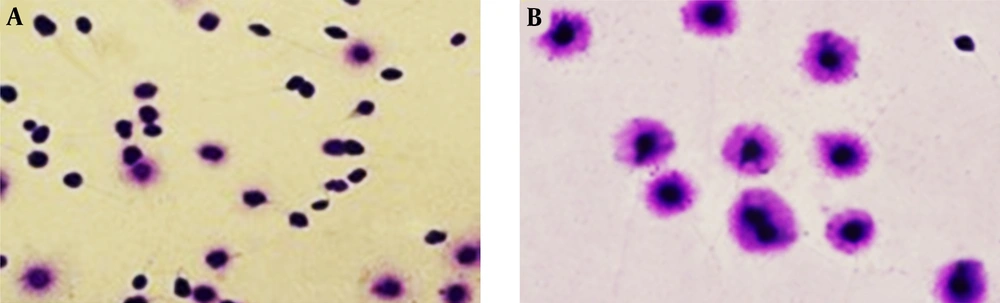
View of DNA fragmentation based on halo formation in different groups (magnification × 100). A significantly higher sperm DNA fragmentation in COVID-19 positive, A, fertile males group; B, compared to the subjects in the control group. Sperm nucleus with large halo (without DNA fragmentation), sperm nucleus with small halo (with DNA fragmentation), and sperm nucleus without halo (with DNA with severe damage).
Abbreviations: FSH, follicle stimulating hormone; LH, luteinizing hormone.
a Values are expressed as mean ± SD unless otherwise indicated.
b Statistical analysis according to unpaired sample t-test and Mann-Whitney test (P < 0.05).
c Significant difference.
Abbreviations: TAC, total antioxidant capacity; DFI, DNA fragmentation index.
a Significant difference.