Breast Cancer as a Major Concern Among Iranian Women

Author(s):
Salman KhazaeiSalman Khazaei1, Parvaneh LakParvaneh Lak2,*, Shahab RezaeianShahab Rezaeian3, Somayeh KhazaeiSomayeh Khazaei4
1Department of Epidemiology, School of Public Health, Hamadan University of Medical Sciences, Hamadan, IR Iran
2Department of OBS/GYN, Chamran Hospital, Iran University of Medical Sciences, Tehran, IR Iran
3Social Development and Health Promotion Research Center, Gonabad University of Medical Sciences, Gonabad, IR Iran
4Rafsanjan University of Medical Sciences, Rafsanjan, IR Iran
*Corresponding Author: Corresponding author: Parvaneh Lak, Department of OBS/GYN, Chamran Hospital, Iran University of Medical Sciences, Tehran, IR Iran, E-mail: Email: [email protected]

Jentashapir Journal of Cellular and Molecular Biology:Vol. 7, issue 4; e33420
Published online:Aug 27, 2016
Article type:Letter
Received:Sep 26, 2015
Accepted:May 27, 2016
How to Cite:Khazaei S, Lak P, Rezaeian S, Khazaei S. Breast Cancer as a Major Concern Among Iranian Women. Jentashapir J Cell Mol Biol. 2016;7(4):e33420. doi: https://doi.org/10.17795/jjhr-33420

Dear Editor,
Breast cancer (BC) is the most common neoplasm in females around the world, and it has been estimated that about 41000 women die of this disease each year (1). Its prevalence in Western Europe and Northern America is between 8 and 10% while in Asian countries is approximately 1% (2). However, the rates in women living in developing regions are rising (3).
During the past decade, BC has become the most frequent malignancy among Iranian women (4). Based on the world health organization (WHO) report in 2014 (5), 14.2% of all cancer-related mortality among women in Iran (23300 deaths), is due to BC (Figure 1).
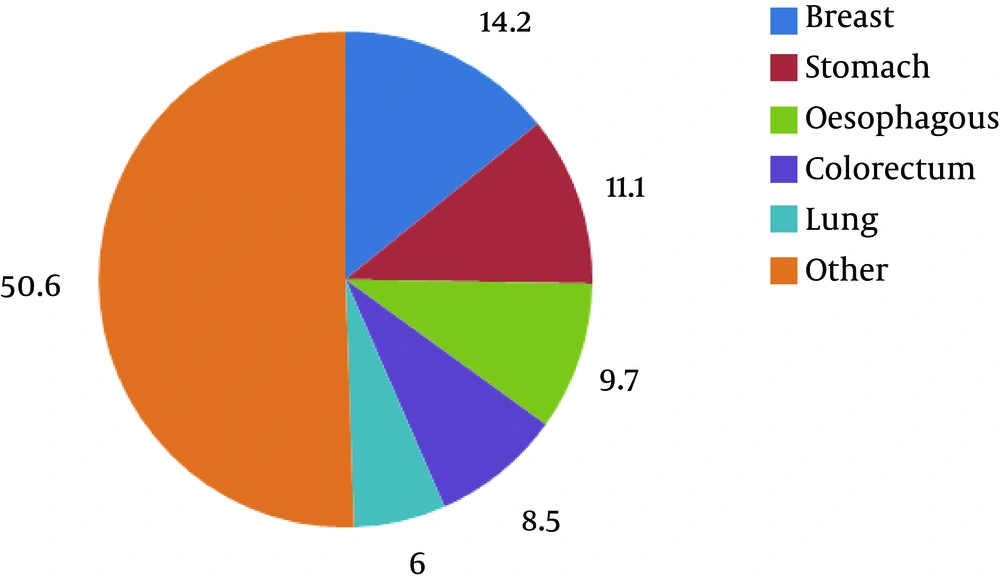
Cancer Mortality Among Iranian Women in 2012
Figure 1.

Cancer Mortality Among Iranian Women in 2012

Also, despite other cancers that have had a decreasing trend in mortality in the recent years, according to Figure 2, BC mortality trend is flat and has even had a slight increase among Iranian women (5).
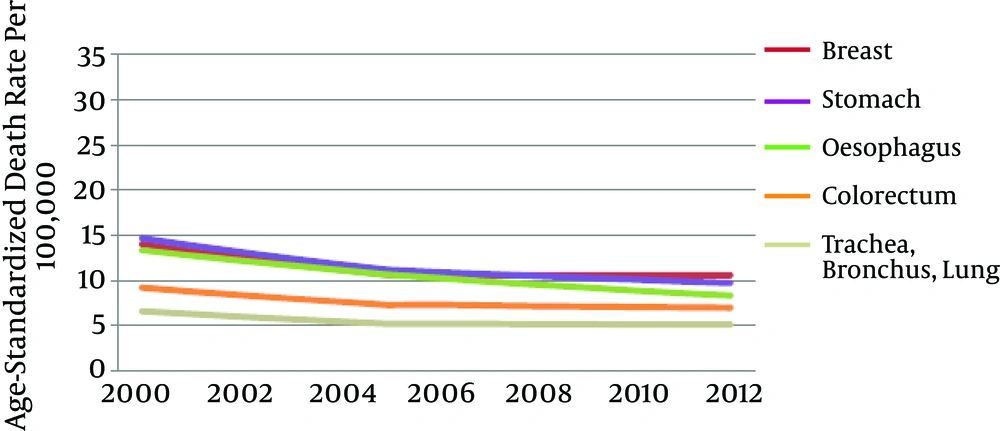
Age-Standardized Cancer Mortality Trends in Iranian Women
Figure 2.

Age-Standardized Cancer Mortality Trends in Iranian Women

In 2011, about half of the women, 15 to 64 years of age were overweight or obese and had low physical activity and only 2% of them had no risk factor (6). Therefore, the mean age is at least 10 years younger than women with the same malignancy in developed countries and a longer period of time is spent with the disease (5). Women with BC in Iran due to some cultural issues encounter many psychosocial stresses and physical problems (6), and unfortunately the role of husbands in supporting patients and fostering self-efficacy in Iranian BC patients is low (7).
In low and middle income countries including our country where BC is diagnosed in very late stages, early detection in order to improve breast cancer outcome and survival is the cornerstone of BC control (8). Mammography remains the main screening tool that can reduce the rate of death from this cancer by about 40% (8).
Self-efficacy affects quality of life of patients and their self-care behavior, but it decreases over time, therefore due to long term engagement among Iranian women it is recommended to increase the role of factors such as education (7), that have important effects on the level of self-efficacy in BC patients.
Employment is important for survival, through managing psychosocial tensions and economical aspects of the disease. Return-to-work can be considered a type of social recovery that enhances the patient’s life quality (9). Therefore, it is necessary for health policies to consider issues of return to work for these patients.

References

  • 1.
    DeVita VT, Lawrence TS, Rosenberg SA. Cancer: principles and practice of oncology-advances in oncology. Philadelphia, US: Lippincott Williams and Wilkins; 2010.
  • 2.
    Parkin DM, Muir CS, Whelan S, Gao Y, Ferlay J, Powell J. Cancer incidence in five continents. 6. France: International Agency for Research on Cancer; 2002.
  • 3.
    Harris JR, Lippman ME, Osborne CK, Morrow M. Diseases of the Breast. Philadelphia, US: Lippincott Williams and Wilkins; 2012.
  • 4.
    Harirchi I, Kolahdoozan S, Karbakhsh M, Chegini N, Mohseni SM, Montazeri A, et al. Twenty years of breast cancer in Iran: downstaging without a formal screening program. Ann Oncol. 2011;22(1):93-7.
  • 5.
    Harirchi I, Karbakhsh M, Kashefi A, Momtahen AJ. Breast cancer in Iran: results of a multi-center study. Asian Pac J Cancer Prev. 2004;5(1):24-7.
  • 6.
    Maharlouei N, Ahmadi SM, B. Lankarani K. Report on the Second Iranian International Conference on Women’s Health Held May 1 and 2, 2013 in Shiraz, IR Iran. Women's Health Bulletin. 2014;1(3). https://doi.org/10.17795/whb-23654.
  • 7.
    Nejad ZK, Aghdam AM, Hassankhani H, Asgari Jafarabadi M, Sanaat Z. Cancer-Related Self-Efficacy in Iranian Women With Breast Cancer. Women's Health Bull. 2015;2(2).
  • 8.
    Elmore JG, Armstrong K, Lehman CD, Fletcher SW. Screening for breast cancer. JAMA. 2005;293(10):1245-56. [PubMed ID: 15755947]. https://doi.org/10.1001/jama.293.10.1245.
  • 9.
    Azarkish F, Mirzaii Najmabadi K, Latifnejad Roudsari R, Homaei Shandiz F. Factors Related to Return to Work in Women After Breast Cancer in Iran. Iran Red Crescent Med J. 2015;17(9):19978. [PubMed ID: 26473073]. https://doi.org/10.5812/ircmj.19978.

Copyright

Copyright © 2016, Ahvaz Jundishapur University of Medical Sciences. This is an open-access article distributed under the terms of the Creative Commons Attribution-NonCommercial 4.0 International License (http://creativecommons.org/licenses/by-nc/4.0/) which permits copy and redistribute the material just in noncommercial usages, provided the original work is properly cited.

Similar Articles

1
May
2018

Assessment of socio-economic and menstrual-reproductive factors related to estimated risk of affecting to breast cancer in the Iraninan woman

Hossein Ansari,
Mahdi Mohammadi,
Younes Mohammadi,
Seyyed Mehdi Hashemi,
Nilofar Ghavami,
Fariba Zare
,et al.

Ansari H, Mohammadi M, Mohammadi Y, Hashemi SM, Ghavami N, et al. Assessment of socio-economic and menstrual-reproductive factors related to estimated risk of affecting to breast cancer in the Iraninan woman. koomesh. 2018;20(3):e152976. doi:

30
Mar
2009

Survival of Breast Cancer in Southern Iran

Seyed Taghi Heydari,
D Mehrabani,
S Z Tabei,
N Azarpira,
M A Vakili

Heydari ST, Mehrabani D, Tabei SZ, Azarpira N, Vakili MA. Survival of Breast Cancer in Southern Iran. Int J Cancer Manag. 2009;2(1):e80514. doi:

30
Sep
2013

Epidemiological study of breast cancer in Tabriz (2006-2009)

MA Hossainpour-Feizi,
F Khodaei,
Azarfam P,
Pouladi N

Hossainpour-Feizi M, Khodaei F, P A, N P. Epidemiological study of breast cancer in Tabriz (2006-2009). J Inflamm Dis. 2024;17(2):e155757. doi:

10
Aug
2014

Survey of modifiable risk factors for breast cancer in Tabriz's woman: A case- control study

Mina Hosseinzadeh,
Jamal‏ ‏ Eivazi Ziaei,
Parvaneh Aghajari,
Nader Mahdavi‎,
Shirin Barzanje Atri‎,
Mohammad Hasan ‏ ‏Sahebihagh‎

Hosseinzadeh M, Eivazi Ziaei J‏, Aghajari P, Mahdavi‎ N, Barzanje Atri‎ S, et al. Survey of modifiable risk factors for breast cancer in Tabriz's woman: A case- control study. J Clin Res Paramed Sci. 2014;3(2):e82095. doi:

9
Jun
2018

The Relationship of Reproductive Risk Factors and Histologic Patterns with Molecular Subtypes of Breast Cancer

Fataneh Zeiyaie,
Nahid Nafissi,
Maryam Khayamzadeh,
Atieh Akbari,
Mohammad Esmaeil Akbari

Zeiyaie F, Nafissi N, Khayamzadeh M, Akbari A, Akbari ME. The Relationship of Reproductive Risk Factors and Histologic Patterns with Molecular Subtypes of Breast Cancer. Int J Cancer Manag. 2018;11(6):e66746. doi: https://doi.org/10.5812/ijcm.66746

Download PDF151.56 KB

Crossmark

Crossmark

Checking

Share on
Cited by
Metrics

Ordering Reprints

Articles are published under the Creative Commons license stated on each article. No permission or royalty fee is required for uses permitted by that license. CCC handles optional bulk and customized reprint orders. Any quotation covers production and delivery services only, not copyright permission. > Request Reprints from CCC 

Search Relations

Author(s):

Related Articles