
1. Background
Nowadays, applying gene expression profiling technique successfully helps to classify breast cancer by determining specific molecular subtypes of cancer. The close link between these subtypes and different clinical behaviors of breast cancers as well as its different response to therapeutic chemotherapy regimens has also been identified (1, 2). It is, thus, suggested a significant association between these molecular subtypes and known risk factors for breast cancer through different etiological pathways (3, 4). For instance, in large nested case-control studies, mammographic density was introduced as a strong risk factor for breast cancer that was closely linked to some specific molecular subtypes of breast cancer (5, 6). As another important factor, women age at menarche and at first birth has been also pointed to be associated with cancer subtypes so that early menarche as well as late age at first experience of delivery were linked to estrogen receptor and/or progesterone receptor positive tumors compared to hormone receptor negative tumors (7, 8). Body mass index (BMI), especially at menopausal ages, has been associated with appearing some specific molecular subtypes of breast cancers that women aged more than 50 years with non-obese status predispose less to develop luminal A-like breast cancers, while those women younger than 42 years with obese status were most likely to develop triple-negative cancer (9). The duration of lactation has been revealed as another factor linking specific molecular subtypes of cancer. An inverse association has been shown between the presence of basal-like tumor and the duration of lactation and, thus, prolonged lactation is now suggested to be protective against basal-like breast cancer (7). Fortunately, most traditional risk factors for breast cancer are modifiable or manageable and, thus, by certainty to the link between some risk factors and molecular breast cancer subtypes, controlling, and managing cancer-related risk factors, the possibility to prevent different molecular subtypes of cancers can be provided. In other words, due to the wide variation of breast cancer risk factors by molecular characteristics, better understanding of this link can effectively help to prevent different molecular subtypes of cancer by identifying and managing related clinical risk factors. The present study aimed at evaluating the reproductive risk factors in relation to molecular subtypes and histological features of cancer in a large group of Iranian women with breast cancer.
2. Methods
This historical cohort study was conducted on 1988 women diagnosed as different subtypes of breast cancers recruited in 2011 to 2016 from cancer research center at Shahid Beheshti University of Medical Sciences. Ethical approvals were granted from the ethical board at Shaheed Beheshti University of Medical Sciences and all participants gave written informed consent before participating into the study. Exclusion criteria were missed information on either of the immunohistochemistry (IHC) markers of tumor or clinical characteristics that could not be corrected by phone calling. Study baseline information on women age, parity, weight and height, family history of breast cancer, the duration of lactation, age at first birth, age of menarche, and history of hormone replacement therapy were all collected by viewing the hospital recorded files. Data on molecular markers were obtained from hospital files obtaining originally from immunohistochemical (IHC) staining technique. Tumor cells that showed any nuclear staining for estrogen receptor (ER) or progesterone receptor (PR) were considered ER (+) or PR (+), respectively, whereas all ER (-) or PR (-) cases showed complete absence of tumor cell staining in all tissue cores. Percent ER and PR staining were dichotomized into positive or negative status with a cutoff at ≥ 10% as positive (10). HER2 status was dichotomized into positive or negative according to the Pathology’s guidelines that HER2 was considered to be negative if protein expression showed 0 or 1+. Proliferation marker Ki67 was measured in hotspot regions according to guidelines and reported as percent staining. Information on tumor invasiveness and metastasis was also collected by reviewing the recorded hospital documents. According to the rules of the categorization of different breast cancer molecular subtypes, luminal A subtype was defined as ER+/PR+/HER2- and KI67 low, luminal B as either ER+/PR-/HER2-, or ER+/PR+/HER2-, KI67 high, or ER+/HER2+/any PR, any KI67, HER2-overexpressing as ER-/PR -/HER2 +, and basal-like as triple negative or ER-/PR-/HER2- (10). Also, based on the pathological reports in hospital recorded files, the cancers were categorized as invasive lobular carcinoma, invasive ductal carcinoma, ductal carcinoma in situ, and mixed pattern. The patients were followed for 5 years and compared the survival across the different molecular subtypes. Finally, data on reproductive factors and other potential covariates as well as tumor specific classes were entered into the statistical datasheet for final analysis.
For statistical analysis, the results were presented as mean ± standard deviation (SD) for quantitative variables and were summarized by frequency (percentage) for categorical variables. Continuous variables were compared, using ANOVA-post-hoc test. Categorical variables were, on the other hand, compared, using Chi-square test. To assess the long-term survival, the Log-rank test was applied and the difference in survival between the groups was presented with the Kaplan-Meier curve. P values less than 0.05 were considered statistically significant. For the statistical analysis, the statistical software SPSS version 23.0 for windows (IBM, Armonk, New York) was used.
3. Results
3.1. Histological and Molecular Patterns Analysis
Initially, 1,016 patients were categorized in luminal A subtype, 177 in luminal B subtype, 108 in HER2 overexpression subtype, and 220 in triple negative subtype. Regarding the histological pattern of the tumor, 1,475 had IDC pattern, 109 had DCIS pattern, 115 had ILC pattern, and 37 had mixed pattern, while histological pattern remained unknown in 163 patients. Table 1 summarized the results related to comparing baseline characteristics across the different molecular subgroups of cancer including luminal A, luminal B, HER2-overexpression, and triple negative. Comparing mean age at the first pregnancy showed a significant difference across 4 groups with the highest mean age for the group with HER2-overexpression and the lowest for those with luminal A (P = 0.045). Regarding tumor size, a significant difference was found between the groups with the different molecular subgroups with the most and the least tumor size in triple negative group and luminal A group, respectively (P = 0.035). In this regard, the frequency of the size of more than 5mm was 8.4% in luminal A group, 10.6% in luminal B group, 6.8% in HER2 overexpression group, and 14.6% in triple negative group. The mean number of lymph nodes involved in breast cancer was significantly higher in luminal B subtypes compared to luminal A and triple negative subtypes (P = 0.004). Similarly, tumor stage was significantly different across 4 molecular subtypes that the tumor stages III-IV was found in 31.6% of patients with luminal A subtype, 42.2% in patients with luminal B, 34.3% in patients with HER2 overexpression, and 26.0% in those with triple negative subtype (P = 0.006). There was no difference across the different cancer molecular subtypes with respect to the duration of lactation (P = 0.884) and number of gravity (P = 0.139). The histological patterns of the tumor were powerfully different in terms of the molecular subtypes of tumor so that luminal A subtype was found more in ILC pattern, luminal B subtype was found more in DCIS pattern, HER2-overexpression subtype was revealed more in DCIS pattern, and triple negative subtype was found more in IDC pattern. When considering each histological pattern, the prominent molecular subtype in all histological patterns was luminal A as 56.6% in IDC pattern, 43.1% in DCIS pattern, 70.4% in ILC group, and 62.2% in mixed group (Table 1).
Table 1.
Comparing Baseline Variables Across the Different Molecular Subtypes
| Item | Luminal A | Luminal B | HER2 Overexpression | Triple Negative | P Value |
|---|---|---|---|---|---|
| Age at first pregnancy | 22.86 ± 5.39 | 24.64 ± 5.63 | 24.68 ± 5.77 | 23.15 ± 5.66 | 0.039 |
| Histology pattern, % | < 0.001 | ||||
| IDC (1475) | 56.6 | 10.1 | 6.1 | 12.9 | |
| DCIS (109) | 43.1 | 11.0 | 9.2 | 11.9 | |
| ILC (115) | 70.4 | 7.8 | 0.9 | 2.6 | |
| Mixed (37) | 62.2 | 10.8 | 5.4 | 8.1 | |
| Tumor size, cm, % | 0.143 | ||||
| < 2 (365) | 34.4 | 21.1 | 32.5 | 29.5 | |
| 2 - 5 (671) | 57.1 | 68.3 | 57.1 | 62.0 | |
| > 5 (100) | 8.4 | 10.6 | 10.4 | 8.4 | |
| Mean number of LN | 2.49 ± 0.15 | 3.81 ± 0.45 | 2.76 ± 0.53 | 2.03 ± 0.31 | 0.004 |
| Tumor stage, % | 0.006 | ||||
| I (227) | 21.3 | 10.2 | 20.6 | 19.6 | |
| II (677) | 47.1 | 47.6 | 45.1 | 54.4 | |
| III (421) | 28.8 | 39.8 | 34.3 | 24.5 | |
| IV (33) | 2.8 | 2.4 | 0.0 | 1.5 | |
| Mean duration of lactation | 2.343 ± 0.86 | 2.43 ± 0.85 | 2.50 ± 0.84 | 2.46 ± 0.87 | 0.884 |
| Mean number of gravida | 2.28 ± 1.68 | 2.03 ± 1.38 | 2.20 ± 1.33 | 2.44 ± 1.78 | 0.139 |
3.2. Survival Analysis
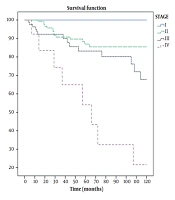
In total, 1 474 out of 1 899 patients were successfully followed-up with the overall follow-up rate of 82.1% and the overall survival of 99.2%. Based on the long-term survival analysis, 5-year survival was found to be 98.3% in luminal A group, 98.3% in luminal B group, 100% in HER2 overexpression, and 98.1% in triple negative. According to the Log-rank test, no difference was revealed between the molecular subtypes in long-term survival. As shown in Table 2, in the age at first live birth subgroup lower than 20 years, no death was reported with the pointed follow-up time. In age at first live birth subgroup 20 to 30 years, 2 events was reported in triple negative subtype group, and in those older than 30 years at first live birth, 1 death was reported in triple negative subtype and another event in luminal A subtype group. In this regard, the lowest 5-year survival was found in the patients aged higher than 30 years at first live birth with triple negative subtype (survival rate of 75.0%). In different subgroups of lactation, long-term death in the groups with lactation shorter than 12 months, between 12 and 24 months and longer than 24 months was 1.31%, 0.45%, and 2.20%, respectively, with the overall survival rates of 98.7%, 99.5%, and 98.4%, respectively. No difference was revealed in long-term death across 4 molecular subtypes of cancer stratified according to the duration of lactation (Table 2). Considering 3 groups of gravida as 0, 1 to 3, and > 3, the long-term death was found in 2.6%, 1.4%, and 1.2%, respectively. No difference was revealed in long-term death across 3 groups. As indicated in Table 2, in the different subgroups, according to the size of tumor (< 2 mm, 2 - 5 mm, > 5 mm), no association was found between molecular subtype and long-term survival; however, survival was adversely associated with the size of tumor. Long-term death or survival of breast cancer was independent to the number of involved lymph nodes. Similarly, no relationship was revealed between molecular subtype and long-term death or survival in different categories of the lymph nodes involvement (Table 2). More importantly, the long-term death was strongly associated with the tumor stage as 0% in stage 0, 0% in stage I, 1.37% in stage II, 1.72% in stage III, and 12.12% in stage IV. However, the association between survival and tumor stage was not dependent to tumor molecular subtypes.
Table 2.
5-Year Survival According to Baseline Variables in the Different Molecular Subtypes
| Item | Luminal A | Luminal B | HER2 Overexpression | Triple Negative | Overall |
|---|---|---|---|---|---|
| Total survival rate | 98.3 | 98.3 | 100 | 98.1 | 98.4 |
| Age at first pregnancy, y, % | |||||
| < 20 | 100 | 100 | 100 | 100 | 100 |
| 20 - 30 | 100 | 100 | 100 | 94.4 | 99.2 |
| > 30 | 96.7 | 100 | 100 | 75.0 | 96.1 |
| Duration of lactation, mo, % | |||||
| < 12 | 98.9 | 97.9 | 100 | 97.9 | 98.7 |
| 12 - 24 | 100 | 95.5 | 100 | 100 | 99.5 |
| > 24 | 97.6 | 98.6 | 100 | 96.7 | 97.8 |
| Number of gravida, % | |||||
| 0 | 97.1 | 94.1 | 100 | 100 | 97.3 |
| 1 to 3 | 98.8 | 97.8 | 100 | 97.1 | 98.6 |
| > 3 | 98.5 | 100 | 100 | 98.4 | 98.7 |
| Tumor size, cm, % | |||||
| < 2 | 99.6 | 96.2 | 100 | 97.9 | 99.2 |
| 2 - 5 | 99.1 | 100 | 100 | 98.0 | 99.1 |
| > 5 | 93.1 | 100 | 100 | 100 | 95.6 |
| Lymph node, % | |||||
| 0 | 100 | 100 | 100 | 100 | 100 |
| 1 to 3 | 97.7 | 100 | 100 | 100 | 98.3 |
| > 3 | 99.0 | 99.3 | 100 | 97.3 | 98.9 |
| Tumor stage, % | |||||
| I | 100 | 100 | 100 | 100 | 100 |
| II | 98.4 | 100 | 100 | 98.1 | 98.6 |
| III | 98.8 | 95.4 | 100 | 97.9 | 98.3 |
| IV | 84.6 | 100 | 100 | 100 | 87.9 |
4. Discussion
In the first step and of 1,899 patients with breast cancer, the evidences of subtype heterogeneity were obtained for some categories of risk factors including age at first pregnancy that was the highest in HER2-overexpression subtype and the lowest in luminal A subtype; tumor size that was the most in triple negative subtype and the least in luminal A subtype; the number of lymph nodes that was the highest in luminal B subtype; and tumor stage that was the highest and the lowest in luminal B and triple negative subtypes, respectively. In other words, a close link was revealed between molecular subtypes of the breast tumor and baseline patients’ characteristics and tumor-related parameters, especially size and stage of the tumor. More importantly, we found a close link between histological pattern of breast cancer and its molecular subtype so that luminal A subtype was found more in ILC pattern, luminal B subtype was found more in DCIS pattern, HER2-overexpression subtype was revealed more in DCIS pattern, and triple negative subtype was found more in IDC pattern. In this study, we had to ignore some other baseline factors such as body mass index, history of HRT, and family history of cancer because of significant missing data related to these variables. Interestingly, this study could not reveal any association among molecular subtypes, the duration of breastfeeding, and number of parity that were found to be inducible factors on heterogeneity of molecular tumor patterns.
The association between age at first pregnancy and increased risk for breast cancer has been well defined. As described by Lambe et al. (11), the risk of breast cancer increased by about 13% for each 5-year increment in age at first birth and for every 5 year-increase in age at last birth, there was a small risk increase of marginal statistical significance. The delay of first birth together with low parity and short duration of breastfeeding are increasing social trends in developed countries (12); however, the association between age at first pregnancy and molecular subtype has been less studied. As shown by Phipps et al. (13), age at first birth was most strongly associated with risk of ER-/PR-/HER2+ disease, but neither parity nor age at first birth was associated with triple-negative breast cancer. Previous studies of breast cancer overall have suggested that disease risk is lower in women with a first birth at age < 20 than in women with a first birth between ages 20 to 29 (14). Thus, early age at first birth is associated with risk of ER+ but not triple-negative breast cancer and, thus, it can be used for discriminating HER2-overexpression subtype from other subtypes. Regarding association between tumor size and triple negative subtype, no previous evidence was reported in similar results; however, it seems that larger tumor size in this subtype leads to poorer prognosis of cancer (15, 16). Similar to this survey, Ma et al. (17) could find that the tumor size was significantly greater in triple negative subtype than other types. In total, larger size of tumor can be predicted in triple negative subtype. We also showed the link between the higher stage of tumor and luminal B subtype. This association was similarly shown in other population-based studies. As shown by Bediaga et al. (18), comparison of the clinic-pathological features of the luminal samples clustered in luminal B and those clustered in luminal A revealed higher stage in luminal B subtype. Also, Serrano-Gomez et al. (19) showed the higher percentage of stage III tumors in patients with luminal B subtypes.
The association between molecular types of breast cancer and its histological features has also been assessed in different studies. In the present observation, luminal A subtype was specified to ILC pattern, luminal B and HER2-overexpression subtypes were specified to DCIS pattern, and triple negative subtype was found more in IDC pattern. Of course, this finding had not completely been in agreement with other studies; thus; this specification may be only observed in the population of the present study. In a study conducted by Cherbal et al. (20) among Algerian women with breast cancer, IDC feature was the most common histological type in all breast cancer subtypes. As indicated by Doebar et al. (21), Her2+ invasive breast cancer was associated with a higher prevalence of DCIS compared to ER+/Her2− and triple-negative subtypes. However, in another study performed by Perez et al. (22), there was no significant difference in the immunophenotype frequencies between pure ductal carcinoma in situ and ductal carcinoma in situ associated with invasive carcinoma. It seems that the association between histological and molecular characteristics is strongly influenced by population characteristics.
4.1. Conclusions
As we expected, the most important factors predicting the survival of breast cancer were age and tumor stage, while other variables such as lymph node involvement, tumor size, the duration of lactation, and even molecular subtypes could not directly predict long-term survival. Various studies assessed the predicting factors for long-term survival in patients with breast cancer, especially in some others, the presence of some molecular subtypes such as ER-/HER2+ were associated with shorter long-term survival (23). In a systematic review published in 2008, tumor size, nodal status, and grade remained the most important prognostic factors for long-term survival between 1995 and 2006; however, their role decreased over time till now (24). Similar to this study, in which the lowest 5-year survival was found in the patients aged higher than 30 years at first pregnancy with live birth with triple negative subtype, breast cancer survival rates was shown to be comparatively lower for women younger than 40 years than for older women across all histological subtypes and stages (25). Also, based on the results reported by Akbari et al. (26), histological grade and age at disease were also the main aspects of correlation of death in patients with breast cancer. Therefore, along with genetic and molecular factors as strong predictors for cancer survival, advanced age and tumor stage can be considered other predictive markers for breast cancer.