Fulltext
Fulltext is available in pdf file.
Jentashapir Journal of Cellular and Molecular Biology
Official Journal of Ahvaz Jundishapur University of Medical Sciences
Image Credit:Jentashapir J Cell Mol Biol
Authors
Background: Motor skills disorder in children with motor dysfunction is a common disorder in childhood. The aim of this study was to investigate the prevalence and severity of musculoskeletal disorders in children with developmental coordination disorder in comparison with healthy children.
Material and methods: Using developmental disorder coordination questionnaire (DCDQ'07), 59 male children with a developmental coordination disorder (length:134.71±6.91, weight: 31.66±6.66, age: 9.33±0.77) and 59 healthy male children were selected, and 13 physical anomalies were evaluated using flexible ruler, goniometer, mirror boxes, tape measure and chessboard. The data were analyzed using SPSS 16, independent t-test and Mann- Whitney U test with statistical significance at p< 0.05. Results: Intensity prevalence of forward head, kyphosis and lordosis posture, crooked neck, shoulders down and tilted back abnormalities in male children with developmental coordination disorder was significantly higher than in the healthy group (p<0.05). However, there was no significant difference in prevalence of pelvic tilt, flat foot (foot pronation), pes cavus (foot supination), hallux valgus, hammertoe, knee valgus, and genu varum between the two groups (p< 0.05).
Conclusion: The results of our study revealed that the children with developmental coordination disorder need more attention and effective corrective action plans.
© 2014, Jentashapir Journal of Cellular and Molecular Biology. This open-access article is available under the Creative Commons Attribution-NonCommercial 4.0 (CC BY-NC 4.0) International License (https://creativecommons.org/licenses/by-nc/4.0/), which allows for the copying and redistribution of the material only for noncommercial purposes, provided that the original work is properly cited.

Volkan-Yazici M, Elbasan B, Yazici G. Motor Performance and Activities of Daily Living in Children with Neurodevelopmental Disorders. Inn J Pediatr. 2018;28(6):e65396. doi: https://doi.org/10.5812/ijp.65396
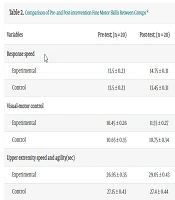
Sabzi AH. The Effect of Selected Motor Games on Fine Motor Skill Development in Children with Developmental Coordination Disorder. J Motor Control Learn. 2025;7(1):e161094. doi: https://doi.org/10.5812/jmcl-161094
Gabbard C, Sullivan R, Albosta M, Lee J. Perceived Motor Clumsiness: A Study of Young College Students. J Motor Control Learn. 2024;1(2):e146436. doi: https://doi.org/10.29252/ijmcl.1.2.3
Maleki S, Alizadeh Zarei M. Correlation Between Executive Function Behaviors and Educational Achievement of Children With Developmental Coordination Disorder. Middle East J Rehabil Health Stud. 2016;3(3):e37378. doi: https://doi.org/10.17795/mejrh-37378
Alibakhshi H, Salmani M, Ahmadizadeh Z, Siminghalam M. Relationship between primitive reflexes and fine motor skills in children with specific learning disorders. koomesh. 2018;20(3):e152982. doi:
Last Update: 1 week ago
Last Update: 1 week ago
Last Update: 1 week ago
Last Update: 5 hours ago
Last Update: 7 hours ago
Last Update: 5 days ago