
Full Text
Full text is available in PDF
Jundishapur Journal of Microbiology
Ahvaz Jundishapur University of Medical Sciences
Authors
Introduction and objective: Approximately 1 in 3 women will require antimicrobial treatment for a Urinary Tract Infection (UTI) before age 24, and 40% to 50% of women will have a UTI during their lifetime. UTIs in male patients are considered complicated. Escherichia coli is the most common cause of UTIs.
Materials and methods: In the present study 7056 patients with clinical symptoms and suspected to UTI were sampled. Clean-Catch midstream urine of the patients was collected. Urine specimens were cultured for isolation of the microbial agents of UTI. The isolated bacteria were identified using biochemical tests. Disk diffusion susceptibility test was used to determine susceptibility of bacterial agents to antibiotics.
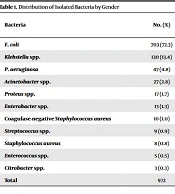
Results: In this study 553(8.7%) patients out of 7056 were shown to be urine culture positive (68% females and 32% males). The most isolated bacterium was E. coli with frequency rate of 59%. The other bacteria were Klebsiella spp. (11.6%), Enterobacter spp. (9.8%), Pseudomonas spp. (7.2 %), Proteus spp. (2.9%), Acinetobacter spp. (2.7%), Congolese positive Staphylococci (2.2%), Coagolase negative Staphylococci (2.3%), Citrobacter spp. (1.3%) and Streptococci α hemolytic (1.1%). All Gram-negative bacteria were more sensitive to amikacin (90.5-100%). The Gram-positive cocci isolated were more sensitive to tobramycin, kanamycin and ciprofloxacin (100%).
Conclusion: It is concluded that Gram-negative bacilli were responsible for UTI infections in our patients. The most common isolated bacteria from urinary tract infections were E. coli and the most effective antimicrobial agents were amikacin, tobramicin and ciprofleoxacin against Gram-negative bacilli and also the most effective antibiotics against Gram-positive cocci were kanamicin, tobramicin and ciprofleoxacin.
© 2009, Author(s). This open-access article is available under the Creative Commons Attribution 4.0 (CC BY 4.0) International License (https://creativecommons.org/licenses/by/4.0/), which allows for unrestricted use, distribution, and reproduction in any medium, provided that the original work is properly cited.
Mirzarazi M, Rezatofighi SE, Pourmahdi M, Mohajeri MR. Antibiotic Resistance of Isolated Gram Negative Bacteria From Urinary Tract Infections (UTIs) in Isfahan. Jundishapur J Microbiol. 2013;6(8):e6883. doi: https://doi.org/10.5812/jjm.6883
Mostafavi Esfahani SN, Rostami S, Shafiei AH. The Causative Agents and Antibiotic Susceptibility Patterns of Healthcare-Associated Urinary Tract Infections (HAUTIs) in Isfahan, Iran: The Impact on Empiric Therapy. Nephro-Urol Mon. 2023;15(4):e140033. doi: https://doi.org/10.5812/numonthly-140033
Noori M, Aghamohammad S, Ashrafian F, Gholami M, Dabiri H, et al. A Retrospective Cross-sectional Study on Prevalence and Susceptibility Pattern of Bacterial Pathogens Causing Urinary Tract Infections at a Teaching Hospital in Tehran, Iran. Arch Pediatr Infect Dis. 2023;11(2):e120903. doi: https://doi.org/10.5812/pedinfect-120903
Tajvidi N, Mahbod SA, Hosseini Shokoh SJ, Naseh I, Tajvidi MA. In-vitro Resistance Pattern of Escherichia coli Isolated from Patients with Urinary Tract Infection in Tehran. Ann Mil Health Sci Res. 2013;11(4):e64659. doi:
Keyhan H, Sedighi S, Mashayekhi B, Fathi M, Mokhtari M. Community Acquired Urinary Tract Infections’ Etiological Organisms and Antibiotics Susceptibility Patterns. Nephro-Urol Mon. 2017;9(5):e62146. doi: https://doi.org/10.5812/numonthly.62146
More by these authors
Last Update: 3 weeks ago
Last Update: 3 weeks ago
Last Update: 3 weeks ago
Last Update: 5 hours ago
Last Update: 1 day ago
Last Update: 4 days ago