
1. Background
The genus Eucalyptus (Myrtaceae) comprises aromatic woody species whose leaves are rich in volatile terpenoid compounds. Eucalyptus camaldulensis Dehnh. is widely distributed in arid and semiarid regions. Eucalyptus camaldulensis essential oil (ECEO) is recognized for its chemical diversity (1). The oil is commonly dominated by monoterpenes and oxygenated monoterpenes, particularly 1,8-cineole, although its chemical profile can vary considerably according to geographical origin and environmental conditions (2, 3). This variability may influence the oil’s biological properties, including its antimicrobial activity. Recent evidence has demonstrated the antimicrobial potential of ECEOs against a range of bacterial and fungal microorganisms and has highlighted substantial variation in their chemical composition across growing conditions and geographical origins (2, 4).
Several constituents of ECEO have been associated with important biological activities. The compound 1,8-cineole (eucalyptol), the major oxygenated monoterpene in many Eucalyptus oils, has been reported to possess antimicrobial, anti-inflammatory, and antioxidant properties (5). Monoterpenes such as α-pinene also contribute to the biological effects of essential oils through membrane disruption and interference with microbial metabolism (6). In addition, sesquiterpenes, including aromadendrene, spathulenol, and globulol, have demonstrated antimicrobial and other bioactive properties (7, 8). These findings suggest that the biological activity of Eucalyptus essential oils may reflect the contributions of multiple phytochemicals, although the relative contributions and possible interactions of individual constituents may vary among oils. Accordingly, determining the phytochemical profiles of ECEOs is crucial for elucidating their biological properties and assessing their potential use as natural antibacterial agents.
2. Objectives
Although E. camaldulensis is widely cultivated in Khuzestan Province, information on the chemical composition and antibacterial potential of its essential oils from different locations remains limited. To address this gap, this study compared ECEOs obtained from four locations in the province—Ahvaz, Abadan, Dezful, and Bostan—with respect to essential-oil yield, chemical profiles, and antibacterial activity. This comparative approach aimed to characterize differences among the four analyzed location-specific composite samples and explore their association with differences in antibacterial activity.
3. Methods
3.1. Plant Material
Mature, healthy, pest-free leaves of Eucalyptus camaldulensis were collected from four geographical locations in Khuzestan Province, Iran (Ahvaz, Dezful, Bostan, and Abadan), between 20 February and 2 March 2024. Three mature E. camaldulensis trees were selected at each location. Leaves from the three trees at each location were pooled to obtain a composite sample representing that location. Thus, each location was represented by one composite biological sample, and the three sampled trees were not considered independent biological replicates. The leaves were shade-dried at room temperature under well-ventilated conditions and protected from direct sunlight. The dried material was stored in airtight containers until further analysis. The plant material was taxonomically identified and authenticated by the Biology Department, Shahid Chamran University of Ahvaz.
3.2. Extraction of Eucalyptus Camaldulensis Essential Oils
The ECEOs were obtained by hydrodistilling 100 g of dried leaf material from each sample with 3 L of distilled water in a Clevenger-type apparatus for 3 h. After extraction, the ECEOs were separated from the distillate, treated with anhydrous Na2SO4, and weighed to calculate the extraction yield. The oils were then transferred to sealed amber glass vials and stored at 4 °C until subsequent analyses. Essential-oil extraction was performed independently three times for each composite sample. These three extractions represented independent extraction replicates from the same pooled plant material and were not considered independent biological replicates. The same extraction procedure, plant-to-water ratio, and handling conditions were applied to all samples to minimize methodological variation among locations.
3.3. Gas Chromatography–mass Spectrometry Analysis
The phytochemical profiles of ECEOs obtained from leaves collected in Abadan, Ahvaz, Dezful, and Bostan were analyzed by gas chromatography–mass spectrometry (GC–MS). Chemical profiling was performed using an Agilent 7890A GC system with a Triple-Axis Detector (Agilent Technologies, USA) and an Rtx-5MS capillary column (30 m × 0.25 mm internal diameter, 0.25 μm film thickness, stationary phase comprising 5% diphenyl and 95% dimethylpolysiloxane). Helium was used as the carrier gas at a flow rate of 1 mL/min. The oven temperature was programmed from 40 to 270 °C at a rate of 3 °C/min. The injection-port and ion-source temperatures were maintained at 250 °C and 230 °C, respectively. A 0.2 µL aliquot of each ECEO was injected in split mode at a reported split ratio of 100. The mass spectrometer was operated in electron ionization mode at 70 eV, with a mass acquisition range of m/z 30 - 350. Each ECEO was analyzed in a single GC–MS run. The acquired data were processed using Agilent MSD ChemStation software (Rev. E.02.02.1413). The detected compounds were tentatively identified by comparing their mass spectra with reference spectra in the National Institute of Standards and Technology (NIST) mass spectral library. Only compounds with spectral matching values greater than 95% were considered for tentative assignment (9). The relative abundance of each identified compound was calculated from its relative chromatographic peak area. Retention indices were not experimentally determined in this study.
3.4. Antibacterial Activity
The antibacterial activities of ECEOs obtained from Abadan, Ahvaz, Dezful, and Bostan were evaluated against Escherichia coli ATCC 25922 and Staphylococcus aureus ATCC 25923. The assays were performed in sterile tubes using a broth dilution procedure. Antibacterial efficacy was characterized by determining the minimum inhibitory concentrations (MICs) and minimum bactericidal concentrations (MBCs) in a liquid culture system, following a previously reported procedure (9). Each ECEO was serially diluted twofold in Mueller–Hinton broth (MHB) containing 0.5% (v/v) Tween 80 as an emulsifying agent to obtain concentrations ranging from 3.90 to 250 µL/mL. Bacterial suspensions were adjusted to a 0.5 McFarland standard, and the final bacterial inoculum in the assay was 5 × 10⁵ colony-forming units (CFU)/mL. A bacterial growth control without ECEO was included, and the effect of Tween 80 at the concentration used in the assay was evaluated separately; no inhibitory effect was observed. Essential-oil blanks containing the corresponding ECEO concentrations in MHB with 0.5% (v/v) Tween 80, but without bacterial inoculum, were also included to account for turbidity originating from the essential oils and distinguish it from bacterial growth.
The tubes were incubated at 37 °C for 24 h and kept on a shaker throughout incubation to facilitate continuous mixing. The MIC was defined as the lowest ECEO concentration that prevented visible bacterial growth compared with the corresponding essential-oil blank. No visible phase separation was observed during the assay. To determine the MBC, aliquots from tubes showing no visible growth were transferred to Mueller–Hinton agar and incubated under the same conditions. The MBC was defined as the lowest ECEO concentration that completely prevented bacterial colony formation. The exact procedure used to prepare the essential-oil stock solutions, the individual volumes of essential oil, broth, and bacterial inoculum, and the final assay volume could not be retrieved from the original experimental records. These parameters are therefore not reported and were not estimated retrospectively. A reference antibiotic was not included as a positive control in the original experiments. The MIC and MBC determinations were performed in three independent experiments. The final MIC and MBC values reported in Table 1 represent the medians of the three independent experimental determinations presented in Table S2 in the Supplementary File.
Table 1.
Antibacterial Effects of the Four Analyzed Eucalyptus camaldulensis Essential-Oil Composite Samples from Khuzestan Province a
| Essential Oil Samples and Test Microorganisms | MIC (µL/mL) | MBC (µL/mL) |
|---|---|---|
| Dezful | ||
| Escherichia coli | 15.62 | 125 |
| Staphylococcus aureus | 125 | 250 |
| Abadan | ||
| Escherichia coli | 7.81 | 31.25 |
| Staphylococcus aureus | 31.25 | 125 |
| Bostan | ||
| Escherichia coli | 31.25 | 125 |
| Staphylococcus aureus | 31.25 | 125 |
| Ahvaz | ||
| Escherichia coli | 62.50 | 250 |
| Staphylococcus aureus | 62.50 | 250 |
a Minimum inhibitory concentration (MIC) represents the lowest concentration of essential oil that completely inhibited visible bacterial growth. Minimum bactericidal concentration (MBC) represents the lowest concentration that resulted in no bacterial growth upon subculture. The final MIC and MBC values reported in Table 1 are the medians of the endpoint concentrations determined in three independent experiments. Individual endpoint values from the three experiments are provided in Table S2 in the Supplementary File.
3.5. Statistical Analysis
Essential-oil yields are expressed as the mean ± standard deviation (SD) of three independent extraction replicates from the same composite sample (n = 3). Because each location was represented by a single composite sample, no inferential statistical comparison among locations was performed; yield differences were therefore interpreted descriptively. Chemical-composition data were also evaluated descriptively without inferential statistical analysis because each location was represented by one composite sample and each ECEO was analyzed by GC–MS in a single analytical run. MIC and MBC values were determined in three independent experiments and are reported as endpoint concentrations; no statistical comparison was performed for these measurements.
4. Results
4.1. Composition of Eucalyptus Camaldulensis Essential Oils
Dried E. camaldulensis leaves were used as the starting material for essential-oil isolation. The ECEOs were recovered by hydrodistillation in a Clevenger-type apparatus using 100 g of leaves and 3 L of distilled water for each sample under standardized operating conditions. Essential-oil yields varied among the four analyzed location-specific composite samples. The highest mean yield was obtained from the Dezful sample (2.10 ± 0.10%), followed by Ahvaz (1.87 ± 0.12%), Bostan (1.53 ± 0.06%), and Abadan (1.23 ± 0.06%). The phytochemical constituents of ECEOs obtained from Ahvaz, Dezful, Bostan, and Abadan were analyzed by GC–MS, and the identified constituents are presented in Table 2. All compound assignments were considered tentative and were based on mass-spectral comparison with the NIST library (spectral matching > 95%), without confirmation using authentic standards or experimentally determined retention indices. To focus on the predominant constituents, only compounds accounting for ≥ 1% of the total relative chromatographic area in at least one sample are presented. Based on their structural characteristics, the detected constituents were classified into four categories: monoterpene hydrocarbons, oxygenated monoterpenes, sesquiterpene hydrocarbons, and oxygenated sesquiterpenes. Figure 1 illustrates the molecular structures of the principal phytochemical compounds detected in the ECEOs.
Table 2.
Major Phytochemicals (>1%) of the Four Analyzed Eucalyptus camaldulensis Essential-Oil Composite Samples from Khuzestan Province, Iran a
| Compound | Molecular formula | Ahvaz | Dezful | Bostan | Abadan | Literature RI b |
|---|---|---|---|---|---|---|
| Monoterpene hydrocarbons | ||||||
| α-Pinene | C10H16 | 4.01 | 12.33 | 12.44 | 6.85 | 936 |
| p-Cymene | C10H14 | 3.50 | 1.77 | ND | ND | 1024 |
| Limonene | C10H16 | 3.60 | ND | ND | ND | 1030 |
| γ-Terpinene | C10H16 | ND | 1.95 | ND | ND | 1060 |
| α-Terpinolene | C10H16 | ND | 1.55 | 1.11 | ND | 1087 |
| 1,3,8-o-Menthatriene | C10H16 | ND | ND | ND | 2.12 | 1112 |
| Oxygenated monoterpenes | ||||||
| 1,8-Cineole | C10H18O | 36.30 | 38.43 | 32.53 | 29.53 | 1022 |
| Pinocarveol | C10H16O | 1.20 | 2.11 | 3.84 | 5.43 | 1661 |
| Terpinen-4-ol | C10H18O | ND | 2.67 | ND | ND | 1177 |
| p-Mentha-1 (7),8-dien-2-ol (isomer 1) | C10H16O | ND | 1.36 | 1.25 | ND | 1233 |
| p-Mentha-1 (7),8-dien-2-ol (isomer 2) | C10H16O | ND | ND | 1.22 | 2.21 | 1181 |
| α-Terpineol | C10H18O | 1.01 | 1.57 | ND | ND | 1190 |
| Sesquiterpene hydrocarbons | ||||||
| Aromadendrene | C15H24 | 11.85 | 6.05 | 7.27 | 12.41 | 1441 |
| α-Gurjunene | C15H24 | ND | ND | 1.18 | ND | 1409 |
| Ledene | C15H24 | ND | ND | 1.25 | 1.86 | 1492 |
| Germacrene B | C15H24 | ND | ND | ND | 1.03 | 1551 |
| β-Selinene | C15H24 | 1.43 | ND | ND | ND | 1486 |
| β-Humulene | C15H24 | ND | 4.40 | 3.69 | 15.81 | 1443 |
| Oxygenated sesquiterpenes | ||||||
| Epiglobulol | C15H26O | 1.25 | 1.23 | 1.76 | ND | 1585 |
| Spathulenol | C15H24O | 8.01 | 1.71 | 2.33 | ND | 1576 |
| Globulol | C15H26O | 8.88 | 5.55 | 6.68 | 6.72 | 1582 |
| Viridiflorol | C15H26O | 1.46 | 1.34 | 1.53 | ND | 1591 |
| Total identified compounds (%) | 82.15 | 84.02 | 77.96 | 83.56 |
a Values are expressed as percentage. Total identified compounds (%) represents the sum of the relative percentages of all compounds identified in each essential oil. Abbreviation: ND, not detected.
b Literature retention index (RI) values are provided for comparison only and were not experimentally determined in this study. Values correspond to retention indices reported for dimethylsilicone stationary phases containing 5% phenyl groups (DIMS5P) under temperature-programmed gas chromatography conditions, as compiled by Babushok et al. (10).
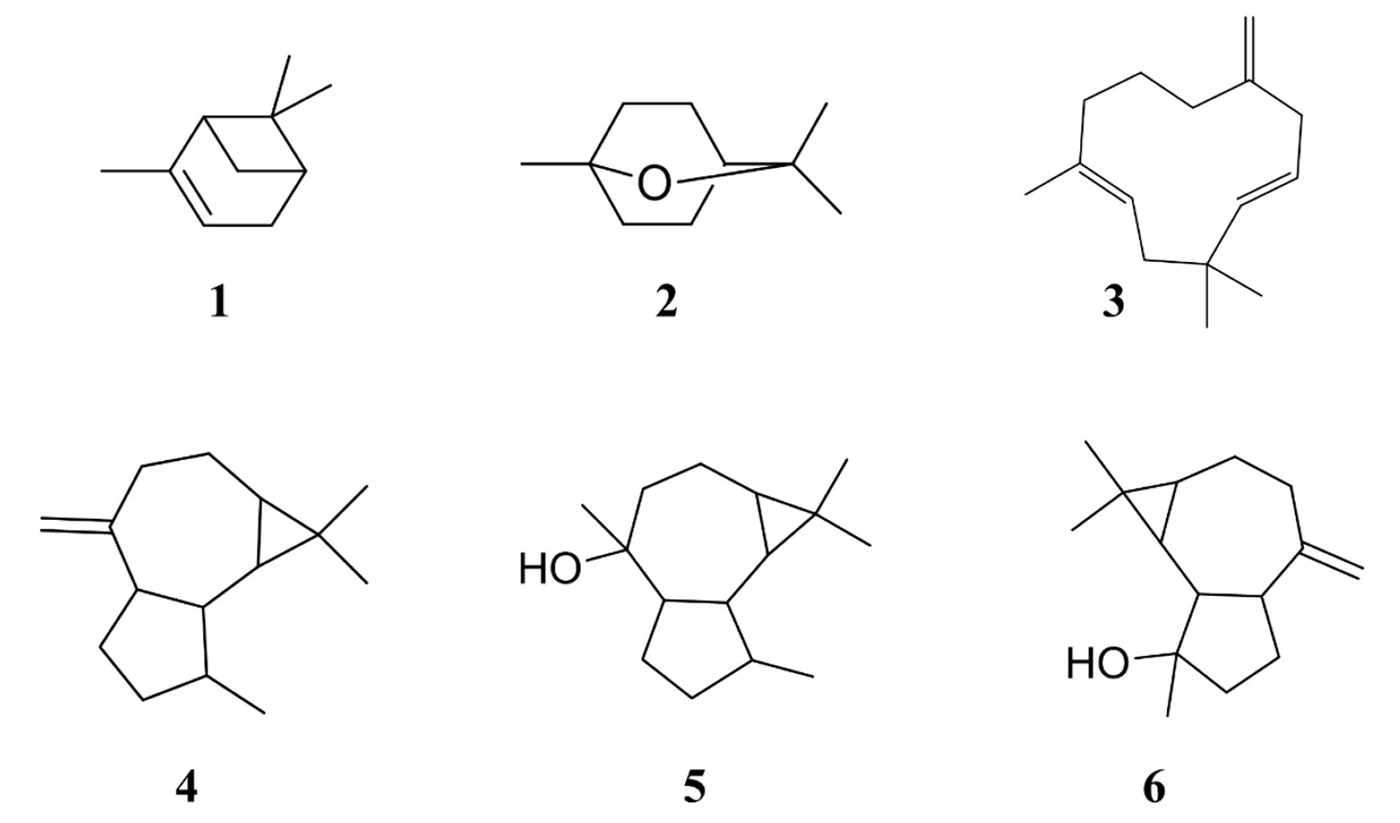
Figure 1.
Chemical structures of the major phytochemicals identified in the Eucalyptus camaldulensis essential oils (ECEOs) from Ahvaz, Dezful, Bostan, and Abadan, Khuzestan Province, Iran. Structures: 1) α-pinene, 2) 1,8-cineole, 3) β-humulene, 4) aromadendrene, 5) globulol, and 6) spathulenol.
The phytochemical profiles of the four ECEOs shared several constituents but also showed clear differences in the occurrence and relative abundance of individual compounds. The predominant compound in all four samples was 1,8-cineole. α-Pinene was also present in all ECEOs, although its relative abundance varied among collection sites. Similarly, pinocarveol was detected in all samples, whereas aromadendrene and globulol were common sesquiterpene constituents across the studied locations. In contrast, several monoterpene hydrocarbons, including γ-terpinene, α-terpinolene, and 1,3,8-o-menthatriene, were detected only in specific samples. The oxygenated monoterpene fraction also differed among the four analyzed samples, with several p-menthadien-2-ol derivatives occurring in only one or two ECEOs.
The sesquiterpene hydrocarbon fraction showed notable differences among samples. Aromadendrene was detected in all four ECEOs, whereas α-gurjunene, ledene, germacrene B, and β-selinene were restricted to one or two locations. β-Humulene was detected in ECEOs from Dezful, Bostan, and Abadan but not in the Ahvaz sample. Among the oxygenated sesquiterpenes, globulol was present in all four ECEOs, whereas spathulenol, epiglobulol, and viridiflorol were detected in three of the four samples. Overall, GC–MS analysis demonstrated both shared and sample-specific constituents among the four analyzed ECEOs.
4.2. Antibacterial Activity of Eucalyptus Camaldulensis Essential Oils
The antibacterial activities of ECEOs collected from Ahvaz, Dezful, Bostan, and Abadan were evaluated against Escherichia coli and Staphylococcus aureus by determining their MICs and MBCs (Table 1). These species were selected as representative Gram-negative and Gram-positive bacteria, respectively, to provide an initial comparison of ECEO activity against bacteria with distinct cell-envelope characteristics. All four ECEOs exhibited inhibitory and bactericidal activity against both bacterial strains, although the magnitude of activity varied with the ECEO sample and bacterial species.
Against E. coli, the Abadan ECEO showed the lowest observed MIC and MBC values among the four analyzed samples, whereas the Ahvaz ECEO showed the highest observed values. The Dezful and Bostan ECEOs showed intermediate observed endpoint values. Against S. aureus, the ECEOs from Abadan and Bostan showed the lowest observed MIC and MBC values among the four analyzed samples, whereas the Dezful ECEO showed the highest observed values. The Ahvaz ECEO showed intermediate observed endpoint values. These comparisons are descriptive, as no statistical comparisons were performed for the endpoint MIC and MBC values. Overall, the results demonstrate differences in antibacterial activity among the analyzed ECEOs and between the two bacterial strains tested.
5. Discussion
5.1. Phytochemical Profiles of Eucalyptus Camaldulensis Essential Oils
The chemical profiles obtained in this study are consistent with the characteristic terpene-rich nature of ECEOs and demonstrate clear chemical variation among samples collected from different locations in Khuzestan Province. The predominance of 1,8-cineole in all four ECEOs is consistent with the well-established cineole-rich chemotype of E. camaldulensis (11). However, considerable variation in the relative abundance of other major constituents, including α-pinene, aromadendrene, β-humulene, spathulenol, and globulol, indicates that the oils cannot be considered chemically identical, despite their shared plant species and geographical proximity. Such compositional variability among Eucalyptus essential oils has been associated with genetic background, geographical origin, and environmental conditions, including climate and other site-specific factors. Recent studies have similarly highlighted substantial chemodiversity among Eucalyptus essential oils and the potential for their volatile profiles to distinguish samples by geographical or varietal origin (12, 13).
Differences among the Khuzestan samples were particularly evident in the sesquiterpene fraction. Although aromadendrene and globulol were common constituents of all four oils, the occurrence and abundance of other sesquiterpenes varied markedly among locations. The relatively high contribution of β-humulene in the Abadan sample and the greater representation of spathulenol in the Ahvaz oil further emphasize the chemical differentiation among samples. Similar compositional polymorphism has been reported for ECEOs from different geographical origins, with substantial variation in the relative proportions of 1,8-cineole, α-pinene, p-cymene, aromadendrene, spathulenol, and globulol. Thus, the present findings demonstrate chemical differences among the analyzed ECEOs collected from different locations, although the contribution of geographical origin itself cannot be separated from other environmental and biological factors in this sampling design (2, 14).
Nevertheless, several limitations should be considered when interpreting these findings. Although three trees were sampled at each geographical location, leaves from those trees were pooled before essential-oil extraction. Consequently, tree-to-tree biological variability within each location could not be assessed independently. The observed differences should therefore be interpreted as location-associated variation among the analyzed composite samples rather than as definitive evidence of geographical effects at the population level. Further studies involving independent biological samples from multiple trees at each location are needed to assess within-location variability and determine the reproducibility of the observed geographical patterns. Overall, the predominance of 1,8-cineole, combined with variation in the accompanying mono- and sesquiterpene constituents, suggests that ECEOs from Khuzestan have a common chemical core but distinct location-associated chemical signatures.
The chemical variation observed among the four analyzed ECEOs is broadly consistent with previous reports describing geographical and environmental influences on essential-oil composition. Barra et al. (15) reported considerable chemical variability among ECEOs collected from different localities in Sardinia, while another study comparing samples from four geographical regions of Turkey also demonstrated qualitative and quantitative differences in their volatile profiles (16). In addition, a comparison of E. camaldulensis plants growing under saline and non-saline conditions revealed significant differences in the relative proportions of several essential-oil constituents, despite similar oil yields. These findings support the view that geographical origin and local environmental conditions may contribute to distinct chemical profiles in ECEOs (17).
5.2. Antibacterial Activity of Eucalyptus Camaldulensis Essential Oils
The results of this study demonstrated that ECEOs exhibited antibacterial activity against both S. aureus and E. coli, although the magnitude of activity varied considerably among the analyzed samples. The Abadan ECEO showed the lowest observed MIC and MBC values against E. coli, whereas the Ahvaz ECEO showed the highest observed MIC and MBC values against E. coli and comparatively high values against S. aureus. Such variation in the antibacterial activity of Eucalyptus essential oils has been reported previously and may be associated with differences in geographical origin, plant material, extraction conditions, chemical composition, and the relative proportions of individual constituents (18). In this study, MIC values ranged from 7.81 to 62.5 µL/mL for E. coli and from 31.25 to 125 µL/mL for S. aureus, while the corresponding MBC values ranged from 31.25 to 250 µL/mL and from 125 to 250 µL/mL, respectively.
Previous research on E. camaldulensis essential oil has reported antibacterial activity against both gram-positive and gram-negative bacteria, although the reported MIC and MBC values differ from those obtained in this study (19). Ostad Asiaei et al. reported MIC and MBC values of 0.15% and 0.25%, respectively, against E. coli, and 0.10% and 0.20%, respectively, against S. aureus. These values correspond approximately to 1.5 and 2.5 µL/mL for E. coli and 1.0 and 2.0 µL/mL for S. aureus, respectively. Thus, the MIC and MBC values reported by Ostad Asiaei et al. were lower than those observed in this study. However, this difference should be interpreted cautiously because the studies differed in bacterial strains, inoculum conditions, essential-oil preparation, concentration expression, and susceptibility-testing methodology. In particular, Ostad Asiaei et al. used a macrodilution procedure, whereas this study used a different MIC/MBC testing procedure (19).
More recently, Sataie-Mokhtari et al. reported an MIC below 8.7 µg/mL for E. camaldulensis essential oil against S. aureus using a tube-dilution method. Although this finding further supports the antibacterial potential of E. camaldulensis essential oil, direct numerical comparison with the present results is difficult because of differences in bacterial strain, essential-oil source and preparation, concentration units, inoculum conditions, and the method used to determine MIC (20). Taken together, the available evidence indicates that MIC and MBC values for Eucalyptus essential oils can vary substantially among studies, emphasizing the need to consider methodological conditions when comparing antibacterial efficacy.
Differences in antibacterial activity among the four oils may be associated with variations in the relative proportions of their constituents. Although 1,8-cineole was the predominant compound in all samples, its abundance alone did not consistently correspond to the antibacterial efficacy of the tested essential oils. For example, the Abadan oil, which showed the lowest observed MIC and MBC values against E. coli, contained a comparatively lower proportion of 1,8-cineole but higher levels of several other constituents, particularly aromadendrene, β-humulene, and pinocarveol. This compositional difference may contribute to the observed variation in antibacterial activity; however, a direct contribution of individual constituents cannot be established from these data. Previous studies have reported antibacterial activity for individual constituents of Eucalyptus essential oils and suggested that interactions among terpenoid constituents may influence the biological activity of complete essential oils (7, 21). However, the antibacterial activity of individual constituents and potential synergistic or antagonistic interactions among them were not directly evaluated in this study. The observed differences in antibacterial activity should therefore be interpreted as associations with differences in overall chemical profiles rather than as evidence of specific compound-level or synergistic effects.
The different responses of E. coli and S. aureus to the ECEOs further indicate that antibacterial activity was microorganism-dependent. The greater susceptibility of E. coli to the Abadan and Dezful oils, compared with S. aureus, suggests that the specific chemical composition of these oils may differentially affect the two bacterial species. However, the Bostan oil had identical reported MIC and MBC endpoints against the two organisms. These patterns highlight the complexity of the interaction between essential-oil constituents and bacterial cell structures. Overall, the present results indicate that differences in the phytochemical profiles of the analyzed ECEOs were accompanied by differences in antibacterial activity. The distinct chemical profiles of the four ECEOs may therefore be associated with the observed variation in MIC and MBC values, although the contributions of individual constituents and possible interactions among them were not directly investigated. These findings highlight the importance of considering the characteristics of individual essential-oil samples and the target microorganism when assessing the antibacterial potential of Eucalyptus essential oils.
5.3. Study Limitations
Several limitations should be considered when interpreting these findings. Environmental and biological factors, including tree genotype and age, soil characteristics, irrigation, salinity, microclimate, and phenological stage, were not controlled or comprehensively characterized. In addition, each location was represented by a single composite sample, and temporal variation within the sampling period may also have contributed to the observed differences. Differences among the four analyzed composite samples should therefore be interpreted as location-associated variation under their respective local conditions rather than as evidence of a direct effect of geographical origin alone. The reproducibility of these observations across additional populations and collection periods remains to be established.
The GC–MS compound assignments were tentative because they were based on NIST library matching without confirmation using experimental retention indices or authentic reference standards, and each essential-oil sample was analyzed in a single GC–MS run. Therefore, potential misassignment of structurally related compounds, particularly terpenoids, and analytical variability in the chromatographic profiles cannot be excluded. Some procedural details of the antibacterial assay, including the exact stock-solution preparation, inoculum/aliquot volumes, and final assay volume, could not be retrieved, which limits the exact independent reproduction of the assay. A reference antibiotic was not included as a positive control, limiting direct comparison of the antibacterial activity of the essential oils with that of a standard antimicrobial agent.
Furthermore, compound-specific antibacterial activity, synergistic interactions, safety, formulation feasibility, and in vivo efficacy were not evaluated. Associations between chemical composition and antibacterial activity are descriptive and should not be interpreted as causal relationships, because no statistical correlation analysis or bioactivity-guided fractionation was performed. The findings should therefore be considered preliminary and specific to the samples and experimental conditions examined.
5.4. Conclusions
The four Eucalyptus camaldulensis essential-oil composite samples examined in this study showed location-associated differences in essential-oil yield, chemical composition, and antibacterial activity against E. coli and S. aureus. The Abadan ECEO showed the lowest observed MIC and MBC values against E. coli under the experimental conditions, whereas the Ahvaz ECEO showed comparatively higher endpoint values. These findings indicate that variation among the examined ECEOs may be accompanied by differences in their chemical profiles and antibacterial properties. However, the contributions of individual constituents, potential synergistic interactions, and the relative effects of environmental and genetic factors were not directly evaluated. The observed antibacterial activity should therefore be considered an in vitro finding specific to the four samples examined. The more active oils may warrant further investigation as potential sources of natural antibacterial compounds, but additional studies using independent biological samples from multiple trees and locations are required to determine the reproducibility of these observations and assess the contribution of geographical and environmental factors.
Abbreviations: ECEO, Eucalyptus camaldulensis essential oil.