1. Background
In recent decades, there has been a great deal of scientific interest in the use of essential oils and plant extracts due to their natural antioxidants and biologically potent metabolites. The European Union countries enormously use essential oils in food industry (as flavors and preservatives), perfumes (fragrances), and pharmaceuticals (for their functional properties) (1). The genus Scrophularia is one of the largest genera of the Scrophulariaceae family, comprising about 300 species (2), mostly represented by perennial herbs, distributed in the Central Europe, Asia, North America, and northern hemisphere, especially in the Mediterranean area (3). In Iran, 42 species are reported; 19 of them are considered as endemic taxa (2, 3). Among them, S. frigida, with its Persian name “Gole Meimoonye Yakhchaali”, is a perennial herb with erect glabrous square stems up to 80 cm. leaves are opposite, rarely upper leaves alternate, glabrous and ovate or ovate-lanceolate, highest ones angust linear; inflorescences are cyme-raceme with open two-lipped flowers (4). Various biological compounds such as phenolic acids, iridoids, phenylpropanoids, flavonoids, saponins, and terpenoids have been isolated from this genus (5-10). These compounds possess anti-inflammatory, antibacterial, immunomodulatory, cardiovascular, diuretic, molluscicidal, cytotoxic, and antitumor properties (11-15). In traditional Chinese medicine, extract of S. ningpoensis Hemsl has been used in the treatment of fever, constipation, pharyngitis, and neuritis (16). Although there are several species of Scrophularia growing in different parts of Iran, few studies have been conducted on the chemical composition of its essential oil (17-20).
2. Objectives
To the best of our knowledge, there is no previous report about chemical composition of essential oil of S. frigida. Therefore, the first aim of this study was to elucidate the composition of this plant essential oil using a combination of GC-FID and GC-MS, and the second aim was to determine seasonal variations (summer vs. autumn) in the composition of its essential oil.
3. Materials and Methods
3.1. Plant Material
Aerial parts of S. frigida were collected from Misho-dagh Mountain near Marand City (Yam) in East Azerbaijan province, Iran, during different seasons (June and October). The collected parts of S. frigida were transferred to Herbarium of Faculty of Pharmacy, Tabriz University of Medical Sciences, Iran, and botanically confirmed by herbalist. Voucher specimens have been deposited with the Herbarium under accession code TBZ-Fph-746.
3.2. Isolation of Essential Oil
The air-dried aerial parts of S. frigida (100 g) were cut into small pieces and submitted to hydro-distillation for 4 hours in a clevenger apparatus using hexane (2 mL) as collector solvent. The pale yellow-colored essential oil were dried (under Na2SO4) and stored in sealed vials. The oil yield (0.06% w/w for summer oil and 0.04% w/w for autumn oil) was estimated on the dry-weight basis.
3.3. GC-MS Analysis
About 1µL of volatile oil/hexane solution was injected into GC-MS analyzer using a Shimadzu capillary GCMS-QP 5050A gas chromatograph mass spectrometer, and DB1 capillary column (60 m x 0.25 mm, I.D., film thickness 0.25 µm) using He as carrier gas with flow rate 1mL/min along with split ratio of 1.29, which was equipped with flame ionization detector (FID). Condition of GC was as follows: The range of column temperature started at 60°C for 5 minutes then maintained at 60°C, -230°C for 20 minutes, finally holding 3 minutes at 280°C. Injector and detector temperature was 220°C and 230°C, respectively. Moreover, all mass spectra were recorded in electron-impact mode with an ionization voltage of 70 eV. Ion source temperature and quadrupole were 270°C and 100°C, respectively. Other parameters were considered as: solvent delay 2 minutes; scan speed 2000 amu/s; scan range 30 - 600 amu, and eV voltage 3000 V.
3.4. Identification of Compounds
The identification of volatile aroma compounds was based on the Kovats indices (KI) on DB1 column which was calculated with reference to homologues series of n-alkans C8 - C20. Also the peak identification was confirmed by computer matching with the Wiley 229, NIST107 along with other published fragmentation patterns of the mass spectra (20). Furthermore, FID response was applied for determining the relative amounts of each constituent, without using correction factors.
4. Results
Two samples of the aerial parts of S. frigida were collected during summer and autumn (June and October 2013) from plants in one site. The chemical composition of the essential oils collected in the two seasons was qualitatively and quantitatively investigated by GC-MS and GC-FID, respectively. The oil content in S. frigida during summer (600 mg/kg) was relatively higher than the sample collected during autumn (400 mg/kg). The composition of the essential oils, the percentage of individual constituents and the Kovats indexes are presented in the Table 1. In total, 20 and 18 compounds were identified and quantified in the oils of autumn and summer accounting for 94.77% and 97.24% of the oils amount, respectively. The data for the current study demonstrated that the contents of the essential oils were varied remarkably with regard to seasonal changes.
Table 1.
The Chemical Composition of S. frigida Essential Oil During Two Different Seasons
| Compound a | KI | Summer, % | Autumn, % | Identification Method b |
|---|---|---|---|---|
| Tropilidin | 785 | NA | 1.26 | GC/MS, Ib |
| 1-Methylcyclopentanol | 951 | NA | 1.72 | GC/MS, Ib |
| 1-Octen-3-ol | 963 | 7.27 | 0.7 | GC/MS, Is |
| n-Nonaldehyde | 1083 | 1.95 | 0.55 | GC/MS, Is |
| L-linalool | 1086 | 38.69 | 11.41 | GC/MS, Is |
| α-Terpineol | 1174 | 9.99 | NA | GC/MS, Is |
| Linalyl propionate | 1176 | NA | 4.62 | GC/MS, Is |
| Decanal | 1185 | 0.77 | NA | GC/MS, Is |
| Nerol | 1210 | 3.49 | 6.46 | GC/MS, Is |
| E-Geraniol | 1235 | 11.20 | NA | GC/MS, Is |
| E-2-decenal | 1238 | 0.54 | NA | GC/MS, Is |
| β-Hydroxylauric acid | 1252 | 1.00 | NA | GC/MS, Is |
| Carvacrol | 1278 | 4.23 | NA | GC/MS, Is |
| Damascenone | 1364 | 1.72 | 1.06 | GC/MS, Is |
| Spathulenol | 1371 | 1.10 | 0.6 | GC/MS, Is |
| β-Copaen-4 -α-ol | 1374 | NA | 1.64 | GC/MS, Is |
| E-β-Ionone | 1466 | 0.92 | NA | GC/MS, Is |
| E-Nerolidol | 1549 | 2.01 | 2.38 | GC/MS, Is |
| Octadecanal | 1696 | 0.54 | NA | GC/MS, Is |
| Myristic acid | 1741 | NA | 1.26 | GC/MS, Is |
| Farnesyl acetate | 1817 | NA | 1.3 | GC/MS, Is |
| Hexahydrofarnesyl acetone | 1831 | 1.85 | 6.65 | GC/MS, Is |
| N-Hexadecanoic acid | 1943 | 7.32 | 30.49 | GC/MS, Is |
| Methyl 9,12,15-octadecatrienoate | 2085 | NA | 0.68 | GC/MS, Ib |
| Heneicosane | 2100 | NA | 3.36 | GC/MS, Ib |
| Oleic acid | 2116 | NA | 3.81 | GC/MS, Ib |
| Phytol | 2124 | 2.65 | 12.99 | GC/MS, Ib |
| Hexadecanal diallyl acetal | 2286 | NA | 1.83 | GC/MS, Ib |
| Total compounds | NA | 97.24 | 94.77 | |
| Non-terpenoid | NA | 22.57 | 59.29 | |
| Fatty acids derivatives | 8.32 | 42.69 | ||
| Ketones and aldehydes | 6.98 | 9.56 | ||
| Others | 7.27 | 7.04 | ||
| Terpenoids | NA | 74.67 | 35.48 | |
| Oxygenated monoterpenes | 68.91 | 17.87 | ||
| Oxygenated sesquiterpenes | 3.11 | 4.62 | ||
| Diterpenoids | 2.65 | 12.99 |
aCompounds listed in order of elution from a DB-1 column.
bIdentification method: Is = Kovats retention index according to authentic standard, Ib = Kovats retention index according to bibliography.
5. Discussion
As depicted in Figure 1, in the case of summer oil, monoterpens (68.91%) were represented mainly by oxygenated compounds such as alcohols with L-linalool (38.69%), geraniol (11.20%), and α-terpineol (9.99%), while the contents of fatty acid derivatives was rather low (8.32%). This finding is in line with the observations of Pasdaran et al. (17) and Amiri et al. (18) about essential oil of Scrophularia genus with the same harvesting season. Conversely, in the case of autumn oil, non-terpenoid compounds made up the higher contribution (59.29%) with fatty acids dominating (42.69%) while the content of monoterpenes was amounted to 17.87%. Fatty acids were represented mainly by n-hexadecanoic acid or palmitic acid (30.49%), and to a lesser extent, by oleic acid (3.81%) and myristic acid (1.26%) in autumn essential oil. The abundance of palmitic acid in S. frigida is consistent with that reported for other representatives of Scrophularia genus such as S. ningpoensis (19). This oil also contained high amount of diterpenes (12.99%), represented by (E)-phytol, in comparison with summer oil (2.65%) (Table 1 and Figure 1).
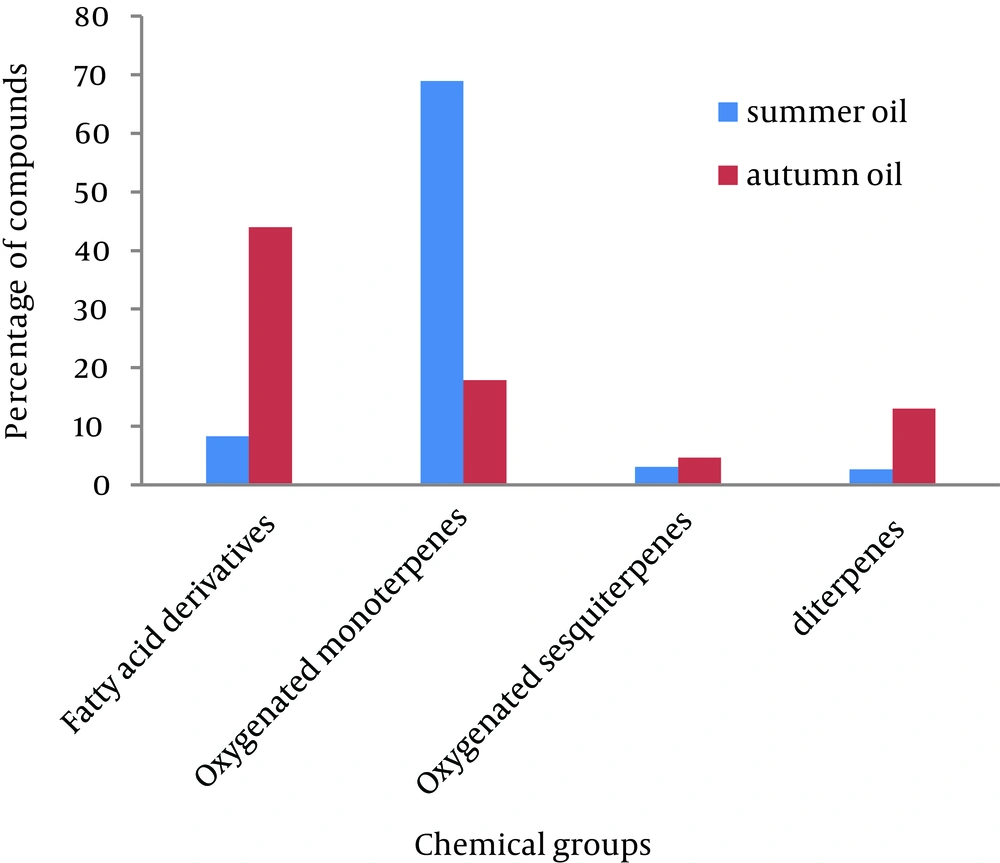
Figure 1.
Seasonal Variation in the Major Chemical Groups of S. frigida Essential Oils
Presence of phytol as one of the main components in autumn oil is in agreement with the findings of Pasdaran et al. about essential oil from aerial parts of S. oxycephala (20). However, the percentage of 1-octen-3-ol (0.7%) was quite lower in autumn oil compared with that of summer oil (7.2%). Previous studies exhibited that the presence of 1-octen-3-ol (an aliphatic alcohol) may be resulted from a simultaneous loss of water-soluble components and an increase in oxidation products during drying process (21). Conversely, hexahydrofarnesyl acetone (6, 10, 14-trimethyl-2-pentadecanone) was present at high level in autumn oil (6.65%) compared with that of summer oil (1.85%). These compounds were routinely seen in essential oils of other species of Scrophularia (17-20). The variations in the chemical composition of these essential oils may be attributed to climatic conditions, harvesting season, and developmental stage (22). In the light of above findings, there might be a reciprocal regulation between oxygenated monoterpenes and fatty acid derivatives. Various types of terpenes are involved in protection against photooxidative stress, attraction of pollinators, moderating thermotolerance, and direct protection against insects and microbes. Moreover, terpene metabolites are vital for plant growth and development and also interacting between plants and their environments (23-25). Therefore, the high amount of oxygenated monoterpenes in summer oil might have been due to these reasons. Our data confirm that environmental conditions and seasonal variations strongly impact on metabolism of monoterpenes. Notably, in our examined oils, no aromatic compounds were detected while the presence of these types of compounds such as eugenol, eugenol acetate, anethol, and so on is common in Scrophularia essential oils (17, 19, 20). In summary, the present study for the first time reported the chemical composition of the essential oils from aerial parts of S. frigida collected in different seasons. The result also indicated that the essential oil yield and composition is affected by intrinsic parameters such as developmental stages of the plant and extrinsic ones like temperature and humidity conditions.