
Full Text
Full text is available in PDF
Jundishapur Journal of Natural Pharmaceutical Products
The Official Journal of Ahvaz Jundishapur University of Medical Sciences
Authors
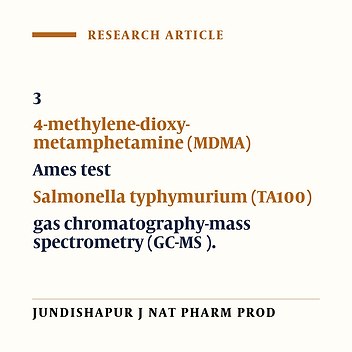
An increase in incidence of illegal use of tablets containing 3, 4-methylene dioxy- metamphetamine (MDMA), has recently become a widespread social problem. MDMA most commonly known today by the street name ecstasy (often abbreviated XTC), is a semi-synthetic member of the amphetamine class of psychoactive drugs. The aim of this study was to investigate the genotoxic effects of MDMA on the basis of the results of an in vitro Ames test. In the first step, a sensitive method of gas chromatography-mass spectrometry (GC-MS) was used for simultaneous quantitation of MDMA in the tablets. The Ames test uses one of the strains of the bacterium Salmonella typhymurium (TA100) that carries mutations in genes involved in histidine synthesis, so that it requires histidine for growth. The variable being tested is the mutagen's ability to cause a reversion, making bacteria grows on a histidine-free medium. When the cultures are exposed to a mutagen, in the absence and presence of a rat liver metabolizing system, some of the bacteria undergo genetic changes due to chemical interactions resulting in reversion of the bacteria to a non-histidine requiring state. The reverted bacteria will then grow in the absence of exogenous histidine. In this test, we used MDMA as a possible mutagen. No increase in bacteria growth in the histidine-free medium was observed. So, no MDMA genotoxicity was observed in this method.
© 2010, Author(s). This open-access article is available under the Creative Commons Attribution 4.0 (CC BY 4.0) International License (https://creativecommons.org/licenses/by/4.0/), which allows for unrestricted use, distribution, and reproduction in any medium, provided that the original work is properly cited.
Gholami S, Soleimani F, Hoseini Shirazi F, Touhidpour M, Mahmoudian M. Evaluation of Mutagenicity of Mebudipine, a New Calcium Channel Blocker. Iran J Pharm Res. 2010;9(1):e126038. doi: https://doi.org/10.22037/ijpr.2010.835
Rezaei M, Khodaei F, Sayah Bargard M, Abasinia M. Long-Term Methadone Intake and Genotoxicity in Addicted Patients. Jundishapur J Nat Pharm Prod. 2015;10(1):e17008. doi: https://doi.org/10.17795/jjnpp-17008
Jalali M, Moein E, kalantari-h H. IN VITRO EVALUATION OF MUTAGENIC EFFECT OF VITAGNUS AND SHIRAFZA IN HUMAN LEUKOCYTES BY SINGLE CELL GEL ELECTROPHORESIS. Jundishapur J Nat Pharm Prod. 2006;1(1):e74296. doi:
Jalali A, Hatamie A, Saferpour T, Khajeamiri A, Safa T, et al. Impact of Pharmaceutical Impurities in Ecstasy Tablets: Gas Chromatography-Mass Spectrometry Study. Iran J Pharm Res. 2016;15(1):e125096. doi: https://doi.org/10.22037/ijpr.2016.1824
Kalantari H, Rezaei M, Mahdavinia M, Jahangirnejad R, Varnaseri G. Determination of the Mutagenicity Potential of Sankol Herbal Medicine by Single Cell Gel Electrophoresis in Rat Hepatocytes in Comparison With H2O2. Jundishapur J Nat Pharm Prod. 2012;7(3):123-126. doi: https://doi.org/10.17795/jjnpp-5480
Last Update: 3 weeks ago
Last Update: 3 weeks ago
Last Update: 3 weeks ago
Last Update: 4 hours ago
Last Update: 1 day ago
Last Update: 4 days ago