Cover image of the article: Brain Serotonin 5-HT2α Receptor Density in Male Rats Can Be Affected by Bisphenol A and Passive Avoidance Learning

Image Credit:J Kermanshah Univ Med Sci

Brain Serotonin 5-HT2α Receptor Density in Male Rats Can Be Affected by Bisphenol A and Passive Avoidance Learning

Authors

Mahnaz TaherianfardMahnaz Taherianfard ORCID1,*, Soodeh RowhaniradSoodeh Rowhanirad ORCID1, Seyed Ali ArefkashfiSeyed Ali Arefkashfi ORCID1
1Shiraz University, Shiraz, Iran
*Corresponding Author: Shiraz University, Shiraz, Iran. Email: mtaherian2025@gmail.com

Journal of Kermanshah University of Medical Sciences:Vol. 30, issue 2; e173063
Published online:Jun 30, 2026
Article type:Research Article
Received:May 27, 2026
Accepted:Jun 15, 2026
How to Cite:Taherianfard M, Rowhanirad S, Arefkashfi SA. Brain Serotonin 5-HT2α Receptor Density in Male Rats Can Be Affected by Bisphenol A and Passive Avoidance Learning. J Kermanshah Univ Med Sci. 2026;30(2):e173063. doi: https://doi.org/10.5812/jkums-173063

Abstract

Background:

Bisphenol A (BPA) may adversely affect the nervous system.

Objectives:

This study aimed to assess the effects of passive avoidance learning on BPA-induced toxicity, as indicated by serotonin 5-HT2α receptor density in the cerebellum, basolateral amygdala, and hippocampus of male rats.

Methods:

Thirty male rats (200 - 220 g) were allocated to six experimental groups. BPA was administered orally for 15 consecutive days. Learning and memory performance were assessed using a passive avoidance shuttle-box paradigm. Serotonin 5-HT2α receptor density was evaluated by immunohistochemistry in the selected brain regions. Immunohistochemical labeling was quantified by measuring color parameters using image-analysis software.

Results:

BPA at both doses reduced 5-HT2α serotonin receptor density in the examined brain structures. Passive avoidance learning mitigated the toxic effects of BPA on 5-HT2α receptor density in these structures.

Conclusions:

Overall, BPA exposure downregulated 5-HT2α receptors in the hippocampus, amygdala, and cerebellum of male rats, whereas passive avoidance learning and memory were associated with an increased receptor density.

1. Background

Humans and other living organisms are substantially exposed to xenoestrogens (1). Xenoestrogens can act as exogenous agents and cause changes or disturbances in the synthesis, secretion, transport, binding, action, and elimination of steroid hormones (2). Bisphenol A (BPA) is a xenoestrogen that exhibits estrogenic activity and acts as a weak partial agonist at estrogen receptors α and β (3, 4).
Sex steroid hormones are essential for the central nervous system (5, 6). Steroid hormones can influence neurogenesis and synapse formation in the hippocampus; thus, they can directly increase hippocampal plasticity, resulting in enhanced hippocampus-dependent learning and memory (7).
Exposure to BPA has been associated with decreased dendritic arborization in the dentate gyrus (8, 9). BPA may compete with endogenous steroid hormones for receptor binding, thereby disrupting synaptogenesis and inducing long-lasting alterations in central nervous system organization. These effects include changes in key neurotransmitter systems, particularly serotonin, which may ultimately impair learning and memory processes (10). Experimental evidence suggests that BPA interferes with synapse development, leading to reduced dendritic branching and spine density in the hippocampus. Such structural changes are accompanied by alterations in neurotransmitter regulation, including serotonergic signaling, and are associated with cognitive deficits (11, 12).
Serotonin is a neurotransmitter present in serotonergic neurons in the central nervous system and in other tissues and is involved in various functions, including learning and memory (13, 14).

2. Objectives

Learning and memory disorders may be associated with changes in serotonin receptor density. Most previous research has examined the role of serotonin in learning and memory, whereas few studies have investigated how passive avoidance tasks influence serotonin receptor density in the brain. This study aimed to determine how passive avoidance learning affects the toxicity of BPA on 5-HT2α receptor density in the CA1 region, cerebellar Purkinje cells, and the basolateral amygdala (BLA).

3. Methods

3.1. Animals and Experimental Design

Thirty adult male Sprague–Dawley rats weighing 200 - 220 g were used. Food and water were provided ad libitum. The rats were housed under a 12-hour light/dark cycle (lights on at 6 AM and off at 6 PM) at a controlled temperature of 20 ± 4°C. After a 1-week adaptation period, the animals were randomly divided into six groups (n = 5 each): 1) NL-sham, which received BPA vehicle without learning; 2) L-sham, which received BPA vehicle plus learning; 3) and 4) NL-BPA groups, which received BPA at 2 doses without learning; and 5) and 6) L-BPA groups, which received BPA at 2 doses plus learning. The animals received BPA at 5 or 50 mg/kg/day by oral gavage for 15 days, after which the passive avoidance test was performed. BPA was purchased from Sigma-Aldrich Co. and dissolved in normal saline as the vehicle.

3.2. Learning Procedure

Learning and memory were assessed using a passive avoidance learning and memory procedure. All animal procedures were reviewed and approved by the Institutional Research Ethics Committee of the School of Veterinary Medicine of Shiraz University (95INT1M1755).

3.3. Tissue Preparation

In the NL groups, 24 hours after the last BPA exposure, and in the L groups, 24 hours after completion of the passive avoidance learning sessions, the rats were anesthetized with sodium thiopental, and the hearts were perfused with 10% formaldehyde. The whole brain was then removed and washed with normal saline. The brains were fixed for 24 hours in 10% formaldehyde in 0.1 M phosphate buffer (pH 7.4), followed by postfixation in 4% formaldehyde in 0.1 M phosphate buffer (pH 7.4). Tissue processing was performed using an automated tissue processor, and paraffin blocks were prepared. Serial 5 µm sections of the amygdala, hippocampal CA1 region, and cerebellar Purkinje cell layer were prepared and mounted on 25% L-lysine-coated glass slides.

3.4. Immunohistochemistry

The slide-mounted sections were dried and then stored at -20°C until antibody labeling. After rewarming to room temperature, the sections were washed, delimited with a hydrophobic marker, and incubated overnight with a primary antibody against serotonin 5-HT2α receptors (dilution 1 × 10⁻³; Abcam, UK). The next day, the sections were rinsed with phosphate-buffered saline (PBS), incubated with an EnVision secondary antibody (Dako Co., Denmark), and washed again with PBS. Finally, the sections were rinsed in PBS 3 times for 10 minutes and reacted with 3,3′-diaminobenzidine (DAB) chromogen (Dako Co., Denmark). The sections were then counterstained with hematoxylin for nuclear staining. Negative-control slides were incubated with PBS without the primary antibody. Figure 1A-C shows representative negative-control images from the cerebellar Purkinje cell layer, BLA, and CA1 region. Receptor density was quantified from digital images using Image Analyzer (version 1.33), which calculates a value based on hue, saturation, and intensity. In this system, lower numerical values correspond to higher receptor density, whereas higher values indicate lower receptor density.
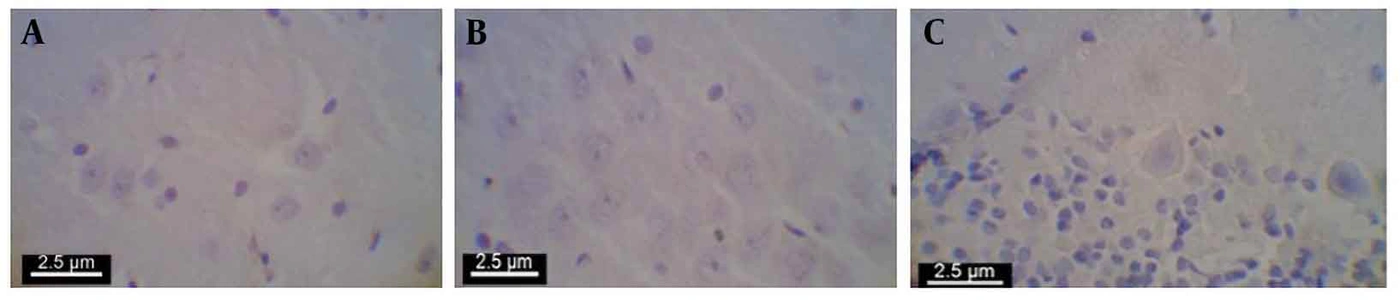
Negative-control photomicrographs for serotonin 5-HT2α receptor density in brain regions: A, basolateral amygdala (BLA); B, hippocampal CA1 region; C, cerebellar Purkinje cell layer.
Figure 1.
Negative-control photomicrographs for serotonin 5-HT2α receptor density in brain regions: A, basolateral amygdala (BLA); B, hippocampal CA1 region; C, cerebellar Purkinje cell layer.

3.5. Statistical Analysis

Statistical analyses were performed using SPSS version 21. One-way analysis of variance (ANOVA) and Tukey post hoc tests were used to determine differences among groups. P < 0.05 was considered statistically significant, and data are presented as mean ± SEM.

4. Results

In cerebellar Purkinje cells, BPA exposure at 50 mg/kg/day significantly decreased serotonin 5-HT2α receptor density compared with both the NL-sham group (P < 0.05) and the NL-BPA 5 mg/kg/day group (P < 0.01) (Figure 2A). In animals pre-exposed to BPA at 50 mg/kg/day, passive avoidance training was associated with a marked decrease in 5-HT2α receptor density compared with both the L-sham and L-BPA 5 mg/kg/day groups (P < 0.001) (Figure 2A). Overall, passive avoidance learning increased 5-HT2α receptor density in Purkinje cells. Figure 2B shows a photomicrograph depicting the density of 5-HT2α serotonin receptors in cerebellar Purkinje cells across all groups. Exposure to BPA at 50 mg/kg/day resulted in a significant (P < 0.05) decrease in serotonin 5-HT2α receptor density in the BLA nucleus compared with the NL-sham and NL-BPA 5 mg/kg/day groups (Figure 3A). In rats pre-exposed to 2 different doses of BPA, the passive avoidance task significantly reduced serotonin 5-HT2α receptor density in the BLA nucleus compared with the L-sham group (P < 0.01). According to Figure 3A, the passive avoidance task significantly (P < 0.001) increased the density of 5-HT2α serotonin receptors in cerebellar Purkinje cells. Figure 3B illustrates a photomicrograph of the density of 5-HT2α serotonin receptors in the BLA nucleus across all groups.
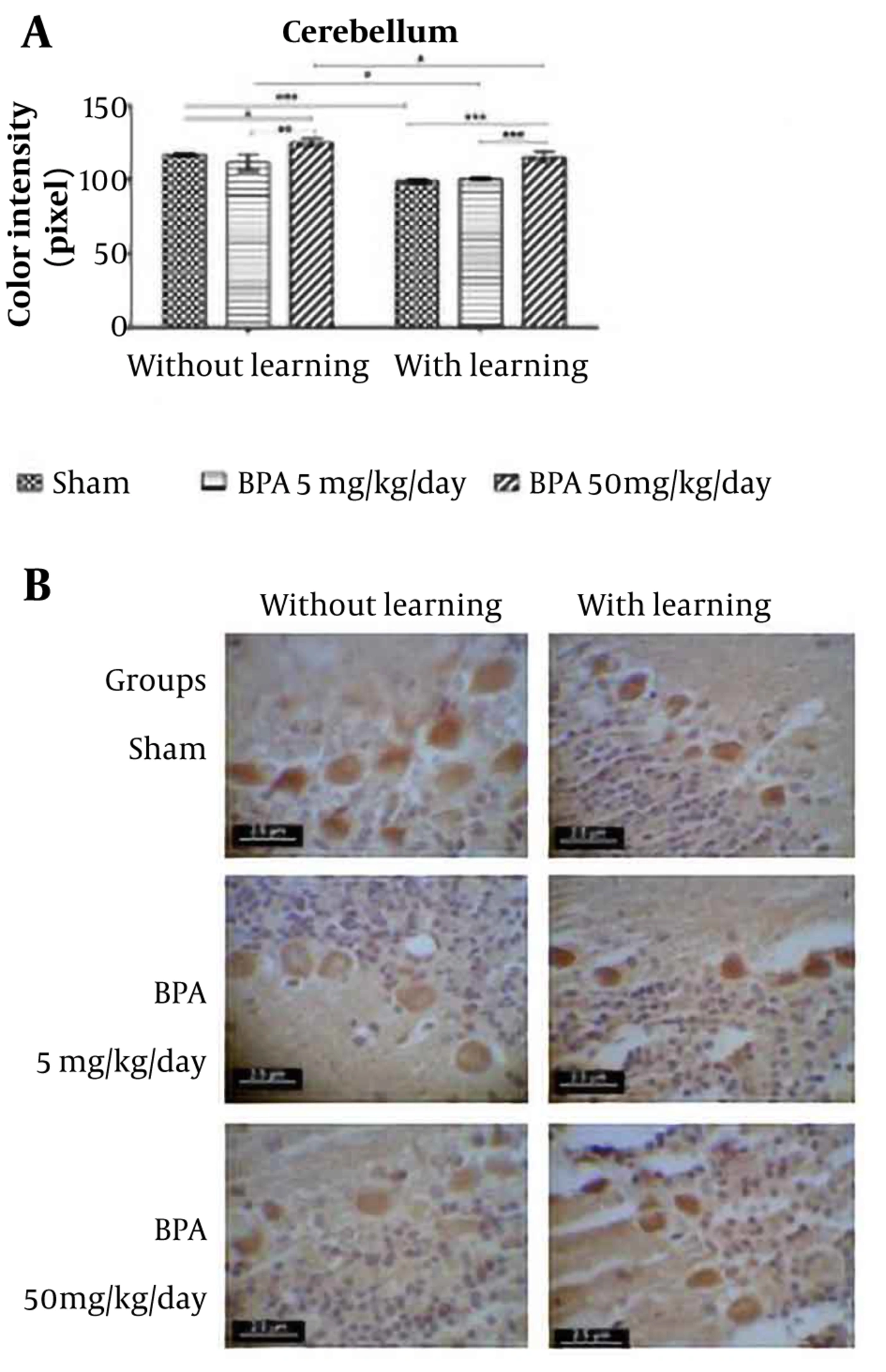
Serotonin 5-HT2α receptor density in cerebellar Purkinje cells of male rats following bisphenol A (BPA) exposure and passive avoidance training. A, Color intensity of immunohistochemical staining in cerebellar Purkinje cells across groups. Numerical values are inversely related to serotonin 5-HT2α receptor density: lower values indicate higher density and vice versa. B, Representative photomicrographs showing the effects of passive avoidance training on serotonin 5-HT2α receptor density in cerebellar Purkinje cells of BPA-exposed male rats across groups. **P &lt; 0.01; ***P &lt; 0.001. Data are presented as mean ± standard error of the mean (SEM).
Figure 2.
Serotonin 5-HT2α receptor density in cerebellar Purkinje cells of male rats following bisphenol A (BPA) exposure and passive avoidance training. A, Color intensity of immunohistochemical staining in cerebellar Purkinje cells across groups. Numerical values are inversely related to serotonin 5-HT2α receptor density: lower values indicate higher density and vice versa. B, Representative photomicrographs showing the effects of passive avoidance training on serotonin 5-HT2α receptor density in cerebellar Purkinje cells of BPA-exposed male rats across groups. **P < 0.01; ***P < 0.001. Data are presented as mean ± standard error of the mean (SEM).
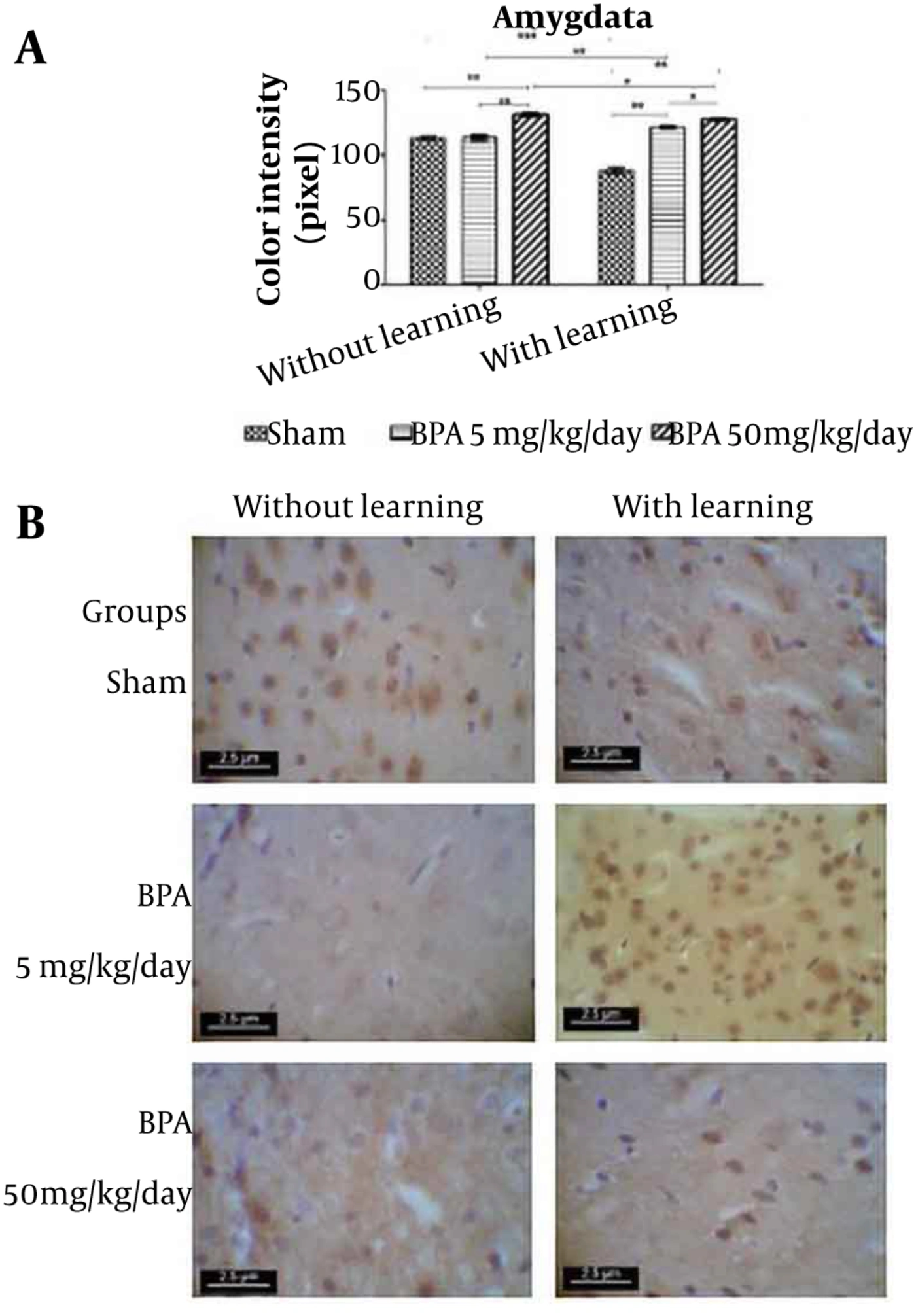
Serotonin 5-HT2α receptor density in the basolateral amygdala (BLA) of male rats following bisphenol A (BPA) exposure and passive avoidance learning. A, Color intensity of immunohistochemical staining in the BLA across groups. Numerical values are inversely related to serotonin 5-HT2α receptor density: lower values indicate higher density and vice versa. B, Representative photomicrographs showing the effects of passive avoidance learning on serotonin 5-HT2α receptor density in the BLA of BPA-exposed male rats across groups. *P &lt; 0.05; **P &lt; 0.01; ***P &lt; 0.001. Data are presented as mean ± standard error of the mean (SEM).
Figure 3.
Serotonin 5-HT2α receptor density in the basolateral amygdala (BLA) of male rats following bisphenol A (BPA) exposure and passive avoidance learning. A, Color intensity of immunohistochemical staining in the BLA across groups. Numerical values are inversely related to serotonin 5-HT2α receptor density: lower values indicate higher density and vice versa. B, Representative photomicrographs showing the effects of passive avoidance learning on serotonin 5-HT2α receptor density in the BLA of BPA-exposed male rats across groups. *P < 0.05; **P < 0.01; ***P < 0.001. Data are presented as mean ± standard error of the mean (SEM).
Figure 4A shows that exposure to low (P < 0.01) and high (P < 0.001) doses of BPA significantly decreased serotonin 5-HT2α receptor density in CA1 compared with the NL-sham group. However, comparison of L versus NL conditions indicated that passive avoidance training significantly increased overall 5-HT2α receptor density in CA1 (P < 0.001). Representative images of 5-HT2α immunoreactivity in CA1 across all groups are presented in Figure 4B.
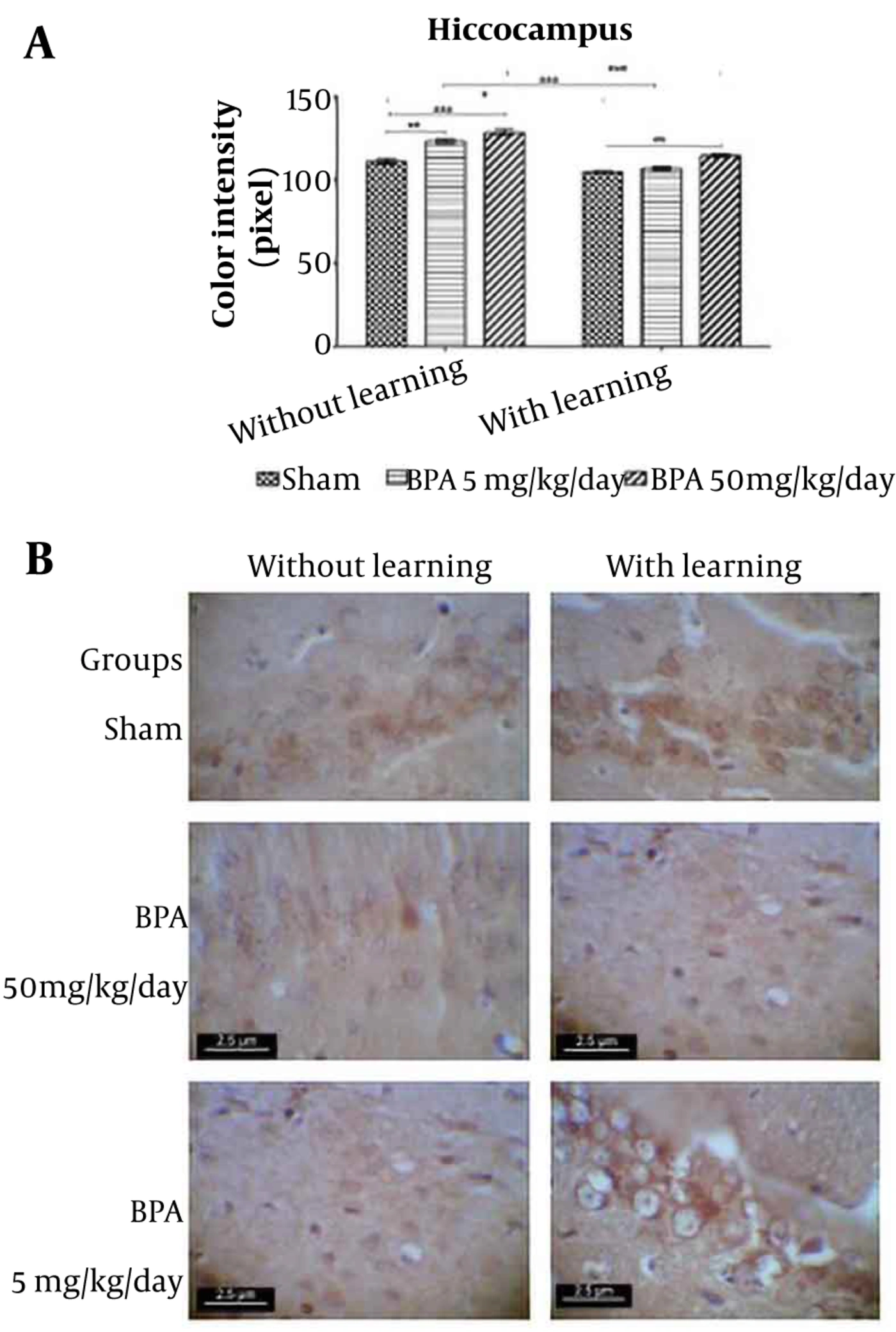
Serotonin 5-HT2α receptor density in the hippocampal CA1 region of male rats following bisphenol A (BPA) exposure and passive avoidance training. A, Color intensity of immunohistochemical staining in the hippocampal CA1 region across groups. Numerical values are inversely related to serotonin 5-HT2α receptor density: lower values indicate higher density and vice versa. B, Representative photomicrographs showing the effects of passive avoidance training on serotonin 5-HT2α receptor density in the hippocampal CA1 region of BPA-exposed male rats across groups. *P &lt; 0.05; **P &lt; 0.01; ***P &lt; 0.001. Data are presented as mean ± standard error of the mean (SEM).
Figure 4.
Serotonin 5-HT2α receptor density in the hippocampal CA1 region of male rats following bisphenol A (BPA) exposure and passive avoidance training. A, Color intensity of immunohistochemical staining in the hippocampal CA1 region across groups. Numerical values are inversely related to serotonin 5-HT2α receptor density: lower values indicate higher density and vice versa. B, Representative photomicrographs showing the effects of passive avoidance training on serotonin 5-HT2α receptor density in the hippocampal CA1 region of BPA-exposed male rats across groups. *P < 0.05; **P < 0.01; ***P < 0.001. Data are presented as mean ± standard error of the mean (SEM).

5. Discussion

In our previous study, BPA at the same doses used in the present study impaired learning acquisition, memory consolidation, and memory retention (15). Studies of exogenous estrogen administration suggest that estradiol can facilitate the acquisition of acute avoidance behavior, although these effects depend on dose and timing (16).
In the present study, BPA at 50 mg/kg/day decreased 5-HT2α receptor density in cerebellar Purkinje cells. Both BPA doses produced greater reductions in the NL-BPA groups than in the L-BPA groups, suggesting that passive avoidance training may counteract BPA neurotoxicity. Passive avoidance learning was associated with increased 5-HT2α receptor expression in Purkinje cells.
Research has shown that serotonin plays a critical role in learning, memory, and other cognitive processes (17). BPA negatively affects learning and memory functions in the cerebellum (11, 18). The cerebellum plays a crucial role in activities related to motor learning (19).
At the molecular level, BPA can interact with estrogen receptors α and β, functioning primarily as a partial agonist (20). Previous studies indicate that BPA exposure alters serotonergic neurons in the cerebellum and other brain regions (21, 22). BPA exposure has been reported to decrease serum estradiol levels in some rodent studies under certain experimental conditions (23).
In the present investigation, BPA at 50 mg/kg/day decreased serotonin 5-HT2α receptor density in the BLA nucleus. Relative to the L-BPA group, the NL-sham and L-sham groups had higher receptor density in the BLA, whereas the low-dose L-BPA group showed lower receptor density in this nucleus.
Serotonin 5-HT2α receptors are commonly postsynaptic in cortical and limbic structures, although presynaptic expression has been demonstrated in regions such as cerebellar granule cells (24). Some investigations have shown that the serotonin 5-HT2α receptor is also presynaptic, modulating glutamatergic, GABAergic, and dopaminergic neurons in a region-dependent manner (25). The effects of BPA on estrogen and serotonin concentrations in the BLA depend on the BPA dose, the life stage at exposure, and the serotonin receptor type.
The inhibitory action of serotonin may occur either directly through 5-HT2α receptor activation on BLA neurons or indirectly via GABAergic interneurons expressing 5-HT3 receptors (26). Therefore, in the present investigation, L-BPA at 5 mg/kg/day appeared to reduce serotonin 5-HT2α receptor density more than NL-BPA at 5 mg/kg/day.
Both NL-BPA doses reduced 5-HT2α receptor density in CA1. Similarly, L-BPA at both doses decreased receptor density in CA1, but the reduction was smaller than in the NL-BPA groups, implying that passive avoidance learning mitigates BPA toxicity. Thus, passive avoidance training ultimately led to higher 5-HT2α receptor density in CA1 than under NL conditions.
Synapse formation and remodeling in the hippocampus are essential for memory acquisition and consolidation (27). Estradiol enhances spine density and hippocampal plasticity, thereby supporting memory, whereas BPA can diminish or block these estradiol-dependent synaptogenic effects (5).
In the rat hippocampus, 5-HT2α receptors are expressed on both excitatory and inhibitory neurons, where they may contribute to signaling through effects on different neuronal populations. The high level of 5-HT2α receptor expression in the hippocampal region may indicate that this receptor plays a key role in functions including learning and memory (24). Evidence suggests that the production of monoamines, such as serotonin, is regulated through mechanisms mediated by estrogen receptors.

5.1. Conclusions

Passive avoidance learning appears to increase serotonin 5-HT2α receptor density in BPA-exposed rats, particularly in the hippocampal CA1 region, basolateral amygdala, and cerebellar Purkinje cells, suggesting a protective effect against BPA-induced serotonergic alterations. Although the neurotoxicity of BPA is well documented, the novelty of this study lies in demonstrating that passive avoidance learning may serve as a neuroprotective intervention by mitigating BPA-induced downregulation of 5-HT2α receptor density across hippocampal, amygdala, and cerebellar circuits.

Footnotes

  • AI Use Disclosure:The authors declare that no generative AI tools were used in the creation of this article.

  • Authors' Contribution:Study Design, Conceptualization, Methodology, Data Analysis, and Final Manuscript Revision: M. T.; Experimental Design, Methodology, Data Analysis, and Writing – Original Draft: S. R.; Investigation and Data Analysis: S. A. A.; All authors reviewed and approved the final manuscript.

  • Conflict of Interests Statement:The authors declare that there is no conflict of interest.

  • Data Availability:The data presented in this study are uploaded during submission as a supplementary file and are openly available for readers upon request.

  • Ethical Approval:All experimental protocols were performed according to the Ethical Committee for Animal Experiments at Shiraz University (Animal welfare code: 95INT1M1755).

  • Funding/Support:Shiraz University supported this research financially (95INT1M1755).

References

  • 1.
    Pan Y, Xie R, Wei X, Li AJ, Zeng L. Bisphenol and analogues in indoor dust from E-waste recycling sites, neighboring residential homes, and urban residential homes: Implications for human exposure. Sci Total Environ. 2024;907. 168012. [PubMed ID: 37871824]. https://doi.org/10.1016/j.scitotenv.2023.168012.
  • 2.
    La Merrill MA, Vandenberg LN, Smith MT, Goodson W, Browne P, Patisaul HB, et al. Consensus on the key characteristics of endocrine-disrupting chemicals as a basis for hazard identification. Nat Rev Endocrinol. 2020;16(1):45-57. [PubMed ID: 31719706]. [PubMed Central ID: PMC6902641]. https://doi.org/10.1038/s41574-019-0273-8.
  • 3.
    Dueñas-Moreno J, Mora A, Kumar M, Meng XZ, Mahlknecht J. Worldwide risk assessment of phthalates and bisphenol A in humans: The need for updating guidelines. Environ Int. 2023;181. 108294. [PubMed ID: 37935082]. https://doi.org/10.1016/j.envint.2023.108294.
  • 4.
    Yuan M, Chen S, Zeng C, Fan Y, Ge W, Chen W. Estrogenic and non-estrogenic effects of bisphenol A and its action mechanism in the zebrafish model: An overview of the past two decades of work. Environ Int. 2023;176. 107976. [PubMed ID: 37236126]. https://doi.org/10.1016/j.envint.2023.107976.
  • 5.
    Finney CA, Shvetcov A, Westbrook RF, Jones NM, Morris MJ. The role of hippocampal estradiol in synaptic plasticity and memory: A systematic review. Front Neuroendocrinol. 2020;56. 100818. [PubMed ID: 31843506]. https://doi.org/10.1016/j.yfrne.2019.100818.
  • 6.
    Hodges TE, Puri TA, Blankers SA, Qiu W, Galea LAM. Steroid hormones and hippocampal neurogenesis in the adult mammalian brain. Vitam Horm. 2022;118:129-70. [PubMed ID: 35180925]. https://doi.org/10.1016/bs.vh.2021.11.003.
  • 7.
    Huang Y, Sun W, Gao F, Ma H, Yuan T, Liu Z, et al. Brain-Derived Estrogen Regulates Neurogenesis, Learning and Memory with Aging in Female Rats. Biology (Basel). 2023;12(6):760. [PubMed ID: 37372046]. [PubMed Central ID: PMC10295457]. https://doi.org/10.3390/biology12060760.
  • 8.
    Kawato S, Ogiue-Ikeda M, Soma M, Yoshino H, Kominami T, Saito M, et al. Perinatal Exposure of Bisphenol A Differently Affects Dendritic Spines of Male and Female Grown-Up Adult Hippocampal Neurons. Front Neurosci. 2021;15. 712261. [PubMed ID: 34616273]. [PubMed Central ID: PMC8488347]. https://doi.org/10.3389/fnins.2021.712261.
  • 9.
    Li C, Sang C, Zhang S, Zhang S, Gao H. Effects of bisphenol A and bisphenol analogs on the nervous system. Chin Med J (Engl). 2023;136(3):295-304. [PubMed ID: 36848196]. [PubMed Central ID: PMC10106255]. https://doi.org/10.1097/CM9.0000000000002170.
  • 10.
    Zhang H, Kuang H, Luo Y, Liu S, Meng L, Pang Q, et al. Low-dose bisphenol A exposure impairs learning and memory ability with alterations of neuromorphology and neurotransmitters in rats. Sci Total Environ. 2019;697. 134036. [PubMed ID: 31476513]. https://doi.org/10.1016/j.scitotenv.2019.134036.
  • 11.
    Costa HE, Cairrao E. Effect of bisphenol A on the neurological system: a review update. Arch Toxicol. 2024;98(1):1-73. [PubMed ID: 37855918]. [PubMed Central ID: PMC10761478]. https://doi.org/10.1007/s00204-023-03614-0.
  • 12.
    Hyun SA, Ko MY, Jang S, Lee BS, Rho J, Kim KK, et al. Bisphenol-A impairs synaptic formation and function by RGS4-mediated regulation of BDNF signaling in the cerebral cortex. Dis Model Mech. 2022;15(7). dmm049177. [PubMed ID: 35781563]. [PubMed Central ID: PMC9346518]. https://doi.org/10.1242/dmm.049177.
  • 13.
    Kazmierska-Grebowska P, Żakowski W, Myślińska D, Sahu R, Jankowski MM. Revisiting serotonin's role in spatial memory: A call for sensitive analytical approaches. Int J Biochem Cell Biol. 2024;176. 106663. [PubMed ID: 39321568]. https://doi.org/10.1016/j.biocel.2024.106663.
  • 14.
    Tortora F, Hadipour AL, Battaglia S, Falzone A, Avenanti A, Vicario CM. The Role of Serotonin in Fear Learning and Memory: A Systematic Review of Human Studies. Brain Sci. 2023;13(8):1197. [PubMed ID: 37626553]. [PubMed Central ID: PMC10452575]. https://doi.org/10.3390/brainsci13081197.
  • 15.
    Taherianfard M, Geramizadeh B, Banihashemi M, Asgari Taiee A, Ensannejad R. Effect of bisphenol A on passive avoidance performance in male rats. Am Med J. 2013;4(2):190-196. https://doi.org/10.3844/amjsp.2013.190.196.
  • 16.
    Wiersielis K, Yasrebi A, Ramirez P, Verpeut J, Regan D, Roepke TA. The influence of estrogen receptor α signaling independent of the estrogen response element on avoidance behavior, social interactions, and palatable ingestive behavior in female mice. Horm Behav. 2021;136. 105084. [PubMed ID: 34749278]. [PubMed Central ID: PMC9420320]. https://doi.org/10.1016/j.yhbeh.2021.105084.
  • 17.
    Coray R, Quednow BB. The role of serotonin in declarative memory: A systematic review of animal and human research. Neurosci Biobehav Rev. 2022;139. 104729. [PubMed ID: 35691469]. https://doi.org/10.1016/j.neubiorev.2022.104729.
  • 18.
    Lapp HE, Margolis AE, Champagne FA. Impact of a bisphenol A, F, and S mixture and maternal care on the brain transcriptome of rat dams and pups. Neurotoxicology. 2022;93:22-36. [PubMed ID: 36041667]. [PubMed Central ID: PMC9985957]. https://doi.org/10.1016/j.neuro.2022.08.014.
  • 19.
    Baladron J, Vitay J, Fietzek T, Hamker FH. The contribution of the basal ganglia and cerebellum to motor learning: A neuro-computational approach. PLoS computational biology. 2023;19(4). e1011024. [PubMed ID: 37347775]. [PubMed Central ID: PMC10286960]. https://doi.org/10.1371/journal.pcbi.1011024.
  • 20.
    Gokso̷yr SØ, Yadetie F, Johansen CT, Jacobsen RG, Lille-Lango̷y R, Gokso̷yr A, et al. Interaction of Bisphenol A and Its Analogs with Estrogen and Androgen Receptor from Atlantic Cod (Gadus morhua). Environ Sci Technol. 2024;58(32):14098-109. [PubMed ID: 39087390]. [PubMed Central ID: PMC11325555]. https://doi.org/10.1021/acs.est.4c01500.
  • 21.
    Barra NG, Kwon YH, Morrison KM, Steinberg GR, Wade MG, Khan WI, et al. Increased gut serotonin production in response to bisphenol A structural analogs may contribute to their obesogenic effects. Am J Physiol Endocrinol Metab. 2022;323(1):E80-E091. [PubMed ID: 35575233]. https://doi.org/10.1152/ajpendo.00049.2022.
  • 22.
    Kaimal A, Hooversmith JM, Mansi MHA, Holmes PV, MohanKumar PS, MohanKumar SMJ. Prenatal Exposure to Bisphenol A and/or Diethylhexyl Phthalate Impacts Brain Monoamine Levels in Rat Offspring. J Xenobiot. 2024;14(3):1036-50. [PubMed ID: 39189173]. [PubMed Central ID: PMC11348251]. https://doi.org/10.3390/jox14030058.
  • 23.
    Welch C, Mulligan K. Does bisphenol A confer risk of neurodevelopmental disorders? What we have learned from developmental neurotoxicity studies in animal models. Int J Mol Sci. 2022;23(5):2894. [PubMed ID: 35270035]. [PubMed Central ID: PMC8910940]. https://doi.org/10.3390/ijms23052894.
  • 24.
    Cummins BR, Billac GB, Nichols DE, Nichols CD. 5-HT2A receptors: Pharmacology and functional selectivity. Pharmacol Rev. 2025;77(4). 100059. [PubMed ID: 40418878]. [PubMed Central ID: PMC12405928]. https://doi.org/10.1016/j.pharmr.2025.100059.
  • 25.
    Taddeucci A, Olivero G, Roggeri A, Milanese C, Giorgio FPD, Grilli M, et al. Presynaptic 5-HT2A-mGlu2/3 Receptor-receptor crosstalk in the prefrontal cortex: metamodulation of glutamate exocytosis. Cells. 2022;11(19):3035. https://doi.org/10.3390/cells11193035.
  • 26.
    Sengupta A, Bocchio M, Bannerman DM, Sharp T, Capogna M. Control of Amygdala Circuits by 5-HT Neurons via 5-HT and Glutamate Cotransmission. J Neurosci. 2017;37(7):1785-96. [PubMed ID: 28087766]. [PubMed Central ID: PMC5320609]. https://doi.org/10.1523/JNEUROSCI.2238-16.2016.
  • 27.
    Reyes-Resina I, Samer S, Kreutz MR, Oelschlegel AM. Molecular mechanisms of memory consolidation that operate during sleep. Front Mol Neurosci. 2021;14. 767384. [PubMed ID: 34867190]. [PubMed Central ID: PMC8636908]. https://doi.org/10.3389/fnmol.2021.767384.

Copyright

Copyright © 2026, Journal of Kermanshah University of Medical Sciences. This open-access article is available under the Creative Commons Attribution 4.0 (CC BY 4.0) International License (https://creativecommons.org/licenses/by/4.0/), which allows for the copying and redistribution of the material only for noncommercial purposes, provided that the original work is properly cited.

Similar Articles

4
Oct
2016
Learning Modulate Down Regulation of GABAAα1 Receptors in Amygdala and Cerebellum of Rats Exposed to Bisphenol A

Learning Modulate Down Regulation of GABAAα1 Receptors in Amygdala and Cerebellum of Rats Exposed to Bisphenol A

Mahnaz Taherianfard,
Mehrzad Banihashemi

Taherianfard M, Banihashemi M. Learning Modulate Down Regulation of GABAAα1 Receptors in Amygdala and Cerebellum of Rats Exposed to Bisphenol A. Arch Neurosci. 2016;3(4):e37297. doi: https://doi.org/10.5812/archneurosci.37297

1
Jan
2015
Deficits in Striatal Dopamine and Hippocampal Serotonin Following Induction of Anxiety/Depressive-Like Behaviors by Bisphenol A

Deficits in Striatal Dopamine and Hippocampal Serotonin Following Induction of Anxiety/Depressive-Like Behaviors by Bisphenol A

Meng Jia,
Julian Pittman

Jia M, Pittman J. Deficits in Striatal Dopamine and Hippocampal Serotonin Following Induction of Anxiety/Depressive-Like Behaviors by Bisphenol A. Arch Neurosci. 2015;2(1):e18555. doi: https://doi.org/10.5812/archneurosci.18555

28
Sep
2015
An interaction between serotonergic receptors (5HT6) with acute stress and corticosterone on retrieval and extinction of fear memory in mice

An interaction between serotonergic receptors (5HT6) with acute stress and corticosterone on retrieval and extinction of fear memory in mice

Maryam Vasheghani,
Abbas Ali Vafaei,
A. li Rashidy-Pour,
Hossien Rajabzadeh,
A. li Boustani

Vasheghani M, Vafaei AA, Rashidy-Pour AL, Rajabzadeh H, Boustani AL. An interaction between serotonergic receptors (5HT6) with acute stress and corticosterone on retrieval and extinction of fear memory in mice. koomesh. 2015;16(3):e151270. doi:

21
Nov
2015
Effects of prenatal exposure to combined stress on memory retention of passive avoidance learning in rats

Effects of prenatal exposure to combined stress on memory retention of passive avoidance learning in rats

Z Homauni Afshari,
mohammad sofiabadi,
M Dezfulian,
H Haghdost Yazdy

Homauni Afshari Z, sofiabadi M, Dezfulian M, Haghdost Yazdy H. Effects of prenatal exposure to combined stress on memory retention of passive avoidance learning in rats. J Inflamm Dis. 2024;19(4):e155917. doi:

30
Sep
2012
The interaction of nicotine and dopamine D1 receptors of the dorsal hippocampus in the perforated plate anxiety test

The interaction of nicotine and dopamine D1 receptors of the dorsal hippocampus in the perforated plate anxiety test

M Piri,
M Nasehi,
F Mafi,
M Shahin,
MR Zarrindast

Piri M, Nasehi M, Mafi F, Shahin M, Zarrindast M. The interaction of nicotine and dopamine D1 receptors of the dorsal hippocampus in the perforated plate anxiety test. J Inflamm Dis. 2024;16(2):e155695. doi:

More by these authors

Mahnaz TaherianfardPubMedScholar
Soodeh RowhaniradPubMedScholar
Seyed Ali ArefkashfiPubMedScholar
Share
Cited by
Metrics