
1. Background
Viral hepatitis is a major global public health challenge and a leading cause of chronic liver disease, cirrhosis, and hepatocellular carcinoma (1). Among the hepatitis viruses, hepatitis B virus (HBV) and hepatitis C virus (HCV) are particularly concerning because of their high prevalence, severe complications, and propensity for chronic infection. These viruses are primarily transmitted through blood and body fluids, including via blood transfusions, surgical and dental procedures, needle sharing, and mother-to-child transmission through the placenta (2).
Hepatitis B virus is a DNA virus belonging to the Hepadnaviridae family and can cause acute or chronic hepatitis. Vaccination programs have substantially reduced its incidence in many countries; however, HBV remains endemic in many developing regions (3). Hepatitis C virus is an RNA virus that primarily causes chronic infection and is a major cause of cirrhosis and hepatocellular carcinoma. Unlike HBV, HCV lacks an effective vaccine, making prevention and screening essential for infection control (4).
The epidemiology of HBV and HCV infections varies by age, sex, geographic location, socioeconomic status, and exposure to risk factors. Sex and age are important determinants of the prevalence and distribution of viral hepatitis (5). Young and middle-aged adults may be more susceptible to infection because of increased social activity, occupational exposure, and healthcare-related exposures. Women, particularly pregnant women, are frequently screened for hepatitis during prenatal care, which may influence detection rates in this population (6).
Viral hepatitis remains a significant health problem in Iraq, with studies reporting variable prevalence across regions (7-9). Basrah Governorate in southern Iraq has a high population density and well-developed healthcare services, which may influence viral hepatitis transmission and detection. However, epidemiological data on the distribution of HBV and HCV infections by age and sex in this region remain limited, particularly over the past five years (10, 11).
2. Objectives
This study aimed to determine the prevalence of HBV and HCV infections among outpatients in Basrah Governorate, Iraq, and to assess their distribution by age and sex. It also aimed to examine associations between demographic factors and hepatitis infections to provide epidemiological data that may inform prevention and control programs.
3. Methods
3.1. Study Design and Population
A cross-sectional study was conducted in Basrah Governorate, Iraq. A total of 1256 outpatients attending private clinics for routine follow-up and medical consultation were included. Participants comprised males and females across different age groups. Demographic data, including age and sex, were recorded for all participants. Participants were categorized into four age groups: ≤ 20, 21 - 40, 41 - 60, and > 60 years.
3.2. Sample Collection and Laboratory Testing
Peripheral venous blood samples (2 mL) were collected from each participant under aseptic conditions during a clinic visit. Samples were allowed to clot; serum was separated by centrifugation and stored under appropriate conditions until analysis. Serum samples were tested for hepatitis B surface antigen (HBsAg) and antibodies to HCV (anti-HCV) using enzyme-linked immunosorbent assay (ELISA) kits (Biorex Diagnostics, UK), according to the manufacturer's instructions. All procedures followed standard laboratory protocols to ensure the accuracy and reliability of the results.
3.3. Ethical Considerations
All procedures were performed in accordance with established ethical standards. Informed consent was obtained from each participant before sample collection, and patient information was kept confidential.
4. Results
4.1. Overall Prevalence and Distribution by Sex
Of the 1256 outpatients tested for viral hepatitis, 29 samples were positive, yielding a prevalence of 2.31%. The remaining 1227 samples were negative, accounting for 97.69% of the total. These findings indicate a relatively low overall prevalence of viral hepatitis in the study area.
Prevalence was higher among males (3.6%) than among females (1.7%). The study included 900 females and 356 males; 16 females and 13 males tested positive. No statistically significant difference was observed between males and females (χ2 = 3.18, P = 0.074), as shown in Table 1.
Table 1.
Distribution of Hepatitis B and C Infections According to Sex a
| Status | Male | Female |
|---|---|---|
| Total | 356 | 900 |
| Positive | 13 (3.6) | 16 (1.7) |
| Negative | 343 (96.7) | 884 (98.3) |
a Values are expressed as No. or No. (%).
4.2. Distribution by Age Group
In the overall sample of 1256 participants, the highest proportion of hepatitis B and C cases was observed in the 21 - 40-year age group (1.5%), followed by the 41 - 60-year age group (0.4%). The lowest proportions were observed in the ≤ 20-year (0.20%) and > 60-year (0.15%) age groups (Figure 1).
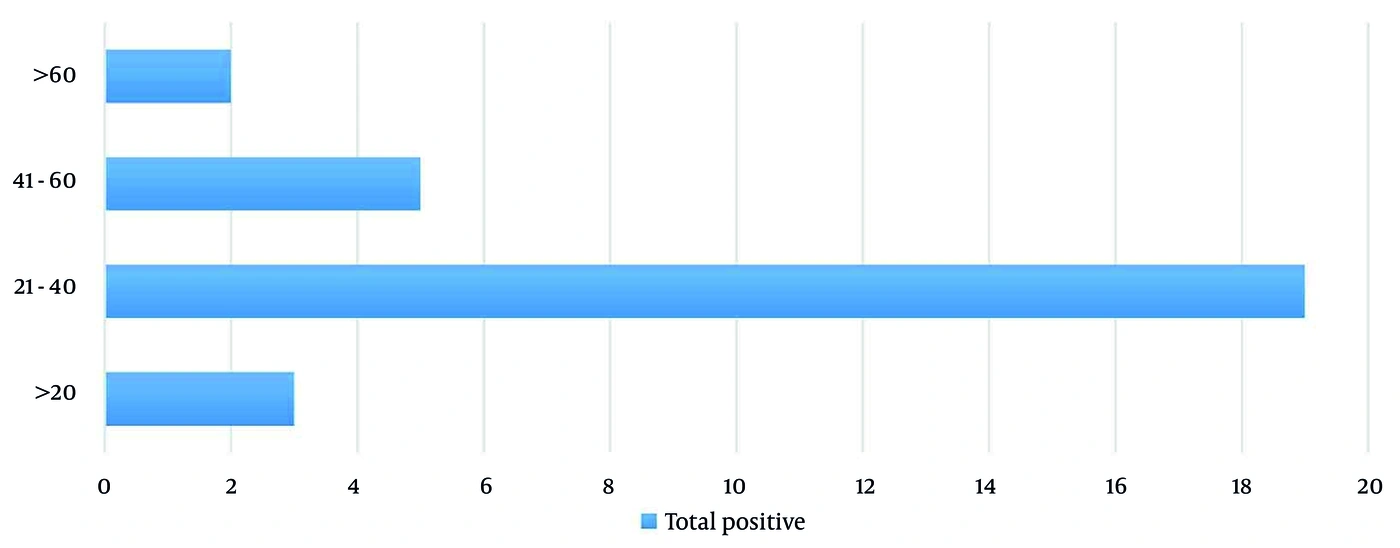
Figure 1.
Distribution of Hepatitis B and C Infections According to Age Groups
Statistical analysis showed a significant association between age group and hepatitis infection (χ2 = 14.2, P = 0.003), indicating that infection rates varied considerably across age groups.
4.3. Association Between Sex and Hepatitis Infection Type
More HBsAg-positive cases were detected in males (n = 9) than in females (n = 5), indicating a higher prevalence of hepatitis B infection among males. In contrast, hepatitis C infection was more common among females, with 11 cases compared with 4 cases among males (Table 2).
Table 2.
Association Between Sex and Hepatitis Infection Type (HBV vs HCV) a
| Sex | Total No. | HBsAg | HCV |
|---|---|---|---|
| Male | 13 | 9 (69.3) | 4 (30.7) |
| Female | 16 | 5 (31.3) | 11 (68.7) |
a Values are expressed as No. (%).
Abbreviations: HBsAg, hepatitis B surface antigen; HBV, hepatitis B virus; HCV, hepatitis C virus.
Statistical analysis showed a significant association between sex and infection type (χ2 = 4.66, P = 0.031), indicating that the distribution of HBV and HCV differed significantly between males and females.
4.4. Distribution of Hepatitis B and C Infections by Age Group
The distribution of infection types varied across age groups. Among participants aged ≤ 20 years, all 3 cases were hepatitis C infections, and no hepatitis B infection was detected. Hepatitis B predominated in the 21 - 40-year age group, with 14 cases compared with 5 hepatitis C cases. In the 41 - 60-year age group, hepatitis C was more common, with 4 cases compared with 1 hepatitis B case. Among participants aged > 60 years, hepatitis B and C were equally distributed, with 1 case each (Table 3).
Table 3.
Distribution of HBV (HBsAg) and HCV Infections According to Age Groups
| Age Group (y) | Total Positive | HBsAg | HCV |
|---|---|---|---|
| ≤ 20 | 3 | 0 | 3 |
| 21 - 40 | 19 | 14 | 5 |
| 41 - 60 | 5 | 1 | 4 |
| > 60 | 2 | 1 | 1 |
| Total | 29 | 16 | 13 |
Abbreviations: HBsAg, hepatitis B surface antigen; HBV, hepatitis B virus; HCV, hepatitis C virus.
Statistical analysis revealed a significant association between age group and infection type (χ2 = 12.6, P = 0.005), indicating that the distribution of HBV and HCV varied significantly across age groups.
5. Discussion
The overall prevalence was in close agreement with previous studies conducted in Iraq. A study of blood donors in Basrah reported a hepatitis B prevalence of approximately 2.3, which was similar to that in the present study (12). This similarity suggests relative stability in the epidemiological pattern of hepatitis B infection in Basrah over time.
The higher prevalence among males, without a statistically significant difference between sexes, was consistent with several previous studies (13-15).
The highest prevalence of hepatitis B and C infections was observed in the 21 - 40-year age group. This group represents the largest and most socially and economically active segment of the population, which may increase exposure to infection risk factors, including medical procedures, blood transfusions, travel, dental treatments, and occupational exposure (16).
The expansion of hepatitis vaccination programs in response to risk factors has shifted hepatitis B prevention toward younger age groups (≤ 20 years). Variation in hepatitis C infection rates among older participants (> 60 years) may be attributable to reduced exposure to risk factors and to the smaller sample size in this group (17).
The present study demonstrated a significant association between sex and infection type. Hepatitis B was more prevalent among males, whereas hepatitis C was more prevalent among females. This finding reflects a distinct epidemiological pattern in the study population. The higher prevalence of HBV among males may be attributable to greater exposure to occupational hazards, surgical procedures, and increased social mobility, which may increase contact with infected blood or body fluids. The higher prevalence of HCV among females may be related to greater exposure to healthcare settings, including antenatal care, blood transfusions, and medical interventions (18).
The significant association between sex and infection type highlights the importance of considering demographic factors in the epidemiology of viral hepatitis and of developing targeted prevention strategies for each group.
The study also demonstrated a significant association between age group and infection type. Hepatitis B was more prevalent among individuals aged 21 - 40 years, whereas hepatitis C was more common in the ≤ 20-year and 41 - 60-year age groups. The higher prevalence of hepatitis B in the 21 - 40-year group may reflect generational differences in immunity and vaccination coverage. Individuals in this group were likely born before the introduction or widespread implementation of hepatitis B vaccination programs, making them more susceptible than younger groups that benefited from early immunization (19).
Variation in hepatitis B prevalence across age groups may also reflect differences in immune response and viral persistence, with individuals in early adulthood potentially having a greater likelihood of chronic infection following exposure (20).
The higher prevalence of hepatitis C in both younger and older age groups may be related to historical exposure patterns and cumulative risk. In older adults, hepatitis C may reflect infections acquired years earlier, given the disease's long incubation period and tendency to remain undiagnosed for extended periods (21). Among younger individuals, HCV infection may indicate ongoing community transmission associated with unrecognized or subclinical infections rather than direct exposure to traditional risk factors (22).
Differences in the biological characteristics of HBV and HCV may contribute to their age-related distributions. Hepatitis B is likely influenced by immunity and vaccination status, whereas hepatitis C tends to persist chronically in the community, contributing to its prevalence across broader age groups (23). These findings highlight the importance of age-specific prevention strategies, including HBV vaccination and enhanced HCV screening, particularly in vulnerable groups.
5.1. Conclusions
The prevalence of HBV and HCV infections among outpatients in Basrah Governorate, Iraq, was relatively low. However, clear epidemiological differences were observed across demographic groups. Hepatitis B was more common among males, whereas hepatitis C was more prevalent among females, with a statistically significant association between sex and infection type. Age was also significantly associated with infection distribution, with the highest prevalence recorded in the 21 - 40-year group. A significant association was found between age group and hepatitis virus type.
These findings underscore the need for targeted screening and investigative programs for high-risk groups, particularly individuals aged 21 - 40 years. Strengthening HBV vaccination campaigns, developing early HCV detection strategies, and increasing community health awareness are essential measures to reduce the burden of viral hepatitis.