Journal of Kermanshah University of Medical Sciences
Peer-reviewed Medical Quarterly
e-ISSN 2588-2570
p-ISSN 2588-2562
Image Credit:J Kermanshah Univ Med Sci
Outline
The comparison of balance performance among children with cochlear implantation, post-aural aid and normal children
Authors
1Dept. of Motor Behavior, Faculty of Physical Education & Sports Sciences, Shahid Beheshti University, Tehran, Iran
2Dept. of Basic Sciences in Rehabilitation, School of Rehabilitation, Iran University of Medical sciences, Tehran, Iran
*Corresponding Author: Corresponding author: Arezoo Ahmad pour, Dept. of Motor Behavior, Faculty of Physical Education & Sports Sciences, Shahid Beheshti University, Tehran, Iran, Tel: +98 9188727659 Email: arezoo.ahmadpour@gmail.com
Published online:Nov 29, 2014
Article type:Research Article
Received:Aug 22, 2014
Accepted:Nov 11, 2014
How to Cite:Ahmad pour A, Aslankhani MA, Ashayeri H, Jafari Z. The comparison of balance performance among children with cochlear implantation, post-aural aid and normal children. J Kermanshah Univ Med Sci. 2014;18(8):e74042. doi: https://doi.org/10.22110/jkums.v18i8.2013
Abstract
Background: This cross-sectional study was carried out to compare balance performance between children with cochlear implants and post-aural aid and normal children.
Methods: The present study was done on 67 severe to profound hearing impaired children. Of these, 21 children with an average age of 7 years and 4 months (±1.7) wore cochlear implant, 46 children with an average age of 7 years and 7 months (±1.7) wore post-aural aid and 60 children with an average 8 years and one month (±11 months) were considered as a control group. All of the children were tested with the 9-stage balance subtest of Bruininks-Oseretsky Test of Motor Proficiency2 (BOT2).
Results: The mean total BOT2 score of hearing impaired children was significantly lower than the normal group (P≤0.001). The mean total BOT2 score among children with cochlear implant, post-aural aids and normal group showed that cochlear implant group significantly performed weaker than the other two groups (P≤0.001).
Conclusion: Hearing impaired children particularly children with cochlear implant are exposed to the risk of balance deficit. Hearing impaired children specially those who wear cochlear implants must be screened for vestibular hypofunction.
Highlights
References
- 1.The references of this article is available on PDF.
Copyright
© 2014, Journal of Kermanshah University of Medical Sciences. This open-access article is available under the Creative Commons Attribution-NonCommercial 4.0 (CC BY-NC 4.0) International License (https://creativecommons.org/licenses/by-nc/4.0/), which allows for the copying and redistribution of the material only for noncommercial purposes, provided that the original work is properly cited.
Similar Articles
15
Feb
2020
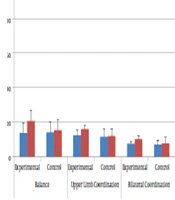
Effect of Balance Training on Balance Performance, Motor Coordination, and Attention in Children with Hearing Deficits
Mohammad Hedayatjoo,
Mehdi Rezaee,
Mehdi Alizadeh Zarei,
Navid Mirzakhany,
Ahmadreza Nazeri,
Alireza Akbarzadeh Baghban
,et al.Hedayatjoo M, Rezaee M, Alizadeh Zarei M, Mirzakhany N, Nazeri A, et al. Effect of Balance Training on Balance Performance, Motor Coordination, and Attention in Children with Hearing Deficits. Arch Neurosci. 2020;7(1):e84869. doi: https://doi.org/10.5812/ans.84869
24
Jun
2017
Effect of Task-oriented Occupational Therapy Intervention on Balance Performance of Children with Cochlear Implants
Dorsa Hamedi,
Sevda Saranajam,
Seyed Amir Mir Ahmadi,
Meymanat Akbari,
Ameneh Safari
Hamedi D, Saranajam S, Mir Ahmadi SA, Akbari M, Safari A. Effect of Task-oriented Occupational Therapy Intervention on Balance Performance of Children with Cochlear Implants. J Clin Res Paramed Sci. 2017;6(1):e81184. doi:
24
May
2017
The effect of duration of using cochlear implant and hearing aid on the speech intelligibility of children with hearing loss
Massoume Hosseini,
Nader Saki,
Negin Moradi,
Majid Soltani,
Mahmood Latifi,
Soheila Nikakhlagh
Hosseini M, Saki N, Moradi N, Soltani M, Latifi M, et al. The effect of duration of using cochlear implant and hearing aid on the speech intelligibility of children with hearing loss. J Clin Res Paramed Sci. 2017;6(2):e81277. doi:
5
Dec
2024
Comparison of Word Complexity and Speech Intelligibility in Deaf Children with Cochlear Implant and Hearing Aids
Mohammad Rezaei,
Solmaz Mehrfar,
Farzad Weisi
Rezaei M, Mehrfar S, Weisi F. Comparison of Word Complexity and Speech Intelligibility in Deaf Children with Cochlear Implant and Hearing Aids. Zahedan J Res Med Sci. 2025;27(1):e156891. doi: https://doi.org/10.5812/zjrms-156891
1
Aug
2023
Comparing the vocabulary, grammatical, narrative, and phonological awareness skills among children with Hearing Loss and Normal Hearing and investigating the association between these language skills
Zahra Ghayoumi,
Zahra Fathalizade,
Milad Karimi,
Parnia Pourmirzaei,
Fatemeh Haresabadi,
Toktam Maleki Shahmahmood
Ghayoumi Z, Fathalizade Z, Karimi M, Pourmirzaei P, Haresabadi F, et al. Comparing the vocabulary, grammatical, narrative, and phonological awareness skills among children with Hearing Loss and Normal Hearing and investigating the association between these language skills. koomesh. 2023;25(2):e152822. doi:
Cited by
- Scopus by DOI: 0
Last Update: 1 week ago
- Scopus by Title: 0
Last Update: 1 week ago
- Scopus by Title (Ref): 0
Last Update: 1 week ago
- CrossRef: 0
Last Update: 6 days ago
- OpenAlex: 1
Last Update: 2 days ago
- OpenCitations: 0
Last Update: 4 days ago
Comments
Number of Comments:0