
1. Background
The sense of hearing serves as the most fundamental basis for natural language acquisition, and hearing loss is one of the key factors contributing to disorders in the development of language skills (1). Auditory feedback plays a crucial role in the development of speech and language in children, as it provides a direct mechanism for reviewing and refining speech production, controlling speech movements, and enhancing speech intelligibility. However, in children with hearing loss, insufficient auditory feedback leads to disruptions in speech and language development (2).
Children with hearing loss often experience various speech and language difficulties due to impaired auditory input, resulting in deficiencies in the clarity of their speech (3). Most individuals with profound hearing loss face challenges with speech intelligibility, which are closely linked to their production abilities and language skills (4).
Word complexity (WC) is a measure influenced by several factors, including syllabic structure, syllable count, types of consonants, and the presence of consonant clusters. These factors are reflected in speech patterns that contribute to increased speech complexity (5). Among the skills related to speech intelligibility are word complexity and context, both of which have a direct and significant relationship with speech clarity (4). Other factors affecting speech intelligibility include age, speech rate, accent, speech disorders, and speaker anxiety (6).
Hearing loss in individuals with hearing impairments can be significantly mitigated with cochlear implants (CI) or hearing aids (HA). Consequently, their speech intelligibility is expected to improve over time (7). Studies investigating the benefits of CI and HA for children with hearing impairments have demonstrated that the age at which a child undergoes surgery or begins using a hearing aid, along with the duration of device use, plays a crucial role in enhancing speech clarity and comprehension (8). Furthermore, several studies have indicated that cochlear implantation significantly improves speech intelligibility in children with hearing impairments (8, 9).
2. Objectives
Given the limited research on speech clarity among Persian-speaking children with hearing loss, this study aims to assess and compare the speech intelligibility of children using CI with those using HA. Additionally, it seeks to investigate the association between speech intelligibility and word complexity in these individuals.
3. Methods
The present study is a cross-sectional, comparative, and analytical investigation aimed at comparing word complexity and speech intelligibility in deaf children using CI and HA.
3.1. Participants
The statistical population of this research consists of all hearing-impaired children aged 4 to 6 years in Hamadan city who use CI or HA. A total enumeration sampling method was employed, in which all children with CI at the Niusha Hamadan Hearing Loss Center were comprehensively studied, and 25 individuals were included in the study based on the inclusion and exclusion criteria. An equivalent number of hearing-impaired children using HA, matched for age and gender, were selected according to the study’s criteria. The study comprised 50 children divided into two groups of 25, with an average age of 5.4 years and a standard deviation of 0.8.
The hearing loss in both groups was sensorineural and ranged between 71 to 90 dB. children with CI and HA had been using their devices since they were 2 to 3 years old. On average, the duration of device use was three years for cochlear implant users and two years for hearing aid users, with a range of 10 to 30 months since the devices were first implemented. The IQ of both groups was within the normal range, as determined by the non-verbal Wechsler test, and all participants had hearing parents.
The exclusion criteria for the study included the presence of additional disabilities, such as blindness, intellectual disabilities, or behavioral issues.
3.2. Evaluations
Evaluations were conducted in a calm environment, ensuring the child felt comfortable and engaged to achieve optimal responsiveness. Each word in the speech clarity assessment was pronounced individually for the child, who then repeated it. The recorded speech samples were subsequently reviewed by three listeners who were non-specialists and unfamiliar with hearing-impaired speech. These listeners assessed whether the recorded sounds were clear or unclear. Upon completing the evaluation, the percentage of speech clarity for each child was determined by each listener, and the average of these percentages was recorded as the child’s final speech clarity percentage.
The criterion for assessing word complexity was the number of syllables in each word, with four types of words included in the test: Monosyllabic, disyllabic, trisyllabic, and quadrisyllabic.
3.3. Statistical Analysis
The collected data were analyzed using the independent t-test and Pearson correlation test, with SPSS version 16 software. Given the sample size of fewer than 100 participants, the normality of the data distribution was assessed using the Kolmogorov-Smirnov test, and a significance level of 0.05 was applied for all statistical tests.
The research tools included a personal information questionnaire and a speech intelligibility test. The personal information questionnaire gathered details such as personal information, educational background, hearing and visual status, and whether the child was bilingual.
3.4. Speech Intelligibility Test
To evaluate speech intelligibility, a list of imitative words was used. The interclass correlation coefficient for this test was 0.85, and the Spearman correlation coefficient was 0.81 (9). A set of 30 words was presented to the children, who were instructed to repeat them. This test has been shown to possess adequate validity and reliability for assessing the speech clarity of hearing-impaired children (10).
4. Results
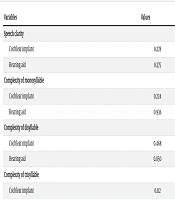
In this study, 50 hearing-impaired children were matched for age and gender, consisting of 15 boys and 10 girls in each of two groups: Hearing-impaired children using HA (25 individuals) and those using CI (25 individuals) (Table 1). The Kolmogorov-Smirnov test indicated that the frequency distribution of the speech clarity and word complexity variables (across four levels) was symmetrical and normal for both groups (Table 2). The independent t-test revealed no significant difference in the average age between the two groups. As shown in Table 3, the mean speech clarity scores demonstrated a statistically significant difference between the groups. Furthermore, a significant difference was identified in the complexity of monosyllabic words between the groups, while no significant differences were noted in the complexity of two-, three-, and four-syllable words.
Table 1.
Descriptive Information of the Sample a
| Variables | Gender | Age | |
|---|---|---|---|
| Male | Female | ||
| Cochlear implant | 15 | 10 | 4.80 ± 0.861 |
| Hearing aid | 15 | 10 | 4.66 ± 8.99 |
a Values are expressed as mean ± SD.
Table 2.
Frequency Distribution of the Study Variables in the Two Groups of Cochlear Implant and Hearing aid Users
| Variables | Values |
|---|---|
| Speech clarity | |
| Cochlear implant | 0.278 |
| Hearing aid | 0.375 |
| Complexity of monosyllable | |
| Cochlear implant | 0.224 |
| Hearing aid | 0.936 |
| Complexity of disyllable | |
| Cochlear implant | 0.468 |
| Hearing aid | 0.850 |
| Complexity of trisyllable | |
| Cochlear implant | 0.112 |
| Hearing aid | 0.092 |
| Complexity of quadrisyllable | |
| Cochlear implant | 0.587 |
| Hearing aid | 0.374 |
Table 3.
Comparison of Mean Age (Months), Speech Clarity, and Word Complexity in the Two Study Groups a
| Variables | Hearing Aid Group | Cochlear Implant Group | P-Value |
|---|---|---|---|
| Age (y) | 4.66 ± 8.99 | 4.80 ± 0.861 | 0.682 |
| Speech clarity | 46.00 ± 11.96 | 55.77 ± 8.11 | 0.015 |
| Complexity of monosyllable | 48.57 ± 21.46 | 72.38 ± 12.62 | 0.001 |
| Complexity of disyllable | 52.00 ± 22.74 | 62.00 ± 15.21 | 0.170 |
| Complexity of trisyllable | 36.83 ± 14.86 | 42.83 ± 14.54 | 0.273 |
| Complexity of quadrisyllable | 20.00 ± 20.00 | 21.33 19.22 | 0.854 |
a Values are expressed as mean ± SD.
Next, the relationship between speech clarity and word complexity was analyzed using a correlation test. As shown in Table 4, there was a significant negative correlation between word complexity and speech clarity in children with hearing impairments (P < 0.001).
Table 4.
Correlation Between Speech Clarity and Word Complexity
| Variables | Speech Clarity Correlation Coefficient |
|---|---|
| Monosyllable complexity | 0.556 |
| Disyllable complexity | 0.653 |
| Trisyllable complexity | 0.694 |
| Quadrisyllable complexity | 0.646 |
5. Discussion
Based on the results of this intergroup comparison of mean speech clarity scores, the cochlear implant group demonstrated higher mean scores than the hearing-impaired children using HA, with a statistically significant difference between the two groups. This suggests that cochlear implantation likely enhances auditory input, thereby improving speech and language skills, particularly speech clarity. Consequently, speech clarity is lower in hearing-impaired children compared to normal-hearing children, with variations observed between cochlear-implanted and hearing-aid users. Cochlear-implanted children exhibit better speech clarity than hearing-aid users due to the provision of more effective auditory feedback, which helps control speech movements and improves intelligibility (11). This finding aligns with the results reported in studies by Mirette et al. (12). However, it contrasts with the findings of Chin et al. (13), which showed no significant difference in speech clarity between these two groups of hearing-impaired children. The discrepancy may stem from differences in the uniformity of speech clarity tests and the levels of speech assessment. In the mentioned study, continuous speech clarity was assessed, whereas in the present study, clarity was evaluated at the word level.
Regarding the intergroup comparison of mean word complexity scores, cochlear-implanted children scored higher at the monosyllabic level compared to hearing-aid users, with a significant difference between the two groups. However, no significant differences were observed for words containing more than one syllable.
It appears that hearing loss reduces children's ability to perceive longer and more complex words, which in turn lowers the speech clarity of hearing-impaired children when expressing more complex words. Regarding the relationship between speech clarity and word complexity, there is a significant positive correlation between the complexity of words and the clarity of speech. In other words, as word complexity increases, speech clarity improves. These results align with the findings of Mansen, who reported that word complexity and sentence structure significantly influence speech clarity in individuals with hearing loss (14).
One limitation of this study is that long-term follow-up to evaluate the speech clarity of hearing-impaired children after cochlear implantation and hearing aid use was not possible due to operational challenges and time constraints. Another limitation was the small sample size. The inclusion and exclusion criteria of the study, along with the subject-matching methodology, made identifying suitable participants a challenging task.
5.1. Limitations and Generalizability
The present study has certain limitations, including its focus on individuals within a limited age group and its confinement to a single city. Consequently, several suggestions can be derived from this study for future research. These include conducting studies in older age groups, extending research to hearing-impaired adults, comparing outcomes with individuals who have speech and language disorders, and conducting studies in other cities across various age groups. Such broader investigations would help establish more standardized and generalizable findings.
5.2. Conclusions
The comparison of speech clarity between the two groups of hearing-impaired children in this study provided valuable insights into the impact of hearing devices on speech performance. The results indicated that children with CI demonstrated better performance than those using HA, highlighting the positive effect of cochlear implantation on auditory input. Consequently, cochlear implantation appears to enhance the communicative performance and speech clarity of hearing-impaired individuals. Additionally, word complexity was found to play a significant role in speech clarity. Therefore, professionals working in the treatment and clinical management of these children should consider the level of word complexity alongside other factors influencing speech clarity to optimize therapeutic outcomes.