Journal of Kermanshah University of Medical Sciences
Peer-reviewed Medical Quarterly
e-ISSN 2588-2570
p-ISSN 2588-2562
Image Credit:J Kermanshah Univ Med Sci
Outline
Predictive factors of ICU bedsores using Braden scale
Authors
Abolhasan Afkar1, Mohammad Mahboubi2, Fardin Mehrabian3, Rabiollah Farmanbar3, Fariba Ghahramani4, Ehsan Kazem Nezhad5,*, Amineh Khodadadi6
1Social Determinants of Health Research Center (SDHRC), Guilan University of Medical Sciences , Rasht, Iran
2Vice-chancellor for Treatment, Kermanshah University of Medical Science, Kermanshah, Iran
3Dept. of Education and Health Promotion, School of Health, Guilan University of Medical Sciences, Rasht, Iran
4Dept. of Epidemiology, School of Health, Shiraz University of Medical Sciences, Shiraz, Iran
5Dept. of Social Medicine, Road Trauma Research Center, Guilan University of Medical Sciences, Rasht, Iran
6Nursing and Midwifery Faculty, Kermanshah University of Medical Sciences, Kermanshah, Iran
*Corresponding Author: Corresponding author: Ehsan Kazem Nezhad, Dept. of Social Medicine, Road Trauma Research Center, Guilan University of Medical Sciences, Rasht, Iran, Tel: +989112369537 Email: kazem_eh@yahoo.com
Published online:Jul 29, 2014
Article type:Research Article
Received:Jun 01, 2014
Accepted:Jul 15, 2014
How to Cite:Afkar A, Mahboubi M, Mehrabian F, Farmanbar R, Ghahramani F, et al. Predictive factors of ICU bedsores using Braden scale. J Kermanshah Univ Med Sci. 2014;18(4):e74112. doi: https://doi.org/10.22110/jkums.v18i4.1855
Abstract
Background: Bed sore is a major problem for inpatients in the hospital. This study was aimed to determine the predictive factors of bedsore in Intensive Care Unit (ICU).
Methods: A descriptive – analytical study was conducted on 673 Intensive Care Unit (ICU) inpatients of 6 selected hospitals in a period of 6 months in Guilan. The participants were selected via simple random sampling. Data were collected by the Braden Scale whose reliability and validity had breen confirmed in previous studies. Data were fed into SPSS software and analyzed using t-test, chi-square and Logistic regression.
Results: The mean age of the subjects was 45.35±16.7. Incidence of bedsore was 3.6%. Dietary patterns, wear and tension were identified as predictors of bed sore after adjustment of odds ratio.
Conclusion: We can properly manage the bed sore and its complications, in addition to predicting the parameters of the given model, through attention to proper nutrition, stretching the muscles and tissues of the patients in ICU. Retraining the personnel of the intensive care unit and training the patients are recommended.
Highlights
References
- 1.The references of this article is available on PDF.
Copyright
© 2014, Journal of Kermanshah University of Medical Sciences. This open-access article is available under the Creative Commons Attribution-NonCommercial 4.0 (CC BY-NC 4.0) International License (https://creativecommons.org/licenses/by-nc/4.0/), which allows for the copying and redistribution of the material only for noncommercial purposes, provided that the original work is properly cited.
Similar Articles
7
Oct
2024
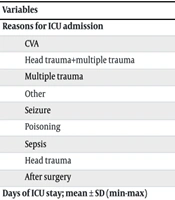
Characteristics and Outcomes of Patients Admitted to Intensive Care Units in an Academic Hospital Northern Iran
Mohammad Reza Habibi,
Leila Kanafi Vahed,
Siamak Rimaz,
Shaghayegh Shahnavazi
Habibi MR, Kanafi Vahed L, Rimaz S, Shahnavazi S. Characteristics and Outcomes of Patients Admitted to Intensive Care Units in an Academic Hospital Northern Iran. Zahedan J Res Med Sci. 2024;26(4):e151648. doi: https://doi.org/10.5812/zjrms-151648
12
Sep
2014
Comparison between the Ability of Glasgow Coma Scale and Full Outline of Unresponsiveness Score to Predict the Mortality and Discharge Rate of Pediatric Intensive Care Unit Patients
Ali Khajeh,
Afshin Fayyazi,
Ghasem Miri-Aliabad,
Hasan Askari,
Noormohammad Noori,
Behrouz Khajeh
Khajeh A, Fayyazi A, Miri-Aliabad G, Askari H, Noori N, et al. Comparison between the Ability of Glasgow Coma Scale and Full Outline of Unresponsiveness Score to Predict the Mortality and Discharge Rate of Pediatric Intensive Care Unit Patients. Inn J Pediatr. 2014;24(5):. doi:
1
Jul
2017
Evaluation the mean alteration trends and validation of nine equivalents of nursing manpower use score in medical patients of intensive care units
Abbasali Ebrahimian,
Ali Fakhr-Movahedi,
Hosein Ghasemian-Nik
Ebrahimian A, Fakhr-Movahedi A, Ghasemian-Nik H. Evaluation the mean alteration trends and validation of nine equivalents of nursing manpower use score in medical patients of intensive care units. koomesh. 2017;19(2):e151099. doi:
31
Jul
2013
Efficiency of SOFA scoring system on predicting mortality rate and stay length in intensive care unit for patients of Al-Zahra hospital of Isfahan
mahbobeh mohammady
mohammady M. Efficiency of SOFA scoring system on predicting mortality rate and stay length in intensive care unit for patients of Al-Zahra hospital of Isfahan. Med Surg Nurs J. 2013;1(2):e87468. doi:
9
Feb
2022
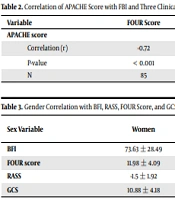
Assessment of Correlation Between Brain Function Index and Three Common Sedation Scales Used in Intensive Care Unite
Ali Shokoh,
Seyed Mohammad Mousavi Mirzaei,
Alireza Khalesi,
Mahmoud Ganjifard
Shokoh A, Mousavi Mirzaei SM, Khalesi A, Ganjifard M. Assessment of Correlation Between Brain Function Index and Three Common Sedation Scales Used in Intensive Care Unite. Arch Neurosci. 2022;9(1):e119726. doi: https://doi.org/10.5812/ans.119726
Cited by
- Scopus by DOI: 0
Last Update: 1 week ago
- Scopus by Title: 0
Last Update: 1 week ago
- Scopus by Title (Ref): 9
Last Update: 1 week ago
- CrossRef: 0
Last Update: 6 days ago
- OpenAlex: 6
Last Update: 2 days ago
- OpenCitations: 2
Last Update: 4 days ago
Comments
Number of Comments:0