Journal of Kermanshah University of Medical Sciences
Peer-reviewed Medical Quarterly
e-ISSN 2588-2570
p-ISSN 2588-2562
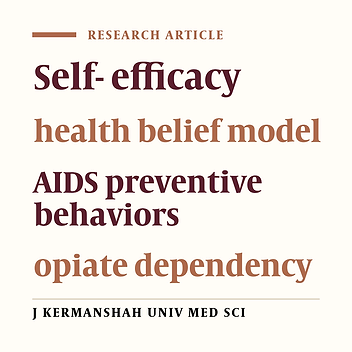
Image Credit:J Kermanshah Univ Med Sci
Outline
Self-efficacy and perceived benefits / barriers on the AIDs preventive behaviors
Authors
1Dept. of Social Health, Saveh School of Nursing, Arak University of Medical Sciences, Saveh, Iran
2Dept. of Health Education, School of Medicine, Tarbiat Modarres University, Tehran, Iran
*Corresponding Author: Corresponding author: Mahmood Karimy, Dept. of Social Health, Saveh School of Nursing, Arak University of Medical Sciences, Saveh, Iran, Tel: +98 256 522 23 50 Email: karimymahmood@yahoo.com
Published online:Jan 19, 2012
Article type:Research Article
Received:Feb 11, 2011
Accepted:Jun 21, 2011
How to Cite:Karimy M, Niknami S. Self-efficacy and perceived benefits / barriers on the AIDs preventive behaviors. J Kermanshah Univ Med Sci. 2012;15(5):e79027. doi:
Abstract
Background: Drug users (opiate dependency) account for about 65% of all AIDS cases in Iran. Drug injection has been identified as the most common way of HIV transmission in these patients. This study aimed to determine self-efficacy, and perceived benefits / barriers of AIDs preventive behaviors in opiate dependency.
Methods: A cross-sectional study was conducted in 2009.The study population was 86 drug user men at Re-birth association in Zarandieh city. The data were collected using self-administered questionnaires includeing demographic characteristics, perceived benefits/barriers of self-efficacy and AIDS preventive behaviors. Data was analyzed with ANOVA, regression and correlation coefficients and descriptive statistical methods.
Results: Regression analysis showed that age, education level, knowledge and perceived benefits/barriers, self-efficacy, all together explain 28% of AIDS preventive behaviors variance. Perceived barriers and self- efficacy were the most important predicting factor. 63% of the samples believed that they have ability of HIV-preventive behaviors.
Conclusion: The study showed the relationship of perceived benefits/barriers, self- efficacy with AIDS preventive behaviors. It is suggested that the findings of this study may be used as a basis for designing interventions to improve better performance in the concerned area.
Highlights
References
- 1.The references of this article is available on PDF.
Copyright
© 2012, Journal of Kermanshah University of Medical Sciences. This open-access article is available under the Creative Commons Attribution-NonCommercial 4.0 (CC BY-NC 4.0) International License (https://creativecommons.org/licenses/by-nc/4.0/), which allows for the copying and redistribution of the material only for noncommercial purposes, provided that the original work is properly cited.
Similar Articles
19
Sep
2007
The Effect of Health Educational Program on Preventing AIDS in Self-reported Addicts' Wives (Kermanshah 2004)
Shamsaldin Niknami,
A Hatami,
AR Heidarnia
Niknami S, Hatami A, Heidarnia A. The Effect of Health Educational Program on Preventing AIDS in Self-reported Addicts' Wives (Kermanshah 2004). J Kermanshah Univ Med Sci. 2007;11(2):e80658. doi:
23
Dec
2015
Procrastination and Self-Efficacy Among Intravenous Drug Users on a Methadone Maintenance Program in Sari City, Iran, 2013
Fatemeh Taghizadeh,
Jamshid Yazdani Cherati
Taghizadeh F, Yazdani Cherati J. Procrastination and Self-Efficacy Among Intravenous Drug Users on a Methadone Maintenance Program in Sari City, Iran, 2013. Iran J Psychiatry Behav Sci. 2015;9(4):e3738. doi: https://doi.org/10.17795/ijpbs-3738
28
Sep
2016
Predicting factors in intentional safe sexual behaviors among drug abusing men covered by rehabilitation centers in Hamadan (Iran): Applying the theory of planned behavior
Babak Moeini,
Syeid Mohammad Mahdi Hazavehei,
Amirabbas mousali,
Alireza Soltanian,
Majid Barati,
Vahid Kafami
Moeini B, Hazavehei SMM, mousali A, Soltanian A, Barati M, et al. Predicting factors in intentional safe sexual behaviors among drug abusing men covered by rehabilitation centers in Hamadan (Iran): Applying the theory of planned behavior. koomesh. 2016;17(4):e151181. doi:
26
Sep
2016
Effectiveness of an Educational Program Based on the Theory of Planned Behavior for Improving Safe Sexual Behaviors Intention among Addicted Males: A Quasi Experimental Study
Babak Moeini,
Seyyed Mohammad Mehdi Hazavehei,
Iraj Zareban,
Amirabbas Mousali,
Saeid Bashiriyan,
Ali Reza Soltanian
,et al.Moeini B, Hazavehei SMM, Zareban I, Mousali A, Bashiriyan S, et al. Effectiveness of an Educational Program Based on the Theory of Planned Behavior for Improving Safe Sexual Behaviors Intention among Addicted Males: A Quasi Experimental Study. Int J High Risk Behav Addict. 2017;6(2):e32432. doi: https://doi.org/10.5812/ijhrba.32432
7
Aug
2018

Predictors of HIV-Preventive Behavior Changes Among HIV-Infected Patients in Iran: Application of the Extended Health Belief Model
Mahmood Karimy,
Iraj Zareban
Karimy M, Zareban I. Predictors of HIV-Preventive Behavior Changes Among HIV-Infected Patients in Iran: Application of the Extended Health Belief Model. Int J High Risk Behav Addict. 2018;7(4):e58145. doi: https://doi.org/10.5812/ijhrba.58145
Cited by
- Scopus by DOI: 0
Last Update: 2 weeks ago
- Scopus by Title: 0
Last Update: 2 weeks ago
- Scopus by Title (Ref): 0
Last Update: 2 weeks ago
- CrossRef: 0
Last Update: 5 hours ago
- OpenAlex: 0
Last Update: 8 hours ago
- OpenCitations: 0
Last Update: 5 days ago
Comments
Number of Comments:0