Journal of Kermanshah University of Medical Sciences
Peer-reviewed Medical Quarterly
e-ISSN 2588-2570
p-ISSN 2588-2562
Image Credit:J Kermanshah Univ Med Sci
Outline
The effect of Kermanshahi animal oil on serum lipid profile in healthy men
Authors
1Dept. of Nutrition, School of Health, Iran University of Medical Sciences, Tehran, Iran
2Dept. of Biostatistics, School of Medicine and Health Research Center, Kermanshah University of Medical Sciences, Kermanshah, Iran
3Dept. of Nutrition, School of Medicine, Kermanshah University of Medical Sciences, Kermanshah, Iran
*Corresponding Author: Corresponding author: Mansour Rezaei, Dept. of Biostatistics, School of Medicine and Health Research Center, Kermanshah University of Medical Sciences, Kermanshah, Iran, Tel: +98 831 4274618-21 Email: mrezaei@kums.ac.ir
Published online:Mar 19, 2011
Article type:Research Article
Received:Nov 04, 2009
Accepted:May 04, 2010
How to Cite:Najafi T, Eghtesadi S, Rezaei M, Daneshvar K. The effect of Kermanshahi animal oil on serum lipid profile in healthy men. J Kermanshah Univ Med Sci. 2011;14(4):e79442. doi:
Abstract
Background: During the procedure of Kermanshahi oil production, some changes occur, which might affect the lipid profile of oil. The aim of this study was to investigate the effect of Kermanshahi animal oil on the lipid profile in healthy men.
Methods: Twenty five healthy men participated in this clinical trial study. After ten days, wash out period that subjects did not consume Kermanshahi animal oil and it was replaced with same amount of butter, serum lipid levels (TC, TG, LDL-C and HDL-C), were measured. Then subjects received 30 g/day Kermanshahi animal oil for 1 month at lunch in replace of other fats. We asked to subjects do not use Kermanshahi animal oil in other meals and replace it with the same amount of butter. After this period, serum lipid and lipoproteins were measured again. Data were analyzed using paired t-test, independent t-test using SPSS soft ware version 12.
Results: Following 30 days intake of Kermanshahi animal oil, there was no change in the total cholesterol level (153.40±21.86 vs. 153.92±24.64 mg/dl). Mean level of LDL-C increased (from 89.08±19.73 to 92.25±22.12 mg/dl) while TG concentration decreased from 112.84±22.33 to 107.76±25.46 and HDL-C level decreased from 41.40±5.08 to 40.76±6.39 mg/dl, but none of these differences were significant (P>0.05).
Conclusion: Present study showed that consumption of 30 g/day Kermanshahi animal oil for 1 month has no effect on serum lipid levels in healthy men.
Highlights
References
- 1.The references of this article is available on PDF.
Copyright
© 2011, Journal of Kermanshah University of Medical Sciences. This open-access article is available under the Creative Commons Attribution-NonCommercial 4.0 (CC BY-NC 4.0) International License (https://creativecommons.org/licenses/by-nc/4.0/), which allows for the copying and redistribution of the material only for noncommercial purposes, provided that the original work is properly cited.
Similar Articles
1
Mar
2015
Comparison of the Effects of Edible Oils: Rice Bran, Grape Seed, and Canola on Serum Lipid Profile and Paraoxonase Activity in Hyperlipidemic Rats
Maryam Ranjbar-Zahedani,
Narges Alinejad,
Seyedeh Maryam Abdollah Zadeh,
Zohreh Mazloom
Ranjbar-Zahedani M, Alinejad N, Abdollah Zadeh SM, Mazloom Z. Comparison of the Effects of Edible Oils: Rice Bran, Grape Seed, and Canola on Serum Lipid Profile and Paraoxonase Activity in Hyperlipidemic Rats. Int Cardiovasc Res J. 2017;9(1):e11662. doi:
31
Dec
2014
Effects of dietary supplementation with virgin sesame oil on lipid profile in rats
M Esmailee,
MR Bigdeli,
M Rahnama
Esmailee M, Bigdeli M, Rahnama M. Effects of dietary supplementation with virgin sesame oil on lipid profile in rats. J Inflamm Dis. 2024;18(4):e155846. doi:
29
Apr
2014
Consumption pattern of lipids and the factors affecting their selection among families in Kermanshah (2011)
Yahya Pasdar,
Mansour Rezaei,
Mitra Darbandi,
Parisa Niazi,
Roya Safari Faramani
Pasdar Y, Rezaei M, Darbandi M, Niazi P, Safari Faramani R. Consumption pattern of lipids and the factors affecting their selection among families in Kermanshah (2011). J Kermanshah Univ Med Sci. 2014;18(1):e74274. doi: https://doi.org/10.22110/jkums.v18i1.1394
31
Oct
2012
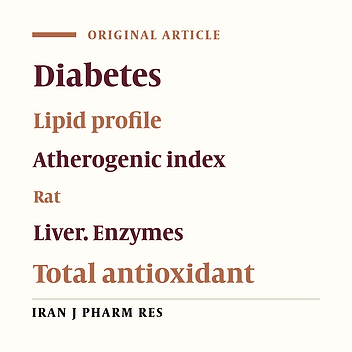
Hepatoprotective and Hypolipidemic Effects of Satureja Khuzestanica Essential Oil in Alloxan-induced Type 1 Diabetic Rats
Hassan Ahmadvand,
Majid Tavafi,
Ali Reza Khalatbary
Ahmadvand H, Tavafi M, Khalatbary AR. Hepatoprotective and Hypolipidemic Effects of Satureja Khuzestanica Essential Oil in Alloxan-induced Type 1 Diabetic Rats. Iran J Pharm Res. 2012;11(4):e125892. doi: https://doi.org/10.22037/ijpr.2012.1213
30
Dec
2012
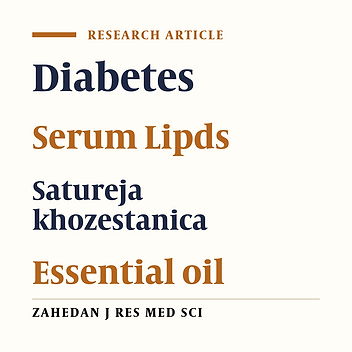
Hypolipidemic and Antiatherogenic Effects of Satureja Khozestanica Essential Oil in Alloxan-Induced Type 1 Diabetic Rats
Hassan Ahmadvand,
Majid Tavafi,
Gholamreza Shahsavari,
Ali Khosrobeigi,
Shahrokh Bagheri,
Foad Abdolahpour
Ahmadvand H, Tavafi M, Shahsavari G, Khosrobeigi A, Bagheri S, et al. Hypolipidemic and Antiatherogenic Effects of Satureja Khozestanica Essential Oil in Alloxan-Induced Type 1 Diabetic Rats. Zahedan J Res Med Sci. 2013;15(8):e92900. doi:
Cited by
- Scopus by DOI: 0
Last Update: 3 weeks ago
- Scopus by Title: 0
Last Update: 3 weeks ago
- Scopus by Title (Ref): 0
Last Update: 3 weeks ago
- CrossRef: 0
Last Update: 5 hours ago
- OpenAlex: 0
Last Update: 1 day ago
- OpenCitations: 0
Last Update: 4 days ago
Comments
Number of Comments:0