Journal of Kermanshah University of Medical Sciences
Peer-reviewed Medical Quarterly
e-ISSN 2588-2570
p-ISSN 2588-2562
Image Credit:J Kermanshah Univ Med Sci
Outline
The effects of health belief model education on knowledge, attitude and behavior of Tehran pharmaceutical industry employees regarding breast cancer and mammography
Authors
Effat Hatefnia1,*, Shamsaldin Niknami2, Mahmoud Mahmoudi1, Fazlollah Ghofranipour1, Meinour Lamyian1
1Dept.of Health Education, Scool of Medicine,Tarbiat Modarres University, Tehran, Iran
2Dept. of Biostatistics, School of Medicine, Tehran University of Medical Sciences, Tehran, Iran
*Corresponding Author: Corresponding author: Effat Hatefnia, Dept.of Health Education, Scool of Medicine,Tarbiat Modarres University, Tehran, Iran, Tel: +98 2182883549 Email: Niknami6@yahoo.com
Published online:Jun 19, 2010
Article type:Research Article
Received:Jul 16, 2009
Accepted:Dec 08, 2009
How to Cite:Hatefnia E, Niknami S, Mahmoudi M, Ghofranipour F, Lamyian M. The effects of health belief model education on knowledge, attitude and behavior of Tehran pharmaceutical industry employees regarding breast cancer and mammography. J Kermanshah Univ Med Sci. 2010;14(1):e79539. doi:
Abstract
Background: Breast cancer is the most common cancer among women worldwide. Because of unknown etiology of cancer there is no specific existing method to prevent this diseases. Annual mammography is considered the most valuable tool for detecting breast cancer in the earliest possible stages. This study was conducted to determine the effects of an education program on promoting mammography behaviors among employees using the health belief model.
Methods: An experimental study was designed to evaluate the effectiveness of a 12 week education program based on health belief model to promote early detection of breast cancer using mammography. The sample size was 220 women aged 35 and over who were working in pharmaceutical industries. Participants were divided into two groups (110 in case group and 110 in control group). Base line and three months after education data was collected using a questionnaire and analyzed using an appropriate soft ware.
Results: The study showed that the mean scores of knowledge, health belief variables (perceived susceptibility, perceived benefits, and perceived severity) and mammography behavior in case group were significantly increased. There was no significant difference observed in control group. The result also confirmed that the mean scores of perceived barriers were significantly decreased in case group but not in the control group.
Conclusion: We can conclude that health belief model educations have an acceptable influence on promoting women to use mammography as a screening tool to early detection of breast cancer.
Highlights
References
- 1.The references of this article is available on PDF.
Copyright
© 2010, Journal of Kermanshah University of Medical Sciences. This open-access article is available under the Creative Commons Attribution-NonCommercial 4.0 (CC BY-NC 4.0) International License (https://creativecommons.org/licenses/by-nc/4.0/), which allows for the copying and redistribution of the material only for noncommercial purposes, provided that the original work is properly cited.
Similar Articles
30
Sep
2012
Health Beliefs as Predictors of Breast Cancer Screening Behaviour in a Group of Female Employees in Shiraz
Abdulaziz Aflakseir,
Parinaz Abbasi
Aflakseir A, Abbasi P. Health Beliefs as Predictors of Breast Cancer Screening Behaviour in a Group of Female Employees in Shiraz. Int J Cancer Manag. 2012;5(3):e80813. doi:
17
Oct
2015
Applying the Health Belief Model in Predicting Breast Cancer Screening Behavior of Women
Leila Masoudiyekta,
Bahman Dashtbozorgi,
Mahin Gheibizadeh,
Amal Saki Malehi,
Mehrnaz Moradi
Masoudiyekta L, Dashtbozorgi B, Gheibizadeh M, Malehi AS, Moradi M. Applying the Health Belief Model in Predicting Breast Cancer Screening Behavior of Women. Jundishapur J Chronic Dis Care. 2015;4(4):e30234. doi: https://doi.org/10.17795/jjcdc-30234
15
May
2012

Investigation of the Impact of HBM-Based Training on BSE in Women Referred to Health Centers in Zahedan in 2010-2011
Alireza Ansari-Moghadam,
Seyede Zahra Hashemi
Ansari-Moghadam A, Hashemi S. Investigation of the Impact of HBM-Based Training on BSE in Women Referred to Health Centers in Zahedan in 2010-2011. Health Scope. 2012;1(1):. doi: https://doi.org/10.5812/JHS.4698
25
Dec
2012
Outcome breast self-examination based on structural Health Belief Model about breast cancer on knowledge,attitude and performance Zahedan teachers’in two groups(simulation &lecture)
Shahin dokht Navabi rigi
Navabi rigi SD. Outcome breast self-examination based on structural Health Belief Model about breast cancer on knowledge,attitude and performance Zahedan teachers’in two groups(simulation &lecture). Med Surg Nurs J. 2012;1(1):e87449. doi:
14
Nov
2021
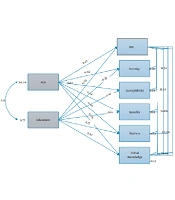
Health Belief Model and Determinants of Breast Self-examination Performance
Fatemeh Mousavi,
Parisa Shojaei,
Azadeh Nazemi,
Sepideh Babania,
Ehsan Aliniagerdroudbari
Mousavi F, Shojaei P, Nazemi A, Babania S, Aliniagerdroudbari E. Health Belief Model and Determinants of Breast Self-examination Performance. Int J Cancer Manag. 2021;14(10):e111509. doi: https://doi.org/10.5812/ijcm.111509
Cited by
- Scopus by DOI: 0
Last Update: 3 weeks ago
- Scopus by Title: 0
Last Update: 3 weeks ago
- Scopus by Title (Ref): 17
Last Update: 3 weeks ago
- CrossRef: 0
Last Update: 5 hours ago
- OpenAlex: 0
Last Update: 1 day ago
- OpenCitations: 0
Last Update: 4 days ago
Comments
Number of Comments:0