Journal of Kermanshah University of Medical Sciences
Peer-reviewed Medical Quarterly
e-ISSN 2588-2570
p-ISSN 2588-2562
Image Credit:J Kermanshah Univ Med Sci
Outline
Perception and behaviors of HIV/AIDS patients: A qualitative study
Authors
1Dept. of Health Education, Tarbiat Modarres University, Tehran, Iran
2Dept. of Nursing Education, Tarbiat Modarres University, Tehran, Iran
*Corresponding Author: Corresponding author: Shamsaddin Niknami, Dept. of Health Education, Tarbiat Modarres University, Tehran, Iran, Tel: +98 21 82883549 Email: niknamis@modares.ac.ir
Published online:Dec 19, 2009
Article type:Research Article
Received:Feb 14, 2009
Accepted:Jun 23, 2009
How to Cite:Rahmati Najarkolaei F, Niknami S, Amin Shokravi F, Ahmadi F. Perception and behaviors of HIV/AIDS patients: A qualitative study. J Kermanshah Univ Med Sci. 2009;13(3):e79598. doi:
Abstract
Background: The number of AIDS patients is increasing worldwide including Iran. Patients' risky behaviors play an important role in this arising trend. Assessing the perception and behaviors may facilitate for clarifying and planning to reduce the incidence of the risky behaviors. This study aimed to investigate the perception and the behaviors of the HIV/AIDS patients.
Methods: This qualitative study conducted in Counseling Behavior Center of Imam Khomeini Hospital for ten months .Data were obtained from an in-depth, semi-structured interview with an open - ended questionnaire applying purposeful sampling method. All interviews recorded and typed precisely word by word and transcripts reviewed and checked again. Deducted themes from data coded and categorized.
Results: 45 out of 61 participants were HIV positive and 16 were AIDS patients. The age range was 21-24 years and 37.7% were female. Themes described in two sections: the first was perception section, which was about ways of acquiring the disease; and insufficient knowledge about the transmission and prevention of the disease. The second section assessed behaviors, which included a number of high-risk behaviors, non-self-disclosure of disease and not using preventive methods.
Conclusion: We concluded that more instructions or counseling in the field of transmission and disclosure of the disease is necessary to improve the social support. AIDS instruction focusing on religious beliefs applying health behavioral change theories and endemic models of health education for supporting the community is recommended.
Highlights
References
- 1.The references of this article is available on PDF.
Copyright
© 2009, Journal of Kermanshah University of Medical Sciences. This open-access article is available under the Creative Commons Attribution-NonCommercial 4.0 (CC BY-NC 4.0) International License (https://creativecommons.org/licenses/by-nc/4.0/), which allows for the copying and redistribution of the material only for noncommercial purposes, provided that the original work is properly cited.
Similar Articles
8
Mar
2021
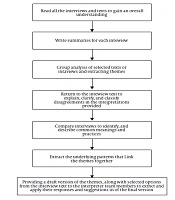
Experiences of People Living with HIV (PLHIV) in Jahrom, Southern Iran: A Phenomenological Study
Hassan Safarzadeh Jahromy,
Mojtaba Hemayatkhah,
Sedigheh Rezaei Dehnavi,
Vahid Rahmanian
Safarzadeh Jahromy H, Hemayatkhah M, Rezaei Dehnavi S, Rahmanian V. Experiences of People Living with HIV (PLHIV) in Jahrom, Southern Iran: A Phenomenological Study. Int J High Risk Behav Addict. 2021;10(2):e108414. doi: https://doi.org/10.5812/ijhrba.108414
3
Mar
2015
Explaining the hindering factors for accepting the disease, a barrier for the HIV/AIDS patients to seek treatment: A qualitative study
Mandana Saki,
Sima Mohammad Khan Kermanshahi,
Eisa Mohammadi,
Minou Mohraz
Saki M, Mohammad Khan Kermanshahi S, Mohammadi E, Mohraz M. Explaining the hindering factors for accepting the disease, a barrier for the HIV/AIDS patients to seek treatment: A qualitative study. J Nurs Midwifery Sci. 2014;1(3):e141393. doi:
9
Jul
2024
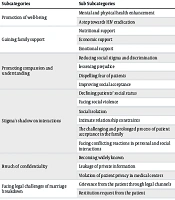
Exploring HIV-Infected Women's Attitudes Toward Disclosing Their Diagnosis: A Qualitative Research
Marzieh Rakhshkhorshid,
Ali Navidian,
Khadigeh Mirzaii Najmabadi
Rakhshkhorshid M, Navidian A, Mirzaii Najmabadi K. Exploring HIV-Infected Women's Attitudes Toward Disclosing Their Diagnosis: A Qualitative Research. J Nurs Midwifery Sci. 2024;11(3):e144378. doi: https://doi.org/10.5812/jnms-144378
30
Jul
2011
Knowledge and Attitudes of Nurses Regarding HIV/AIDS (Tehran –2010)
Mohammad Ali Cheraghi,
Esmaeil Mohammad Nejad,
Jamaloddin Begjani,
Narmela Rabirad,
Seyyedeh Roghayeh Ehsani,
Mohammad Akbari Kaji
Cheraghi MA, Mohammad Nejad E, Begjani J, Rabirad N, Ehsani SR, et al. Knowledge and Attitudes of Nurses Regarding HIV/AIDS (Tehran –2010). Arch Clin Infect Dis. 2011;6(3):e93416. doi:
19
May
2020
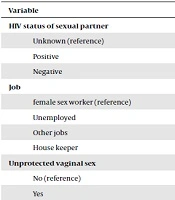
Individual and Social Predictors of HIV Status Disclosure in HIV-Positive Individuals in Ahvaz, Khuzestan, Southwest of Iran
Shirin Hasanpour,
Mansoureh Fakhouri,
Mojgan Mirghafourvand
Hasanpour S, Fakhouri M, Mirghafourvand M. Individual and Social Predictors of HIV Status Disclosure in HIV-Positive Individuals in Ahvaz, Khuzestan, Southwest of Iran. Int J High Risk Behav Addict. 2020;9(2):e89575. doi: https://doi.org/10.5812/ijhrba.89575
Cited by
- Scopus by DOI: 0
Last Update: 3 weeks ago
- Scopus by Title: 0
Last Update: 3 weeks ago
- Scopus by Title (Ref): 9
Last Update: 3 weeks ago
- CrossRef: 0
Last Update: 6 hours ago
- OpenAlex: 0
Last Update: 1 day ago
- OpenCitations: 0
Last Update: 4 days ago
Comments
Number of Comments:0