Fulltext
The full text of this article is available on PDF
Journal of Kermanshah University of Medical Sciences
Peer-reviewed Medical Quarterly
Authors
Introduction: Hemophilia is a hereditary disease with intraarticular hemorrhage as the most common manifestation of it. Having taken into consideration the progressive articular degeneration, individual dysfunction, need for medical and surgical treatment, great cost to the patients, and also legal problems brought about by hemophilia patients’ dysfunction, this study examines the relationship between clinical dysfunction and radiologic signs in hemophilic patients.
Materials and Methods: This cross sectional study included 236 hemophilic patients admitted to Seyed Al Shohada hospital in Isfahan during 2001. They were all examined clinically by an orthopaedic and rediologically by a radiologists. Articular symptoms, radiologic signs, age and level of hemophilic factor were assessed. Data were then analyzed using Kruskil –Walis and Chi-square tests.
Results: %45 of the patients did not show any radiologic signs. In terms of articular involvement, 6% were in stage I and %8.5 were in stage II. While the figure for stage III was %11.8 , stage IV and V had 22% and 6.7% of the patients respectively. Clinical dysfunction was mild in 54.6%, moderate in 32.6% and severe in.8% of the patients. The least severity of radiologic involvement was seen in patients under 3 years of age with the highest in patients more than 16 years old. The most common joints involved were knee 37%, elbow 25%, ankle 22%, wrist 7/4%, shoulder 6/2%, and hip 2/4% respectively. In addition, the lower level of factor VIII, was associated with higher severity of articular involvement (P<0.001)
Conclusion: This study shows that about 72% of hemophilic patients were radiologically normal or had reversible problems. The articular lesions could be prevented by immediate injection of coagulation factors and keeping the level of factor VIII at normal range. The lower level of factor VIII was associated with rebleeding and higher severity of articular involvement. It was demonstrated that articular involvement becomes more severe with aging. However, in severe cases, there was no statistical relationship between severity of radiologic articular involvement and individual dysfunction (rate of articular dysfunction). This means that hemophilic dysfunction cannot be prevented through radiology. Therefore radiology is not a useful method for screening patients with dysfunction.
© 2008, Journal of Kermanshah University of Medical Sciences. This open-access article is available under the Creative Commons Attribution-NonCommercial 4.0 (CC BY-NC 4.0) International License (https://creativecommons.org/licenses/by-nc/4.0/), which allows for the copying and redistribution of the material only for noncommercial purposes, provided that the original work is properly cited.
Faranosh M, Danayie N, Ghorbani R, Rahamani M, Jazebi M, et al. Survey of the relationship between of thrombophilic factors and the rate and severity of bleeding in patients with severe hemophilia A. koomesh. 2024;9(4):e152211. doi:
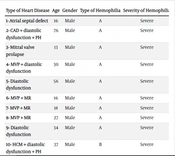
Saadatifar H, Behrouzi R, Shiravizadeh AG, Shakerian N, Saadatifar S. Evaluation of Cardiovascular Status in Hemophilia Patients in Dezful: Echocardiography, Electrocardiography, and Cardiac Risk Factors. J Adv Immunopharmacol. 2023;3(2):e139250. doi: https://doi.org/10.5812/tms-139250
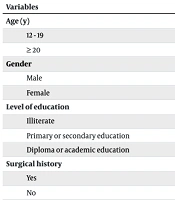
Naderi M, Chaichi Z, Mirzaei I, Parsi-Moud A, Yaghoubi S. Patterns of Addiction Behavior in Patients with Hemophilia: A Cross-sectional Study in Southeastern Iran. Int J High Risk Behav Addict. 2025;14(4):e165041. doi: https://doi.org/10.5812/ijhrba-165041
Company F, Rezaei N, Aliasgharpoor M. Prevalence of factor VIII inhibitor in patients with hemophilia A in Sanandaj. J Kermanshah Univ Med Sci. 2011;15(2):e79379. doi:
shakouri M, Hosseini MS, Dorgalaleh A, Shahidi M, Zaker F. Complete Genotype and Clinical Phenotype of Hemophilia B: A Study on Iranian Patients. J Cell Mol Anesth. 2021;6(1):e150285. doi: https://doi.org/10.22037/jcma.v6i1.33722
Last Update: 3 weeks ago
Last Update: 3 weeks ago
Last Update: 3 weeks ago
Last Update: 4 hours ago
Last Update: 1 day ago
Last Update: 4 days ago